
To look upon a tree is to witness a patient prayer written in wood and leaf—a living masterclass in Gestalt and field dynamics. While human life often fractures into scattered thoughts, anxiety for the future, and unfinished business, a tree exists entirely in the here and now. It operates on sacred time, stretching upward toward the celestial light while rooted deeply in the dark mysteries of the earth.
Yet, beneath this peaceful exterior lies a dynamic biological miracle and a profound embodiment of field theory, biosemiotics, contact boundaries, and self-actualization.
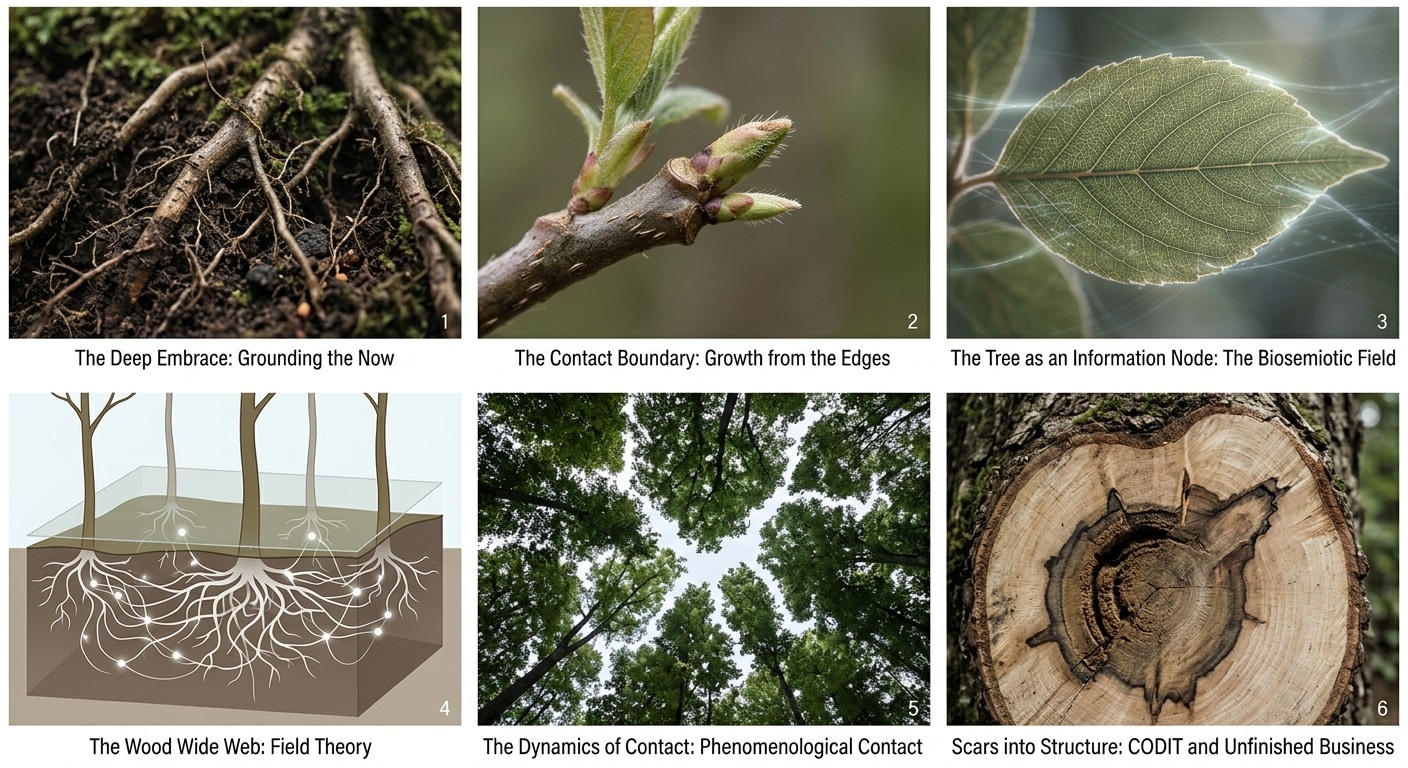
1. Grounding in the Now: How Roots Navigate the Dark
Long before a shoot ever reaches for the sky, a tree’s journey begins in the subterranean dark. Guided by geotropism, the emerging embryonic root (radicle) plunges downward into the earth. It does not map its full journey in advance; it senses and responds only to what it touches in the immediate moment.
- The Root Cap (The Sensorial Edge): The tip of every root is protected by a microscopic helmet called the root cap. Secreting a lubricating gel (mucigel), it senses physical boundaries, obstacles, and soil density, negotiating contact step-by-step.
- Statoliths (Internal Orientation): Inside the root cap cells, tiny starch-filled organelles called statoliths sink to the bottom under gravity’s pull. They act as the tree’s internal compass, constantly grounding its orientation in the physical reality of “down.”
- Fine Root Hairs (Organism-Environment Exchange): Millions of microscopic root hairs form the ultimate contact boundary, taking in water and minerals through osmosis—a pure exchange across the threshold where tree meets world.
In Gestalt therapy, growth requires a firm Ground before a clear Figure can emerge. The root system is the ultimate physical Ground—a massive, unseen web in the top 12 to 24 inches of soil that stabilizes the organism so it can dare to stretch into the unknown.
2. The Contact Boundary: Growth at the Edges
A tree does not expand everywhere at once. It grows strictly at its boundary points—its tips and its skin—through specialized regions of unspecialized cells called meristems.
- Primary Growth (Reaching Outward): At the tips of twigs and roots, apical meristems actively meet the surrounding world, extending the tree’s boundary into sky and soil.
- Secondary Growth (Integrating History): Beneath the bark lies the vascular cambium. Each year, this ring divides to create new wood (xylem) inside and new inner bark (phloem) outside.
This outer expansion reveals a striking Gestalt principle: the past is not discarded, but integrated into the present structure. The heartwood at the center of an ancient oak is its former outer self. It no longer actively transports sap, yet it stands as solid structural support for the active, living boundary growing outward today.
3. The Tree as an Information Node: The Biosemiotic Field
Instead of seeing a tree as a static, isolated physical object, modern biosemiotics and Gestalt Field Theory reveal it as an active, continuous process of environmental computation and information processing.
- The Science of Sensing: A tree processes thousands of data streams simultaneously—light spectrum shifts, gravity vector changes, micro-vibrations from insect footsteps, drought-induced acoustic cavitation (tiny ultrasonic popping sounds in the trunk), and volatile organic chemical (VOC) signals in the air.
- Biosemiotics & Cybernetics: The tree is an information node that receives, interprets, and translates signals into structural change. When a caterpillar bites a leaf, the tree releases airborne warning signals (terpenes) to neighbor trees, which immediately begin synthesizing defensive tannins.
- The Gestalt Shift: A tree is not an “object” sitting in an environment; it is an active process of information exchange. It is a dynamic boundary where the environment informs the organism, and the organism responds by re-shaping the field.
4. Field Theory: The Wood Wide Web
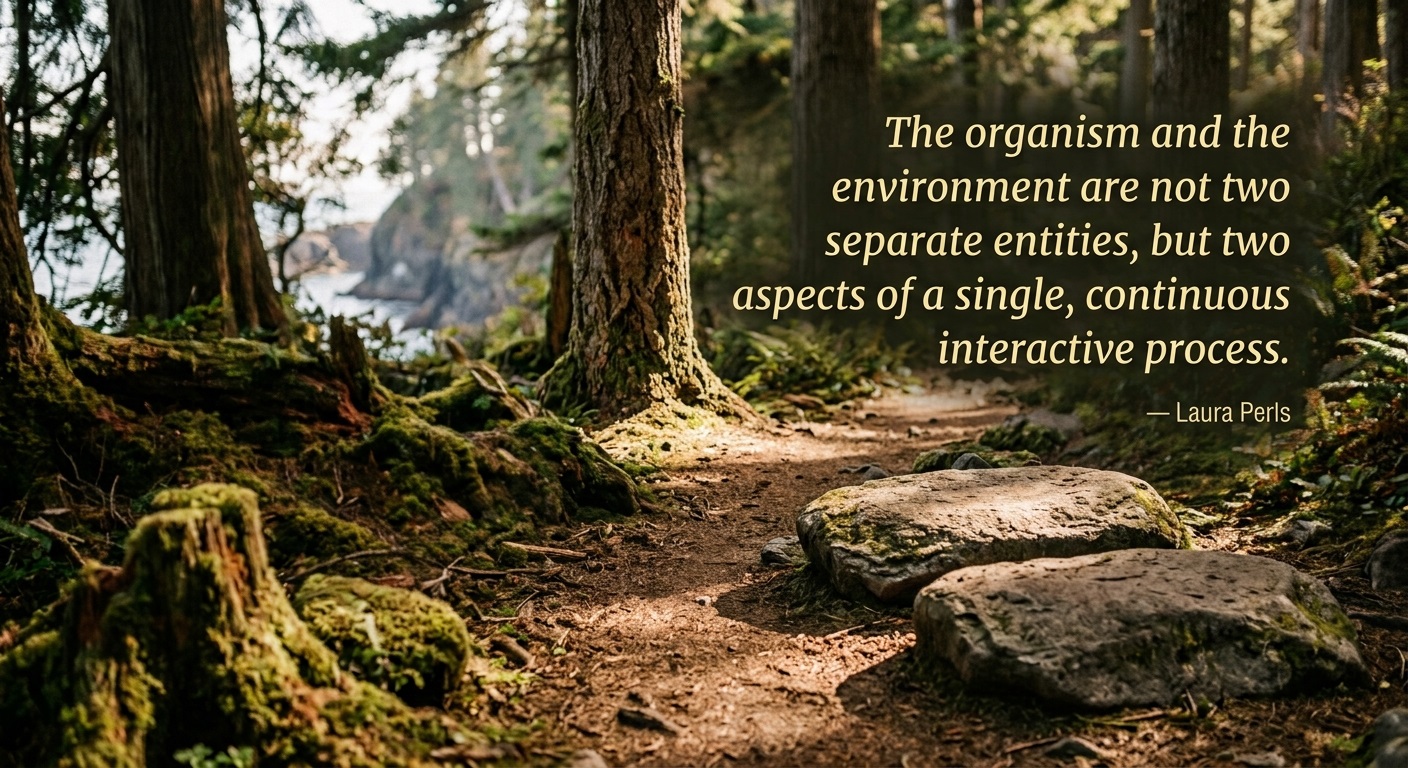
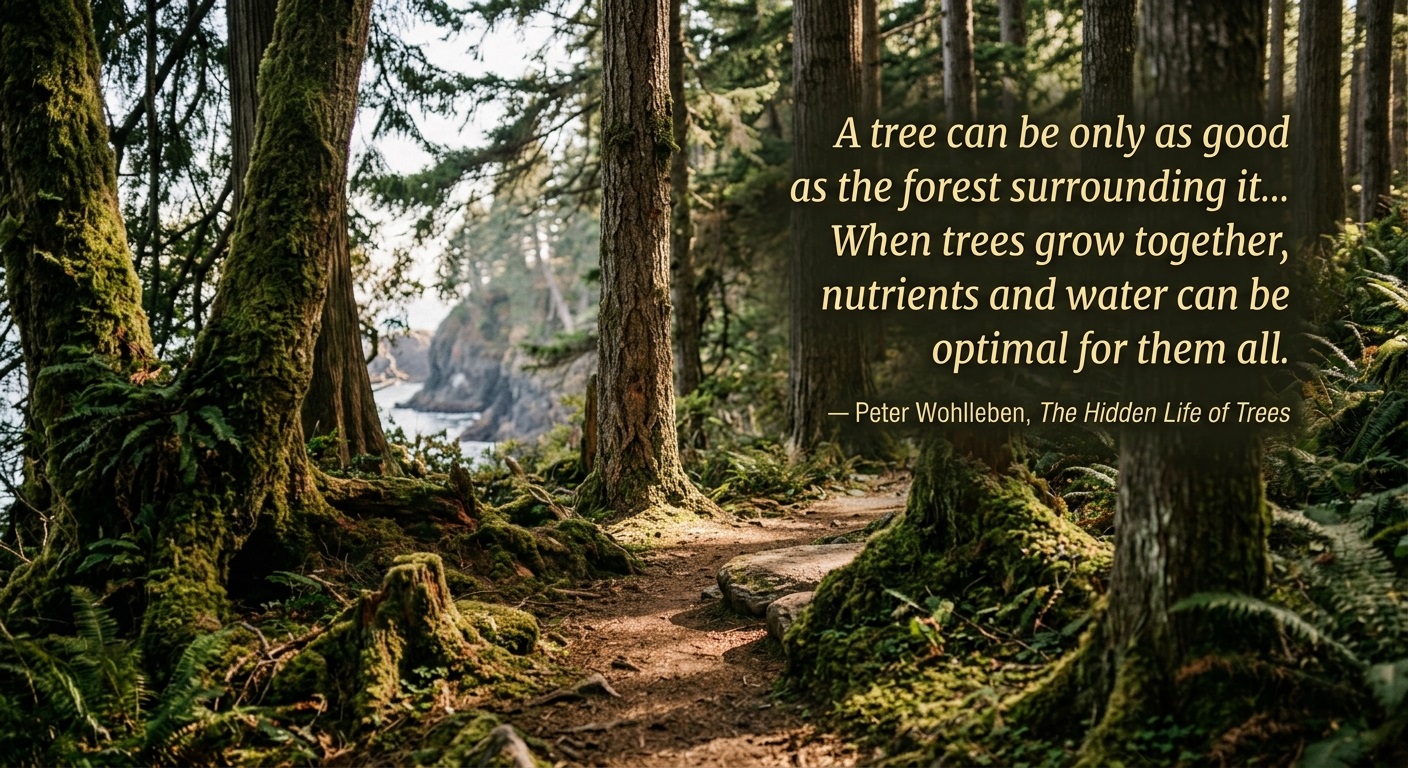
In Gestalt psychology, no organism can be understood in isolation from its environment; the organism and environment form a single, unified field. A tree does not exist in a vacuum—it is intrinsically woven into an underground web of fungal threads known as mycorrhizae.
Through this network, older “Mother Trees” send sugars and vital signals to struggling saplings in the shade. The forest functions as a single whole (Gestalt), where the health of one node affects the entire system.
The Dynamics of Contact in the Canopy
| Phenomenon | Biological Mechanism | Gestalt Perspective |
| Crown Shyness | Canopies avoid touching, leaving channel-like gaps in the sky. | Healthy contact boundaries; honor of self and other without confluence or intrusion. |
| Capillary Pull | Evaporation from leaves creates a negative pressure lifting water hundreds of feet. | Unforced growth; allowing environmental pull to organize internal energy naturally. |
| Dormancy | Dropping leaves and slowing metabolism during harsh winter months. | Withdrawal from contact; sacred rest to allow a new Gestalt to form for spring. |
5. Re-defining the “I-Thou” Encounter: Phenomenological Contact
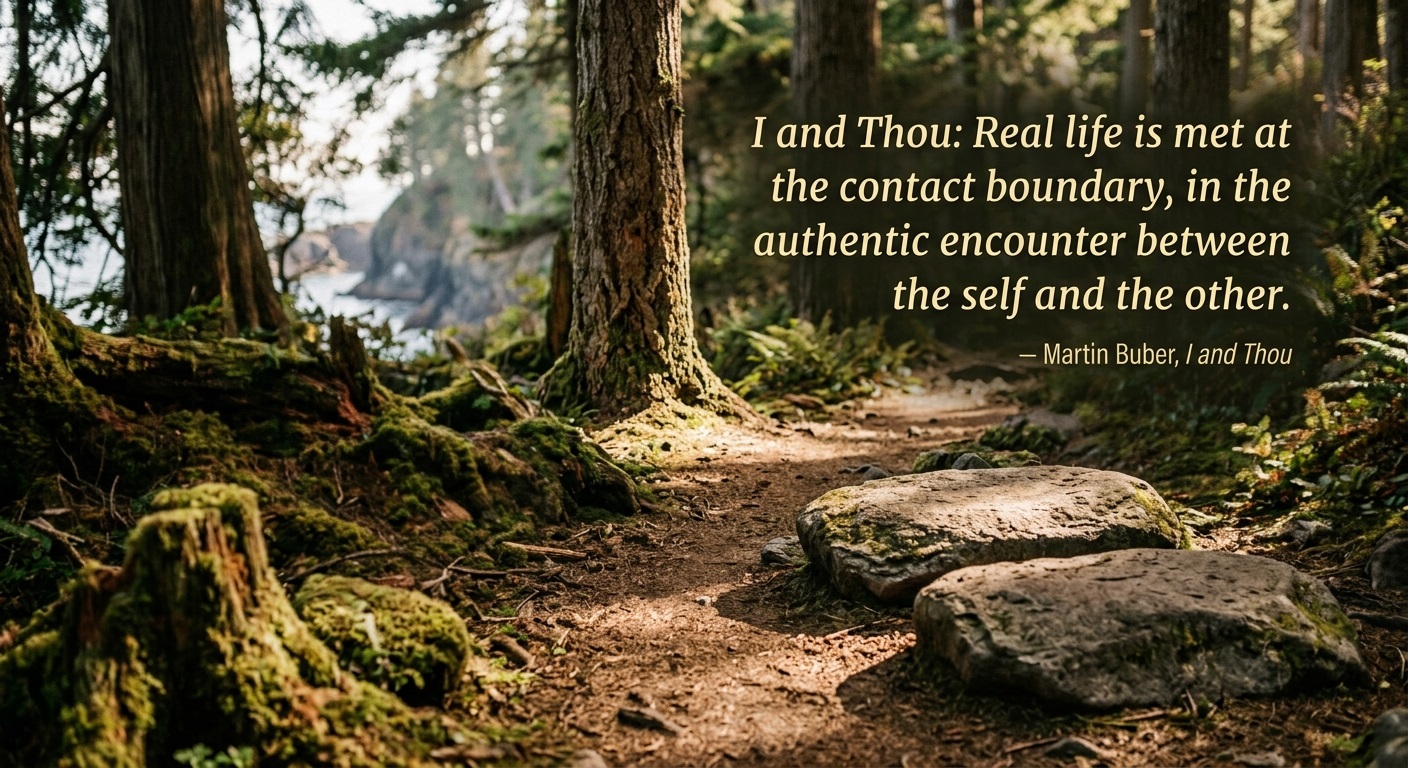
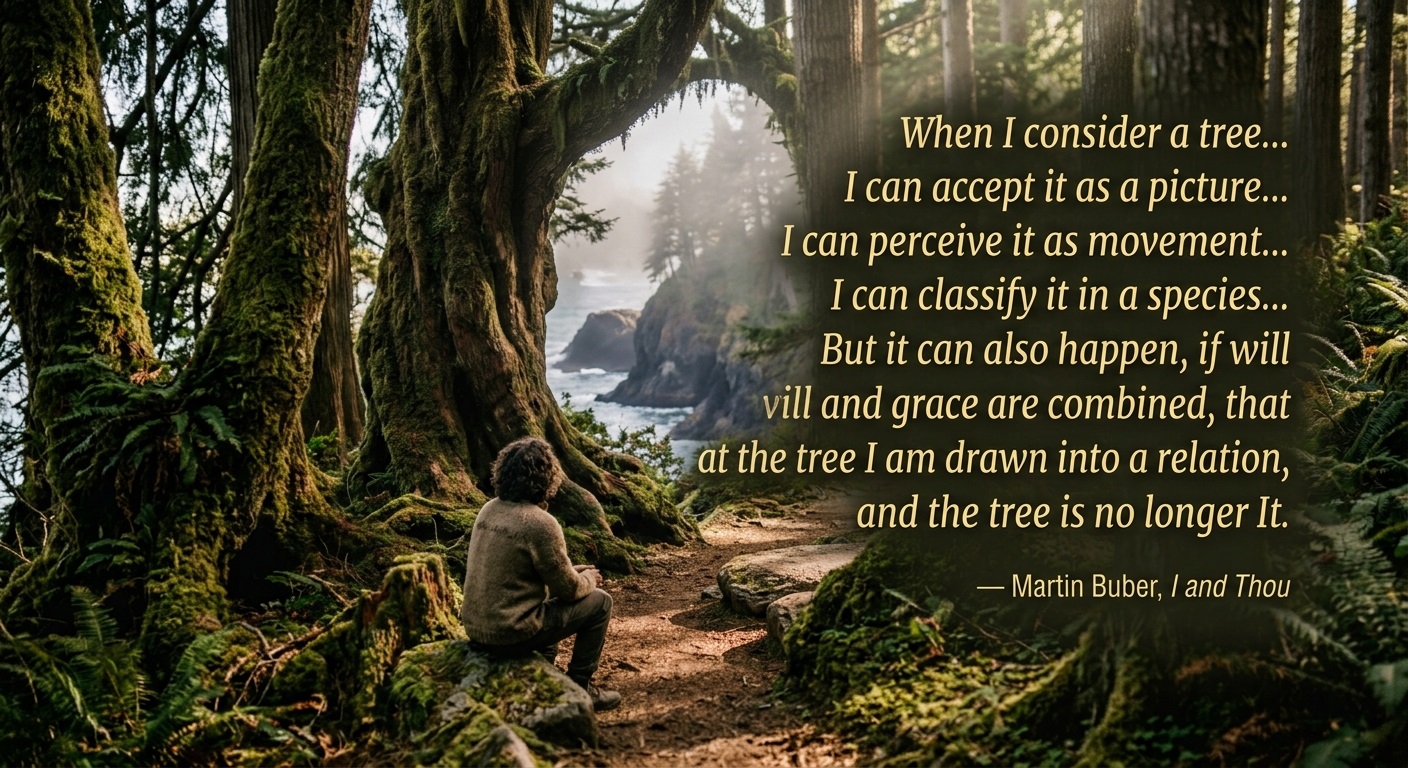
We often view trees in an “I-It” relationship—as lumber, shade, landscaping, or carbon-offset statistics. Bringing Martin Buber’s philosophy and Gestalt phenomenology into deep contact with trees transforms our perception.
- Phenomenological Bracketing: When standing before an ancient tree, suspend all utility, botanical labels, and human projections. Drop the desire to “use” or “evaluate” it.
- The Witness Position: Shift from looking at the tree to becoming aware of the shared field. Notice how the tree holds space, how its presence modulates the acoustics, light, and temperature around you.
- The Authentic Encounter: Meeting a tree in an “I-Thou” posture means acknowledging it as a center of awareness with its own temporality. It operates on a slower temporal wavelength—its “now” spans centuries. Entering contact with a tree requires slowing down human internal chatter to align with its slow, grounded rhythm.
6. Integral Consciousness: The Four Quadrants of the Tree
To offer a truly integral vision, we can look at the tree through Ken Wilber’s Four Quadrants, mapping how the physical tree aligns with its subjective, cultural, and ecological reality:
| Quadrant | Level | Tree Reality |
| Upper-Left | Individual / Interior | Felt Presence & Interiority: The non-verbal subjective experience of being—a living center that responds to sunlight, wind, and gravity with quiet, slow-wave awareness. |
| Upper-Right | Individual / Exterior | Objective Biology: The cambium, xylem, stomata, cellular meristems, and physical mechanics of photosynthesis. |
| Lower-Left | Collective / Interior | Inter-subjective / Cultural: Sacred groves, mythic trees of life (Yggdrasil, Bodhi tree), folklore, and the shared human-forest memory. |
| Lower-Right | Collective / Exterior | Inter-objective / Ecological System: The Wood Wide Web, oxygen-carbon feedback loops, microclimate regulation, and watershed dynamics. |
7. Scars into Structure: CODIT and Unfinished Business
In Gestalt therapy, unexpressed emotions and unintegrated past experiences form “unfinished business” (fixed Gestalts) that block present vitality. Trees demonstrate the physical art of resolving unfinished business through compartmentalization (CODIT).
- CODIT (Compartmentalization of Decay in Trees): When a tree loses a branch or suffers a wound, it does not try to “heal” the old tissue back to its original state. Instead, it builds four physical chemical walls around the wound, sealing off decay and continuing to grow around it.
- Integration, Not Eradication: The wound remains inside the tree forever—visible in the tree rings—but it no longer drains the organism’s energy.
- The Gestalt Parallel: True psychological growth is not about erasing scars or pretending the past didn’t happen. Like wood, we compartmentalize trauma, accept the scar as part of our core ground, and build fresh, living layers around it.
8. Photosynthesis: The Paradoxical Theory of Change
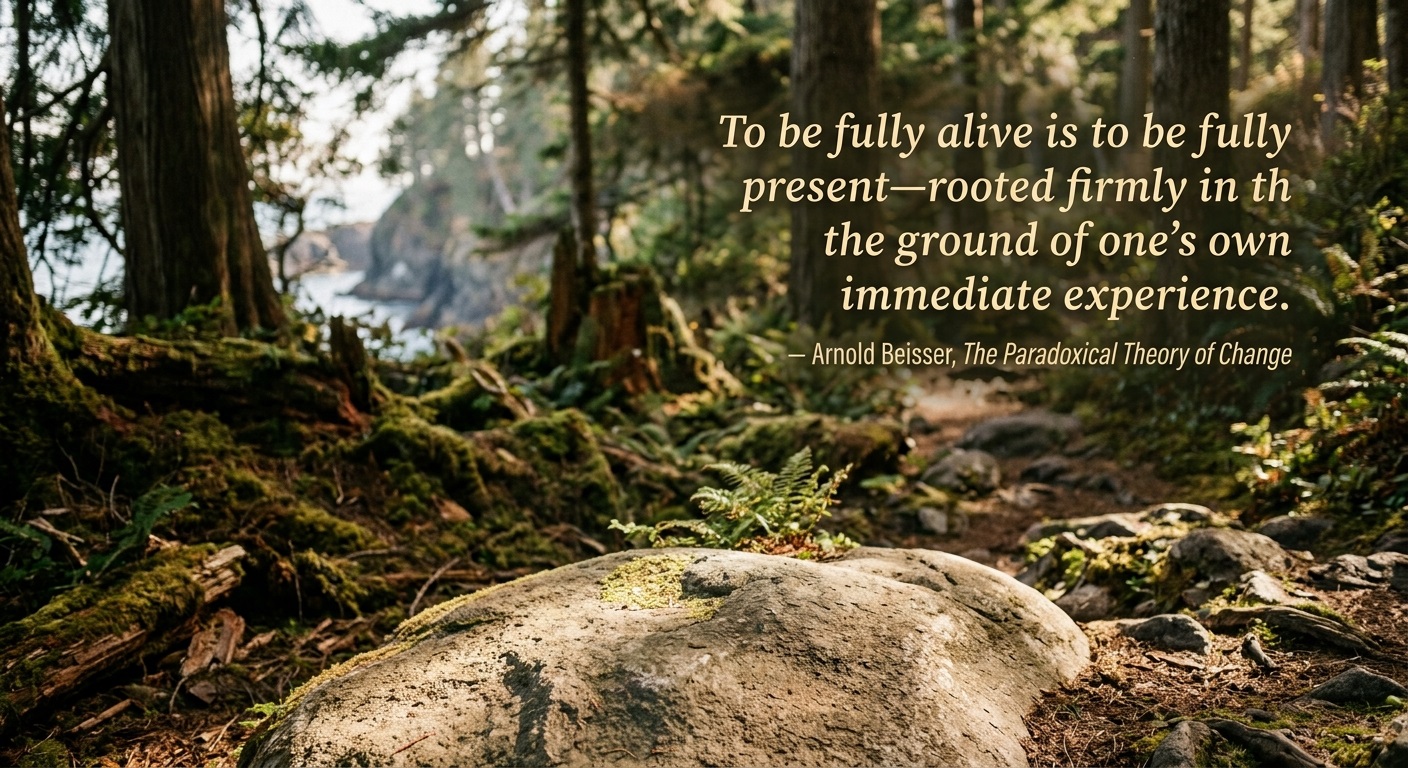
Through photosynthesis, a tree performs a daily act of alchemy. It does not fight to become a rock or a cloud; it accepts its nature as a tree and fully engages with its immediate field—taking in light from above and carbon dioxide from the air to build its physical body.
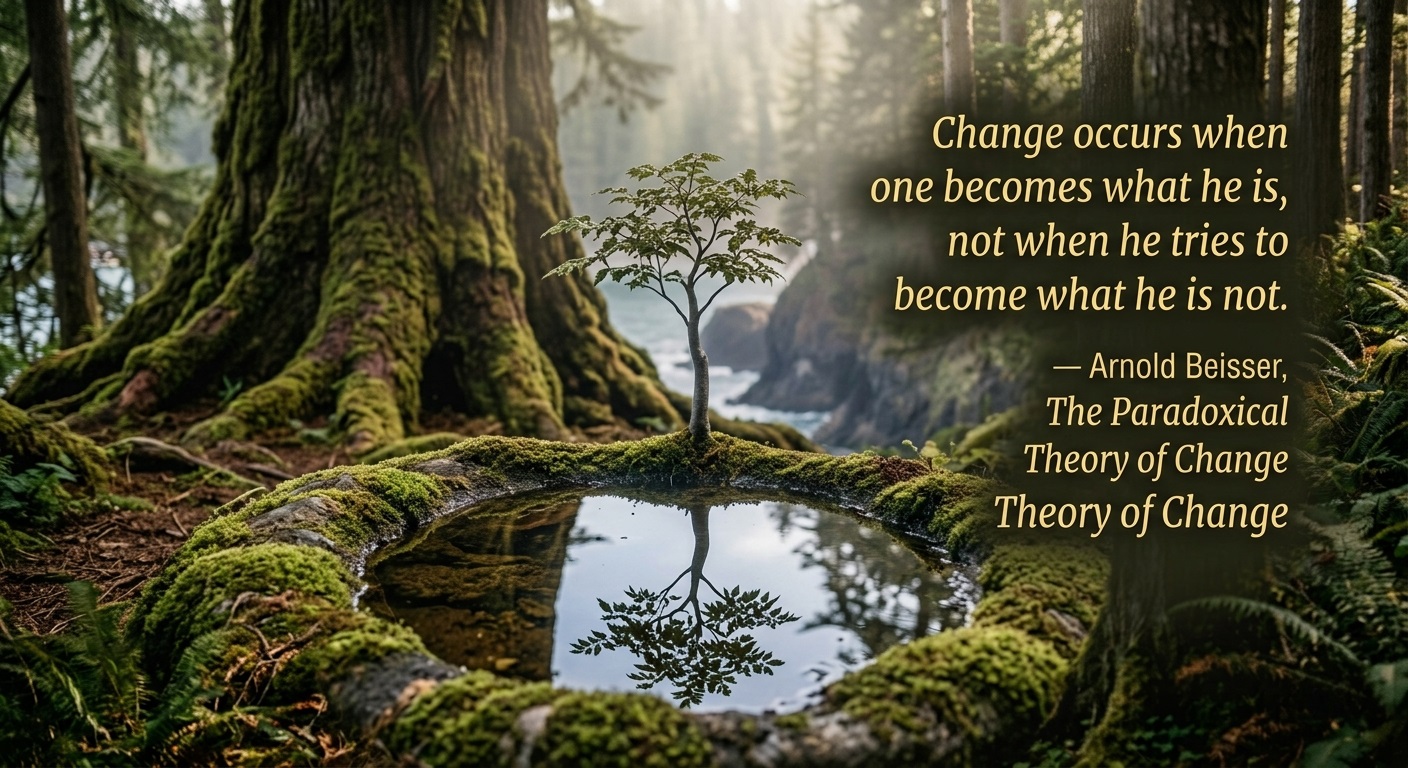
By fully occupying its present state, the tree transforms light into wood and breath into shelter, effortlessly fulfilling its self-actualization.
The Whole Tree, The Present Field
To understand how a tree grows is to understand that growth is never forced. Trees do not rush their blossoms, nor do they resist the autumn winds when it is time to withdraw contact and let go. They remain grounded in the soil of their present reality, trusting that by simply being what they are, the entire forest becomes whole.

REFERENCES
Ecology, Forest Intelligence & Plant Physiology
- Wohlleben, Peter. The Hidden Life of Trees: What They Feel, How They Communicate—Discoveries from a Secret World. Greystone Books, 2016.Explores the social networks of forests, fungal underground connections, and mutual care among trees.
- Simard, Suzanne. Finding the Mother Tree: Discovering the Wisdom of the Forest. Knopf, 2021.A personal and scientific journey into mycorrhizal networks and how “Mother Trees” recognize and nurture surrounding saplings.
- Kimmerer, Robin Wall. Braiding Sweetgrass: Indigenous Wisdom, Scientific Knowledge and the Teachings of Plants. Milkweed Editions, 2013.Integrates botanical science with indigenous relational philosophy, framing nature as a source of reciprocal gifts and teachings.
- Mancuso, Stefano, and Alessandra Viola. Brilliant Green: The Surprising History and Science of Plant Intelligence. Island Press, 2015.Examines plant perception, neurobiology without a brain, and how plants process environmental signals.
2. Gestalt Therapy, Field Theory & Phenomenology
- Perls, Frederick, Ralph Hefferline, and Paul Goodman. Gestalt Therapy: Excitement and Growth in the Human Personality. Julian Press, 1951.The foundational text of Gestalt therapy, establishing the theory of the organism-environment field, contact boundaries, and figure-ground formation.
- Beisser, Arnold. “The Paradoxical Theory of Change.” In Gestalt Therapy Now, edited by Joen Fagan and Irma Lee Shepherd, Science & Behavior Books, 1970.The seminal essay outlining how true growth occurs through fully accepting one’s present state rather than striving to be different.
- Buber, Martin. I and Thou. Translated by Walter Kaufmann, Scribner, 1970.Philosophical treatise on relational existence, contrasting objectifying (“I-It”) encounters with authentic, present (“I-Thou”) relationships.
- Perls, Laura. Living at the Boundary. Gestalt Journal Press, 1992.Essays and lectures detailing the continuous, interactive nature of the organism-environment field.
3. Integral Theory & Cybernetics / Biosemiotics
- Wilber, Ken. Sex, Ecology, Spirituality: The Spirit of Evolution. Shambhala Publications, 1995.Introduces the Four Quadrants model (Integral Theory) to integrate subjective interiority, objective biology, cultural meaning, and systemic ecology.
- Abram, David. The Spell of the Sensuous: Perception and Language in a More-Than-Human World. Vintage Books, 1996.A phenomenological exploration of how human perception intersects with the living, sensing world of nature.
- Kohn, Eduardo. How Forests Think: Toward an Anthropology Beyond the Human. University of California Press, 2013.A groundbreaking work in biosemiotics demonstrating how forests process signs, communicate, and engage in non-human thought.

