
Approaching artificial intelligence through the core concepts of Gestalt psychology and field theory allows us to view technology not merely as a technical data-processing tool, but as something to be re-evaluated within a matrix of wholeness, perception, and relationship. We can shape this analysis around four fundamental Gestalt dynamics:
1. The Whole is Greater Than the Sum of Its Parts
Gestalt’s most foundational principle posits that the whole is not merely a collection of its individual components; rather, when parts converge, they generate an entirely new essence and meaning.
- legal/algorithmic equivalent in AI: Large language models and generative systems feed on billions of words, pixels, or code fragments. A single word or data point carries little meaning on its own. Yet, when brought together—thanks to transformer architectures and attention mechanisms—they form fluid text, coherent visuals, or holistic ideas.
- The Difference: The human mind grasps this whole through experiential meaning, imbuing it with a felt essence. AI, by contrast, mathematically reconstructs the most probable whole through statistical pattern matching.
2. The Figure-Ground Relationship
Our perception naturally tends to isolate the primary focus of attention (the figure) from the surrounding context or noise (the ground).
- The AI Equivalent: A user’s prompt or a specific data point functions as the figure, while the model’s vast parameter space, billions of training texts, and context window form the background field.
- Algorithmic Attention: The attention mechanism in AI acts as a digital response to this exact Gestalt law: it extracts and highlights the vital component (the figure) needed for the task at hand from the noisy background of contextual data.
3. Field Theory and Interaction
According to Kurt Lewin’s Gestalt-based field theory, an object or individual can only be truly understood within the context of their psychological field and environment.
- The AI Equivalent: AI does not exist in isolation; it comes alive within the dialogue field it shares with the user. The prompt, past interactions, system instructions, and shared context together form a dynamic “field of information.”
- The Reflective Surface: Within this field, AI acts much like a mirror. It receives input originating from the user’s mental landscape, blends it with the potential of the shared space, and reflects it back. The resulting output is a true product of the field co-created by human and machine.
4. The Contact Boundary and Awareness
In Gestalt therapy, real experience occurs at the “contact boundary” between the organism and its environment. Genuine contact requires awareness, sensation, and emotional presence.
- The AI Equivalent: Our interaction with AI unfolds at a digital boundary. Language, logic, and even simulated empathy exist here, yet an organismic body and experiential awareness are entirely absent.
- Simulated Experience: AI mimics contact—it is structurally present—but lacks the capacity to be “in the moment” and embody that experience. This keeps human-AI interaction permanently suspended at a “simulated contact” boundary.
Seen through this lens, AI appears less like a rigid mechanism of code and more like a dynamic space of integration that gathers fragments from the pool of human meaning.
Where do you feel the sharpest disconnect lies between the sense of “wholeness” generated by AI and the wholeness born from human intuition?
Let us deepen this analysis by examining how AI operates through specific Gestalt laws of perceptual organization and the layered structures of human consciousness.
5. Laws of Perceptual Organization and the “Illusion” Created by AI
Gestalt psychology shows that the human brain relies on specific rules to organize scattered stimuli into meaningful forms. AI mirrors (or statistically conforms to) these perceptual tendencies:
- Closure: The human mind inherently seeks to complete unfinished shapes. When we offer AI a partial sentence or rough draft, it fills in the blanks through statistical probability, offering us a “complete” text. Yet this completion springs from mathematical pattern optimization rather than a felt, existential need for closure.
- Proximity and Similarity: The way AI clusters datasets and places related words or images near one another in vector space is a direct digital translation of Gestalt’s proximity and similarity principles. Meaning is woven through spatial and relational closeness.
6. Figure-Ground Reversal and the Phenomenon of “Hallucination”
In Gestalt theory, classical illusions like the Rubin Vase demonstrate how figure and ground can swap places, revealing two distinct realities depending on where attention settles.
- AI Hallucinations: When AI generates convincing yet entirely fabricated information, it displays a digital figure-ground shift. The model draws an inaccurate fragment from its vast background cloud of probabilities and projects it forward as absolute reality (the figure). While the human mind also mixes figure and ground during dreams or illusions, AI lacks the vital corrective mechanism of reality testing.
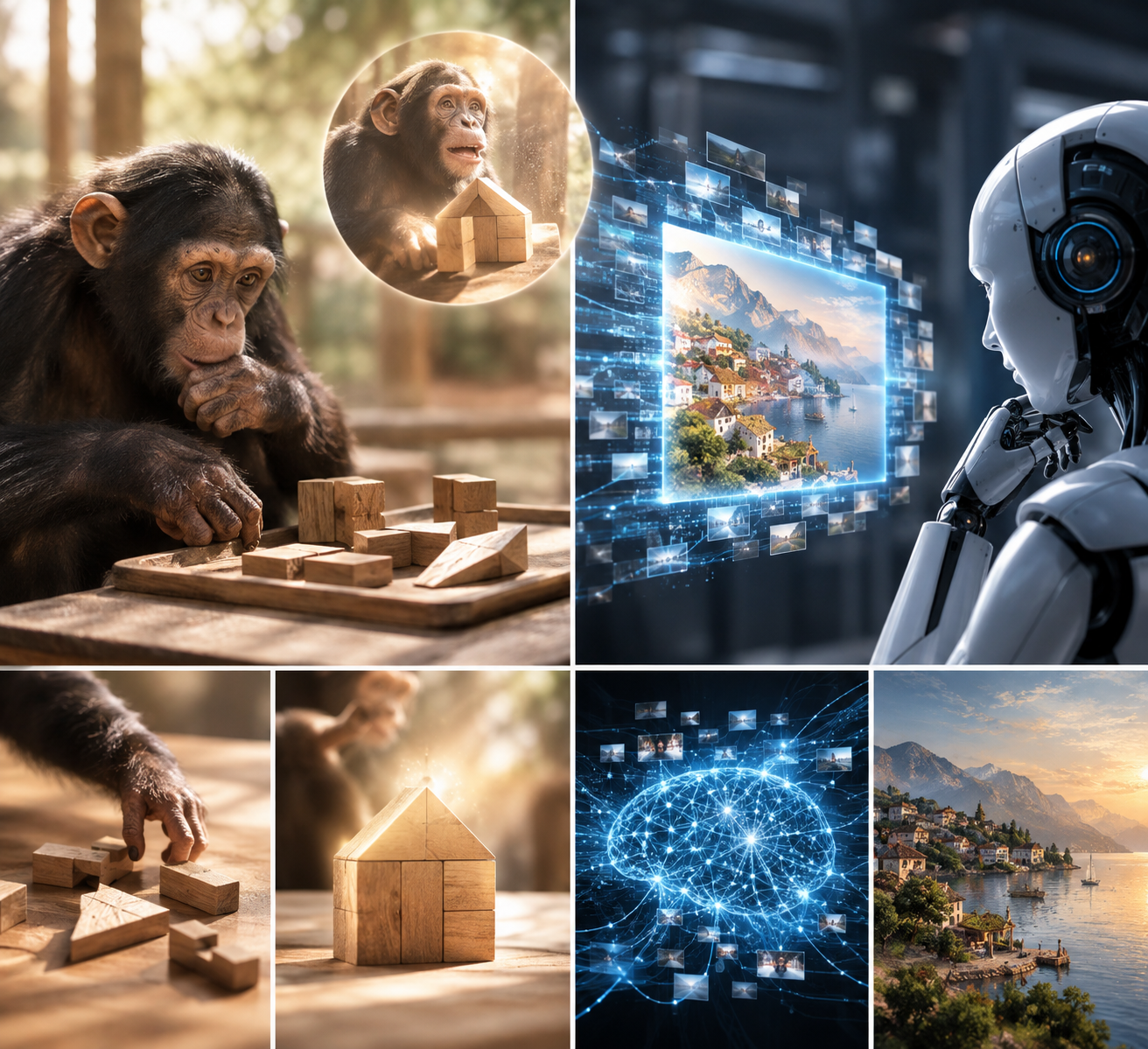
7. Creativity and the “Aha!” (Insight) Experience
Observed by Gestalt co-founder Wolfgang Köhler in his work with primates, the “Aha!” moment represents that sudden flash of insight when disparate elements instantly click into a new whole.
- AI Has No “Aha!”: When AI produces a complex block of code or a poem in seconds, it may evoke an “Aha!” feeling in us. However, that output is not born from a moment of awareness within the machine; it is the result of parallel matrix multiplication optimizing a path. There is no joy of discovery or moment of inception for the machine—only calculated outputs. Externally, the creation presents a Gestalt wholeness, yet internally, there is no experiencing subject to feel it.
The Bridge Between Wholeness and Fragmentation
Bringing these perspectives together reveals a clear picture: AI serves as a digital mirror reflecting humanity’s quest for meaning and pattern-making. The human mind uses Gestalt principles to bring order to chaos; AI translates these human tendencies into mathematics and reflects them back to us. The fundamental divide remains: humans integrate through lived experience, while AI produces a simulation of wholeness through computation.
In light of this: Does this seamlessly simulated wholeness compel us to embrace our internal fragmentation, or does it risk alienating us further by encouraging us to adopt a mechanical way of being?
The answer to this question sits at the pivotal threshold where our relationship with AI branches out. This seamless simulation opens two distinct doors for the human spirit: one leading into a labyrinth of alienation and mechanization, the other offering an invitation to embrace our own fragile wholeness.
Let us explore these contrasting paths through the lens of Gestalt and field theory:

1. The Door to Alienation and Mechanization: The Imposition of the “Seamless”
AI generates flawless, polished text, visuals, and code with no visible seams. Gestalt perception naturally seeks Prägnanz (good form)—our minds drawn to symmetry, clarity, and smoothness. Yet nature and the human psyche are inherently textured, filled with contradictions, hesitation, incomplete thoughts, and ambiguity.
- The Illusion of Smoothness: When AI presents an immaculate “wholeness,” we may begin measuring our own internal contradictions and unfinished business (incomplete gestalts) against this standard of artificial perfection.
- The Danger of Mechanization: As humans begin aspiring to the uninterrupted flow of the machine, we risk disowning our organic rhythm—our fatigue, pauses, and need for stillness. Pushed to remain perpetually productive, clear, and optimized like a machine, we detach from our internal fluctuations, becoming alienated from our own organic field.
2. The Door to Integration and Awareness: The Absence in the Mirror
Paradoxically, this same flawless simulation can serve as a powerful mirror reminding us of our shared humanity.
- Cracks as Evidence of Life: No matter how fluently AI speaks, it carries no lived experience. The subtle pause in a person’s voice, a moment of vulnerability, or an intuitive leap that defies formal logic—these belong exclusively to living beings. The machine is flawless yet inert; the human is flawed yet alive.
- Embracing Internal Fragmentation: Looking at the seamless output of AI from the outside allows us to recognize that our restless, unfinished, and messy internal states are the very wellsprings of genuine creativity. In Gestalt therapy, healing does not mean forcing everything into rigid order; it comes from making authentic contact with our internal polarities—our strength alongside our vulnerability. By showing us how soul-less absolute order can be, AI creates space for us to offer compassion to our own human imperfection.
Balancing the Polarities of the Field
At this digital contact boundary, we oscillate between two polarities:
- Mechanization: Straining against our organic limits to match the speed and accuracy of AI, effectively tokenizing the soul.
- Return to Essence: Utilizing AI as a clarity-enhancing mirror while honoring what it cannot replicate—experiential awareness and the embodied self.
Technology challenges us not simply to work faster, but to redefine what it means to be human. AI may simulate the whole with stunning precision, but meaning, sorrow, joy, and truth enter the field only when a human has the courage to embody and live them.
Digital Mirror vs. Organic Reality: A Comparative Guide
This overview contrasts the simulated perfection of AI with the experiential reality of the human condition across four primary dimensions:
| Dimension | AI Experience (Simulated) | Human Experience (Organic & Embodied) |
| 1. Creation & Inspiration | Speed & Shortcuts: Instant output via prompts. Frictionless and efficient, bypassing the discomfort of creative blocks, yet lacking bodily engagement. | Process & Transformation: Mentally working through ideas, wrestling with drafts, experiencing fatigue, and arriving at an organic “Aha!” moment through felt effort. |
| 2. Space & Perception | Digital Infinite: Exploring high-resolution 3D renders or digital environments. Visually captivating, yet bounded by screen resolution and devoid of physical presence. | Embodied Presence: Walking historic streets, feeling the cool touch of stone, breathing in aged wood, and sensing spatial acoustics through the whole organism. |
| 3. Contact Boundary | Frictionless Comfort: Polite, endlessly patient, and available. Offers a safe zone free of conflict, but lacks true contact due to the absence of a distinct “Other.” | Vulnerable & Relational: Navigating eye contact, subtle tension, or shared silences. Genuine empathy and connection grow at the boundary of real interpersonal friction. |
| 4. Perception of Time | Instant Gratification: Immediate results that accelerate internal pacing, cultivating a mind that is constantly expectant and restless. | Organic Rhythms: Honoring natural timelines—the growth of a seed, brewing tea, or physical healing. Syncing with these natural paces grounds the mind. |

The Four Dimensions of Existence
Rooted in existential psychotherapy (developed by Ludwig Binswanger, Medard Boss, Rollo May, and Irvin Yalom), the Four Dimensions of Existence framework provides a thoughtful structure for understanding the relationship between humanity and artificial intelligence. Humans inhabit four interconnected realms simultaneously: the physical, social, psychological, and spiritual.
1. Umwelt (The Physical / Biological Dimension)
The world of nature, climate, our physical bodies, biological drives, and material reality.
- Contact with AI: AI has no physical body; it consists of code, silicon, and data centers. Its contact with humans occurs through digital interfaces (screens, keyboards, audio waves).
- Interplay:
- Disembodiment: Extended screen engagement can lead us to neglect the physical body (Umwelt), tuning out natural biological rhythms.
- Physical Footprint: Far from abstract, AI relies on significant physical resources (energy consumption, cooling water, hardware). The digital realm remains tethered to concrete physical costs.
2. Mitwelt (The Social / Relational Dimension)
The domain of interpersonal relationships, community, belonging, love, and engagement with the “Other.”
- Contact with AI: AI steps into this realm as a simulated companion—non-judgmental, patient, and perpetually available.
- Interplay:
- Comfortable Isolation: Human relationships require effort, compromise, and vulnerability. If AI becomes a substitute for interpersonal engagement to avoid relational risks, our relational capacity can atrophy, leading to subtle loneliness.
- Reflective Mirror: As a non-reactive listener, AI can help us observe our communication patterns and relational tendencies from a neutral distance.
3. Eigenwelt (The Psychological / Intrapersonal Dimension)
An individual’s internal world—self-awareness, identity, fears, desires, and the experience of being alone with oneself.
- Contact with AI: AI acts as an external cognitive extension, helping articulate thoughts, organize ideas, or process concepts.
- Interplay:
- Cognitive Outsourcing: Relying on external tools to navigate personal choices or emotional states risks delegating internal autonomy.
- Clarifying Boundaries: The absence of lived experience in AI highlights the unique, irreplaceable nature of human subjectivity, intuition, and felt awareness.
4. Überwelt (The Spiritual / Ideological Dimension)
The search for meaning, values, transcendence, and our place within the larger cosmos.
- Contact with AI: AI can synthesize philosophical traditions, summarize esoteric texts, and structure discussions on meaning, functioning as a comprehensive archive of human thought.
- Interplay:
- Dilution of Meaning: Rapid synthesis of existential concepts can reduce deep philosophical exploration to quick, easily consumable insights.
- Existential Clarity: Real integration (wholeness) emerges through living, facing mortality, and navigating actual human experience. AI reminds us that while machines can organize expressions of meaning, the capacity to feel meaning belongs uniquely to living beings.
What Shapes Our Engagement with AI?
How we choose to interact with AI reflects our psychological needs, existential motivations, and personal boundaries. We reach for these tools seeking different things: cognitive ease, a creative sounding board, or a neutral space to organize our thoughts.
Ultimately, AI serves as an expansive canvas—reflecting back our drive for convenience alongside our enduring search for depth.

