

There’s a particular kind of tiredness that doesn’t come from doing too much. It comes from being too much — or rather, from having to decide, over and over, which version of yourself gets to show up. The witty one for the group chat. The composed one in the meeting. The easygoing one at dinner with friends who half-expect you to carry the mood. By the end of a day like that, you haven’t necessarily worked hard. You’ve performed hard. And performance, unlike rest, doesn’t end when you close your laptop or put your phone face-down on the table. It just changes venues.
This is the quiet condition many of us live inside now: a low hum of self-monitoring that runs beneath almost every interaction. Somewhere along the way, being someone became a project — something to build, edit, and launch, rather than something we simply are. And the strange thing is, the more energy we pour into becoming an improved, curated, more impressive version of ourselves, the further away genuine ease seems to get.
Gestalt therapy has something unusually direct to say about this. Not a technique, not a five-step plan — a reversal of the whole premise.
The Paradoxical Theory of Change
In 1970, the psychiatrist Arnold Beisser wrote a short essay that would go on to become one of the most quietly influential ideas in psychotherapy. He called it the paradoxical theory of change, and its core claim is almost embarrassingly simple: change happens when someone becomes fully who they are, not when they strain to become who they are not. Trying to force yourself into a different shape doesn’t produce growth — it produces resistance, a kind of internal tug-of-war between the self you’re pushing away and the self you’re pushing toward. Real movement, Beisser argued, comes from full contact with what’s actually here.
It’s worth sitting with how counterintuitive this is. Nearly everything in a self-improvement-saturated culture tells us the opposite: name the gap between who you are and who you want to be, then close it through effort and willpower. Beisser is suggesting something almost the reverse — that the gap itself, obsessively maintained, is what keeps us stuck. Interestingly, a much older tradition arrives at a similar place from a completely different direction. In Taoist thought, the idea of wu wei — often translated as “effortless action” — points to a way of moving through the world that doesn’t fight against what is, but works with it. Two traditions, separated by continents and centuries, converging on the same quiet insight: force distorts, acceptance releases.
Figure and Ground: What We Push to the Front, What We Hide Behind
Gestalt psychology gives us another tool that’s almost too elegant for how much it explains: the relationship between figure and ground. In any perceptual field, something comes forward as the object of attention — the figure — while everything else recedes into the background, still present but unattended to. A face at a party stands out; the wallpaper behind it disappears from awareness, though it never actually vanishes.
Apply this to the self, and something clarifying happens. On social media, the figure is the curated image — the good angle, the accomplishment, the caption that lands just right. The ground is everything that got left out: the fatigue, the contradiction, the ordinary Tuesday that looked like nothing worth posting. At work, the figure is competence, composure, the person who has it handled; the ground is the uncertainty, the need for help, the moments of not-knowing that get quietly filed away. Among friends, we often settle into a fixed role — the funny one, the reliable one, the one who’s always fine — and that role becomes the figure, while the messier, fuller person underneath waits in the background, rarely invited forward.
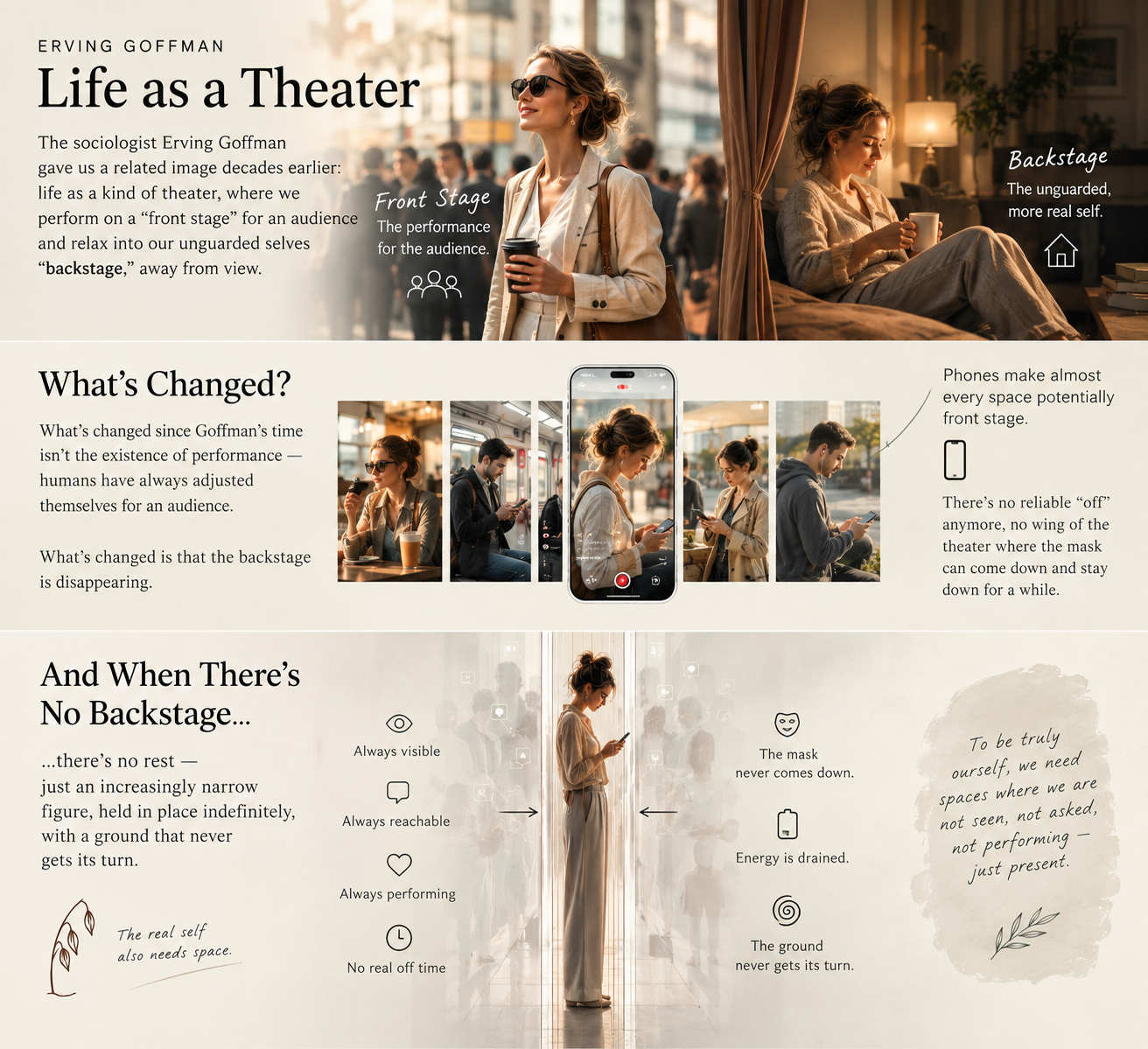
The sociologist Erving Goffman gave us a related image decades earlier: life as a kind of theater, where we perform on a “front stage” for an audience and relax into our unguarded selves “backstage,” away from view. What’s changed since Goffman’s time isn’t the existence of performance — humans have always adjusted themselves for an audience. What’s changed is that the backstage is disappearing. Phones make almost every space potentially front stage. There’s no reliable “off” anymore, no wing of the theater where the mask can come down and stay down for a while. And when there’s no backstage, there’s no rest — just an increasingly narrow figure, held in place indefinitely, with a ground that never gets its turn.
The Weight of Being Watched, Even by Ourselves
There’s a philosophical layer underneath all this that’s worth naming, because it explains why the exhaustion feels almost existential rather than merely logistical. Jean-Paul Sartre described something he called “bad faith” — the way people construct a self not from their own freedom, but in reaction to how they imagine others perceive them. Martin Heidegger had a related worry about what he called das Man, the anonymous “they” that quietly dictates how one is supposed to think, dress, feel, and be, until a person loses track of which impulses were ever really their own.

Both ideas sharpen the Gestalt point considerably. This isn’t just about tiredness. It’s about a kind of slow self-abandonment — where the effort to be seen a certain way slowly crowds out the far quieter, far more vulnerable task of simply being someone, with or without an audience.
Why the Performance Never Quite Finishes
Gestalt therapy describes a natural rhythm called the cycle of contact: a need arises, we become aware of it, we mobilize toward meeting it, we make real contact with what satisfies it, and then — this part matters — we withdraw, satisfied, and the need recedes so a new one can take its place. It’s the psychological equivalent of breathing in and breathing out.
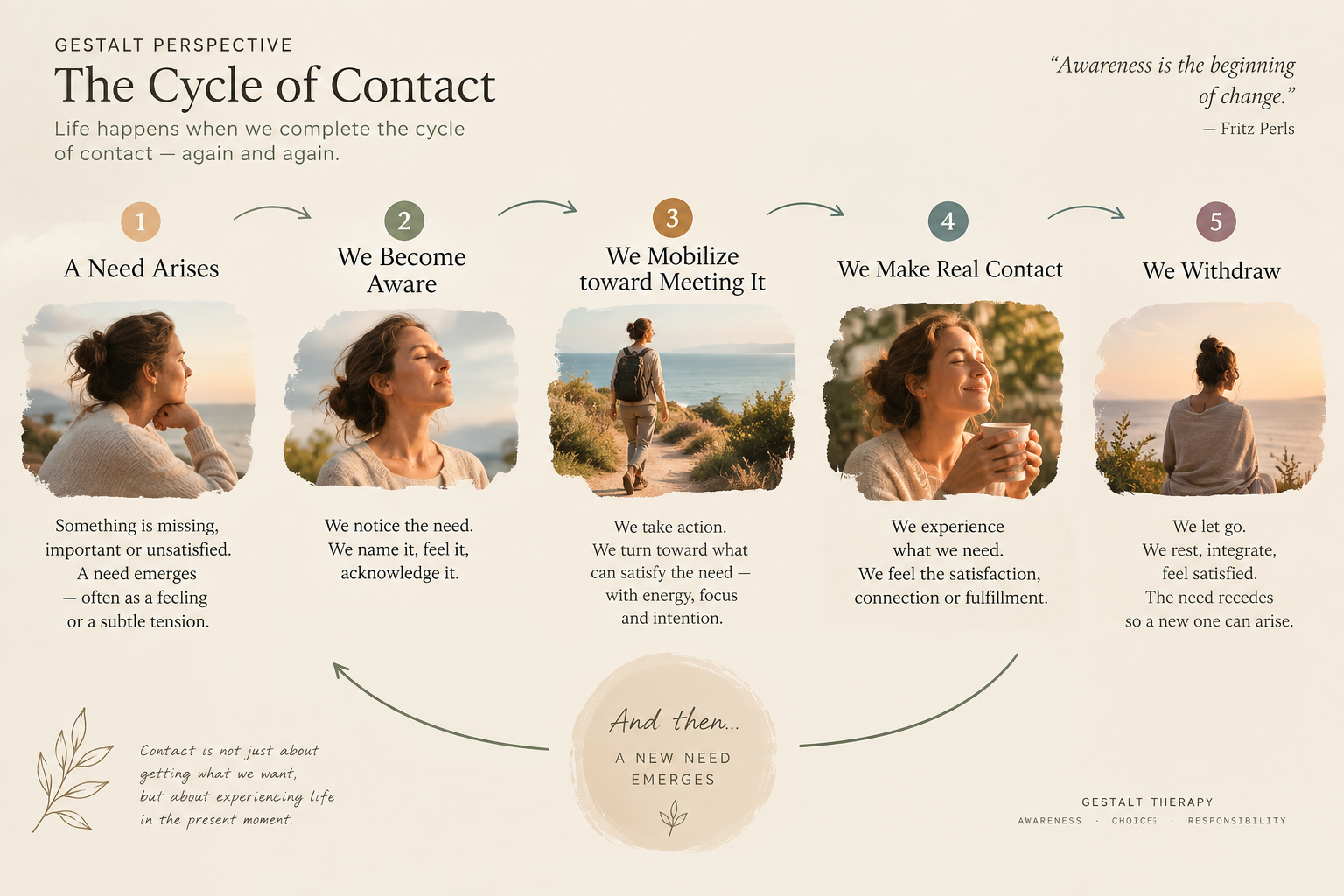
Constant self-presentation interrupts this cycle at the contact stage. Instead of meeting a moment directly — a conversation, a piece of work, a shared meal — part of our attention is always diverted toward managing how the moment will look or read from the outside. We’re never fully in it, because we’re also standing slightly beside it, watching ourselves be watched. The result isn’t a single dramatic wound. It’s an accumulation of small, incomplete moments — what Gestalt therapists call “unfinished business” — piling up quietly across every platform and relationship where we’ve been performing instead of arriving.
The psychoanalyst D.W. Winnicott traced a version of this back to early development, describing a “true self” that emerges through being met and responded to as we actually are, and a “false self” that forms when a child learns, very early, to comply with what others expect in order to stay safe or loved. What begins as an adaptive survival strategy in childhood can quietly calcify into an adult habit of performing rather than being — not because anyone is being dishonest, but because the muscle for simply being met was never given the chance to develop.
More recently, the philosopher Byung-Chul Han has argued that we’ve entered what he calls an “achievement society,” where exhaustion no longer comes from external repression but from something we do to ourselves — a relentless, self-administered demand to optimize, produce, and appear well. Nobody is standing over us with a whip. We’ve simply internalized the whip, and we hold it ourselves, at all hours, across every platform where we might be seen.
What Acceptance Actually Offers the World
Here’s where it would be easy to misread all of this as an argument for giving up — for shrugging, disengaging, retreating into passivity because performing is exhausting. That’s not what Gestalt theory is pointing toward. Accepting what is isn’t resignation. It’s what makes real contact with another person possible in the first place.
Think about the difference between spending time with someone who is performing warmth and someone who is simply, unguardedly warm. The first can be pleasant, even charming — but there’s a wall behind it, sensed rather than seen. The second offers something the first cannot: the possibility of being met, not managed. A curated self can be admired. Only an actual self can be known. And it’s that quality — reliability, depth, the sense that what you’re getting is real — that draws people toward genuine connection rather than mere engagement.
There’s a paradox worth holding onto here, one that echoes Beisser’s original insight: the less we strain to be interesting, the more capacity we have left over to simply be present — and presence, it turns out, is the thing people actually respond to. Not the highlight reel. The person who showed up.
A Necessary Counterpoint
None of this means every act of self-presentation is a betrayal of some hidden true self. Trying on different versions of ourselves — especially earlier in life — can be a genuinely healthy way of discovering who we are, not just concealing it. Adolescents experimenting with identity, adults trying out a new professional persona, someone testing a bolder version of themselves before an audience of strangers — these aren’t necessarily flights from authenticity. Sometimes performance is exploration, not evasion.
The more useful distinction isn’t performance versus no performance. It’s chosen performance versus compulsive performance — the difference between playfully trying something on and anxiously never being able to take it off. One is expansive. The other is a cage with excellent lighting.
What This Looks Like on an Ordinary Day
None of this resolves into a five-step plan, because that would just be another form of trying to force change rather than allow it. But a few small, concrete shifts tend to matter:
Noticing the performance impulse the moment it arises — the urge to phrase something more impressively, to soften an honest “I don’t know,” to post the flattering version instead of the true one — without immediately obeying it. Just noticing, first.
Practicing small, low-stakes moments of unguarded honesty: telling a friend you’re tired instead of performing “fine,” admitting uncertainty in a casual work conversation instead of manufacturing false confidence.
And online, perhaps the hardest one: tolerating the discomfort of occasionally looking ordinary. Posting from what’s actually happening rather than from what would read well. Letting some of the ground stay visible, instead of endlessly polishing the figure.
The Contribution of Simply Being
Gestalt therapy’s deepest claim isn’t really about therapy at all — it’s about what wholeness requires. Not perfection. Not an impressive figure held steady against an edited-out ground. Just the willingness to be found, fully, exactly where we are.
It’s worth imagining, for a moment, what ordinary social life might feel like if presence quietly replaced performance as its default currency — if showing up mattered more than showing off. Not a world without friends who make each other laugh, without professional competence, without care in how we present ourselves. Just one where all of that grows out of actually being someone, rather than substituting for it.
Bibliography
Books
- Beisser, A. R. (1970). The Paradoxical Theory of Change, in J. Fagan & I. L. Shepherd (Eds.), Gestalt Therapy Now. Palo Alto, CA: Science and Behavior Books.
- Perls, F., Hefferline, R. F., & Goodman, P. (1951). Gestalt Therapy: Excitement and Growth in the Human Personality. New York: Julian Press.
- Goffman, E. (1959). The Presentation of Self in Everyday Life. New York: Doubleday.
- Winnicott, D. W. (1965). The Maturational Processes and the Facilitating Environment (includes “Ego Distortion in Terms of True and False Self,” 1960). London: Hogarth Press.
- Winnicott, D. W. (1971). Playing and Reality. London: Tavistock Publications.
- Han, B.-C. (2015). The Burnout Society (E. Butler, Trans.). Stanford, CA: Stanford University Press.
- Sartre, J.-P. (1943). Being and Nothingness (H. E. Barnes, Trans.). New York: Philosophical Library.
- Heidegger, M. (1927). Being and Time (J. Macquarrie & E. Robinson, Trans.). Oxford: Blackwell.
- Laozi. Tao Te Ching (various translations, e.g., Stephen Mitchell, 1988, Harper Perennial).
YouTube Videos
- Schuman, J. The Practice of Being Yourself — TEDxBroadway.
- McHugh, C. The Art of Being Yourself — TEDxMiltonKeynesWomen.
- Goffman,E. The presentation of self in everyday life
Research Articles
- Nguyen, L., & Barbour, K. (2017). Selfies as expressively authentic identity performance. First Monday, 22(11). https://doi.org/10.5210/fm.v22i11.7745

