
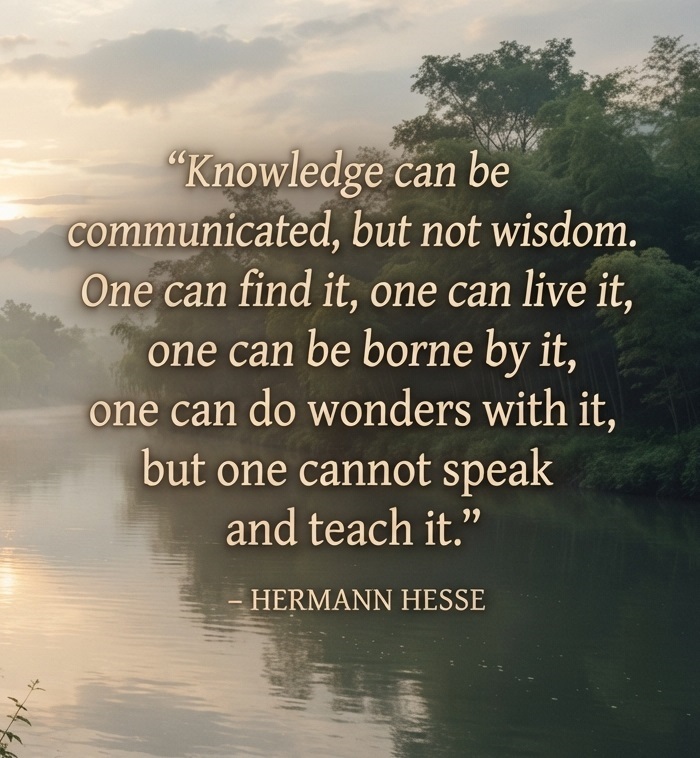
In this profound passage, Hermann Hesse touches upon an ancient epistemological divide: the chasm separating what can be formally instructed from what must be existentially embodied. Knowledge belongs to the domain of the divisible—facts, formulas, dogmas, and data points that can be cleanly packaged, transmitted through language, and memorized. Wisdom, conversely, resists the architecture of grammar. It is slippery, holistic, and deeply resistant to transmission.
When placed under the lens of Gestalt psychology—which asserts that the whole is greater than the sum of its parts and that meaning emerges from direct, unified perceptual organization—Hesse’s assertion ceases to be merely a poetic paradox. It becomes a precise psychological description of human consciousness. Knowledge is the mechanical assemblage of isolated parts, whereas wisdom is the emergent, un-fragmentable Gestalt of a life fully lived.
The Anatomy of Knowledge: The Illusion of the Parts
To understand why wisdom cannot be taught, we must first examine what can be taught: knowledge.
Knowledge is modular. It operates on the reductionist premise that complex realities can be broken down into discrete components, studied independently, and reassembled. Language itself is a vehicle of knowledge; words are symbols acting as building blocks, pointing to specific objects, rules, or historical timelines. A teacher can transmit the mechanics of chemistry, the syntax of a language, or the chronology of a war because these phenomena can be atomized. They can be broken down into structural “parts” and handed from one mind to another like bricks in a masonry project.
From a Gestalt perspective, knowledge deals with the focal elements—the distinct points of data that catch our attention. However, Gestalt psychology warns us against “atomism,” the error of believing that an experience can be entirely explained by analyzing its individual stimuli. Explaining every individual brushstroke, chemical composition, and canvas texture of a masterpiece does not reproduce the psychological awe of standing before it. Knowledge gives us the inventory of the room, but it does not teach us how it feels to inhabit the space.
The Phenomenology of Wisdom: The Emergent Whole
If knowledge is the inventory of parts, wisdom is the emergent Gestalt of human existence. Wisdom cannot be broken down into instructional bullet points because it is not a collection of facts; it is an integrated state of being.
As Hesse observes, “One can find it, live it, be borne by it, one can do wonders with it, but one cannot speak and teach it.” Wisdom is born from the synthesis of joy, suffering, error, integration, and time. It is the invisible harmony that emerges when a person processes their entire lived reality into a cohesive orientation toward life.
Consider a melody. A sequence of musical notes played in isolation possesses no inherent emotional narrative. It is only when the notes flow together—transcending their individual existence—that a melody emerges. If you try to hand someone a single note and claim you have handed them the song, you have failed entirely. Wisdom is the melody of a life. It cannot be extracted, isolated, and handed over in a textbook. It requires the listener to play their own instrument through direct experience.
The Trap of Dogma and the Figure-Ground Distortion
Why does wisdom, when spoken aloud by a teacher, so often sound foolish?
When a wise individual attempts to translate holistic realization into linear language, they are forced to compress a multi-dimensional, experiential Gestalt into flat, one-dimensional sentences. They turn a living process into a static doctrine.
In Gestalt psychology, perception relies on the dynamic interplay between figure (what stands in the center of our awareness) and background (the vast context from which the figure emerges). When wisdom is converted into spoken rules or moral maxims, the dynamic background—the trials, tears, context, and existential depth that gave the insight its meaning—is stripped away. Left with only the bare “figure” (the words), the listener hears a simplistic cliché or a dogmatic platitude. Without the psychological background, profound insight collapses into superficial foolishness. This is why dogma so frequently misses the truth it claims to protect: it freezes a living Gestalt into a rigid artifact.
Conclusion: The Path of Direct Experience
Hesse and Gestalt psychology ultimately converge on a single, liberating truth: understanding cannot be bypassed through passive reception.
We live in a culture that hungers for shortcuts, seeking to download wisdom through TED talks, self-help manuals, and quick summaries. Yet Hesse reminds us that the map is never the territory. Knowledge can guide us to the edge of the mountain, but wisdom requires us to make the climb ourselves.
True realization is an internal reorganization—a shift in the Gestalt of consciousness where the disparate parts of our struggles, joys, and reflections suddenly snap into a unified, mature whole. We cannot teach this integration to others; we can only live authentically, creating the conditions where they, too, may stumble into their own awakening.
References
- Hesse, Hermann. Siddhartha: An Indian Tale. Translated by Gunther Olesch, Hilda Rosner, et al., Om Books International, 2015 (p. 106).
- Koffka, Kurt. Principles of Gestalt Psychology. Routledge, 1935.
- Wertheimer, Max. Productive Thinking. Harper & Brothers, 1945.

