Hassan Fathy: The Modest Visionary Who Built for the People

(Image created by chatGPT)

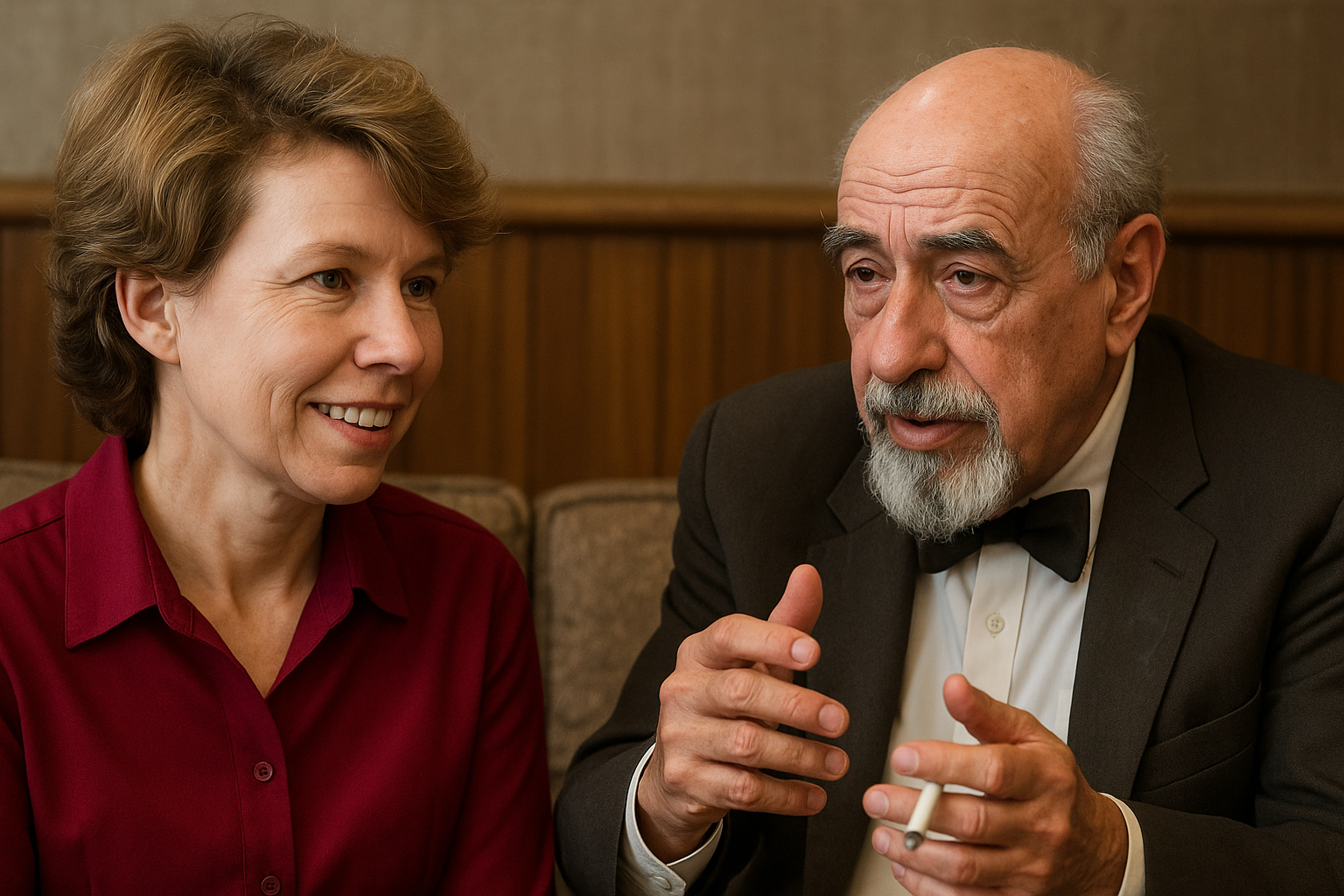
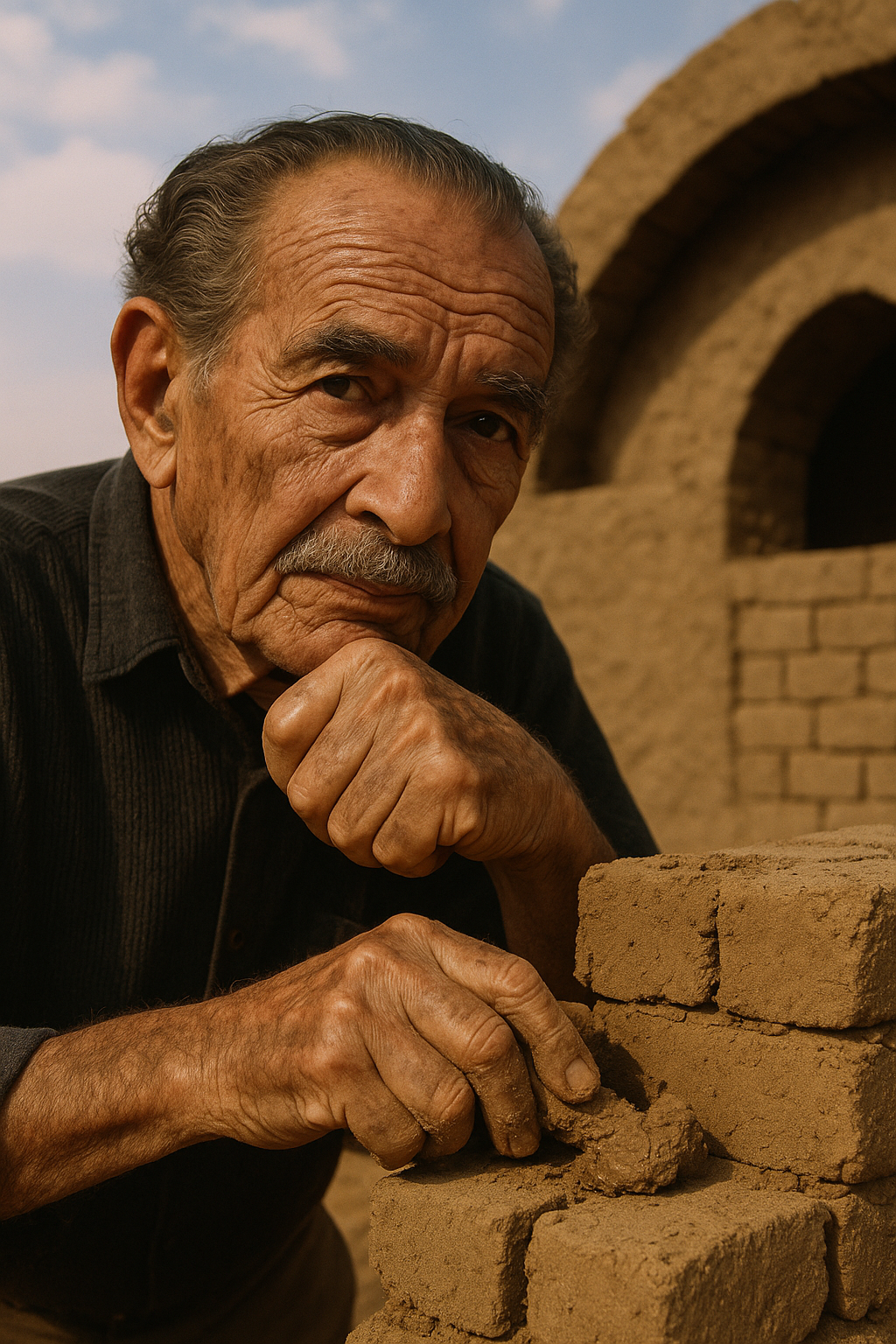
When we think of Egyptian architecture, our minds often leap to the grandeur of the pyramids, temples, or the mysteries of Imhotep. Yet, in the 20th century, another name emerged as a beacon of vision and humility: Hassan Fathy (1900–1989). Unlike the monumental builders of ancient Egypt, Fathy’s mission was not to glorify kings or gods, but to serve the ordinary people of his country.

A Life of Contrasts

Born into an affluent, aristocratic family in Alexandria, Fathy could easily have pursued a comfortable life, designing villas and palaces for the wealthy. Instead, he chose a different path. His heart belonged to the poor Egyptian farmers and villagers, those who had little voice and even fewer resources. Despite his elegant dress and refined upbringing, he dedicated his architecture to those who could not afford architects at all.

This choice shaped his legacy. As he once expressed, he preferred to call his work building with the people rather than for the poor—because he believed in dignity, participation, and community, not charity.

Vision and Philosophy

Fathy rejected the industrialized, imported materials of modernist architecture—steel, glass, and concrete—arguing they were unsuited to Egypt’s climate, economy, and traditions. Instead, he turned to the earth itself. “Build your architecture from what is beneath your feet,” he advised, advocating adobe and mudbrick as natural, sustainable materials that had served Egypt for millennia.

For him, architecture was not about spectacle, but about harmony—with nature, with culture, and with human needs. He often said: “If the architect does not respect the God-made environment, it will be a sin against God.” Courtyards for shade, domes and vaults for cooling, and narrow streets for community life were not just design choices, but echoes of wisdom embedded in Egypt’s vernacular traditions.

A Man of Many Talents

Fathy was not only an architect. He was also a professor, engineer, amateur musician, dramatist, and inventor. He designed nearly 160 projects, from modest country retreats to fully planned communities with schools, mosques, markets, and theaters. He trained villagers to make their own building materials and believed strongly in self-reliance. His belief was simple: architecture should be human-scaled, ecological, and empowering.

Projects That Spoke of Hope

One of his earliest commissions after graduating in 1926 was a school in Tala, a small town on the Nile. There, he witnessed appalling poverty, dilapidated houses, and poor sanitation. The experience haunted him and became the seed of his lifelong mission: to improve the lives of those most in need.

His most famous work was the village of New Gourna, near Luxor. Commissioned in the 1940s to resettle communities living near the Valley of the Kings, Fathy envisioned a self-sufficient settlement of homes, mosques, schools, theaters, and markets—all built with local materials by the people themselves. He consulted families, involved ethnographers, and designed spaces that were functional, affordable, and beautiful. He even insisted: “Architecture is for life, not for luxury.”

Successes and Challenges

New Gourna, while visionary, also revealed the tensions between ideals and reality. Many villagers resisted relocation because it cut them off from their livelihoods near archaeological sites. Critics argued that domes and vaults—central to Fathy’s designs—were associated with funerary architecture, and thus culturally inappropriate for homes. Others pointed out that mudbrick, while ecological, required constant upkeep, which some communities struggled to maintain. These criticisms did not erase the brilliance of the project but highlighted the complexities of blending tradition, modern needs, and social change.

Later, he expanded his vision beyond Egypt. In Dar al-Islam, New Mexico (1981), he recreated adobe-based community design for a new cultural and educational center. In New Baris village, deep in the Egyptian desert, he created an austere yet noble settlement for families. He also built houses in Jordan and designed apartments in Cairo that blended tradition with modern comfort. Even in exile, his buildings radiated warmth and dignity.

Renderings Full of Life

Fathy’s architectural drawings themselves were works of art. Unlike the cold precision of modern renderings, his sketches were full of imagination—birds flying across facades, trees drawn horizontally, animals and people living within the plans. To him, drawings were not about rigid objectivity but about evoking life. He once remarked: “Architecture must leave space for imagination, because imagination gives freedom.”

Recognition and Legacy

In 1980, he was honored with the Aga Khan Chairman’s Award for Architecture. In 2017, Google celebrated him with a Google Doodle, acknowledging his pioneering contributions. Yet, despite the recognition, he remained a modest visionary. “It is not luxury people need—it is water, shade, and dignity,” he reminded the world.

Hassan Fathy has often been called the father of sustainable architecture in the Middle East. His ideas—about passive cooling, natural materials, self-building, and architecture rooted in culture—were decades ahead of their time. In an era of climate crisis and social inequality, his work feels more urgent than ever.

The Timeless Voice of Hassan Fathy

Perhaps his own words express his philosophy best:

  • “We are nothing like poor and rich—we are all human beings.”
  • “When man builds with his own hands, he leaves something of himself in the building.”
  • “Beauty exists in nature when form conciliates the forces acting on it. Architecture must learn from this harmony.”

Hassan Fathy did not build monuments to power or ego. He built homes, villages, and communities. He built with mud, but also with imagination, compassion, and faith. More than buildings, he left us an invitation: to rediscover architecture as an act of respect—for people, for culture, and for the Earth itself.

REFERENCES:

HASSAN FATHY | born today / International Celebrations in Architecture

Making Architecture for the Poor with Hassan Fathy /

Hassan Fathy Santa Fe

# 3 Hassan discussion

Architect Hassan Fathy 1978

A rare documentary – about the architect, the “Sheikh of Architects” Hassan Fathy – at his home in Darb al-Labana.

Tasarım-Dekorasyon-Mimarlık-Design-Decoration-Architecture içinde yayınlandı | , , , , , , ile etiketlendi | Yorum bırakın

Connection, Choice, and Being Fully Human

Introduction: The Man Who Brought Gestalt to Europe

In 1969, a young psychologist named Bob Resnick boarded a plane to Rotterdam. Fritz Perls, one of the founders of , had asked him to bring Gestalt to Europe for the first time. “I may be the luckiest psychotherapist in the world,” Resnick later reflected. “That one invitation opened up fifty years of teaching and learning across cultures.”

Who was Bob Resnick? A Gestalt therapist, trainer, and storyteller. But above all, a man who believed that therapy was not about playing roles or fixing people—it was about meeting each other authentically, in the here and now. His words remain a compass for anyone curious about Gestalt, relationships, and what it means to be fully human.


Connection at the Core: The Human Dilemma

For Resnick, the essence of Gestalt therapy was not technique but relationship.

“The basic human dilemma is how to be connected to another and maintain yourself.”

This dilemma shows up in every relationship: parent and child, husband and wife, therapist and client. Too much closeness, and we lose ourselves in fusion. Too much distance, and we drift into isolation. The art of living is the movement between the two—contact and withdrawal, connection and separation.

As a father, grandfather, and husband, Resnick lived this dance. He valued connection above all, but he insisted that withdrawal is just as vital. Without the space to breathe, contact suffocates. Without moments of connection, individuality becomes loneliness.

💡 Reflection: Where do you lean—toward merging too much, or pulling away too often? How do you find your rhythm between closeness and independence?


The Gift from Gestalt: Permission to Be Yourself

When Resnick first trained in psychoanalysis and behaviorism, he was expected to put on the white coat, speak in the language of diagnosis, and “play doctor.” At the UCLA Neuropsychiatric Institute, he recalls feeling like an actor reading lines.

Then came Fritz Perls and Jim Simkin. “Here I was not only told to be me,” Resnick said, “but I was tapped on the shoulder—and sometimes nudged in the butt—if I wasn’t being me.”

It was a revelation: therapy wasn’t about performance, it was about presence. Gestalt allowed him to drop the mask of expert and show up as a person.

This was no easy permission—it required courage. Being authentic meant showing his uncertainty, his difference, his humanity. But it was liberating. He often said that without Gestalt, he would have burned out decades earlier.

💡 Reflection: Where in your life do you feel pressured to “play a role”? What might happen if you dropped the performance, even a little?


Theory as Lived Experience: When Ideas Become You

Resnick loved theory—but only when it was embodied.

“When I’m working well, I’m not thinking theory at all. It’s in me. I’ve assimilated it. If therapy is flowing, I don’t look like you, and you don’t look like me. That’s not only okay—it’s essential.”

He warned against cloning: therapists who imitate their teachers instead of finding their own style. “If you look too much like me, then you’re only a second-rate Bob. And I’d be a second-rate you.”

For him, theory mattered only when it informed practice. Otherwise, it was just intellectual entertainment.

💡 Reflection: What ideas in your life have become so lived, so integrated, that you no longer have to think about them—they simply shape how you move in the world?


Encounters with Fritz: Mandates, Nudges, and Saying No

Some of Resnick’s most formative moments came from his relationship with Fritz Perls.

  • A Mandate to Europe (1969): Fritz asked him to introduce Gestalt to Europe. The young American psychologist found himself in Rotterdam, teaching a therapy that was born in Europe but had matured in America. That invitation opened fifty years of international work.
  • A Model for Couples: When Resnick told Fritz he was seeing couples but found little theory on the subject, Fritz sheepishly admitted: “I’m not very good at that.” Then he added: “That would be a good thing for you.” Resnick took it as a mandate—and spent the next five decades developing a Gestalt model of primary relationships.
  • Saying No: Not every invitation was followed. When Fritz encouraged him to start a competing institute in New York, Resnick refused. “You fight with your own wife,” he told Fritz, “I’m not getting involved in that.”

His choices show the Gestalt spirit: taking in what nourishes, spitting out what doesn’t.

💡 Reflection: Have you ever had to say no to someone you admired deeply, in order to stay true to yourself?


The Larger Field: Therapy in a Changing World

In later years, Resnick turned his attention to a bigger question: how can Gestalt address global issues?

Climate change. Migration. Political polarization. “Clients come to talk about their fight with their spouse,” he said. “They don’t come to be recruited into thinking about global warming. And yet, these larger field issues affect us all.”

For him, the challenge was: how do therapists stay rooted in the personal while also being awake to the global? Therapy cannot solve climate change—but awareness of the larger field can deepen how we understand our lives.

💡 Reflection: When you think about your personal struggles, how are they connected to the wider world? What bigger “field” do they live in?


Love, Relationships, and the Fusion Trap

One of Resnick’s greatest contributions was in couples therapy. He challenged the romantic ideal of fusion—“two become one.”

“In fusion, two become one, and then there are none,” he warned. Fusion may feel safe at first, but it erases individuality. It leads to what he called the “secretly miserably married”: couples who stay together, not out of nourishment, but out of fear, duty, or resignation.

Instead, he championed the connection model: two people in an ongoing dance of contact and withdrawal, presence and space. Only here can both partners stay alive, authentic, and nourished.

💡 Reflection: In your closest relationships, do you allow both connection and space? Where do you fall into fusion—or into distance?


The Challenge and the Gift of Awareness

For Resnick, awareness was the heart of Gestalt. He explained it through a simple sequence:

  • Movement creates difference.
  • Difference creates awareness.
  • Awareness creates choice.

Without difference, there is no awareness—like fingers in body-temperature water, boundaries disappear. Change the temperature slightly, and suddenly awareness returns.

To illustrate this, Resnick designed creative experiments. For men afraid of commitment, he once suggested: “Drive for a week without using reverse gear.” Very quickly, they discovered how limited their choices became. Without the possibility of “no,” every “yes” became terrifying.

Awareness restores choice. And choice is freedom.

💡 Reflection: Where in your life do you long for more choice? What small experiment could you try to bring new awareness?


From Childhood Survival to Adult Character

Resnick also spoke about how our early survival strategies become fixed into character.

Children, he explained, are born into environments they did not choose. If a child grows up in chaos, they may learn to withdraw, keep quiet, and scan carefully before acting. This is creative, even lifesaving.

But what once was healthy becomes rigid. As adults, we may still live by the same survival rules, long after the danger has passed. Resnick called this anachronistic character—behaviors that were once adaptive, now outdated. Like driving a horse and buggy on a superhighway.

💡 Reflection: What old survival strategies do you still carry, even though your environment has changed?


Closing: Showing Up Authentically

Bob Resnick’s legacy is a simple yet powerful invitation: show up as yourself, in contact with others, aware of the field around you.

Gestalt, in his eyes, was not a technique but a way of living: being present, authentic, aware, and willing to dance between contact and withdrawal.

So perhaps the question he leaves us with is this:

👉 Today, what would it mean for you to show up a little more as yourself—in your relationships, in your choices, in your life?

New Contemporary Gestalt: Tradition Alive and Evolving

Resnick often described his work as New Contemporary Gestalt Therapy. By this he meant that Gestalt’s foundations—existentialism, field theory, phenomenology, and dialogue—remain solid. Yet therapy cannot stay frozen in the 1950s or 60s.

“To stay alive and vital, any system must be open to integrating new information, and discriminating which of that information fits with its worldview,” Resnick explained.

In the early days, Gestalt was sometimes distorted into wild encounter groups where “authenticity” meant doing whatever you felt. Resnick called this a misuse: “There was a lot of damage done in those days by these distortions.”

The new contemporary Gestalt he envisioned was different:

  • It honors process over content—not just problem-solving, but exploring how people live, relate, and make meaning.
  • It seeks awareness that leads to choice, not just catharsis or expression.
  • It adapts to the world we live in today—considering cultural context, global issues, and relational complexity—while still rooted in its original pillars.

For Resnick, Gestalt wasn’t a museum piece. It was alive, evolving, and capable of speaking to new generations.

💡 Reflection: In your own life, where do you hold on to tradition—and where do you let things evolve to stay alive?


Key Takeaways from Bob Resnick

  • Connection is a dance: The human dilemma is balancing closeness and individuality. Healthy relationships move between contact and withdrawal.
  • Be yourself, not your role: Gestalt invites authenticity. Therapy (and life) works best when we stop “playing doctor” or hiding behind masks.
  • Theory must live in you: Real learning shows up in practice, not in memorized concepts. Assimilate, don’t imitate.
  • Say yes and no wisely: Even to mentors. Growth means choosing your own path.
  • The wider field matters: Personal struggles exist inside larger global issues. Therapy should honor both.
  • Fusion kills relationships: “Two become one, and then there are none.” True intimacy comes from connection without erasing individuality.
  • Awareness restores choice: Movement → Difference → Awareness → Choice. Without awareness, there is no freedom.
  • Old survival habits become character: What saved us in childhood can trap us in adulthood. Awareness interrupts the cycle.
  • Experiments open possibilities: Trying something new creates fresh awareness and new choices.
  • Gestalt is a way of living: Show up authentically, stay aware, and let contact guide you.

REFERENCES:

Robert W Resnick, Ph D – New Contemporary Gestalt Therapy

Humans of Gestalt- Bob Resnick

Bob Resnick, Keynote speaker — EAGT Gestalt Conference 2019, Budapest, Hungary.

Introduction to the Resnick’s Connection Model of Couple’s Therapy

Dialogue Bob Resnick and Margherita Spagnuolo Lobb

gestalt içinde yayınlandı | , , , , , , , , , , , , ile etiketlendi | Yorum bırakın

The Illusion of Free Will, the Block of Time, and the Wholeness of Experience

  • (Image created by chatGPT)

A dialogue between physics and Gestalt therapy


Introduction: The Mystery of Time and Choice

There is something deeply human in pausing to wonder: What is time? Do I really choose my life?
We experience the passing of hours, the unfolding of days, and the weight of decisions. Yet, when physicists like Sabine Hossenfelder tell us that time may not “flow,” that free will is an illusion, and that consciousness does not magically collapse reality into being, our intuitive sense of life feels challenged.

At the same time, Gestalt Therapy—rooted in existential philosophy and awareness practice—invites us into the immediacy of “here and now.” It reminds us that while the universe may be deterministic, our lived reality unfolds through polarities, awareness, and the dance of contact between self and world.

In this blog, I want to bring these worlds into conversation: physics and therapy, the block universe and the therapeutic field, determinism and responsibility. Sometimes they speak in parallels, offering the same perspective with different words. At other times they reveal polarities—two opposing but complementary views on the same human question.


Part I: Time and the Block Universe

Physics: Time as Dimension

Sabine explains that Einstein’s theory of relativity dismantled our everyday view of time. Time, rather than being a universal flow, is just another dimension—woven together with space into a four-dimensional fabric. From this perspective, past, present, and future exist equally. The “now” is not universal but depends on the observer.

This gives rise to the block universe: a timeless structure where every event, from the birth of a star to your next breath, exists already. The future is not waiting to be born—it simply is.

Gestalt Parallel: The Field is Whole

Gestalt Therapy, though born from psychology rather than physics, speaks a similar language in its concept of the field. Everything is interconnected, part of a larger whole. The present moment is not isolated; it is the emergent figure against a vast ground of past experiences, cultural influences, and future anticipations.

Just as relativity says “now” depends on the observer’s frame, Gestalt says the figure you perceive depends on your perspective within the field. Reality is whole; what we notice is a slice.

Parallel: Both views deny a single, universal “now.” Both affirm that reality is a vast structure, and our experience is only one relational angle into it.


Part II: Free Will and Determinism

Physics: No Room for Free Will

Sabine’s argument is clear: the laws of physics are deterministic equations. Given initial conditions, the future is set—already written since the Big Bang. Even randomness in quantum mechanics doesn’t save free will, because randomness is not willed.

Free will, in the sense of “I could have done otherwise,” is an illusion. Our sense of choice comes only from not knowing the outcome of the brain’s calculation until it finishes.

Gestalt Polarity: Responsibility and Choice

Here Gestalt stands as a polar opposite. Gestalt Therapy places deep emphasis on choice and responsibility. Not in the metaphysical sense of being outside causality, but in the experiential sense: at each moment, I stand between polarities, and I choose how to move.

In Gestalt, freedom is not about escaping determinism; it is about becoming aware of the forces at play—internal, relational, societal—and responding authentically. Fritz Perls would say: “Awareness, per se, is curative.”

Polarity: Physics dismisses free will as incoherent; Gestalt reframes free will into lived responsibility.


Part III: Consciousness and the Observer

Physics: Consciousness Not Required

Many interpretations of quantum mechanics flirt with the idea that consciousness collapses the wave function. But Sabine remains skeptical: there is no evidence consciousness plays a special role in physics. The observer is simply a coordinate system, not a mystical mind.

Gestalt Parallel and Polarity

Here we find both parallel and polarity.

  • Parallel: Gestalt, too, avoids mysticism. The “observer” in therapy is simply the part of us that becomes aware of experience. Like physics’ coordinate system, it structures perception but does not create reality.
  • Polarity: Yet Gestalt honors consciousness as transformative. When a client brings unconscious patterns into awareness, the field shifts. Not because consciousness collapses reality, but because it changes the figure/ground of experience, altering what becomes possible in relationship.

Part IV: Living in Polarities

Gestalt Therapy teaches that life is lived in polarities: yes and no, self and other, freedom and necessity. Growth is not about erasing one side but about holding both.

Physics, too, lives with paradox: wave and particle, determinism and randomness, space and time fused into one.

In this sense, both disciplines encourage us to live with tension rather than resolution. To accept that reality is larger than simple categories.


Part V: Stories of Parallels and Polarities

Let’s weave a few human stories:

  • A client feels stuck, replaying regrets from the past. Physics whispers: the past still exists as real as the present. Gestalt asks: What figure from that past is still unfinished, seeking closure now?
  • A scientist insists free will is nonsense. A therapist responds: Perhaps. But what do you do when you feel anger? Do you deny choice, or do you take responsibility for how you express it?
  • A meditator experiences timeless presence. Sabine’s block universe offers a rational twin: all times coexist. Gestalt nods: awareness is the gateway into that felt timelessness.

Part VI: Towards an Existential Softness

The convergence of physics and Gestalt is not about solving mysteries, but softening our stance toward them.

  • If time is a block, then each moment is already written. But Gestalt reminds us: even if written, living it consciously is transformative.
  • If free will is an illusion, then responsibility is simply another pattern of the universe. But in our experience, it matters.
  • If consciousness does not collapse the wave, it still reshapes the story we tell ourselves.

Life, then, is not about control but about participation—being aware, being present, and embracing the paradoxes.


Part VII: Probability – Between Certainty and Possibility

Physics: Randomness Without Will

In Sabine’s explanation, the universe is governed by deterministic equations with occasional quantum jumps. These jumps are probabilistic—they follow strict mathematical distributions, but no one, not even the particle itself, “decides” the outcome.

Probability here is not about freedom; it’s about structured uncertainty. The dice are loaded by the laws of physics, yet the outcome remains unpredictable in detail.

Gestalt Parallel: The Field of Possibilities

Gestalt Therapy resonates with this. Each moment in the therapeutic encounter is a field of possibilities: how the client responds, what figure emerges, what word is spoken next. Nothing is entirely free, because each option is shaped by history, context, and the relational field. But there is unpredictability—newness can appear.

Probability, then, is a parallel: in both physics and Gestalt, the future is not fully open, nor fully closed. It is a distribution of likelihoods.

Gestalt Polarity: Predictability vs. Surprise

Gestalt also highlights the polarity: we long for certainty, yet we thrive on surprise. Therapy is not about making life predictable, but about expanding awareness so that more possibilities become visible.

Here, physics and therapy diverge:

  • Physics says: probability is mathematical, impersonal, without meaning.
  • Gestalt says: probability is lived as uncertainty, and in that uncertainty lies the possibility of creativity, change, and growth.

Story Example

Imagine tossing a coin. Physics tells us the trajectory is deterministic if we knew all initial conditions, but practically we treat it as 50/50 probability. In Gestalt terms, life is like that coin toss: structured by the past, but open enough that new configurations emerge.

Part VIII: Chaos – Order at the Edge

Physics: Chaos Without Freedom

In physics, chaos does not mean randomness. It means deterministic systems that are highly sensitive to initial conditions. A tiny change at the start produces wildly different outcomes—like the famous butterfly effect.
Sabine stresses this: chaos may make prediction impossible, but it does not open the door to free will. The system still follows deterministic laws, just in a way that looks unpredictable from our limited perspective.

Gestalt Parallel: Sensitivity of the Field

In Gestalt Therapy, the human field is just as sensitive. A single word, a glance, an interruption can shift the whole process of a session. Like chaotic systems, relationships and inner processes amplify small differences into large transformations.

Here is a parallel: both physics and Gestalt show us that complexity grows from sensitivity, not randomness.

Gestalt Polarity: Chaos vs. Stability

Gestalt also explores the polarity between chaos and order in personal growth. Change often begins with a disruption, a chaotic period when old structures break down. The therapist knows: don’t rush to fix the chaos. Stay with it. Out of disorganization emerges a new figure, a new order.

This polarity is life-giving:

  • Too much stability → rigidity, stagnation.
  • Too much chaos → fragmentation, overwhelm.
  • The dance between them → creativity, growth, transformation.

Story Example

Think of a client who suddenly feels their life is “falling apart.” From a physics lens, we could say: you are in a chaotic system, still following laws, but unpredictable in outcome. From a Gestalt lens: this chaos is part of the growth cycle, a fertile void where something new can be born.

Part IX: Questions for the Reader

To make this exploration interactive, I invite you to reflect:

  1. When you hear that the past, present, and future exist equally in a block universe, how does that change your relationship to regret or hope?
  2. If free will is an illusion, what does responsibility mean for you? Is it still real in your lived experience?
  3. In what ways does your awareness reshape your reality, even if physics says consciousness is not special?
  4. What polarities in your life are you currently holding—freedom vs necessity, self vs other, hope vs despair?
  5. Can you live with paradox without rushing to resolve it? What does it feel like to simply stay with the tension?

Conclusion

Physics gives us equations; therapy gives us meaning. Together, they sketch a world that is both determined and alive, fixed and open, whole and fractured.

Sabine Hossenfelder’s sharp clarity and Gestalt Therapy’s experiential wisdom do not cancel each other—they enrich each other. They remind us that while the universe may be a block of spacetime, our lived reality is a dance of awareness, responsibility, and paradox.

Perhaps the task is not to decide whether free will or time’s flow are “real,” but to ask: How do I live in this mystery? How do I bring awareness to the polarities shaping my experience?

In the end, the story is not about escaping determinism. It is about living consciously in the field, knowing that awareness itself—though not magical—is profoundly transformative.

REFERENCES:

Does the Past Still Exist?

You don’t have free will, but don’t worry.


I don’t believe in free will. This is why

What if the Effect Comes Before the Cause?

Sabine Hossenfelder – What’s the Deep Meaning of Probability?

How Chaos Control Is Changing The World

Consciousness and Quantum Mechanics: How are they related?

gestalt içinde yayınlandı | , , , , , , , , , , , , , , , , , ile etiketlendi | Yorum bırakın

Caught in the Act: When Quantum Mechanics Forces Reality to Make Up Its Mind

An Unlikely Convergence: The Physicist, The Mathematician, and The Philosopher

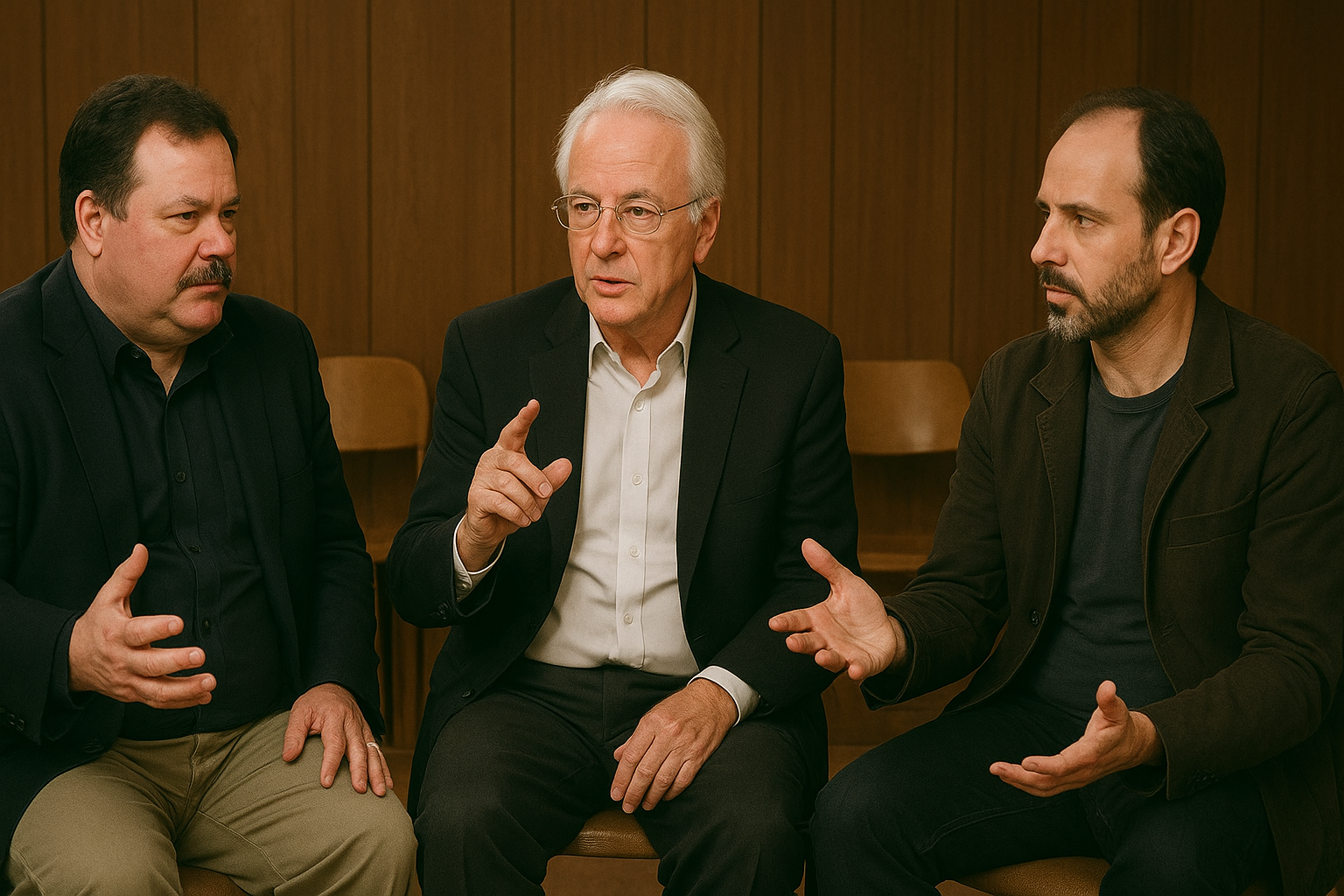
The stage is set not for a clash, but for a triangulation. On one side, Sabine Hossenfelder, the pragmatic physicist, a vocal critic of scientific groupthink, who demands mathematical rigor over mystical hand-waving. On another, Sir Roger Penrose, the Nobel laureate mathematical physicist, a titan of 20th and 21st-century thought, whose mind effortlessly bridges the colossal scales of black holes and the enigmatic nature of consciousness. And completing the triangle, beaming in from the philosophical frontier, Slavoj Žižek, the cultural theorist and philosopher, armed with psychoanalysis, Hegelian dialectics, and a seemingly endless supply of provocative metaphors from pop culture and politics.

Their mission: to tackle one of the most profound and persistent questions in all of science, a question that has humbled giants like Einstein and continues to baffle us today. Has quantum mechanics, for all its stunning predictive power, ultimately revealed the universe to be fundamentally unknowable?

The debate, hosted by Güneş Taylor, begins with a quintessential Einsteinian grumble, a sentiment that has echoed through the decades: “The more success the quantum theory has the sillier it looks.” This is the central paradox. Quantum mechanics works. It is the most accurately tested theory in the history of science. Your手机, your GPS, the laser in your grocery store scanner—all are testaments to its practical dominion over the microscopic world.

Yet, its meaning remains shrouded in a fog of paradox. Heisenberg’s Uncertainty Principle isn’t just a statement about our clumsy measurements; it suggests a fundamental limit on what can be known. The entities we call electrons and photons do not seem to be anything definite until we force them to declare themselves. As Heisenberg concluded, they inhabit a shadowy world of “potentialities or possibilities rather than one of things or facts.”

So, are we merely players in a world of competing models, none of which can ever truly describe the universe? Or was Einstein’s hunch right—is there a deeper, deterministic theory waiting to be uncovered, one that banishes uncertainty and describes a universe independent of our prying eyes?

This blog post will journey through the arguments presented by our three illustrious speakers, exploring their agreements, their tensions, and the profound questions they leave hanging in the air. We will dissect the “measurement problem,” grapple with the role of consciousness, and ask what it truly means for something to be “real.”

Part I: The Opening Pitches – Rejecting the Unknowable, Redefining the Real

The host’s opening question is direct: “Should we accept that quantum mechanics has made the universe unknowable?” The answers, though all negative, come from radically different directions.

Sabine Hossenfelder: The Call for Mathematical Clarity

Hossenfelder is first to the podium, and her position is clear, pragmatic, and slightly exasperated. Her answer is a firm “no.” She identifies a troubling trend in popular science and even within parts of the physics community: a fetishization of “quantum weirdness.”

“We need to go beyond weird,” she asserts, echoing physicist Philip Ball. But she goes a step further: “We also need to go beyond words.” For Hossenfelder, the fascination with spooky metaphors and mind-bending paradoxes is a distraction from the real work. The problem is not philosophical; it is mathematical.

She points to the “measurement problem” as the core issue. The mathematical formalism of quantum mechanics describes two utterly different types of evolution:

  1. Smooth, deterministic evolution: Governed by the Schrödinger equation, where a particle exists in a smear of all possible states (a superposition).
  2. Abrupt, random collapse: The moment a measurement occurs, this fuzzy cloud of possibilities “collapses” into a single, definite outcome.

The theory does not tell us what constitutes a “measurement” or when this collapse happens. This, for Hossenfelder, is an unacceptable lacuna—a missing piece of physics. She laments the lack of candidate solutions, name-checking Penrose’s own gravitational objective reduction as one of the few serious proposals, and calls for more attention and experimental testing of these ideas. Her mission is to replace mystery with mechanism.

Slavoj Žižek: The Ontological Incompleteness of Reality

Žižek, ever the philosopher, approaches the question with a characteristic blend of humility and audacity. He defers to the scientists on the specifics of big bang theories but offers a breathtaking philosophical reinterpretation of what quantum uncertainty might signify.

For Žižek, the epistemological limitation—the fact that we cannot know both the position and momentum of a particle—is not merely a failure of our instruments. It is a clue to the very nature of reality itself. What appears as our limitation is actually transposed into an openness within reality.

He offers a “stupid metaphor” (which is, as always, brilliantly illustrative): a video game. The trees in the background are not fully rendered; they are low-resolution textures because the game’s rules don’t allow you to approach them. They exist only as potential detail. Žižek’s radical proposition is that quantum mechanics suggests reality itself is not fully constituted.

“The basic insight is that… Reality itself is not constituted. There are gaps in it. Reality is an unfinished project in itself.”

This is a monumental shift in perspective. Uncertainty is not an overlay we project onto a complete, clockwork universe. It is part of the fabric of being. The wave function’s potentialities are not just mathematical tools; they represent a form of reality that precedes our classical notion of solid “things.” He playfully suggests that quantum mechanics “caught God being lazy,” that the universe at its fundamental level is ontologically incomplete, not fully structured. For a materialist like Žižek, this is the ultimate conclusion: a universe that generates its own rules and gaps from within, without need for a divine programmer.

Roger Penrose: The Objective Bridge Between Scales

Penrose, with the quiet authority of a master, agrees that the universe is not unknowable. But he immediately disentangles this from the question of determinism. His focus is on the puzzling disconnect between the quantum world (small) and the classical world (big).

The problem, as he outlines it, is the superposition principle. An atom can be here and there. But a macroscopic object like a glass? We never see a glass in a superposition of being on the table and on the floor. Why? The standard Copenhagen interpretation implies that it is the act of observation that collapses the wave function. Penrose finds this deeply unsatisfying.

He presents his own groundbreaking solution, an attempt to marry the two great pillars of modern physics: quantum mechanics and general relativity. He argues that their core principles—superposition and the equivalence principle—are subtly incompatible.

His famous calculation proposes that a superposition has a finite lifetime, determined by the gravitational interaction between the different states. Imagine a superposition of a glass in two slightly different positions. The tiny difference in the gravitational field of these two states makes the superposition unstable. It will decay, or “collapse,” after a time you can calculate. For a single atom, this time is enormous. For a dust speck, it’s measurable. For a glass, it’s instantaneous.

This is Objective Reduction (Orch-OR). The key point is its objectivity. The collapse “has nothing to do with anybody looks at it or not.” It is a physical process driven by gravity, resolving the measurement problem without invoking conscious observers. The world does not depend on our observation; it depends on an objective, physical threshold related to mass and space-time geometry.

Part II: The Heart of the Matter – Does the World Depend on Our Gaze?

The debate naturally flows into the most famous and misunderstood aspect of quantum theory: the role of the observer.

The “Red Herring” of Consciousness

Penrose is unequivocal: “Observation is a red herring in my view.” The famous double-slit experiment, where particles seem to “know” if they are being watched, is misinterpreted. It’s not about consciousness; it’s about interaction and, in his view, the objective gravitational threshold of collapse. The weather on a lifeless planet, he argues in a compelling thought experiment, is not a blur of all possible weather patterns waiting for a conscious being to look at a photo of it to snap into one specific history. That, he says, “makes no sense to me whatsoever.” The collapse happened long ago, objectively.

Hossenfelder partially agrees, but from a different angle. She clarifies that strictly speaking, any observation requires interaction (e.g., photons bouncing off an object), and thus inevitably disturbs the system. For large objects like a boulder, this disturbance is negligible. For a single electron, it’s catastrophic. The conflation, she argues, is between this unavoidable physical interaction and the idea of a conscious being doing the observing. “In the mathematics, that never appears.” She agrees with Penrose that the solution must be intrinsic to the system, likely involving new physics, perhaps related to gravity.

Žižek’s Dialectical Materialist Observer

Žižek, true to form, finds a way to “agree and disagree at the same time.” He runs through the pantheon of interpretations—objective collapse theories (like Penrose’s), the many-worlds interpretation (which eliminates collapse by spawning infinite universes), and even the panpsychist idea that elementary particles possess a form of proto-consciousness (which he dismisses).

His unique contribution is to reframe the issue from a materialist perspective. He argues that the true lesson of the “observer effect” is not that we create reality with our minds (a vulgar idealism), but that we are fundamentally within the reality we are observing.

“This is why I will name now somebody whom I respect politically but not philosophically. For me the worst idealist is Lenin…” he says, provocatively. He argues that Lenin’s materialism, which posits a world of objective laws observed from a neutral outside position, is itself idealist. True materialism, for Žižek, incorporates the observer into the system. Quantum mechanics is “deeply materialist because it includes us into reality.” The paradox of observation is the paradox of a system observing itself, a loop that is inherently messy and inconsistent—and for Žižek, this very inconsistency might be the source of consciousness and freedom.

Part III: God’s Dice and the Nature of Reality

The discussion turns to Einstein’s famous rejection of quantum randomness: “God does not play dice with the universe.”

Locality vs. Determinism

Hossenfelder provides crucial context. Einstein’s quip wasn’t just about a dislike for randomness; it was driven by a deeper concern: locality. She explains the thought experiment of a particle passing through a slit. Upon measurement on one side, the wave function on the other side must instantaneously vanish—a “spooky action at a distance” that violated Einstein’s own theory of special relativity. His “God does not play dice” was a hope for “hidden variables” that would restore both determinism and locality, ensuring no faster-than-light influence. John Bell’ later experiments arguably showed that you can’t have both locality and certain intuitive forms of reality, but the quest to reconcile quantum mechanics with relativity continues.

Harmony vs. Mess

Žižek attacks the theological undertones of Einstein’s statement. Even without a personal God, Einstein believed in a “marvelously arranged” universe, a deep, harmonious mathematical order. Žižek rejects this. For him, the universe is “an irreducible mess.” Local necessities emerge, but always contingently. He sees Einstein, ironically, as “a religious guy” for his faith in this higher harmony. Quantum mechanics, in all its weirdness, forces us to drop this idea of a pre-ordained cosmic order. It reveals a universe that is fundamentally open and incomplete.

Quantum Reality vs. Classical Reality

Penrose introduces a fascinating distinction to navigate these puzzles: Quantum Reality vs. Classical Reality.

  • Classical Reality: The world of tables, chairs, and glasses. You can “ascertain” its properties. You can ask a glass its shape, and it will tell you directly and definitely.
  • Quantum Reality: The world of electrons and superpositions. You cannot “ascertain” its state. You can only “confirm” it through repeated experiments. A quantum state is a set of potentialities that only yield probabilities upon interrogation.

This distinction, Penrose argues, resolves the paradoxes of “spooky action.” You can’t use entanglement to send a signal faster than light because, until you make a classical measurement, the information isn’t there to be ascertained; it’s only confirmable later. This protects causality. Most of our world is classical, so we think we’re dealing with ascertainable reality all the time. But when we dive into deliberate quantum experiments, we are playing by the rules of quantum reality, a realm where confirmation, not ascertainment, is the only available tool.

Part IV: The Final Frontier – Gravity, Retrocausality, and Cheese

The debate concludes with a flurry of provocative ideas.

Žižek, with his love for the anomalous, brings up the concept of particles “borrowing energy from the future” to tunnel through barriers, linking it to his psychoanalytic concept of the “Big Other” (the symbolic order of reality) and cartoon physics (Wile E. Coyote running off a cliff and only falling when he looks down). His profound question is: what is the tension within quantum reality itself that forces it to collapse? It cannot be a “happy domain” of pure potential; it must contain its own impossibilities and contradictions that drive it toward concrete existence.

Hossenfelder provides a stunning physical response that serves as a perfect closing argument. She simplifies the problem: send a single photon through a beam splitter. The photon and the splitter become entangled. The photon has a 50% chance of going one way, giving the splitter a tiny kick of momentum, and a 50% chance of going the other way, with no kick. Upon collapse, the momentum must suddenly be definitively in one place or the other. This instantaneous redistribution of energy and momentum, she argues, is fundamentally incompatible with General Relativity.

The mathematical contortions required to make it work lead to ideas of “retrocausality”—energy flowing backwards in time. “This is where these stories come from about retrocausality… and whatnot.” Her conclusion? This glaring incompatibility means the solution must involve a deeper understanding of gravity. “It’s got to have something to do with gravity.” In this, she finds a powerful point of agreement with Penrose’s life’s work.

And true to form, Žižek reminds us that all great things—from French cheese to champagne—emerge from malfunctioning, from something going wrong. Perhaps the universe itself is no different.

Conclusion: The Unfinished Project

The debate between Hossenfelder, Penrose, and Žižek does not provide easy answers. Instead, it beautifully maps the territory of our ignorance.

  • Hossenfelder gives us a clear mission: stop marveling at the weirdness and find the new physics. The problem is mathematical, and the solution likely lies in experimentally testing bold ideas like those of Penrose.
  • Penrose provides a breathtakingly elegant potential solution, weaving together gravity, quantum mechanics, and consciousness into a coherent, if speculative, whole. He insists on an objective reality independent of us, but one with two tiers: the confirmable quantum world and the ascertainable classical world.
  • Žižek performs the crucial philosophical work of reinterpreting the scientific data. He argues that quantum mechanics is not a problem to be solved but a revelation to be understood: the universe is ontologically open, an “unfinished project.” True materialism accepts that we are caught in the messy, self-referential loop of a reality that is not fully constituted.

They all agree on one thing: the universe is not unknowable. But they profoundly disagree on what it is that we are to know. Are we to discover a new mathematical law that completes the quantum picture? Are we to understand the objective threshold where quantum possibility becomes classical fact? Or are we to fundamentally rethink our concepts of being, reality, and our place within it?

Quantum mechanics has not made the universe unknowable. It has shown us that the universe is far stranger, more open, and more mysterious than we ever imagined. The project of understanding it is not finished because reality itself, it seems, is not finished. We are not mere observers of a cosmic clockwork; we are participants in an ongoing creation, and the act of our questioning is part of the process that forces reality to make up its mind.

REFERENCE:

Quantum and the unknowable universe | FULL DEBATE | Roger Penrose, Sabine Hossenfelder, Slavoj Žižek / The Institute of Art and Ideas

Bilim-Teknoloji-Yapay Zeka / Science-Technology-AI içinde yayınlandı | , , , , , , , , , , , , ile etiketlendi | Yorum bırakın

The Quantum Music of Life: DNA, Consciousness, and the Future of Physics

Image created by ChatGPT

What if the code of life is not merely written in molecules, but sung in quantum harmonies? What if our DNA is not only chemistry, but also consciousness listening to the whispers of the cosmos?

For centuries, physics has spoken in the language of matter and energy. It has measured stars, split atoms, built computers, and carved the industrial age. Yet, in all its brilliance, it has turned away from the greatest mystery of all: life itself.

Living systems are not closed machines. They are open symphonies — exchanging matter, energy, and information with their environment. They are far from equilibrium, resisting entropy by weaving patterns of self-organization. They breathe, they feel, they know. But physics, for the most part, has left them aside, comfortable in the predictable realm of inanimate systems.

Dr. Anita Goel, physician, physicist, and pioneer in nanotechnology, stands at the edge of this frontier. Her vision is bold: the molecular machines that copy our DNA — tiny nanomotors whirring inside every cell — may not merely follow chemical laws. They may be quantum computers, maintaining coherence long enough to sense, process, and decide.


DNA as the Piano, the Environment as the Pianist

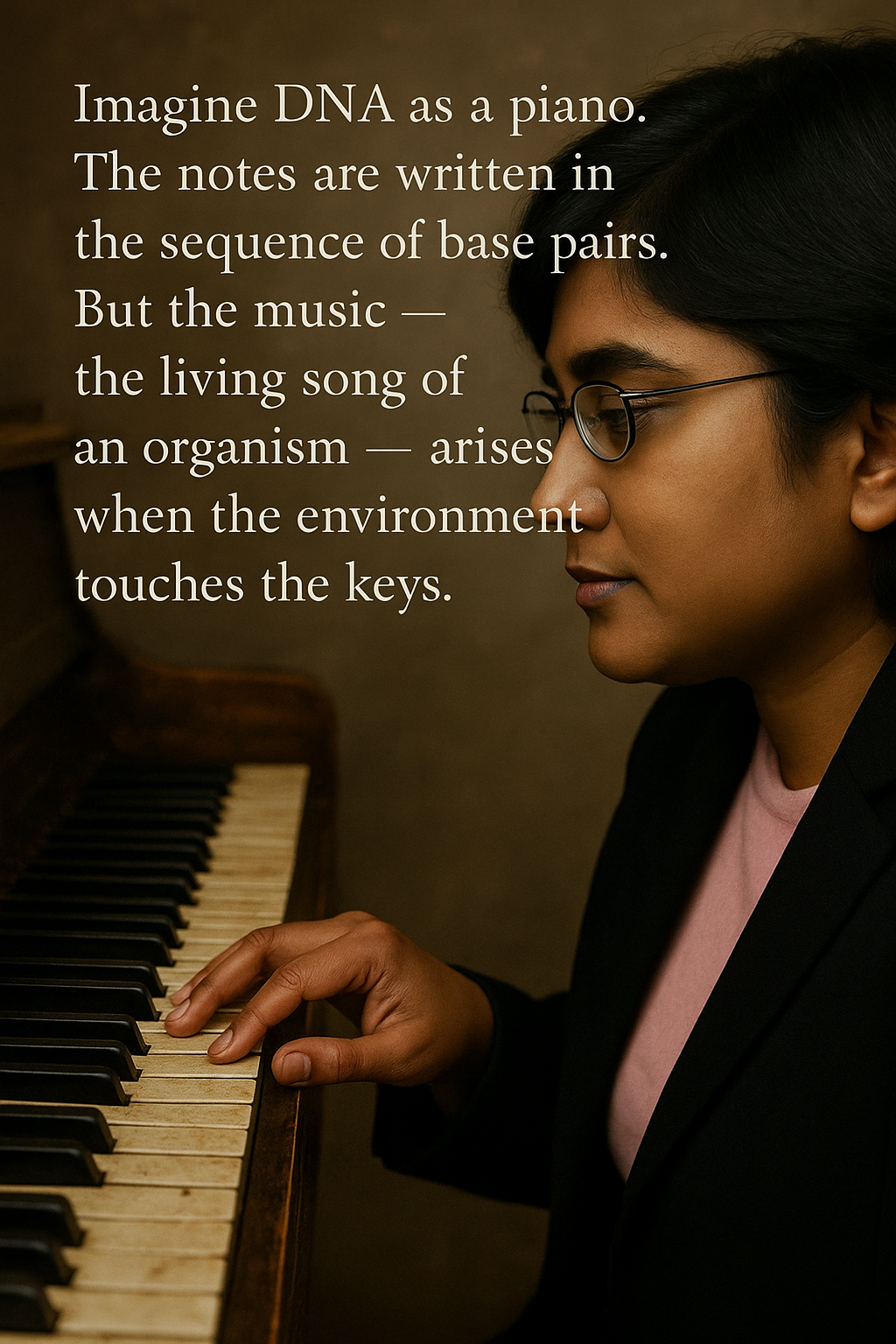
“Imagine DNA as a piano,” Goel says. “The notes are written in the sequence of base pairs. But the music — the living song of an organism — arises when the environment touches the keys.”

Two people may carry the same gene, one that predisposes them to illness. Yet only one falls sick. Why? Because beyond the static code lies the milieu — the world of signals, forces, and fields that shape expression.

Is mutation purely random, as Darwin taught? Or could the environment influence how the nanomachines make mistakes, correct errors, and evolve? Here, Lamarck whispers back into science, suggesting that life may be more responsive, more tuned to context than we dared admit.


Nanomachines: Quantum Engines of Life

Consider this: the DNA polymerase, a motor that reads and writes genetic code, operates with an efficiency of 99.99%. No car, no human invention, comes close. To copy a single base of DNA, it performs an estimated hundred billion internal steps in just milliseconds.

What is it “thinking” about?

Could it be searching through possibilities, like a quantum algorithm finding the right match in a sea of candidates? Could it be listening to quantum whispers from its environment, sensing fields beyond our classical imagination?

If so, then the most essential machinery of our bodies is not only chemical — it is quantum mechanical. And this would mean that life itself is quantum poetry in motion.


The Double Slit Dream

In physics, the double slit experiment revealed the quantum world: particles that behave as waves, collapsing into certainty when observed. Goel dreams of performing a similar experiment on living systems — to catch DNA nanomachines in the act of maintaining coherence, showing interference patterns, proving their quantum nature.

It is a moonshot. It requires technologies of exquisite precision. But if achieved, it would be a scientific earthquake: demonstrating that the building blocks of biology live in the quantum domain.


Information: The Third Element

Einstein gave us matter and energy, bound by the elegance of E = mc². But Goel suggests we must add a third: information.

Information is not abstract. It is as real as a stone, as physical as light. It shapes how molecules move, how systems organize, how life emerges. The universe may not be built only from atoms and waves, but also from patterns, codes, and symmetries.

John Wheeler, the great physicist, once said: “It from bit.” Goel takes it further: matter, energy, and information dance together in an inseparable triad.


Something Missing in Quantum Mechanics

For all its triumphs, quantum mechanics remains unfinished. It explains the dance of particles, builds lasers and computers, and predicts experiments with uncanny precision. Yet even its founding fathers — Einstein, Schrödinger, and later Roger Penrose — felt a quiet dissatisfaction.

Einstein never believed the story was complete. “God does not play dice,” he insisted, pointing to the mystery of randomness at the heart of the quantum world. Schrödinger, too, felt unease. His famous thought experiment of the cat — alive and dead at once until observed — was not meant as a celebration, but as a warning: this theory leaves something unresolved. Penrose has echoed the same: quantum mechanics works, but it may be hiding a deeper layer of reality.

Dr. Goel adds her voice to this lineage of doubt. She sees that the equations of quantum mechanics describe probabilities for ensembles, but not the trajectory of a single molecule. The wave function, elegant though it is, lacks resolution. It is a low-definition picture of a high-definition universe.

And so she asks: What if our physics is incomplete because it has not yet come to terms with life, living systems, and consciousness?

To pretend we have a “theory of everything” while ignoring these phenomena, she argues, is premature. A true unification must embrace the very fabric of experience — the way cells exchange matter, energy, and information with their environment, and the way awareness itself arises.

Something is missing in quantum mechanics. Perhaps it is the recognition that consciousness is not outside the equation, but inside it — woven into the heart of reality itself.

The Secret Life of DNA Strings

DNA is not a static code carved in stone. It is a living string, a dynamic thread constantly responding to the environment. In Dr. Goel’s experiments, she shows that the very speed at which DNA is read can be tuned — slowed, halted, or even reversed.

With lasers stretching the delicate strand, her team has observed how tension changes the polymerase motor’s behavior. Under certain conditions, the nanomachine comes to a stop. With more force, it shifts into reverse, unzipping the DNA, correcting mistakes, erasing errors as though pressing a cosmic backspace key.

This is more than mechanics. It is music.

The DNA string is like a violin string, vibrating differently depending on how it is played. The environment — mechanical forces, electromagnetic fields, even quantum signals — acts as the bow. Together, they produce the melody of life.

Two people may carry the same genetic mutation, yet one falls ill while the other thrives. Why? Because the “song” of their DNA depends not only on the sequence of notes, but on how the environment touches the strings.

Here lies a radical idea: evolution may not be purely random. The environment may leave its fingerprints on DNA in real time, guiding change, whispering corrections, playing the organism like an instrument in the orchestra of existence.

The Hard Problem of Consciousness

Science often tells the story this way: matter came first. From the Big Bang arose physics, chemistry, biology, and finally — after billions of years — consciousness.

But what if the pyramid is upside down? What if consciousness is fundamental, and matter, energy, and spacetime arise from it?

This is not only philosophy. It is a call to rewrite physics itself, so that our theories do not merely calculate probabilities of particles, but honor the lived reality of awareness.

Murray Gell-Mann once told Goel over lunch: yes, consciousness is thought of as emergent complexity. But when she asked, “What if we could build a physics where consciousness is primary?” — he paused, and said: If you could do that, I’d agree.


Living Systems as Quantum Sensors

If DNA nanomachines truly maintain coherence, they are not only engines but sensors. They could pick up quantum information from their environment — entanglement, subtle fields, non-local signals.

In this view, each cell in our body is a listening station, tuned to the music of the universe. Evolution then is not blind randomness, but a dialogue — between organism and cosmos, code and context, self and whole.


Toward a Conscious Civilization

Our age, shaped by reductionism, has given us dazzling technologies, but also a narrow story: humans as machines, utility as purpose, resources as finite commodities. It leads to a dystopia where AI replaces labor, and humans question why they exist at all.

But if we shift the paradigm — if consciousness is woven into the very fabric of reality — then life is not a machine, but a miracle. Humans are not isolated egos, but participants in a cosmic web.

Such a worldview births responsibility: to care for the Earth as our own body, to see ethics as science, to build technologies that honor life rather than diminish it.


A Call to Curiosity

The quest is not easy. It is filled with skepticism, experiments yet to be built, theories yet to be born. But as Goel reminds us, progress begins with questions:

  • What if DNA is a quantum piano?
  • What if information is as real as matter and energy?
  • What if consciousness is not emergent, but fundamental?

We stand at the threshold of a new physics — one that may finally embrace life, consciousness, and the wholeness of existence.

Perhaps the future of science is not to reduce the universe into parts, but to listen to its music.

And perhaps, when we do, we will hear not only the song of DNA, but the echo of consciousness itself, playing through us like a cosmic instrument.

Stay curious. The frontier is not out there — it is within us, written in the quantum notes of our very cells.

REFERENCE

Towards A New Physics Of Living Systems and Consciousness / Essentia Foundation

Bilim-Teknoloji-Yapay Zeka / Science-Technology-AI içinde yayınlandı | , , , ile etiketlendi | Yorum bırakın

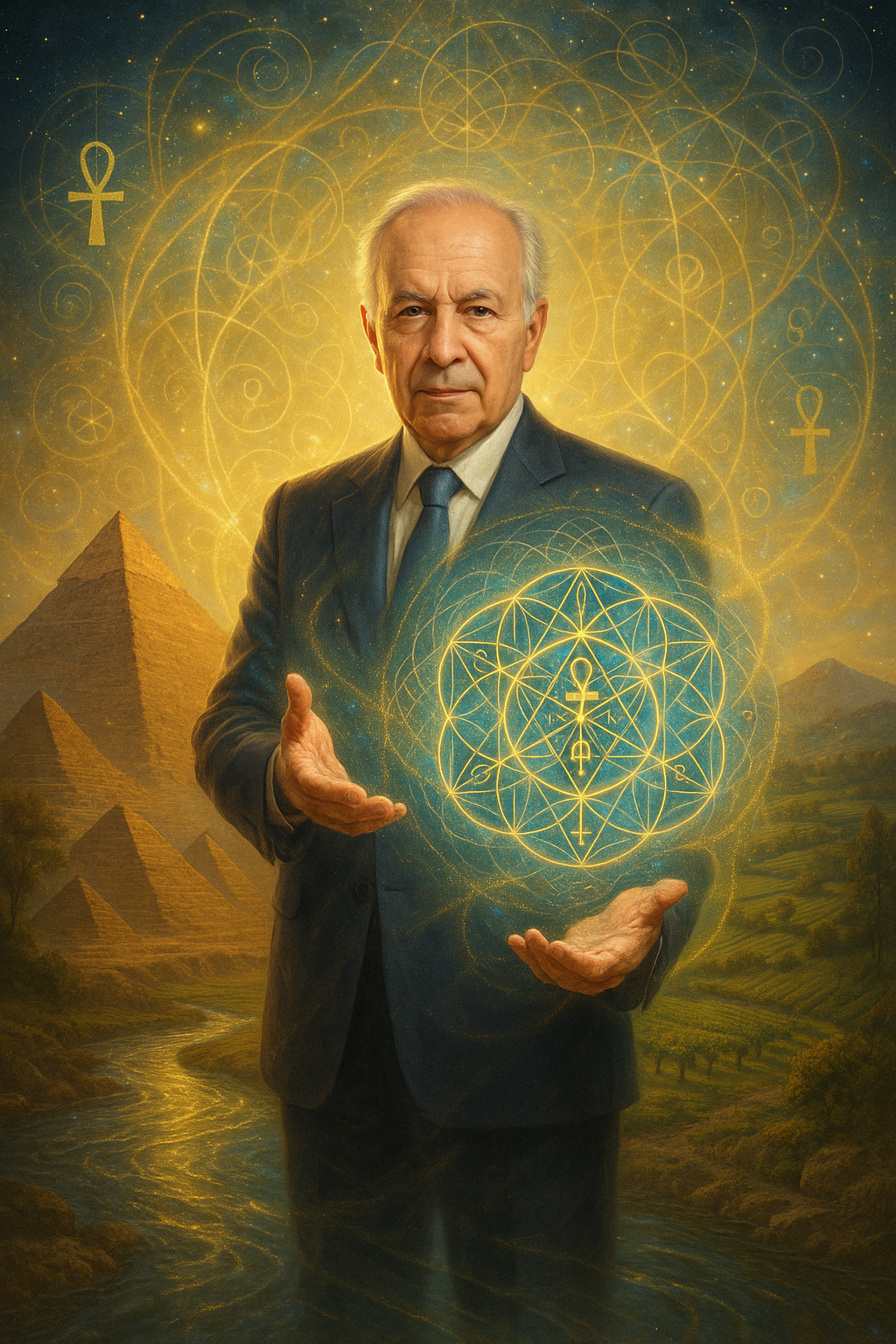
Abdel Wahed El-Wakil: Architecture as the Language of Spirit

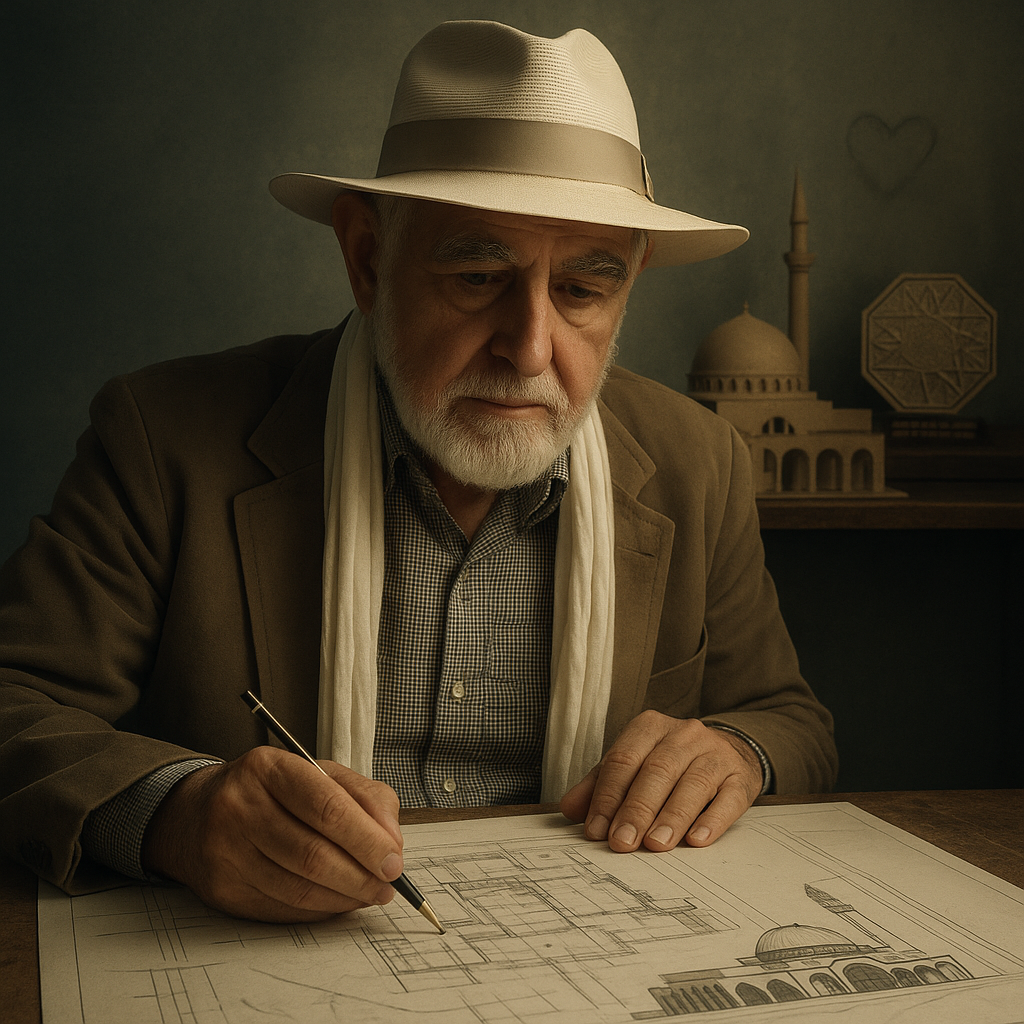
Abdel Wahed El-Wakil Image created by ChatGPT

Some architects are remembered for their buildings. Others are remembered for their philosophy. But a rare few, like Abdel Wahed El-Wakil, are remembered for both—and for the way their work transforms the very meaning of what architecture can be.

To encounter El-Wakil’s vision is to be reminded that buildings are not inert structures but living beings, breathing with the spirit of their makers and their communities. In his words:
A house without a courtyard is like a man without a soul. The courtyard is the soul of the house.

A Childhood of Revolution and Displacement

Born in Egypt in the 1940s, El-Wakil grew up in a world of upheaval. His earliest memories were of war, revolution, and a nation caught between its ancient soul and the alluring promises of Western modernity. At ten years old, he witnessed the 1952 revolution that toppled the monarchy. But the new republic, instead of recovering Egypt’s cultural dignity, began copying the West.

He recalls:
The revolution talked of nationalism, of identity, of everything. But all they did was copy the West. In architecture, it was the same thing.

This sense of loss—of people abandoning their own traditions for alien models—became the question that would haunt his career: How can architecture serve the identity of a people?

The Hidden Master: Hassan Fathy

At university, the curriculum praised Renaissance, Gothic, and Baroque architecture. Islamic architecture, the tradition of his own land, was either ignored or dismissed as “non-historical.” It was as if Egypt’s soul had been erased from the very discipline that shaped its cities.

Then, by chance, El-Wakil heard of Hassan Fathy, a man whispered about but never officially taught. Fathy had already achieved international recognition, yet in Egypt his name was silenced. El-Wakil sought him out.

What he found was a revelation. Fathy’s buildings, made of mudbrick, were luminous and beautiful, despite being built from what many considered “the material of the slums.” El-Wakil recalls:
It was like seeing Rodin’s Thinker sculpted not in marble, but in mud. Suddenly I understood—the nobility of a material lies not in itself, but in how it is handled.

This encounter gave El-Wakil a compass: architecture rooted in tradition, made from the earth, responsive to climate and culture, yet transcendent in form.

Against the Tide of Modernism

In the 1960s, when the world celebrated the moon landing and dreamed of capsule cities and flying cars, El-Wakil resisted the allure of futurism. For him, the sterile glass towers and concrete blocks of modernist architects like Mies van der Rohe were impoverished compared to the spiritual resonance of a mosque dome or a vaulted adobe home.

Architecture without philosophy becomes engineering. Architecture without aesthetics becomes engineering. Compare a glass box to Notre Dame, to an Indian temple, to a mosque. One speaks to your heart, the other says nothing.

He called it “T-square architecture”—lines without soul, forms without meaning. In contrast, his architecture was alive with courtyards, domes, vaults, and gardens—spaces designed to mirror the harmony of creation itself.

Architecture as Identity and Spirit

El-Wakil insists that architecture is not merely a style fixed in time, but a living language rooted in space and identity. Traditional Islamic architecture, he explains, adapts not to fashion but to environment. The mosque in Cairo, the house in Aleppo, the courtyard in Isfahan—each different in form but united in spirit.

Our architecture is not caught in the vortex of time. It is placed in space. It is not something of the past—it is a living reality.

At its highest level, architecture becomes a recognition of the Creator. Courtyards are not just climate solutions—they are metaphysical centers, bringing God’s creation, nature, into the heart of human dwellings.

A house without the courtyard is like a man without a soul. The courtyard is the soul of the house.

The rooms are built around the court. What is the court? It is the open garden. What is the garden? It is the world created by God. What is the building? It is the world fashioned by man. The house places God’s creation in the center.

The Teacher and the Mason

His path was not without struggle. When he tried to introduce Islamic architecture at university, 15 professors attacked him, forcing him to resign. Later, working with master masons, he realized how far academia had drifted from the realities of building.

One mason once told him:
When you make a mistake as an architect, you erase it with a pencil. When I make a mistake under a dome, we both die.

This humility before craft shaped El-Wakil’s teaching. For him, knowledge is not in papers and theories but in practice, apprenticeship, and learning from those who touch the materials of earth.

Symbolism in Architecture: Speaking Beyond Form

El-Wakil often reminds us that architecture is not mute. Every element—dome, arch, minaret, or courtyard—speaks in symbols, carrying meaning that transcends material. For him, symbolism is not decoration, but essence.

The dome, for example, is not simply a roof. It is the image of the heavens, the vault of creation hovering over the faithful. The courtyard is not an empty square—it is the ordered garden, the echo of Paradise placed at the heart of human dwelling.

Even the act of carving stone becomes symbolic:
When you dress a stone, you remove the superfluous and keep the essential. You are spiritualizing the stone—and spiritualizing yourself.

In this sense, his buildings are not designed only for the eye but for the soul. They embody the unseen, reminding those who enter that the material world is always pointing beyond itself, to the eternal.

Works of Spirit: Domes and Courtyards

Among his most celebrated works are the King Saud Mosque in Jeddah, with its daring 20-meter dome built without steel reinforcement; the Island Mosque, praised for its purity of form; and his villas on the Alexandria coast, including the Agamy house, which won him the Aga Khan Award in 1980.

The Agamy house became a symbol of his philosophy. Built traditionally with local craftsmen, it drew international acclaim. Yet the most moving testimony came not from critics but from the client, a businessman. He confessed to El-Wakil:
It is the first time I fell in love with something. All my life was money. But from the day you built that house, my wife and children never left it. It became our soul.

Copying, Originality, and Ego

In an era obsessed with originality, El-Wakil redefines the word. “Original means returning to the origin. Creative means designing according to the created order of God—not twisting buildings into eggs, horns, or crescents to feed the ego.

For him, copying tradition is not plagiarism—it is honor. A true masterpiece is when the student copies the master so faithfully that he becomes indistinguishable from him. This was how he understood his own early works, often mistaken for those of Hassan Fathy.

Legacy and Recognition

El-Wakil’s courage to resist modernist trends earned him international recognition. He received the Aga Khan Award for Architecture twice, and in 2009 he was honored with the Driehaus Prize, one of architecture’s highest accolades for traditional design. His mosques across Saudi Arabia, his houses in Egypt, and his teaching in England and beyond stand as living testaments to his philosophy.

But for El-Wakil, awards are secondary. What matters is the survival of meaning in architecture—the reminder that buildings must speak to the heart, not just to the eye.

Toward the Eternal

Perhaps the essence of his philosophy is captured in his reflections on ancient Egypt. Pharaohs built their palaces in mudbrick, like their people, so none survive today. Only the temples remain. Why? Because sacred buildings, embodying spirit, outlast the material.

Our homes, like our bodies, return to earth. But our mosques, our sacred monuments, remain—because spirit does not die.

In the end, Abdel Wahed El-Wakil does not simply build. He reminds us that to build is to pray, to carve stone is to spiritualize oneself, and to dwell is to recognize our Creator. His architecture stands not as nostalgia, but as prophecy: that a future without soul will collapse, but a future rooted in spirit will endure.

REFERENCES

Documentary: Architect Abdelwahed El-Wakil / Caravane Earth

Abdel Wahed El-Wakil in conversation with Lucien Steil / Caravane Earth

Человек, который работает на Бога. / The man who works for God. / Russian Hour

Connecting the natural environment to the built one. Prof. Abdel-Wahid El-Wakil talks to The Circle / Circle People Community

Middle Ground / Middle East: Religious Sites in Urban Co / Archnet

Tasarım-Dekorasyon-Mimarlık-Design-Decoration-Architecture içinde yayınlandı | , , , , , , , , ile etiketlendi | Yorum bırakın

Kara Büyüden Şans Ritüeline: Anadolu’da Büyü

Hep arkadaşımın arkadaşının akrabalarının başına gelen bir konu iken bu sefer armut tam dibime düşünce bu konuya birçok perspektiften bakmak ve araştırmak ihtiyacı hissettim.

Meğer ne kadar da dibimizdeymiş, aramızdaymış bu büyü meraklısı zayıf ruhlar.

Kocaman bir konuyu hap bilgi olarak derliyorum:

İçerik

  1. Büyü nedir?
  2. Farklı dinlerde büyü (Hristiyanlık, Yahudilik, islam, Hinduizm, Budizm, Zerdüştlük, Şamanizm)
  3. Günümüzde Anadolu’da büyü pratikleri (aşk, nazar, ayırma, şans ve bolluk, kara büyü)
  4. Ünlü büyü kitapları
  5. Evde büyü buldum, ne yapabilirim?
    • Eşyaları Temizleme / Uzaklaştırma
    • Kur’an ve Dua ile Korunma
    • Temizlik Ritüelleri
    • Kişisel Korunma
    • Psikolojik ve Ruhsal Destek

6. Büyü yapan ve yaptıran insanların sorumlulukları (İslam’da, Hristiyanlıkta, Yahudilikte, Hinduizm ve Budizmde)

7. Büyü ile ilgili halk arasında dolaşan sözler

BÜYÜ NEDİR?

Büyü, insanlık tarihi kadar eski bir olgu olarak, farklı toplumlarda farklı biçimlerde karşımıza çıkar. Genel anlamıyla büyü; doğaüstü güçleri kullanarak olayları, insanları veya nesneleri etkileme çabasıdır. İlk izlerine Mezopotamya, Antik Mısır ve Şamanik kültürlerde rastlanır. İnsanlar büyüyü kimi zaman şifa bulmak, korunmak, yağmur yağdırmak, aşkı veya bereketi çağırmak için; kimi zamansa zarar vermek ya da kontrol etmek amacıyla kullanmıştır.

Bölgeler arasında büyü pratikleri çeşitlilik gösterir: Orta Doğu’da muska ve tılsımlar öne çıkarken, Afrika’da voodoo ve ruh çağırma ritüelleri yaygındır. Avrupa’da Orta Çağ boyunca cadılık, büyücülük ve kara büyü kavramları kilise tarafından ciddi yaptırımlarla karşılaşmıştır. Anadolu kültüründe ise hem halk hekimliği hem de dini motiflerle iç içe geçmiş, nazardan korunma veya iyileştirme amaçlı “ak büyü” uygulamaları kadar, zarar verme niyetiyle yapılan “kara büyü” de vardır.

Bu konuda yazılmış pek çok eser, büyünün kültürler arası farklılıklarını ve etkilerini incelemektedir. Örneğin, James Frazer’ın Altın Dal adlı eseri büyü, din ve mit arasındaki bağlantıları araştırırken; Mircea Eliade’nin Şamanizm çalışması, büyüsel pratiklerin ritüel ve inanç boyutlarını ele alır. Günümüzde ise büyü, bir yandan folklorik bir miras, diğer yandan modern toplumların bilinçaltında hâlâ etkisini sürdüren bir kavram olarak varlığını korumaktadır.

GÜNÜMÜZDE ANADOLU’DA BÜYÜ PRATİKLERİ

1. Aşk Büyüsü (Bağlama Büyüsü)

  • Amaç: İki kişiyi birbirine bağlamak, sevgi uyandırmak veya birini kendine aşık etmek.

2. Nazar ve Kötü Enerjiyi Giderme Büyüsü

  • Amaç: Kişiyi nazardan, kötü gözden veya negatif enerjiden korumak.
  • Malzemeler: Nazar boncuğu, tuz, su, Kur’an’dan belirli ayetler (örneğin Felak ve Nas sureleri), tütsü (günlük veya amber).
  • Güncel Kullanım: Hemen her kesimde, özellikle çocuklara veya yeni doğanlara nazar boncuğu takma yaygın; hocalar veya büyücüler bu ritüelleri hâlâ uygular.

3. Ayırma Büyüsü

  • Amaç: İki kişiyi birbirinden ayırmak veya bir ilişkiyi bitirmek.

4. Şans ve Bolluk Büyüsü

  • Amaç: Sıkıntı yaşanılan alanlarda (iş, sağlık, evlilik, kazanç gibi…) başarı elde etmek veya şans çekmek.

5. Kara Büyü

  • Amaç: Düşmana zarar vermek, hastalık getirmek veya hayatı zorlaştırmak.

Genel Özellikler ve Güncel Durum

  • Uygulayıcılar: Çeşitli Imamlar, medyumlar veya “bilgili” kabul edilen yaşlılar bu büyüler için başvurulan kişilerdir. Günümüzde sosyal medya ve internet, bu pratikleri yayarak modernize etmiştir.
  • Kültürel Bağlam: Bu uygulamalar genellikle gizli tutulur ve toplumda hem merak hem de korkuyla karşılanır. İslam’a aykırı görülse de, bazıları bunu dini ritüellerle birleştirir.
  • Yasal ve Etik Durum: Türkiye’de büyü yapmak yasal değildir ve dolandırıcılıkla ilişkilendirilebilir.

ÜNLÜ BÜYÜ KİTAPLARI

En ünlü büyü kitabı olarak genellikle “Grimorium Verum”, “The Key of Solomon” (Solomon’un Anahtarı) ve “The Book of Abramelin” gibi eserler öne çıkar. Ancak, Anadolu bağlamında veya genel popüler kültürde en çok bilinen büyü kitabı olarak “Picatrix” (Ghāyat al-Ḥakīm) sıkça anılır. Bu eserler tarih boyunca gizem ve sihirle ilişkilendirilmiştir.

  • Picatrix: 10. veya 11. yüzyılda Arapça yazılmış, daha sonra Latinceye çevrilmiş bir grimoirdir. Astronomi, astroloji ve simya ile büyüyü birleştirir. İslam dünyasından Avrupa’ya geçen bu kitap, Orta Çağ’da büyücüler ve alimler tarafından kullanılmıştır. Anadolu’da da eski Türk-İslam kültürünün bir parçası olarak dolaylı etkileri görülmüştür.
  • The Key of Solomon: Kral Süleyman’a atfedilen bu kitap, koruyucu semboller, mühürler ve cinleri kontrol etme ritüelleri içerir. Batı okültizminde çok etkilidir.
  • Grimorium Verum: 18. yüzyılda yazıldığı düşünülen bu eser, kara büyü ve cin çağırma ritüelleriyle ünlüdür.

Günümüzde bu kitapların orijinal nüshaları nadir bulunur ve çoğu akademik çalışma veya çeviri olarak mevcuttur. Anadolu’da ise yazılı bir “büyü kitabı” geleneği yerine, sözlü aktarımlar ve muska yazım teknikleri daha yaygındır.

EVDE BÜYÜ BULDUM, NE YAPABİLİRİM?

🧹 1. Eşyaları Temizleme / Uzaklaştırma

  • Büyü için kullanılan nesneler (pirinç, iğne, sabun vb.) elden eldivenle alınmalı ve kimsenin gözü önünde açılmamalı.
  • Bu nesneler genellikle ya suya atılır ya da toprak altında gömülür. Özellikle akan suya (dere, deniz) atmak “arınma” kabul edilir.
  • Bazı yerlerde ise tuz serpilip yakarak imha etme de tercih edilir.

📖 2. Kur’an ve Dua ile Korunma

  • Evde Bakara Suresi, özellikle Ayet-el Kürsi ve Felak – Nas duaları okunur. Bunlar halk arasında en güçlü korunma ayetleri olarak bilinir.
  • Kur’an’ın sesli okunması evde “ağır” enerjiyi dağıtır.
  • Odalara Yasin Suresi okunması da tavsiye edilir.

👉 Bu üçlü (Ayet-el Kürsi, Felak, Nas) düzenli okunduğunda, halk inancına göre hem manevî kalkan oluşturur hem de insanın kalbine güven ve huzur verir.

✨ Bu dualar, sadece büyü/nazar gibi şeylere karşı değil, kalp huzuru, korkunun dağılması ve güven duygusu için de çok faydalı görülür.

📖 Bakara Suresi

  • Kur’an’ın en uzun suresidir.
  • İçinde pek çok konu vardır ama özellikle iman, ibadet, Allah’a güven ve şeytandan sakınma üzerinde durur.
  • Halk arasında “okunduğu eve şeytan girmez” inancı vardır.
  • Özellikle 255. ayet (Ayet-el Kürsi) bu surenin en meşhur ve koruyucu kabul edilen kısmıdır.

Ayet-el Kürsi (Bakara, 255. Ayet)

  • Allah’ın kudretini, ilmini ve sınırsız gücünü anlatır.
  • “O’nu uyku ve uyuklama tutmaz”, “göklerde ve yerde ne varsa O’nundur” gibi ifadelerle Allah’ın mutlak hâkimiyetini vurgular.
  • Koruyucu kabul edilmesinin sebebi, insana “ben yalnız değilim, beni her an gören, bilen ve koruyan bir güç var” duygusunu vermesidir.
  • Hz.Muhammed’in (s.a.v.) hadislerinde de Ayet-el Kürsi’nin okunulan evi ve kişiyi koruduğu rivayet edilir.

🌅 Felak Suresi

  • Sabahın aydınlığına, karanlığın kaybolmasına atıfla başlar.
  • İçinde özellikle “kötülüklerden Allah’a sığınmak” vurgulanır.
  • Haset (kıskançlık), karanlık, düğüm düğüm büyü yapanlar gibi kötülüklere karşı korunma duasıdır.
  • Bu yüzden büyüye karşı okunacak en önemli surelerden biri sayılır.

🌙 Nas Suresi

  • İnsanların Rabbine, Melikine, İlâhına sığınmayı öğütler.
  • Özellikle vesvese veren kötü düşüncelere, şeytanın telkinlerine karşı korunma duasıdır.
  • Kalbe gelen korku, kaygı, şüphe gibi olumsuz duyguları yatıştırır.

🔑 Ortak Nokta

Bu sure ve ayetlerin hepsi Allah’a sığınmayı, korku ve kötülük karşısında güven duygusu bulmayı öğütler.
Büyü, nazar veya kötü niyet gibi şeylerden korunmak için okunmaları, aslında insanın bilinçaltına da şu mesajı verir:
👉 “Hiçbir güç Allah’tan üstün değildir. Allah dilerse beni her şeyden korur.”

Bu inanç kişiye hem manevi kalkan olur, hem de psikolojik rahatlama sağlar.


🌿 3. Temizlik Ritüelleri

  • Sirke ve tuzlu su ile evi silmek çok yaygın bir uygulamadır. Sirke, kötü enerjiyi kırdığına inanılır.
  • Adaçayı, üzerlik otu (nazar otu), tütsü yakılarak evin odalarında gezdirmek manevi temizlik sayılır.
  • Evde beyaz bir mum yakıp başında dua etmek de kullanılır.

🧿 4. Kişisel Korunma

  • Üzerlik tohumu taşıma, nazar boncuğu veya küçük Kur’an (cevşen gibi) üzerinde bulundurmak halk arasında korunma amacıyla yapılır.
  • Abdestli gezmek, düzenli olarak Felak ve Nas surelerini okumak kişisel kalkan kabul edilir.
  • Birçok kişi sabah-akşam 3 defa İhlas, Felak, Nas okuyarak korunma yapar.

🌊 5. Psikolojik ve Ruhsal Destek

  • Böyle bir şey bulmak insana korku verebilir. Önemli olan korkunun kendisinin büyünün etkisinden daha yıpratıcı olabileceğini bilmektir.
  • Büyüyü bulan kişinin kendini yalnız hissetmemesi, güvendiği insanlarla paylaşması ve manevi destek alması çok kıymetli.

BÜYÜ YAPAN VE YAPTIRANLARIN SORUMLULUKLARI

☪️ İslam’da

  • Büyü yedi büyük günah arasında sayılmıştır.
  • Hz.Muhammed (s.a.v.): “Kim bir kahine (falcıya) veya büyücüye gider, ona inanırsa, Muhammed’e indirilene (Kur’an’a) küfretmiş olur.” (Ebu Davud)
  • Büyü yaptıran kişi de büyük günah işlemiş olur, çünkü:
    • Allah’tan başkasına güvenmiş,
    • İlahi düzene karşı “başkasının kaderini değiştirmeye” kalkmıştır.
  • İslam hukukunda, yaptıran da, yapan da ağır günahkâr kabul edilir.
  • Manevi yaptırım: ahirette azap, dünyada ise iç huzursuzluk, bereket kaybı, ilişkilerde bozulma şeklinde yaşanabileceği söylenir.

✝️ Hristiyanlıkta

  • İncil’e göre büyüye gitmek, Tanrı’ya değil, şeytana yönelmek demektir.
  • Büyü yaptıran, “Tanrı’ya güvenmek yerine başka güçlere güvenmekle” suçlanır.
  • Sonuç: günahkâr sayılır, tövbe edip geri dönmezse ruhunun kurtuluşunu tehlikeye atar.

✡️ Yahudilikte

  • Tevrat açıkça “Büyücüye gitme” der.
  • Yaptıran kişi Tanrı’nın gazabına uğrayacağına inanılır.
  • Bu, putperestlikle eş değer sayılır.

🕉️ Hinduizm ve ☸️ Budizm’de

  • Büyü yaptırmak kötü karmaya yol açar.
  • Çünkü başkasının özgürlüğüne, sağlığına veya mutluluğuna zarar vermek niyet düzeyinde bile ağır karmadır.
  • Yaptıranın da hayatına geri döner: hastalık, başarısızlık, ilişkilerde bozulma, ruhsal huzursuzluk.

🌀 Halk İnançlarında

  • “Büyü yaptıran, kendine de kapı açar” derler.
  • Yani büyüye başvuran kişi, aynı zamanda kendi hayatına olumsuz enerjileri davet etmiş olur.
  • Kendi iç huzuru kaybolur, evinde bereket azalır, sürekli dert, korku ve huzursuzluk yaşayabilir.

🔑 Özet

👉 Büyü yaptıran kişi de, en az büyü yapan kadar sorumludur.

  • Dini açıdan: büyük günah, ahirette cezalandırılma.
  • Manevi açıdan: huzursuzluk, bereket kaybı, ilişkilerde bozulma.
  • Spiritüel açıdan: kötü enerji kapısı açıldığı için, kişinin kendi yaşamında da terslikler oluşur.

⚖️ Yani büyü yaptıran, aslında kendi kaderini de riske atar. Çoğu gelenekte bu yüzden çözüm “büyüye başvurmak” değil, dua, tövbe, arınma ve teslimiyet olarak gösterilir.

BÜYÜ İLE İLGİLİ HALK ARASINDA DOLAŞAN SÖZLER

Anadolu’da büyü ile ilgili halk arasında dolaşan sözler, genellikle kültürel inanışlar, atasözleri ve deyimler aracılığıyla nesilden nesile aktarılmıştır. Bu sözler, büyünün gücüne, etkilerine veya sonuçlarına dair halkın bakış açısını yansıtır. Aşağıda, büyü temalı bazı geleneksel halk sözleri ve ifadeleri bulabilirsiniz. Bazıları doğrudan alıntılar, bazıları ise bu kültüre dayalı olarak uyarlanmışlardır:

  1. “Büyü bozulmazsa gölge düşer ömre.”
    • Büyünün etkisinin uzun süreli olabileceği ve hayatı karartabileceği inancını ifade eder.
  2. “İğne batırdığın yerden kan akar.”
    • Büyüde kullanılan iğnelerin, hedef kişiye fiziksel veya manevi zarar verebileceği düşüncesini yansıtır.
  3. “Şekerle tatlı, iğneyle acı gelir.”
    • Aşk büyüsünde şekerin tatlılık, iğnenin ise acı veya kontrol getirdiğine dair halk inanışını vurgular.
  4. “Göz değdiği yerde büyü tutar.”
    • Nazarın büyüyle birleştiğinde daha etkili olabileceği fikrini taşır.
  5. “Büyü yapanın eli yanar.”
    • Büyünün geri tepebileceği ve yapanı da etkileyebileceği inancını ifade eder.
  6. “Muska gizli, niyet açıktır.”
    • Büyülerin genellikle gizlice yapıldığı, ancak niyetin her zaman hissedilebileceği düşüncesini yansıtır.
  7. “Dua ile başlar, büyü ile biter.”
    • Dini unsurların büyü ritüellerinde hem koruyucu hem de tersine kullanılabileceği fikrini taşır.
  8. “Toprağa gömdüğün söz, rüzgârla döner.”
    • Büyü malzemelerinin toprağa gömülmesiyle yapılan ritüellerin geri dönüşü olabileceği inancını ifade eder.
  9. “Büyü bilene değil, inananadır.”
    • Büyünün etkisinin, yapanın yeteneğinden çok inananın psikolojik durumuna bağlı olduğu görüşünü yansıtır.
  10. “Kara büyü, kara gün getirir.”
    • Kötü niyetle yapılan büyünün hem yapanı hem de çevresini olumsuz etkileyebileceği düşüncesini vurgular.
Deneme-Essays içinde yayınlandı | , , , , , , , , , , , , , , , , , , , , , , ile etiketlendi | Yorum bırakın

Alcoholism and denial

When someone with alcoholism doesn’t acknowledge their problem or refuses treatment, it’s one of the most challenging situations for loved ones.
The key is to understand that denial is part of the illness — not stubbornness alone — and to approach it with a balance of compassion, boundaries, and persistence.

Here’s a breakdown of what you can do:


1. Focus on Behavior, Not Labels

Avoid saying “You’re an alcoholic” — this often triggers defensiveness.
Instead, point out specific, observable behaviors:

“I’ve noticed you’ve missed several mornings of work after drinking.”
“You got home late last night and seemed confused.”

This can open the door for reflection without feeling attacked.


2. Don’t Argue When They’re Drunk

Wait for a calm, sober moment to talk. Conversations during intoxication often escalate and rarely lead to real insight.


3. Use “I” Statements

Keep the focus on your feelings and experiences rather than accusations:

“I feel worried when you drive after drinking because I care about your safety.”


4. Set Boundaries Without Ultimatums You Can’t Keep

Boundaries protect you and prevent enabling:

  • No alcohol in the house.
  • No lending money for activities that might involve drinking.
  • If behavior becomes unsafe, you may need to leave or ask them to leave.

5. Avoid Enabling

Enabling is anything that protects them from the consequences of their drinking — calling in sick for them, paying their bills, covering up problems. Sometimes natural consequences are the only things that prompt change.


6. Encourage Small First Steps

Instead of pushing for rehab immediately, suggest smaller steps:

  • Talking to a doctor “just for a health check.”
  • Attending one support group meeting “to see what it’s like.”
  • Reading an article or watching a video about alcohol use.

7. Seek Support for Yourself

  • Al-Anon or SMART Recovery Family & Friends meetings offer tools and emotional support.
  • A therapist can help you navigate the emotional strain and maintain healthy boundaries.

8. Know When to Step Back

If their drinking is causing harm to you or children, or becomes abusive, it may be necessary to remove yourself from the situation. Protecting your own well-being is not abandoning them — it’s essential.


Bottom line: You can’t force someone to admit they have a problem or to seek help — but you can create conditions where facing reality becomes more likely. That means removing your part in enabling, staying consistent with boundaries, offering information without pressure, and making sure you have your own support system.

Sağlık-Health içinde yayınlandı | , , ile etiketlendi | Yorum bırakın

Explaining alcoholism to children

Explaining alcoholism to children is delicate — the goal is to be truthful but age-appropriate, helping them understand without overwhelming them or making them feel responsible.
Here’s a framework you can adapt based on age and situation:


1. Keep It Honest, Simple, and Age-Appropriate

  • Young children (under 8) → Simple language, no medical jargon.
    Example: “Mom/Dad is sick because they drink too much alcohol. Alcohol is something adults sometimes drink, but too much can make them act differently and not feel well.”
  • Older children (8–12) → Add a little more detail.
    Example: “Alcohol can make people’s brains work differently. Sometimes, they can’t stop even when they want to, and it can cause problems at home or work.”
  • Teens → They can handle more direct conversations, but still keep it compassionate.
    Example: “Alcoholism is a disease. It affects how the brain works, and it’s not about willpower. Your parent needs help to get better.”

2. Reassure Them

  • “It’s not your fault.”
  • “You can’t fix it, but there are people who can help.”
  • “You are loved and cared for, no matter what.”

3. Address Their Feelings

Encourage them to name their emotions — scared, angry, embarrassed, confused — and validate that these feelings are normal.
Example: “It’s okay to feel upset or confused. Many kids feel this way when a parent is struggling with alcohol.”


4. Explain the Behavior Without Excusing It

Help them separate the person from the illness:
“When your mom/dad drinks too much, it’s the alcohol affecting their brain — not because they don’t love you.”


5. Offer Safety & Support

  • Make sure they know who they can talk to (other parent, relative, teacher, school counselor).
  • If things at home become unsafe, they should know it’s okay to leave the room or call for help.

6. Provide Hope

Explain that people can get better with help, but recovery takes time:
“There are doctors, counselors, and programs that help people stop drinking and live healthy lives again.”


7. Suggest Healthy Outlets

Encourage them to focus on hobbies, friends, and activities that make them feel safe and happy.
Mention that there are support groups for kids (like Alateen) where they can meet others in similar situations.


Example Full Conversation for a Child (Around Age 10)

“I want to talk to you about something important. You’ve probably noticed that Mom/Dad has been drinking a lot and acting differently. Alcohol is a drink for adults, but too much can make people sick and act in ways they normally wouldn’t. This sickness is called alcoholism, and it makes it hard for them to stop drinking even if they want to.

This is not your fault, and it’s not something you can fix. What you can do is talk about how you feel, and remember that you’re not alone. We have people who can help us, and I’m here to make sure you’re safe and loved.”


Alcoholism is not a weakness — it’s a complex illness shaped by biology, psychology, and life circumstances. It can creep in quietly or arrive suddenly, but its effects touch not only the person drinking, but also their family, friends, and community. The good news is that recovery is possible, and there is no single “right” path — from medical detox to therapy, support groups, mindfulness practices, and emerging treatments, each step can bring a person closer to a healthier, more connected life. Patience, compassion, and persistence matter as much as any method. Whether you’re seeking help for yourself or supporting someone you love, remember: every day without alcohol is a step toward freedom, and no one has to take that step alone.

Sağlık-Health içinde yayınlandı | , , , , , , ile etiketlendi | Yorum bırakın

Alcoholism: A Pocket Guide for Understanding and Helping

Alcoholism — or alcohol use disorder (AUD) — is more than “drinking too much.” It’s a chronic condition that changes the brain, hijacks decision-making, and affects health, relationships, and self-worth.
Because alcohol is legal and socially accepted, the line between “casual drinker” and “problem drinker” can be blurry — until it’s not.
This guide is designed to be your pocket tool: clear, practical, and easy to use whether you’re learning for yourself, for someone you love, or for professional interest.

When Can It Start?

Alcoholism can develop at any age — from late teens experimenting at parties to midlife professionals who start using it to “unwind” after work.
Often, it begins with drinking for stress relief, sleep, or social comfort. Over time, tolerance builds, meaning you need more for the same effect. That’s when the slide can begin.


Is It in the Genes?

Research suggests 40–60% of the risk may come from genetics. If alcoholism runs in your family, your risk is higher — but genes are not destiny.
Environment, coping skills, mental health, and even cultural attitudes toward alcohol can tip the scale either way.


Warning Signs

  • You drink more or longer than planned.
  • You’ve tried to cut down but couldn’t.
  • Drinking interferes with work, studies, or relationships.
  • You feel anxious or shaky without alcohol.
  • You drink in dangerous situations (before driving, with certain medications).

Is It Curable?

There’s no instant “cure,” but alcoholism is treatable and recovery is possible. Think of it like diabetes: it can be managed, and you can live a healthy, fulfilling life with the right tools.

How Alcoholism Can Be Treated — Methods That Work

Different approaches help in different ways, and often a combination gives the best results.


1. Medical Detox

How it helps:
For heavy drinkers, suddenly stopping can cause dangerous withdrawal (seizures, delirium tremens). Medical detox in a clinic or hospital provides 24/7 monitoring, fluids, and medication to make withdrawal safer and more comfortable.
Best for: People with severe dependence or previous dangerous withdrawals.

2. Rehabilitation Programs

How it helps:

  • Inpatient rehab (living at a facility) offers a structured, trigger-free environment.
  • Outpatient rehab allows people to stay at home while attending daily or weekly therapy.
    Both combine counseling, education, and skills-building.
    Best for: Those who need intensive support, especially in early recovery.

3. Therapy & Counseling

How it helps:

  • CBT (Cognitive Behavioral Therapy): Identifies and changes thought patterns that lead to drinking.
  • Motivational Interviewing: Helps build personal motivation for change without pressure.
  • Trauma therapy: Addresses unresolved issues that may fuel drinking.
    Best for: Anyone wanting to understand why they drink and how to replace it with healthier coping skills.

4. Support Groups

How it helps:

  • AA (Alcoholics Anonymous): A 12-step program focusing on peer support and spiritual growth.
  • SMART Recovery: Evidence-based tools for self-management, no spiritual component.
    They offer understanding from people who’ve been there, and accountability to keep going.
    Best for: Those who benefit from community support.

5. Medication-Assisted Treatment

How it helps:

  • Naltrexone: Blocks alcohol’s pleasurable effects, reducing the urge.
  • Acamprosate: Helps normalize brain chemistry after quitting.
  • Disulfiram: Causes unpleasant reactions if you drink (deterrent).
    Best for: People who relapse frequently or have strong cravings.

6. Holistic & Alternative Approaches

How they help:

  • Mindfulness & meditation: Reduces stress and helps you ride out cravings.
  • Yoga & breathwork: Supports emotional regulation and physical recovery.
  • Acupuncture & herbal remedies: Used in some cultures to ease cravings (effect varies).
  • Ayahuasca-assisted therapy: Explored in South America for deep emotional healing — controversial and should only be done in legal, supervised settings.
    Best for: Those who want a mind-body-spirit approach alongside medical or psychological treatment.

7. Contingency Management (CM)

What it is:
A behavioral therapy that uses small rewards for achieving sobriety milestones (negative alcohol tests, attending therapy).
How it works:
Rewards reinforce positive behavior until sobriety habits strengthen internally.
Best for: People who respond well to structure and tangible motivation.
Evidence: Strong results in reducing substance use, especially when combined with counseling.

8. Community Reinforcement Approach (CRA)

What it is:
Therapy that focuses on replacing the lifestyle connected to drinking with new, rewarding activities.
How it works:
Teaches coping skills, builds sober social networks, improves family relationships, and addresses work or housing issues.
Evidence: Proven effective for both alcohol and drug addiction, especially long-term.

9. Dialectical Behavior Therapy (DBT)

What it is:
Originally for borderline personality disorder, now used for addictions.
How it works:
Teaches mindfulness, emotional regulation, and distress tolerance to manage urges.
Best for: People with intense emotions, trauma, or co-occurring mental health issues.

10. Pharmacogenetic Matching

What it is:
Using genetic testing to match patients with the most effective medication (e.g., certain genetic profiles respond better to naltrexone).
Evidence: Still emerging, but promising for personalized addiction medicine.

11. Neurofeedback

What it is:
Brain training using EEG to help regulate brain activity.
How it works:
Teaches the brain to shift from craving/stress states to calmer, more focused states.
Evidence: Mixed, but some studies show reduced cravings and improved emotional stability.

The Role of Psychology

Psychology is the bridge between quitting drinking and staying sober. It helps:

  • Identify triggers (stress, social pressure, loneliness).
  • Build new coping strategies.
  • Heal the guilt, shame, and broken trust alcoholism often leaves behind.

How to Support Someone in Recovery

Friends can:

  • Listen without judging.
  • Offer healthy distractions (walks, hobbies, outings without alcohol).
  • Encourage help-seeking without pushing.

Family can:

  • Educate themselves about alcoholism.
  • Set boundaries (no alcohol in the house, no covering up mistakes).
  • Join family support groups like Al-Anon.

What to Say / Never Say

Say:

  • “I care about you and I’m here.”
  • “I’m proud of your effort.”
  • “You’re not alone in this.”

Never Say:

  • “Just stop drinking.”
  • “If you loved me, you’d quit.”
  • “You’re hopeless.”

Handling Relapse

Relapse is common — it’s not the end, it’s part of the process for many. The key is to act quickly:

  • Identify what triggered it.
  • Get back into meetings, therapy, or medical care.
  • Remind them they haven’t “lost all progress” — every sober day counts.

Typical Sentences People with AUD May Say

  • “I can stop whenever I want.”
  • “It’s just one drink.”
  • “Everyone drinks this much.”
  • “I’m under a lot of stress.”

Useful Resources

Final thought: Alcoholism is complex — a mix of biology, psychology, and environment. No one is immune, and no one is beyond help. With the right combination of methods, support, and personal commitment, recovery is not just possible — it’s happening every day.

Sağlık-Health içinde yayınlandı | , , , , , , , , , , , , , , , , , , , , , , ile etiketlendi | Yorum bırakın

The Alchemy of Connection: How Authentic Work Attracts Unknown Friends

“No matter how isolated you are and how lonely you feel, if you do your work truly and conscientiously, unknown friends will come and seek you.” —Carl Jung


Introduction: The Lonely Path to Unexpected Companionship

We’ve all felt loneliness—the artist in their studio, the writer at their desk, the scientist in their lab. Yet Carl Jung’s alchemist offers a paradoxical comfort: isolation paired with sincere work becomes a magnet for connection. This blog explores Jung’s wisdom through psychology, alchemy, and nature, revealing how dedication to our true path summons unseen allies.


1. Jung’s Psychology: Individuation and the Collective Unconscious

Individuation: Jung’s concept of becoming our authentic selves is a journey inward. Like the alchemist’s disciple, we confront shadows (the nigredo phase) to emerge whole. This authenticity resonates with others, drawing them unconsciously.

Synchronicity: Jung coined this term for meaningful coincidences. When aligned with our purpose, the universe conspires—a chance meeting, an unexpected opportunity—mirroring the “unknown friends” who appear.

Collective Unconscious: Shared archetypes bind humanity. By honoring our true work, we tap into this universal psyche, attracting those who resonate with our essence.

Example: A writer’s vulnerable memoir sparks a global community, strangers united by shared struggles.


2. Alchemy as Metaphor: Turning Isolation into Gold

Alchemy transcends lead-to-gold; it’s soul-work. The disciple’s journey mirrors alchemical stages:

  • Nigredo (darkness): Loneliness and self-doubt.
  • Albedo (purification): Commitment to authentic work.
  • Rubedo (fulfillment): The “inner gold” of self-realization attracts kindred spirits.

Jung saw alchemy as psychological transformation. By persisting in our “laboratory” (craft), we emit a frequency that draws others.

Example: An entrepreneur’s passion project, initially overlooked, gradually attracts investors and collaborators.


3. Universal Forces and Nature’s Wisdom

Nature thrives on symbiosis. A lone tree’s roots foster fungal networks (the “Wood Wide Web”), nourishing the forest. Similarly, our focused energy creates ripples in the human ecosystem.

Cycles and Seasons: Winter’s isolation precedes spring’s bloom. Trusting nature’s timing, we understand that periods of solitude seed future connections.

Example: A conservationist’s decade-long reforestation effort inspires a volunteer movement.

4. Psychological Echoes: Flow, Vulnerability, and the Magnetism of Authenticity

The alchemist’s promise—that authentic work attracts connection—finds resonance in modern psychology. Below, we explore theories that explain why dedication to purpose acts as a beacon for “unknown friends,” alongside real-life examples.

Expanded Psychological Frameworks

  1. Flow (Mihaly Csikszentmihalyi)
    • Concept: Immersive engagement in meaningful tasks creates a state of “flow,” where time dissolves and creativity thrives. This joy radiates outward, magnetizing others.
    • Example: A musician loses herself in composing a symphony, later discovering a fanbase moved by her raw emotion.
    • Learn MoreCsikszentmihalyi’s TED Talk on Flow.
  2. Vulnerability (Brené Brown)
    • Concept: Brown’s research shows that courageously embracing imperfection fosters trust and belonging. Authenticity dismantles walls, inviting others in.
    • Example: A CEO shares their mental health struggles in a TED Talk, sparking a company-wide culture of openness.
    • Learn MoreBrené Brown’s The Power of Vulnerability.
  3. Self-Actualization (Abraham Maslow)
    • Concept: At the peak of Maslow’s hierarchy, self-actualized individuals live authentically, inspiring others through their alignment with purpose.
    • Example: Malala Yousafzai’s unwavering advocacy for education galvanized a global movement.
    • Learn MoreMaslow’s Hierarchy of Needs.
  4. Logotherapy (Viktor Frankl)
    • Concept: Frankl’s belief that finding meaning in suffering transforms isolation into connection. Purposeful work becomes a lifeline for others.
    • Example: Holocaust survivors’ memoirs (e.g., Man’s Search for Meaning) uniting readers across generations.
    • Learn MoreViktor Frankl Institute.
  5. Self-Efficacy (Albert Bandura)
    • Concept: Belief in one’s ability to succeed creates a ripple effect, empowering others to take action.
    • Example: Greta Thunberg’s climate strikes inspiring millions of young activists.
    • Learn MoreBandura’s Self-Efficacy Theory.
  6. Productive Love (Erich Fromm)
    • Concept: Fromm’s idea that creativity and care—expressed through work—forge bonds that transcend loneliness.
    • Example: Mr. Rogers’ Neighborhood TV show, built on empathy, still unites audiences decades later.
    • Learn MoreErich Fromm’s The Art of Loving.
  7. Unconditional Positive Regard (Carl Rogers)
    • Concept: Creating a nonjudgmental space for growth invites others to show up authentically.
    • Example: A therapist’s podcast on radical acceptance spawning a supportive listener community.
    • Learn MoreCarl Rogers’ Client-Centered Therapy.

Real-Life “Unknown Friends” Stories (With Reference Links)

Each story underscores that “unknown friends” are not just people—they’re opportunities, serendipities, and renewed purpose.

  1. The Writer’s Memoir
    • Tara Westover’s Educated—a solitary journey of self-education—resonated with millions battling familial and societal constraints.
    • ReferenceTara Westover’s Educated.
  2. The Entrepreneur’s Project
    • Elon Musk’s early SpaceX failures attracted engineers who shared his vision, transforming isolation into collaboration.
    • ReferenceSpaceX’s Founding Story.
  3. The Conservationist’s Reforestation
    • Wangari Maathai’s Green Belt Movement began with planting trees alone; today, it’s a global network of eco-activists.
    • ReferenceThe Green Belt Movement.
  4. The Teacher’s Innovation
    • Sal Khan’s solo YouTube tutorials evolved into Khan Academy, a free education platform used by 100+ million learners.
    • ReferenceKhan Academy’s Origin Story.
  5. The Caregiver’s Quiet Impact
    • Mother Teresa’s small Calcutta mission grew into an international order of compassion.
    • ReferenceMissionaries of Charity.

How to Apply These Insights

  • Journal PromptWhat work makes you lose track of time? How might sharing it—even quietly—invite connection?
  • Action Step: Start a passion project blog, art Instagram, or local initiative. Trust that consistency, not virality, builds community.
Psikoloji / Psychology içinde yayınlandı | , , , , , , , , , ile etiketlendi | Yorum bırakın

The Gestalt Prayer analysis

  • Image created by ChatGPT

I do my thing and you do yours.
I am not in this world to live up to your expectations,
And you are not in this world to live up to mine.
You are you, and I am I,
And if by chance we find each other, then it is beautiful.
If not, it can’t be helped.”

― Frederick Perls, Gestalt Therapy Verbatim

The Gestalt Prayer, written by Fritz Perls, encapsulates several core concepts of Gestalt therapy, a form of psychotherapy that emphasizes personal responsibility and focuses on the individual’s experience in the present moment. Here’s an analysis of the prayer through the lens of the five Gestalt concepts: here and now, awareness, figure and ground, field theory, and holism.

1. Here and Now

The concept of “here and now” in Gestalt therapy emphasizes the importance of focusing on the present moment rather than dwelling on the past or anticipating the future. The prayer reflects this by encouraging individuals to concentrate on their own actions and experiences in the present. The phrase “I do my thing and you do your thing” highlights the immediacy of personal action and the present reality of each individual’s life, rather than being preoccupied with others’ expectations or past interactions.

2. Awareness

Awareness is a key element in Gestalt therapy, involving a deep understanding of one’s thoughts, feelings, and actions. The prayer promotes self-awareness and self-acceptance, encouraging individuals to be mindful of their own needs and desires without being swayed by external expectations. “You are you and I am I” suggests an awareness of personal boundaries and an acknowledgment of each person’s unique experience and identity.

3. Figure and Ground

In Gestalt therapy, “figure” refers to the aspects of experience that are the focus of attention, while “ground” refers to the background or context. The prayer suggests that the “figure” is one’s own actions and experiences (“I do my thing”), while the “ground” is the surrounding context, including other people’s actions and expectations. The prayer implies that one’s own actions should be the primary focus (figure) against the backdrop of others’ behaviors and expectations (ground), which should not dominate one’s personal experience.

4. Field Theory

Field theory in Gestalt therapy posits that an individual cannot be understood in isolation but must be seen in the context of their environment. The prayer acknowledges the interconnectedness of individuals and their environments while maintaining personal autonomy. “If by chance we find each other, it’s beautiful” reflects the idea that interactions occur within a shared field, and these interactions are part of the individual’s experience. However, it also recognizes that each person operates within their own unique field and that alignment is not always possible (“If not, it can’t be helped”).

5. Holism

Holism in Gestalt therapy refers to viewing individuals as whole beings, rather than as a collection of separate parts. The prayer embodies this by addressing the entirety of one’s existence and interactions. It suggests that an individual’s identity and experiences should be seen as complete and autonomous (“You are you and I am I”), and that meaningful connections are part of a holistic experience, enhancing the whole but not defining it. This holistic view promotes self-reliance and completeness within oneself, irrespective of external validation or expectations.

Summary

The Gestalt Prayer succinctly encapsulates the essence of Gestalt therapy by promoting self-reliance, present-focused awareness, and an understanding of the self within a broader context. It emphasizes personal autonomy while acknowledging the importance of meaningful connections, all within a framework that sees the individual as a holistic being operating in an interdependent field.

gestalt içinde yayınlandı | , , , , , , , , , , ile etiketlendi | Yorum bırakın

Stan Grof’s Radical Vision of Psychology Through Breath, Birth, and Expanded Consciousness

Psychiatrist Stanislav Grof stands as a towering figure challenging the very foundations of Western psychology. His decades of research into non-ordinary states of consciousness – through LSD therapy, Holotropic Breathwork, and studying spiritual traditions – reveal a vastly richer and more complex human psyche than conventional models allow. Based on the provided transcripts, here are the core subjects he illuminates:

  1. The Ego: False Identity vs. Essential Self:
    • Freud vs. Spirituality: Grof contrasts Freud’s view of the ego as essential for accurate perception and adaptation to reality with spiritual traditions that see the ego as an obstacle to true spiritual development.
    • The “False Ego”: He proposes that what dies in profound experiences (like psychedelics or deep breathwork) is not a vital function, but a false ego. This ego is forged during the traumatic experience of biological birth – specifically the intense confinement and struggle of the birth canal.
    • Birth Imprint: This birth experience creates a fundamental sense of separation (“me vs. the hostile world”), the need for control, and underlying anxiety/paranoia that colors our entire life perspective. Letting go of this ego doesn’t impair functioning; it brings emotional freedom and a sense of being part of the world, not separate from it. Kafka’s paranoid mole story exemplifies this ego’s self-defeating nature.
  2. Holotropic States of Consciousness:
    • Beyond “Altered States”: Grof rejects the term “altered states” (implying distortion) and coined “Holotropic” – meaning “moving toward wholeness.” These are specific non-ordinary states with immense healing, transformative, and evolutionary potential.
    • Accessing Hidden Realms: In our ordinary state, we access only a fraction of our potential. Holotropic states open doors to deeper layers of the psyche normally inaccessible.
    • Traditional Contexts: Grof identifies these states as the core of:
      • Shamanic Initiatory Crises: Ordeals, dismemberment, death/rebirth, connection with nature/power animals, leading to self-healing and healing abilities.
      • Rites of Passage: Socially structured rituals (using fasting, isolation, drumming, plants, ordeals) facilitating symbolic death/rebirth to mark life transitions (puberty, marriage, etc.), enabling psychological disentanglement from early dependencies (especially maternal).
      • Ancient Mysteries (e.g., Eleusinian): Rituals based on death/rebirth myths, inducing identification with deities through powerful procedures (likely involving psychedelics like ergot-derived brews), leading to profound transformation (“born again,” “twice-born”).
  3. The Perinatal Domain: The Psychology of Birth:
    • The Core Discovery: Grof’s most revolutionary contribution is the significance of the birth process. Contrary to Freud and mainstream psychiatry (which denied memory or psychological impact of birth), Grof found that experiences related to biological birth are deeply recorded in the psyche and constantly resurface in holotropic states.
    • Basic Perinatal Matrices (BPMs I-IV): He mapped the birth process into four experiential clusters:
      • BPM I: The undisturbed womb (oceanic bliss, union).
      • BPM II: The onset of labor, cervix closed (“no exit” – claustrophobia, helplessness, existential despair).
      • BPM III: The struggle through the birth canal (titantic struggle, sexual/sadomasochistic energy, aggression, purgatory).
      • BPM IV: Birth itself and the relief/rebirth (death-rebirth experience, liberation, triumph, connection).
    • Life Patterns: Unresolved emotions and physical sensations from these stages profoundly shape our adult psychology, relationships, and even pathologies (e.g., depression linked to BPM II, violence linked to BPM III). Healing involves reliving and integrating these experiences.
  4. Transpersonal and Archetypal Realms:
    • Beyond the Personal: Grof’s work consistently shows experiences transcending personal biography and birth trauma:
      • Past-Life Experiences: Vivid, seemingly historical recollections from other times/cultures, sometimes with verifiable details (referencing Ian Stevenson’s work).
      • Archetypal Realms: Encounters with universal mythological figures, deities, and realms (light/dark, underworld/heavenly).
      • Psychoid Phenomena: Experiences blurring the line between psyche and matter, like profound synchronicities (meaningful coincidences), challenging materialist science.
    • Collective Unconscious: This validates and expands Jung’s concept, showing direct experiential access to these transpersonal dimensions.
  5. Holotropic Breathwork: Psychedelic-Like Therapy Without Drugs:
    • Origins: Developed with his wife Christina after LSD became illegal. Inspired by observing that specific breathing patterns could reignite or deepen psychedelic experiences during sessions.
    • The Method: Combines accelerated breathingevocative music (designed to guide an inner journey), focused bodywork (to release blocked energy/emotions), and a supportive setting (participants work in pairs: “breather” and “sitter”).
    • The Experience: Induces holotropic states similar to psychedelics, facilitating access to perinatal material, emotional catharsis, transpersonal experiences, and the inner healing intelligence. Grof emphasizes its power and safety when conducted properly.
    • The Goal: Mobilize the individual’s “inner healing intelligence” to process trauma, complete unfinished gestalts (especially birth), and move towards wholeness.
  6. Critique of Mainstream Psychiatry & Materialist Science:
    • Pathologizing Spirituality: Grof fiercely criticizes psychiatry for misdiagnosing genuine spiritual emergencies or mystical experiences (holotropic states) as psychosis (“endogenous psychosis” is a meaningless label without biological basis).
    • The Medical Model Failure: Symptomatic suppression with drugs (driven by pharmaceutical interests) ignores the root causes accessible in holotropic states and prevents deep healing.
    • Cartesian-Newtonian Paradigm Limitation: He argues that materialist science (consciousness as a brain byproduct) is utterly inadequate to explain the phenomena observed in consciousness research. Modern physics (quantum, relativity) aligns more with mystical/spiritual worldviews than old materialism.
  7. A New Paradigm: Transpersonal Psychology & the Future:
    • Founding Role: Grof co-founded Transpersonal Psychology with Maslow, Sutich, and others to include spirituality, peak experiences, and the full spectrum of consciousness.
    • Integration Needed: He advocates for a psychology that integrates:
      • Valid insights from Freud (biography) and Jung (archetypes/collective unconscious).
      • The crucial perinatal domain (birth psychology).
      • The transpersonal realms (past lives, archetypes, mystical states).
      • Wisdom from ancient and indigenous traditions (shamanism, rites, mysteries).
    • Humanity’s Crisis & Hope: Grof links humanity’s ecological and social crises (violence, greed, pollution) to the unintegrated ego/pain rooted in the perinatal matrices. He sees the exploration of holotropic states and the resulting spiritual awakening (“experiential spirituality” beyond dogma) as essential for humanity’s survival and evolution towards a more conscious, compassionate existence.

In essence, Stan Grof’s work provides a map to the deepest territories of the human psyche, validated through thousands of sessions. He reveals birth as a pivotal psychological event, champions the healing power of non-ordinary states accessed through breath and ritual, and calls for a psychology that embraces the full spiritual and transpersonal dimensions of human existence as the key to both individual wholeness and planetary survival.

References:

Holotropic Breathwork Founder Stan Grof on Birth, Life, Breath, and Death

Stan Grof, ‘the depths of the psyche’

Holotropic States of Consciousness – Radical Visions of Psychology

Psikoloji / Psychology içinde yayınlandı | , , , , , , , , , , , , , , , , ile etiketlendi | Yorum bırakın

Decoding Reality: Three Revolutionary Perspectives on Consciousness, God, and Existence

(Image created by ChatGPT)

The provided text summarizes profound ideas from three leading thinkers – Chris Langan, Federico Faggin, and Bernardo Kastrup – challenging conventional scientific and philosophical views of reality, consciousness, and existence. Here’s a breakdown of their core arguments and key insights:

1. Chris Langan (Cognitive-Theoretic Model of the Universe – CTMU): God as the Fundamental Processor

  • Core Subject: Reality is a self-aware computational system (“self-simulation”), with God as the essential, conscious, processing core.
  • Key Concepts & Sentences:
    • “God exists… properties match those of God as described in most of the world’s major religions… omniscience, omnipotence, and omnipresence.” Langan asserts God’s existence isn’t just belief, but a logical necessity derived from the structure of reality itself via the CTMU.
    • “We’re living in the display of that simulation… God captures both the display and the processor.” Reality has two aspects: the observable “display” (like a computer screen) and the underlying “processor” (God). God transcends and encompasses both.
    • “Reality is actually generative… everything is being created all the time.” The universe isn’t static; it’s constantly being processed and recreated moment by moment.
    • “This table is conscious… generically conscious.” Consciousness is fundamental and exists at all levels, even inanimate objects, via “identity operators” (fundamental units of processing).
    • “You will persist after you die… Where you go depends on who [you] really is… God is going to cut you off.” Afterlife existence depends on one’s relationship with God. Hell is self-created separation from God’s sustaining processing power.
    • “Angels are real demons are real is the devil real oh yes.” Evil (Satan) exists as a necessary antithesis to God’s perfection, gaining coherence through human structures (governments, corporations).

2. Federico Faggin (Inventor of the Microprocessor): Consciousness as Foundational Quantum Field

  • Core Subject: Consciousness is fundamental, not emergent from the brain. The brain is a receiver/translator for a deeper quantum field of consciousness. Matter is an appearance generated by consciousness interacting with this field.
  • Key Concepts & Sentences:
    • “Consciousness is beyond matter beyond this space and time.” Consciousness is primary; matter and spacetime are secondary phenomena.
    • “Particles are not objects particles are states of a field.” Quantum physics reveals that fundamental reality is fields, not discrete particles. Cells and bodies are complex expressions of quantum fields.
    • “Quantum information… cannot be copied or cloned… behaves more like experience than data.” Subjective experience (qualia) is akin to quantum information – unique, uncopyable, and collapses upon measurement.
    • “The collapse of the wave function is the representation of… free will… observation itself… is what finalizes reality.” Conscious observation isn’t passive; it actively participates in collapsing quantum possibilities into actuality, linking consciousness and free will to the core of reality.
    • “When the body dies… consciousness doesn’t disappear it simply loses its local connection… ‘Oh my god I there is another world here.'” Death is the disconnection of consciousness from the body/brain interface, allowing awareness to shift back to its fundamental field state, potentially perceiving a broader reality (supported by NDEs).
    • “Each conscious being feels like an eye because each one is a distinct viewpoint within the greater whole.” Individuality arises as unique perspectives (“facets”) within the unified field of consciousness.

3. Bernardo Kastrup (Analytic Idealism): Reality as Mental, Matter as Dashboard

  • Core Subject: Consciousness is fundamental. The physical world (“matter”) is merely the appearance of mental processes within universal consciousness (“Mind at Large”) when observed across dissociative boundaries. There is only one mind.
  • Key Concepts & Sentences:
    • “Everything is inherently mental… matter is a dashboard representation.” The physical world is like the dials on a plane’s dashboard – a useful representation of a deeper reality (the “sky”), not the reality itself. Without an observer (dashboard), there is no “matter” as we perceive it.
    • “The brain is simply what mental activity looks like when observed from the outside.” The brain doesn’t produce consciousness; it is the external appearance of localized conscious activity within the dissociated “alter” (individual).
    • “We are not machines we’re not separate we are fields of consciousness each one a unique way the universe sees itself.” Individuals are dissociated alters of the single universal consciousness (“Mind at Large”), creating the illusion of separation.
    • “God… is the only thing that exists and it’s you and it’s me and it’s the cat… the whole shebang.” Kastrup identifies God with this universal consciousness (Mind at Large + all alters), possessing the traditional attributes (omnipresent, omniscient, omnipotent) by definition.
    • “Time and space exist only in here we create time and space as a sort of a filing system.” Time and space are not fundamental aspects of external reality but mental constructs for organizing experience within consciousness.
    • “You have agency but your choice is determined by that which you are… the universe is computationally irreducible.” Free will exists as agency, but choices flow deterministically from one’s current state. Even God cannot predict choices before they are made; the universe must “play itself out.”

Critical Convergences & Challenges:

  1. Consciousness is Fundamental: All three thinkers reject materialism. Consciousness isn’t generated by the brain; it’s primary (Faggin, Kastrup) or an inherent property of reality’s structure (Langan).
  2. Beyond the Physical: They posit realities beyond the measurable physical universe – God’s processing domain (Langan), the quantum field of consciousness (Faggin), or Mind at Large (Kastrup).
  3. Death is Not the End: Consciousness persists beyond bodily death (Langan, Faggin explicitly; implied by Kastrup’s universal consciousness).
  4. Reality is Participatory: Observation/consciousness isn’t passive; it plays an active role in shaping reality (Faggin’s wave collapse, Langan’s processing).
  5. Challenges Materialist Science: They argue science, by focusing solely on the measurable “dashboard” (Kastrup) or classical information (Faggin), misses the deeper, conscious foundation of reality. True AI consciousness is deemed impossible under these models.

This text synthesizes radical perspectives that fundamentally challenge our understanding of existence, suggesting consciousness, not matter, is the bedrock of reality, intimately connected to concepts of God, free will, and our ultimate destiny.

Bilim-Teknoloji-Yapay Zeka / Science-Technology-AI içinde yayınlandı | , , , , , , , , ile etiketlendi | Yorum bırakın

Ancient Wisdom Meets Modern Science: The Revolutionary Promise of BioGeometry

Image: created by AI – does not represent Mr.Karim.

In an era defined by climate crises and technological overload, Dr. Ibrahim Karim, an Egyptian-Swiss architect and founder of BioGeometry, proposes a radical solution rooted in ancient wisdom: harnessing the invisible, harmonizing power of life force energy through geometric design. In a recent interview, Dr. Karim unveiled how this emerging science bridges millennia-old principles with modern innovation to address today’s environmental and health challenges.

The Science of BioGeometry: Harmonizing Energy Through Shape

BioGeometry, a term coined by Dr. Karim, merges “bio” (life) with “geometry” to describe a design language that interacts with life force—an intelligent, holistic energy he believes underpins all natural systems. “Life force is the cradle of creation,” he explains, arguing that modern science’s dismissal of this energy has led to harmful technologies, from electromagnetic radiation to polluting emissions.

Key to BioGeometry is the concept of resonance. By crafting specific geometric shapes—often inspired by nature or ancient sacred sites—Dr. Karim claims these designs can neutralize harmful energies and amplify beneficial ones. For example, small geometric emitters placed in cars or homes purportedly transform electromagnetic fields into “healing cocoons,” akin to Earth’s natural magnetic fields.

From Swiss Valleys to Smart Cities: Proof in Practice

Dr. Karim’s most striking evidence comes from Switzerland, where BioGeometry solutions were applied in regions plagued by health and environmental crises. In the towns of Hemberg and Fischburg, his team reported a 60% reduction in health symptoms—verified by Swiss Parliament doctors—after installing geometric emitters. Migratory birds returned, cows regained fertility, and chronic ailments like headaches and fatigue diminished.

“The government called it the miracle of Hemberg,” Dr. Karim recalls. The solution? Three geometric shapes affixed to mobile communication towers, piggybacking on signals to distribute harmonized energy across the region.

Ancient Civilizations and the Lost Art of Life Force

Dr. Karim draws parallels between BioGeometry and ancient practices. Sacred sites like Egypt’s pyramids or European cathedrals, he argues, were strategically built atop underground water veins and energy grid intersections. These “power spots” emitted life force, fostering health and societal cohesion. “History is the history of power spots” he asserts, lamenting modern cities’ disconnect from these natural grids.

He criticizes theories that ancient Egyptians used pyramids for electricity, insisting their true purpose was life force amplification. “They planted their architecture in nature,” he says, likening ancient structures to living organisms.

A Crossroads for Humanity

Dr. Karim warns that without integrating life force into modern tech, civilization risks collapse. Yet he remains optimistic: BioGeometry’s applications—from wearable “bio-signature” pendants to city planning—could revolutionize industries. His BioSignatures App, launching soon, allows users to print and apply geometric designs for personal energy harmonization.

The Physics of Quality: A New Frontier

Central to Dr. Karim’s work is the “physics of quality,” a framework exploring the 98% of reality beyond sensory perception. He likens life force to a “hidden orchestra” governing biological functions, accessible through resonance. “Your body is run by the universe,” he says, urging a shift from quantitative to qualitative science.

A Call to Reconnect

As climate disasters escalate, Dr. Karim’s message resonates: humanity must realign with Earth’s life force or face expulsion from its “immune system.” His vision? A future where technology and nature coexist through BioGeometry’s principles. “We are cells in Earth’s body,” he concludes. “To survive, we must harmonize—not dominate.”

Dr. Ibrahim Karim’s books, including Hidden Reality: The Physics of Quality and BioGeometry Signatures, are available online. Learn more at https://www.biogeometry.ca/home

This article synthesizes key insights from Dr. Karim’s interview, emphasizing actionable solutions and historical context. For the full discussion, visit YouTube.

Bilim-Teknoloji-Yapay Zeka / Science-Technology-AI içinde yayınlandı | , , , , , , , ile etiketlendi | Yorum bırakın