The I-Thou relationship in Gestalt Therapy, inspired by Martin Buber’s philosophy, emphasizes authentic, genuine, and meaningful interactions between individuals. It contrasts with I-It relationships, where the other is treated as an object rather than a person. Here’s a daily example to illustrate this concept:
Daily Example:
Context:
Imagine you meet a close friend for coffee. Both of you have busy lives, but you’ve set aside this time to catch up and support each other.
Interaction:
Initial Greeting:
I-It: You greet your friend out of habit, exchange polite small talk without much genuine interest.
I-Thou: You greet your friend warmly, make eye contact, and genuinely express happiness to see them.
Conversation:
I-It: You talk about your own life without really listening to your friend. Your responses are automatic, and you’re distracted by your phone.
I-Thou: You listen attentively to your friend, fully present in the moment. You put your phone away, maintaining eye contact, and show empathy and interest in what they’re sharing.
Discussing Challenges:
I-It: When your friend talks about a problem, you give quick, impersonal advice without considering their feelings or perspective.
I-Thou: You acknowledge their feelings and validate their experiences. You might say, “That sounds really tough. How are you feeling about it?” This response shows you value their emotions and perspective.
Sharing Personal Experiences:
I-It: When it’s your turn to share, you talk at length about yourself without connecting it to the conversation or considering your friend’s interest.
I-Thou: You share your experiences honestly but also relate them to what your friend has shared. You might say, “I’ve been feeling stressed at work too. How do you cope with your stress?”
Ending the Meeting:
I-It: You end the conversation abruptly, checking your watch, and leave without a meaningful goodbye.
I-Thou: You express gratitude for the time spent together and reaffirm your connection. “I really appreciated our talk today. Let’s do this again soon.”
Reflection:
By engaging in an I-Thou relationship, you treat your friend as a unique individual with their own thoughts and feelings, fostering a deeper, more authentic connection. This approach contrasts with an I-It relationship, where interactions are more transactional and less meaningful.
Conclusion:
The I-Thou relationship in Gestalt Therapy emphasizes presence, empathy, and genuine engagement. Applying this to daily interactions enriches relationships and enhances personal connections, making everyday experiences more fulfilling and meaningful.
Context: Imagine you enjoy spending time outdoors, hiking in natural settings to relax and rejuvenate. However, you’ve recently developed an allergy to certain types of pollen, making your usual hiking experiences uncomfortable and sometimes harmful to your health.
Situation: You need to balance your love for nature and hiking with the need to avoid allergens that negatively impact your health.
Creative Adjustment:
Assessing Personal Needs and Environmental Resources:
Need: Enjoyment of nature and hiking without triggering allergies.
Resources: Knowledge of different trails, weather reports, allergy medications, and alternative outdoor activities.
Finding a Balance:
Adapting to the Environment:
You start by researching local trails that have lower levels of the specific pollen you’re allergic to, focusing on those with fewer allergenic plants.
You hike during times of the day or seasons when pollen levels are lower, such as early morning or after rain, which can reduce pollen in the air.
Changing the Environment:
You wear protective gear, like a pollen mask and sunglasses, to minimize exposure to allergens while hiking.
You carry allergy medications or inhalers as a precautionary measure to handle any unexpected allergic reactions quickly.
Exploring Alternative Activities:
You explore other outdoor activities that align with your love for nature but pose less risk of allergen exposure, such as visiting botanical gardens with low-allergen plants, bird watching, or engaging in water-based activities like kayaking or canoeing.
Outcome: By creatively adjusting, you are able to continue enjoying your passion for nature and hiking without compromising your health. You find new trails and times that are safer for you, and you also discover alternative outdoor activities that enrich your experience of nature.
Reflection from a Gestalt Perspective: This example demonstrates the concept of creative adjustment in a natural setting by balancing personal needs with environmental conditions. It involves:
Awareness: Recognizing your need for nature and the challenge posed by allergies.
Experimentation: Researching trails, timing hikes, and using protective gear.
Integration: Successfully integrating personal adjustments with environmental changes to create a safe and enjoyable nature experience.
Through creative adjustment, you effectively negotiate between adapting to the environment and making changes to suit your needs, achieving a harmonious balance that fosters personal enjoyment and well-being in nature.
Context: Imagine you are working in a demanding job that requires long hours. Over time, you start to feel increasingly stressed and notice that you’re becoming irritable and exhausted. This situation provides an opportunity to understand the Gestalt therapy notion of health through organismic self-regulation.
Scenario:
1. Awareness of Shifting Needs: You begin to notice that your primary need has shifted from career advancement to needing rest and relaxation. Initially, your awareness was focused on completing work tasks and meeting deadlines. However, you start to recognize signs of burnout and realize that your need for rest is becoming more urgent.
2. Identifying with Ongoing Experience: You acknowledge your feelings of exhaustion and stress without judgment. Instead of ignoring these feelings, you allow them to guide your actions. This might involve taking a step back from work to understand what is truly important for your well-being at this moment.
3. Organizing Behavior Based on Awareness: With this newfound awareness, you decide to adjust your schedule to include more breaks and time for relaxation. You communicate with your employer about setting boundaries, such as not working after a certain hour or taking a mental health day when needed.
4. Awareness of Environment: You remain aware of your work environment and how it impacts your health. You also consider the needs of your colleagues and employer, ensuring that your decisions are considerate and balanced. For example, you might propose a more flexible working arrangement that benefits both you and your team.
5. Compassion and Care: Your self-regulation includes compassion towards yourself. You practice self-care activities such as mindfulness, exercise, and hobbies that bring you joy. At the same time, you show empathy towards your colleagues by being open about your experiences and encouraging a supportive workplace culture.
6. Contact with Present Experience: You stay in touch with your current experience by regularly checking in with yourself. This means paying attention to your stress levels, emotional state, and overall well-being. When you notice that work is starting to become overwhelming again, you take proactive steps to address it, such as seeking support or adjusting your workload.
Outcome: By following the principles of Gestalt therapy, you create a healthier balance in your life. You are able to meet your work responsibilities while also taking care of your mental and physical health. Your ability to recognize and respond to your needs as they arise allows you to function more effectively and maintain a sense of well-being.
Reflection: This example illustrates the Gestalt therapy notion of health through organismic self-regulation. It shows how being aware of shifting needs, identifying with one’s ongoing experience, and organizing behavior accordingly can lead to healthier functioning. By staying in contact with what is emerging in your person-environment field, you can make adjustments that support your overall growth and well-being.
Activity: Create a colorful collage with various shapes and colors. Ask your audience to group the shapes.
Explanation: “Notice how you naturally grouped similar shapes and colors together? Our brains love to find patterns, which helps us make sense of the visual chaos.”
2. Continuation:
Activity: Draw several lines on a board, some continuous and some broken. Ask participants to trace the lines with their eyes.
Explanation: “Did your eyes follow the smooth, continuous lines more easily? This is because our brains prefer paths that flow without interruption, guiding us through the visual world effortlessly.”
3. Closure:
Activity: Show incomplete shapes (e.g., a circle missing a segment).
Explanation: “Your mind automatically fills in the gaps to see a complete shape. This ability to see wholes even when parts are missing helps us understand incomplete information quickly.”
4. Proximity:
Activity: Scatter various objects (e.g., pens, coins) on a table. Group some closely together and leave others spaced apart.
Explanation: “Notice how you perceive objects that are close together as related? This principle helps us organize and group elements based on their physical closeness.”
5. Figure-Ground:
Activity: Show an image like the famous “vase/face” optical illusion.
Explanation: “What do you see first, a vase or two faces? This demonstrates how we separate objects (figures) from their background (ground), allowing us to focus on what’s important.”
6. Common Region:
Activity: Place items within different colored boxes or circles on a slide.
Explanation: “See how elements within the same border or background are grouped together in your mind? This principle uses boundaries to create a sense of belonging among objects.”
7. Symmetry:
Activity: Display symmetrical and asymmetrical patterns.
Explanation: “Our brains love balance. Symmetrical objects are perceived as part of the same group, giving us a sense of harmony and order.”
Interactive Storytelling Approach:
Create a narrative where each principle is part of a detective’s toolkit. The detective uses these principles to solve a mystery. For example:
Story: “Detective Mind was puzzled. She entered a room with scattered clues. Using the principle of similarity, she grouped similar items together, revealing a hidden pattern. Following the continuous lines of footprints, she avoided distractions. Even with missing clues, her brain’s closure ability filled in the gaps. Items placed closely pointed to a key suspect due to proximity. She differentiated between the figure (the suspect) and the background (the scene). Grouping clues in the same area (common region) unveiled a message. Finally, the symmetry of the layout led her to the final piece of evidence.”
Visual Demonstrations:
Use animations to show how each principle works.
Include interactive elements where the audience can move objects around on a screen to see the principles in action.
Use real-life examples and ask the audience to identify the principles in everyday settings, like in logos, art, and nature.
By engaging your audience with activities, storytelling, and interactive demonstrations, you make the explanation of Gestalt principles both creative and memorable.
Have you ever wondered how your brain instantly makes sense of the busy visual world around you? Before you consciously register individual details, your mind automatically organizes shapes, colors, and spaces into meaningful patterns and clear groups.
This seamless cognitive shortcut relies on the Gestalt Principles of Visual Perception—a set of psychological concepts introduced in the early 20th century explaining how we interpret visual information as unified wholes rather than isolated parts. Whether you are navigating a smartphone app, reading a menu, or simply scanning a room, these foundational rules shape everything you see and interact with every day.
Here is a breakdown of the seven key principles that dictate how our visual minds work:
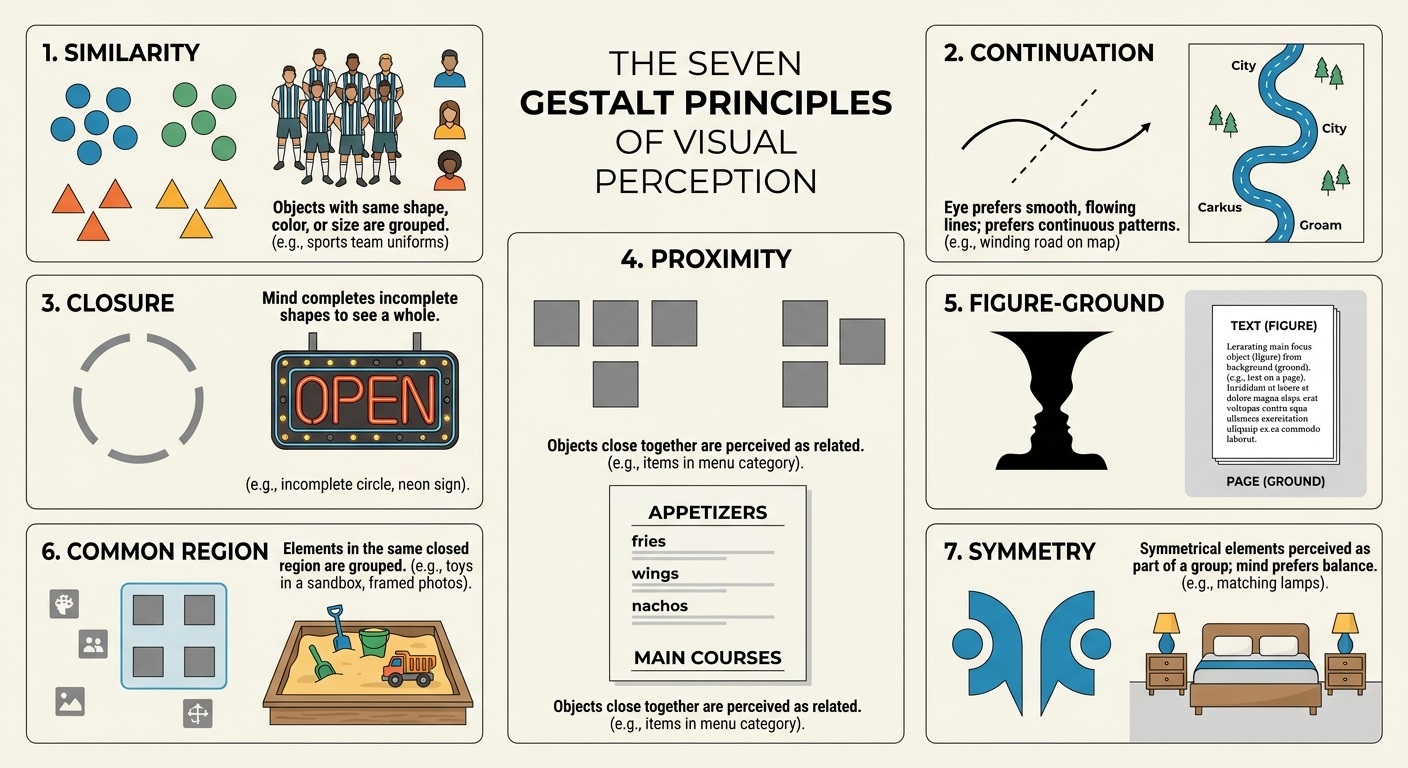
Similarity:Objects that are similar in appearance are often perceived as part of the same group. For example, items with the same shape, color, or size are seen as related. *Example: When you see a group of people wearing the same uniform, such as a sports team or school students, your mind automatically groups them together based on their similar appearance.
Continuation:The eye is drawn to continuous lines and patterns rather than abrupt changes. We prefer smooth, flowing forms over disconnected or jagged ones. *Example: When looking at a road map, you perceive the path of a winding road as a smooth and continuous line, even if there are interruptions by text or other symbols.
Closure:When presented with incomplete shapes, our minds tend to fill in the gaps to create a whole, recognizable image. For instance, we can identify a circle even if a part of it is missing. * Example: When looking at a partially obscured sign, your brain fills in the missing letters to recognize the word or message. For instance, if you see a neon sign with some lights out, you can still read the intended message.
Proximity:Objects that are close to each other are perceived as more related than those that are spaced farther apart. This principle is often used in design to group related items together. * Example: In a restaurant menu, items listed close together are perceived as belonging to the same category or meal, such as appetizers grouped together in one section.
Figure-Ground:This principle describes how we separate objects from their background. The “figure” is the main object of focus, while the “ground” is the surrounding area. For example, text on a page (figure) stands out against the white background (ground). * Example: When reading a book, the text is perceived as the figure (foreground) while the white pages are perceived as the ground (background), allowing you to focus on the words.
Common Region:Elements located within the same closed region are perceived as part of a group. Borders or backgrounds can create a common region, grouping elements together visually. * Example: In a children’s playground, toys placed within a sandbox are perceived as a group because the sandbox creates a common region around them. Similarly, a photo collage framed with a border makes all the pictures within that frame appear as part of a single group.
Symmetry:Symmetrical elements are perceived as part of the same group. This principle suggests that our minds prefer balance and harmony, leading us to group symmetrical objects together. *Example: Similarly, a pair of matching lamps on either side of a bed create a sense of balance and harmony, leading our minds to group them together.
27 Nisan 2024 tarihinde Sophie Hellinger, İstanbul Healing Academy’nin konuğu oldu. Online gerçekleştirilen etkinlikte aile dizimi hakkında ve aile dizilimine katılmak isteyenlerin nelere dikkat etmeleri ve kimlerden bu desteği alabilecekleri konusunda bilgi verildi. Tekrarının ara ara yapılması dileği ile bu konuda soruları olanlara ve bilinçli hareket etmek isteyenlere ufacık bir rehber olması amacı ile yazıya döküp paylaşıyorum:
Sophie Hellinger kimdir?
2018’den beri Sophie Hellinger, Orjinal Hellinger Aile Dizimi’nin tek ve önde gelen temsilcisi olmuştur. Binlerce katılımcı dünya çapında seminerlerine ve kongrelerine katılmıştır. Aile Diziminin ruhsal gelişiminin motoru olarak, sayısız insanın daha mutlu, daha sağlıklı ve daha başarılı bir yaşama kavuşmasına yardımcı olmuştur.
Yirmi yıldan fazla bir süre önce Sophie Hellinger, Bert Hellinger ve onun Aile Dizimi’ni tanışmadan önce, Ayurveda ve Geleneksel Çin Tıbbı (GÇT) alanlarında yoğun bir eğitim almıştı. Yıllarca yurtdışında bu alternatif iyileştirme yöntemleri için bir sağlık merkezi ve bir otel ile bağlantılı bir seminer evini yönetmiştir. Ayrıca, Sophie Hellinger çeşitli meditasyon türleri ve alternatif iyileştirme yöntemlerinde eğitim almıştır. Daha önce, gayrimenkul ve emlak geliştirme işinde başarılı bir girişimciydi.
Yıllarca Sophie Hellinger, insanların zihinsel ve fiziksel sağlığını ve gelişimini iyileştirmenin ve onları mutlu ve tatmin edici bir yaşama, bir ruhsal varlık olarak yönlendirmenin yollarını araştırdı. Sophie Hellinger, Bert Hellinger tarafından Aile Dizimi’ni keşfetene kadar arayışının hedefine ulaşmamıştı. 1999’da Bert Hellinger’ın izniyle, hala aile sistemi kolaylaştırıcısı olarak özel eğitimini, Cosmic Power® dahil olmak üzere sunduğu HellingerSchule®’yi kurdu.
2002’de Bert Hellinger ile evliliğinden sonra, Sophie Hellinger ve Bert Hellinger, Aile Dizimini Orjinal Hellinger Aile Dizimine daha da geliştirdiler, ki bu günümüzde dünya çapında sadece HellingerSchule® tarafından öğretilen, gösterilen ve sunulan bir yöntemdir. O zamandan beri Sophie Hellinger, Bert Hellinger’ın tüm seminerlerinde ve performanslarında eşit bir ortak olarak aktif ve hazır bulunmuştur.
Sophie Hellinger ayrıca dünya çapında öğretilen ve uygulanan Cosmic Power® enerji yöntemini geliştirmiştir. Onun ve Bert Hellinger’ın görüşüne göre, bu algılama ve nefes alma tekniği, özel bir algılama tekniği gerektiren Orjinal Hellinger® Aile Diziminin temelini oluşturur.
Ayrıca, Sophie Hellinger bir kitap yazarı olarak da adını duyurdu. Eserleri birkaç dile çevrilmiş ve Güney Amerika ve Çin gibi yerlerde de bulunmaktadır.
2018’de Bert Hellinger kamu yaşamından emekli oldu ve tüm çalışmalarını eşine, Sophie Hellinger’a devretti.
Yıldan yıla artan bir şekilde artan bir talep nedeniyle, Hellinger Aile Dizgici olmak için kaynağa yönelik bir eğitim isteyenler için Sophie Hellinger, Hellinger®schule‘yi kurdu. Bu okulda, öğrencilere Bert Hellinger tarafından keşfedilen temel yaşam yasaları, “Sevgi Emirleri” ve günümüzün Orjinal Hellinger® Aile Dizimi öğretilir. Program, gerekli tüm yaşam durumları için seminerler, konuşmalar, dersler ve dizimlerle deneysel olarak öğretilmektedir. Uygulama ve denetim seminerleri teklifi tamamlar.
SH: Aile dizimi eğitimlerinin 16.modülü kaynakta öğrenmek. Bu konu için X şemasını uygularım, her zaman şöyle bir şema uygulanır demek mümkün değil.
Çünkü sen de ben de biliyoruz ki dünyada kimsenin göz bebekleri, parmak işaretleri aynı değil. Her insan biriciktir. Her insan belli bir systemin belli bir formda birleştiği belli bir parçasıdır. Diyabete karşı bir ilaç olsaydı o zaman sisteme karşı gelmiş olurduk ve böyle bir bakış açısı Bert Hellinger’in aile dizimi sistemi ile hiçbir ilgisi bulunmamaktadır. Biliyorum ki bazı dizimciler bu yönde çalışmaktalar ancak başta bir rahatlama getirse de 2-3 sene içinde durum ağırlaşmaktadır. Sağlık benim her zaman tutkumdu ve bu sebeple Bert Hellinger benimle birlikte daha derinlere inmiş ve hastalıkların neyi ifade ettiğini sorgulamıştır. 30 sene önce, Avusturya Linz’te onkoloji kliniğinde doktorlar ve kanser hastaları vardı. Nihai sor şudur: Hasta çözüm için hazır mıdır değil midir?
Bert Hellinger ruhun bir hastalığa özlem duyduğunu görmüş, Acı çekmek çözüme ulaşmaktan çok daha kolaydır cümlesini sarf etmiştir. Peki neden? 27 senedir bu çalışmaların içindeyiz, systemin nasıl inşa edildiğini ve sürecin nasıl geliştiğini biliyoruz. Hastanın öncelikle bir görüşmeye ihtiyacı vardır. Tüm dünyada 1 tek tesadüfün bile olmadığına inanırım, hastalık ta bir tesadüf değildir. Eğer birisi kolit olduysa, akciğer enfeksiyonu geçiriyorsa veya mide kanseri olduysa sebebi “her zaman” kendi ruhunda yatar. Hasta bir insanın kör bir aşk içinde yaşadığını ve hayatının çoğunda agresif, kızgın ve korku dolu olduğunu söyleyebilirim. Diyat hastalığında sadece karaciğer değil tüm beden etkilenmiştir, tüm organlar.
İlk sorum şudur? Nasıl yaşıyorsun? Yani bedenin sana “evet, bu şekilde bana çok iyi geliyor mu diyor? Bilimin de araştırma sonuçlarına göre diyabet olanın neredeyse hiç et yememesi, çok hareket edip, çok sebze yemesi doğrudur. Bu durumda değerlerin çok çabuk düzeldiği görülebilir. Ancak kim et yemeden, sadece sebze yiyerek ve bol hareket ederek yaşıyor ki? Ancak özünde diyebiliriz ki diyabet hastalığı her zaman sevgi ile ilgilidir. Hayatın tatlı yönleri eksiktir. Bunu teyit edebilir misin?
Dinleyici: Evet edebilirim.
SH: Diyabet olan kimse çip takarak, değerlerini takip ederek iyileşme göstermemiştir. İkinci sorum, diyabet hastalığı ne zaman ortaya çıkmıştır? Yaşlılık şekeri çoğu kişide vardır. Bazen yaşlı insanların hayatında da hayatın tatlı yönleri eksiktir. Hastalıkların bizleri nerelere yönlendirdikleri gerçekten inanılmaz. Bugün yaptığımız çalışmamızda ortaya çıkan durumda da hastalığımla ilgisi aklıma asla gelmeyebilirdi. Doktorun bize sorusu hep “eksik olan nedir?” olur. Bilseydik zaten yapardık. Ruhun bağırmaktadır: eksik olan nedir? Kendine bunu hiç sordun mu? Ruhumun neye ihtiyacı var diye sordun mu?
Tüm dünyada ben ve benim bedenimden başka yakınlıkta bir ilişki yoktur. Ben ve benim bedenim isimli çalışma modülümüz mevcut. Diğer tüm ilişkiler sonra gelir. Ben ve bedenim en derin en yakın ilişkidir, ötesi yoktur. Bir yerde ağrım olunca dikkatimi oraya veriyor muyum?
Biraz önce yaptığımız çalışmada bir katılımcının rahim ağzında kanserojen bir durum olduğunu görmüştük. Bunun arkasında yapay döllenmenin, eşini reddetmenin olduğunu ve bunların rolünü kimse öngöremezdi. Bu fikre kimse gelemezdi, yoksa zaten bu hastalık oluşmazdı. Hiçbir kadın rahimağzı kanseri olmak istemez. HPV (human papilloma virus) teşhisi konması yardımcı olmuyor, “kanserin yayılmaması için müdahale etmem lazım” demek, bu konu bu kadar kolay değil, nitekim beden çok kolay hastalanmadığı gibi çok kolay da iyileşmez. Bedendeki hastalık 10 ila 20 yıl öncesinde hazırlanmaya başlıyor, yavaş yavaş bedende ilerler ve her zaman duygularla ilişkisi vardır. Ve her zaman şimdiki veya diğer sistemle ilgilidir, her zaman.
Katılımcı sorusu 1: Almanya Köln’den katılıyorum. 5 senedir aile dizimlerine katılıyorum. Tanıdığım bir kişi antidepresan kullanmakta ve bağımlı. En son bir aile dizimine katıldı ve bağımlılığı üzerinde çalıştı. O gün birşey anladı mı bilmiyorum ama çalışmadan sonra , sanırım 2-3 hafta sonra yine antidepresan kullanmaya başladı, düzenli olarak kullanmaya devam ediyor. Biraz tembel bir yapısı var ama bir hareketlenme görüyorum. Aile dizimi yapmakla antidepresan kullanmanın veya bağımlılığın nasıl bir ilgisi var acaba? Siz nasıl görüyorsunuz bunu? İşliyor mu? Aile dizimini yapınca %100 bilinçli mi olamk lazım?
SH: Bilmiyorum. Temelde diyebilirim ki ruh kendi dilini kullanır, ruhun evrensel bir dili vardır. Türkiye’de mi Almanya’da mı yaşıyor? Ailesi nerede yalşıyor?
K1: Hepsi Türkiyede yaşıyor.
SH: Ailede bağımlı olan tek kişi mi?
K1: Hayır, kardeşi de bağımlı ama control altında, bir de kuzeni bağımlı ama o da control altında. Kuzeni daha yeni rehabilitasyondan çıktı.
SH: Uyuşturucunun genelde baba ile ilgisi vardır. Orada bir sorun vardır. Daha fazla birşey söyleyemem. Bunu teyit edebilir misin?
K1: Radikal bir aile yapıları var. Bunu hiç düşünmemiştim. Teşekkürler.
Katılımcı sorusu 2: Aile dilimi 1 sorunla ilgili tek bir kez yapılıyor şeklinde bir algı var, doğru mudur? İnsanın aynı sorunu birden fazla kez çalışma yapılabilir mi?
SH: Tüm aile bir ağaç gibi hareket eder, kökleri, gövdesi ve dalları bulunur. Ağacın diyelim bir dalında bir sorun var, hasta, yaprakları kahveleşiyor, tek bir dalda diyelim…Sonra bu hasta olan yaprakları ve dalları marketten aldıkları bir ilaç ile ilaçlıyoruz. Bunun sorunu olan bir insan ve bu kişi yapılan dizilim olarak karşılaştırabiliriz. Bu sene içinde b,ir başkasında aynı sorun meydana gelebilir veya gelmeyebilir, o zaman yine ilaçlama yapılır. O zaman yine dizilim yapılır. Sonra sonbahar gelir yapraklar düşer, gelecek sene ilkbaharda yapraklar yine çıkar, bir başka dalda önceki sene gibi aynı hastalık gelir. Bir diğer dalda da çıkabilir. Kaça det ise o kadar dizime denk gelir. Gelecek sene tekrar…Bahçıvan kazandı, ağaç kazandı, ağaç sahibi sorun çözüldü zanneder. Kökleri nasıl sağlığa kavuşturacağımı bilmezsem ağaç sürekli artarak hastalanır, dışarıdan iyileştiği görülse de. Aile diziliminde sistemde köklerde doğru gitmeyen şeyi tespit edersem, system iyileşir. Sorun tekrarlanmaz. Ancak bugün aile dizilimi iyi bir ticaret haline gelmiş vet ek seferlik açılım ilgi çekiciliğini kaybetmiştir. Türkiye bu çalışmaları yapanların bunu nereden öğrendiklerini bilmiyorum, bizim seminerlerimizde maksimum 3 Türk vardı, o zamanlar bile oldukça yaşlılardı. Belki hayatta değiller bile. Bert’in şöyle güzel bir karşılaştırması var: Diyelim ünlü Ressam Renoir’in bir eseri açık arttırmada 200 milyona satılıyor. Ama kopyasını 1€’ya satin alabilirsin. Yani kimin, kimi, nerede kopyaladığını bilemiyorum. Kopyalar değersizdir. Dünyada 10 farklı üniversitede yapılan bir araştırmada meşhur bir şairin original şirrinden bir paragraph alındı ve öğrencilere okundu. Sonra aynı paragraph çok hafif değiştirilerek öğrencilere tekrar okundu. Yani original şiir ve değiştirilmiş yeni bir original şiir yaratılarak okundu. Sonra öğrenciler sınava alındı. %80 Orijinal metni hatırladı ve içeriğini aktarabildi. Hatta 1 yıl sonra bile hatırladılar. Değiştirelen metinden %5’i kadarı bile hatırlayamadı.
Bu alanda original olan Bert Hellinger, bunun kurucusudur. Ancak dünyada 1000lerce dizim yapan var, bizim kendi çatımız latında birkaç bin aile dizilimcisini eğittik. Soru orijinali mi istiyorsun yoksa bir kopyayı mı istiyorsun? Bu sebeple eğitimi farklı derecelerde pahalıdır.
Aile dizimi öğrenmek için farklı farklı eğitimler var, başkalarına göre daha pahalı olabiliriz ama orijinali mi istiyorsun yoksa kopya olanı mı?
İyi birşeyin bedeli vardır. Ancak müşteri iyi veya kötü dizilimin farkını genelde anlayamaz. Bu sebeple her müşteri ilk dizilimi yaptığı kişide en iyisi olduğu düşüncesi ile kalmaktadır. Sorunun tek seferde çözülmüşse iyi bir dizilimcidir, çözülmediyse kötü bir dizilimcidir. Bir kopyacıda kendini bulmuş olabilirsin.
Bir dizilimimn etkisini görmek için yeterli kaliteli bir zamana ve kişisel içsel bir uyarlanmaya ihtiyacı vardır. Bu olmazsa hiçbir dizilim etki etmez. Sakın ha sürekli açılımlara katılmayın, yoksa kendi sisteminizi öyle bir bağlarsınız ki bir daha açamazsınız.
K3: Insan kendi kendisine dizilim açabilir mi? veya objelerle çalışırken …Bu durumda kör noktayı görebilir mi?
SH: Öncelikle objeler konuşmaz, yani bu alanda eğitimi almış ve terapide uzun yıllar çalışmış birisi olması lazım ki yorum yapabilsin. Kendisi için çözüm bulamamış bir kişi danışanı için çözüm bulamaz. Açılım yapanların eğitim almış olması şarttır. Eğitim almamış olanlar …Doktor gibi, eğitim almamış doctor olmaz, ayrıca doctor sürekli eğitimlere devam eder. Diyebilirim ki yaşlı ve deneyimli bir doktora üniversiteden yeni bir doktora göre daha çok güvenim var. Ama tabii herkes bir yerde yola başlamıştır. Burada soru: Bunu bir misyon mu edineceğim yoksa işimi bırakıp bunu bir ticaret haline mi getireceğim.
Bert Hellinger’in Cosmic Power eğitimine başladık, algımızın müthiş bir şekilde keskinleşmesine hizmet eden bir yaklaşımla çalışıyoruz. Bert şunu demişti: önce keskin algı gelir sonra aile dizimi gelir. Bu algıya sahip olmayan aile dizlimi yapamaz. Belirli bir şema uygulanmaz. Yoksa tek bir ilacımız olurdu, her kalp hastasına aynı ilaç uygulanmaz, hepsi kendi içinde değerlendirilir. Beden hastaysa, ruh ta hastadır. Ama psikoterapide ilaç vardır ama kişi iyileşmez, anti- olarak bilinirler, birşeye karşı demek. Cosmic Power eğitimini alan aile dizilimi ile çok yol alır.
K4: Otizmli çocuklarla hiç çalıştınız mı? Deneyiminiz ne yönde? 3 yaşında çocuğum otizmli.
SH: Birlikte çalıştığımız bir uzman vardı ve yaptığı araştırmalarda otizmin en büyük kaynağının çoklu “aşı” olduğunu tespit etmişti. Ancak bu sistemik olarak bunun için bir temel bulunduğu taktirde geçerli. Genelde otizmli çocuklar 2-3 çocuk oluyor, tek çocuk olmuyor. Sistemik bir sebebi var. Son bir soru alıp tamamlayalım.
K5: Sizin önerebileceğiniz, Türkiyede güvenebileceğimiz, sizden eğitim almış kişiler var mı? Bunu merak ediyorum. Bu işi yapan çok fazla kişi var ama kime güveneceğimizi bilemiyoruz. Bilemediğimiz için kimseden destek almıyoruz açıkçası.
SH: Hala hayattalar mı bilmiyorum, 30 sene önce birileri vardı.
Bert demiştir ki kötü bir dizilimciye denk gelen kötü bir dizilimciyi hak etmiştir, iyi bir dizilimciye denk gelen iyi bir dizilimciyi hak etmiştir. Sonuçta iyi mi kötü mü 1-2 sene sonra göreceksiniz.
Dizilimden sonra durumlarının kötüleştiğine dair bize birçok yardım talebi mail geliyor. Dizim 10 sene ya da daha fazla etki eder.
Aile dizilimine dair sürekli online webinarlar, eğitimler düzenliyoruz. Ayrıca uygulayıcıların da sürekli kendilerini güncellemeleri lazım. 20 sene önceki bilgiler bugün artık değişti. Aile dizimi tıp gibi kendini geliştirmeye devam etmekte.
Birçok kadın erkek kolaylaştıcı arayışındadır. Çünkü annelerine güven yolunu bulamamışlardır.
In the Laylu ve Ben podcast hosted by Evrim Sümer, the guests were clinical psychologist and gestalt therapist Prof. Dr. Hanna Nita Scherler and educational consultant Ateş Ataseven. The topic discussed was raising children from a Gestalt perspective, fostering fluidity in parenting, and achieving balance.
To listen to the Turkish language podcast, click HERE.
Translation has been made with the help of chatGPT and may involve some translation erros and may effect the meaning. Our apoligies.
Evrim Sümer: Could you explain Gestalt to us a bit?
Hanna Nita Scherler: I teach, live, and advocate Gestalt as a philosophy of life. Rather than as a psychotherapeutic approach, I have embraced it as a philosophy of life that everyone can use in their daily lives, and I strive to promote its widespread adoption in this manner.
Gestalt literally means ‘whole.’ Let me try to explain what this could mean within the framework of parent-child relationships. Every parent strives to do what they believe is the best, the right thing, the utmost for their child. Whatever they do will become part of the whole. Theoretically, let’s say they show a lot of love, a lot of understanding, fulfill their needs, let’s not evaluate this as good or bad. Considering the tensions inherent in life, there is a polarity to this, meaning not showing love to the child, not fulfilling their wishes, and so on. You might ask, what parent wouldn’t want to fulfill their child’s wishes, to love them? Theoretically, in order for a child, especially in their adult life, to be prepared for encounters they may face, to not be surprised by them – we can think of it like a vaccination – every parent should mildly embarrass their child, mildly blame them, mildly withhold love, mildly reject them when they are young. It may sound strange when you listen, but especially if we look at Erik Erikson’s psychosocial development theory, he says exactly this. That is, shaping and molding every type of behavior they may encounter in life, much like formatting or educating. Gestalt is a mindfulness that encompasses everything possible, a lifestyle aimed at developing existence.
ES: During our preliminary discussion, you mentioned the stages of conscious development in a child up to the age of 18, and this got me really excited. Why? Because there were things like mistakes in these stages, indicators of the child, the child’s relationship with the parent, its reflection, problems, and how the parent will interpret this. Shall we delve into the stages of age a bit?
HNS: Let’s do it. Now, the conscious development I’m going to talk about will be excerpts from Ken Wilber’s “integral theory.” When I read it, it truly expanded my horizons; I am grateful to him.
Let me explain in terms of parenting: Every individual grows by seeking an answer to the question “who am I?” You might say a baby between 0-1 year old doesn’t ask the question “who am I.” True, they don’t ask it mentally, but they start to define whatever “I” is beneath this skin in the universe, actually.
Now, a baby between 0-1 year old is entirely dependent on the mother’s care, a being that will die if not fed or nourished. The awareness of a baby under 0-1 year old develops as inside the skin and outside the skin. How do they understand this? You know babies put their toes in their mouths; they register the difference between that sensation and the sensation of any toy they put in their mouth. And in this way, they can develop and establish the difference between what’s inside the skin and what’s outside the skin.
Theoretically, consciousness should progress from being positioned within the skin to encompassing what’s outside the skin and move through that stage, complete it. If consciousness remains stuck only within the skin during that stage, the child becomes “autistic.”
If consciousness is entirely positioned outside the skin, the child becomes “psychotic.” The boundary between self and other disappears. They can imagine that when someone walks down the street and looks into their eyes, they can understand what I’m thinking in the future.
ES/ So how does consciousness remain solely outside the skin? Because aren’t these actions instinctual? Looking at their hands, putting their foot in their mouth, hitting their head while moving their hand and feeling that pain… Are there situations where these can be prevented?
HNS/ For example, if a child is swaddled and not allowed to play with any toys, then they can’t feel… Between the ages of 2 and 3, the child’s physical identity has been established. They start to notice things like, “I’m crying, but my mother isn’t.”
“My mother is laughing, but I’m not.” It seems we have different feelings. This period is very important. Because between the ages of 1 and 2, when children start to articulate and lay the foundations of verbal communication with their parents, parents are very happy and excited. They applaud everything the child does, so the child is naturally reflected with grandeur. If this reflected grandeur exceeds a certain level, the child’s consciousness only revolves around their own feelings, and they become what we know as “narcissistic.”
If their consciousness is predominantly centered on the feelings of others, then they become “borderline.” For example, “Okay, my child, if you don’t want to eat, don’t eat, but I’m devastated when you don’t eat,” now should they eat or not… a dilemma. Or saying, “Okay, my child, don’t eat,” but then being upset because they didn’t eat.
ES/ I’ve noticed myself doing these things too. Saying, “Okay, don’t eat it, but then you’ll go to a different school,” things like that, so that’s wrong… Ateş, how did you handle the ages of 0-1-2-3 as a father of two?
Ateş Ataseven/ Öykü, my daughter, is 20 years old, and Alp, my son, is 14. For me, the period between 0-6 years was tremendously instructive yet somewhat perplexing. The moment my daughter was born, I had this connection in my mind, like, since I’m a father, my father became a grandfather, and I had a grandfather who is no longer here. It felt like it was my turn. Then I felt a great anxiety, wondering if I could take care of them, if I could raise them, if I would do the things that my mother and father did to me and that bothered me. Isn’t there a guide for these things? Why do they come without guidance? I remember my worries about how to behave, even a simple electronic device comes with an instruction manual, but these things don’t, how will we act?
The ages of 0-1 passed by quickly; I didn’t understand much, the majority of the burden was on the mother.
The period between 2-3 years stands out more in my mind. I remember feeling like she perceived me as someone else, like “mother and him,” as if the whole world belonged to the two of them. During that time, I was dealing with busy work, and I remember her occasionally saying, “now go home” to me. Years later, I discussed this with Nita. Honestly, it’s not true in my opinion.
ES/ Everyone’s character and life circumstances are different. As you said, she perceived me as a stranger at first. At the beginning, it’s the mother and the baby, they’re one, the father starts to become part of the child’s life later on.
HNS/ Especially after breastfeeding periods, but I see fathers too, when they’re around 1-2 months old, for example, they become much more involved, changing diapers, getting up, it’s a beautiful thing.
AA/ I never shied away from those kinds of things, although of course, most of it was handled by the mother. I have a funny story about “how fathers enter into the relationship between mother and child.”
When Öykü was in kindergarten, they had an evaluation at the end of the first month, they’re giving information about Öykü, she’s playing outside the door, we’re listening to the expert, they’ve drawn pictures, they’re analyzing from there, what she did, what she didn’t. She drew a picture, her mother and herself in one corner of the paper, proportional heights, she drew me covering 80% of the paper, a big head, a big body, and the expert said, “You occupy an important place in Öykü’s life, this is what it tells us.” I said, “We don’t experience it that way, she handles everything with her mother.” We got into a bit of an argument. Should we ask Öykü why she drew it like this? We called her over, the expert asked, “Why did you draw your father like this?” She answered, “Because my dad looks like Shrek.” You see, she drew what she sees, there’s not much of a deep story here. She drew me like that because I’m not petite. Even when they’re in a tight spot, their first words are “mom.” Their question at this age is “where’s mom?” In 9 out of 10 topics, the first person they look for is still their mothers. Not me. She’s the first thing that comes to their mind.
HNS/ The importance of the ages 2-3 is that, for the child, the mother and father are always either good or bad. A good mother. Or always bad. At the age of 2-3, the child is like, “Oh, my mom is good sometimes and bad sometimes, so they don’t know how to mix good and bad in the same pot.
The biggest challenge is at 2-3. If they can’t handle this with the help of their parents, they become “borderline.” So in later life, they’ll give emotional credit to a friend. The first thing they say when I’ve done something they don’t like is “then I don’t want you,” and then when I do something good, it’s “okay, I want you.” Then again, “I don’t want you.” Life doesn’t work like that. That’s the most important lesson of ages 2-3.
At the age of 4-5, they have thoroughly learned language and mastered it, so the answer they give to the question “who am I?” shifts from my physical body, my emotional body to “I am my mind”, I can speak, I can think.
Now that language is spoken, children now emerge from the paradise of the present and here. Whatever existed before language is now present. There’s no yesterday, no tomorrow, no abstract thought.
When they discover speech at the age of 4-5, that’s when they say, “these are my thoughts,” they discover it. There are thoughts I can share with others, thoughts I can keep to myself. They discover that. At the age of 4-5, it coincides with the time Freud developed his theory, encountering neurotic individuals, like this:
If consciousness, at the age of 4-5, is predominantly situated in the mind and rejects the body, it becomes what we know as a “neurotic person.”
If consciousness is predominantly situated in the body, it becomes an “impulsive person,” like, what are you looking at, wanna fight. That kind of person.
If consciousness is situated in thoughts accepted by others, there’s a pathology we call “script pathology,” meaning they become someone who seeks to please others, who seeks acceptance from others.
If my consciousness is situated in thoughts I won’t share with others, it becomes an “antisocial person.”
ES/ That was a fantastic guideline. Ateş, would you like to add something about the more practical implications of these?
AA/ Everything you said resonates with me; I understand once again that I harbor all of them in different doses.
HNS/ But that’s normal.
AA/ There must be some reflection of the different doses I carry within me towards them, unintentionally. That’s why I think they also experience these in varying degrees. One strange thing I’ve noticed is that two children growing up under the same conditions can be two different individuals. I think they began to differentiate precisely after the age of 4-5. For example, one might be very impatient, the other very indecisive. Together, they create a double storm. I tend to think about myself rather than the children in these narratives.
ES/ I also thought more about myself than Leyla in this narrative. For example, age 4 was one of the most challenging years for me; very stubborn, headstrong, always wanting something different if given a choice. After 6, it’s much sweeter, you can do things together, they become quite knowledgeable.
AA/ My experience is like this; terrible 2, incredible 3, unbelievable 4, OMG 5… Now, for example, I still feel like what to do with 20. I realize these don’t end. Because they have their own tests too. They’re also exploring me, themselves, their relationships.
Asking yourself questions is one of the things I’ve learned from Nita, I think it’s a good thing. Am I a good father? Am I a good person? Even if there’s no answer when I’m immersed in what I can do, sometimes just asking the right question is enough. It’s okay to stay in the question.
HNS/ Between the ages of 6-11, as I mentioned earlier, whether one’s thoughts are accepted by others or not, it either becomes script pathology or an antisocial person.
11-18, the theory says 18, but I’m not one of those who think adolescence ends at 18 in Turkey; I believe it lasts a bit longer, we can extend it into the 20s.
ES/ It seems to last a bit longer in boys, doesn’t it?
HNS/ I don’t differentiate between boys and girls, generally, our adolescence doesn’t end at 18. During adolescence, the task of consciousness is as follows: I have a physical body, I have emotions, I have thoughts that I share or don’t share with others, the same applies to others, I need to be able to think about all of these in a holistic way, accept them, and be able to apply them, so I call this “forming an abstract backbone.” Just as we have a concrete backbone, children who can form this abstract backbone have formed an identity. Children who cannot form this often experience an identity crisis. Who am I, what are my emotions, what do I want, where do I begin, where do I end… Children who are still searching experience chaos.
ES/ Adolescence also involves hormones, what is the most important thing during this period? Is it the attitude of the family? It could be the family’s philosophy or behavior style. Apart from that, there are thousands of people they encounter, schools, buses, streets…
HNS/ During this period, the adolescent’s sense of belonging shifts from the family to peers, and the answer to the question “where do I belong?” is more often found in peers than in the family. The family is seen as a secure harbor that will encompass them, comfort them, and guide them on the right path when there is a problem with peers or in life outside the home. This is quite natural.
AA/ I read something on social media about parents being pushed away during adolescence, and I remember behaving rebelliously myself. I read it like this: Adolescence is a period that ensures parents not to get too upset when children go away.
ES/ I like the saying “mental illness is hereditary, it passes from children to parents.” When you look at Turkish parents, what are the most common mistakes we make? Can you say something about that?
HNS/ I’m not particularly fond of such generalizations. Especially as a Gestalt practitioner, I believe that each individual should be evaluated in their own context, that each individual will find meaning in their own context. But I can say this: whatever upsets or angers parents about their children’s behavior, I can confidently say that it presents an invaluable opportunity for integration, maturation, and personal growth for the parent.
It’s not the child’s behavior itself that makes the parent happy or unhappy, but the meaning the parent attributes to that behavior. Therefore, whether consciously or not, as parents, we evaluate, interpret, and respond to our children based on the values and beliefs we have learned and internalized. When a child’s behavior falls outside our cognitive framework, the initial reaction of parents is usually to try to fit the child’s behavior into their own cognitive framework. Instead, perhaps we should ask ourselves, are there ways to expand our own value or belief frameworks to encompass the child’s behavior?
ES/ Could you explain the importance of not giving everything your child wants?
HNS/ Children learn and internalize thought, emotion, and behavior patterns within the family they are born and raised in. Theoretically, these are imprinted as mental images in the child’s brain. According to Gestalt psychology, human phenomena are not perceived in parts but as a whole.
What does this mean? When a thought, emotion, or behavior that matches the pattern in my mind is triggered, the entire pattern in my mind is activated. Therefore, I try to make sense of that phenomenon with the entirety of that pattern in mind. So what will the child learn? “Whatever I want is done. I am valuable, what I want happens.”
They will internalize this. But when they go outside the home and their every wish is not met like it is by their parents, they will feel like a fish out of water. In work, relationships, friendships. Therefore, they should be inoculated with exposure to all kinds of behaviors they may encounter from the beginning. Finding ways to develop their abstract muscles at home while they are still children is crucial. A little unfulfilled desire, a little sadness, a little rejection, a little anger towards parents—these are very beneficial experiences.
ES/ How about addressing children as “mommy,” “daddy,” “sweetheart,” “darling”?
AA/ We must have said it before, I’m thinking about what I said, I say “daddy,” I can’t remember what I said recently.
HNS/ I don’t see a problem with “sweetheart” or “darling” for children, but addressing a child as “mommy” or “daddy,” or a sister as “sissy”… where did that come from? This form of address wasn’t present in my childhood. Theoretically, there are significant drawbacks.
AA/ There are also forms of address like “ask our mom,” “ask our dad.”
HNS/ Or sentences like “our dad is very angry.” It puts oneself in a childlike position.
The concept of contact lies at the heart of the Gestalt perspective. Contact is crucial. I can make contact not only with others but also with the parts I contain within myself—my emotions, body, thoughts, and spirituality. When a parent constructs sentences in interaction with the child like “I, as your father, think this way, feel this way,” it invites and facilitates the child to clarify their own emotional, mental, and physical boundaries. The clearer a child defines their boundaries in terms of all the resources they contain, the more fulfilling their internal completion and growth will be. But if a child calls their grandfather “grandma,” there is ambiguity about where I start and end, and where they start and end—there’s a vagueness in the air. Ambiguity gradually makes contact boundaries less distinct.
Let me explain with a metaphor: each of us is both a plane and an airport. If I don’t clearly delineate the lines of the runway where planes will land from a distance, and if I don’t illuminate them visibly at night, how will you know where to land as a plane?
ES/ Calling a child “mommy” or “daddy” also prevents the child from finding themselves, but I understand it like this: Children are more vulnerable at a young age, so I don’t see a problem with calling a growing child “mommy” or “daddy” after 6 or 7 years old. It’s like a show of love.
HNS/ No, why should it be a show of love?
Lastly, I recommend that parents label their children’s emotions. Suppose a child wants chocolate but their mother doesn’t buy it, and the child gets upset or sad. The mother can say to the child, “I didn’t buy you chocolate, so you might be mad at me, and that’s okay, or you might be sad, that’s okay too. Sometimes we don’t get what we want, and we can react by getting angry or sad.” What does this teach? That there’s room for all emotions in the spectrum of human experience, and it’s normal to experience them. Allowing emotions to be felt and expressed is crucial.
AA/ About myself, I can say this: I never stop worrying about children. It can be controlled, not turning into panic, but I can’t set aside my concerns about their future. I guess it will continue like this.
HNS/ Do you load the duty of reducing anxiety onto your children?
AA/ More about economic conditions, issues related to the geography we live in, constantly fuel that anxiety.
ES/ Is that anxiety healthy as long as it doesn’t disrupt my daily life and relationship with the children?
HNS/ Let’s say it’s natural.
AA/ At some point in my life, I want to experience the inner peace of this: They’ve established their routines, found the environment where they’ll be happy, and there’s nothing left of my self here.
HNS/ What’s your connection to this? Are you aware of this thought? I’ve done my duty, I’m a sufficient father.
AA/ Of course, I’ve been Nita’s student for many years, it’s a topic we’ve talked about a lot, there’s the concept of inadequacy rooted in me.
ES/My grandmothers saying was: If a child is the money in the bank, then my grandchild is the interest on it, and enjoying it is the sweetest. I really had an epiphany today. Thank you all.
“Gestalt bakış açısı ile çocuk büyütmek, ebeveynlikte akışkanlığı sağlamak ve dengeyi kurmak” başlıklı birçoğumuzu yakından ilgilendiren değerli bir konu ele alındı.
Nita hocamın değerli izni ile yazıya dökerek Gestalt öğrencilerinin, genel olarak konuya ilgi duyanların, çocuk ve ebeveyn psikolojisi ile ilgilenenlerin ve öngöremediğim kişilere fayda sağlaması amacıyla yayınlıyorum.
Evrim Sümer: Gestalt’I bize biraz anlatabilir misiniz?
Hanna Nita Scherler: Gestalt’I bir yaşam felsefesi olarak öğretiyor, yaşıyor ve öğretiyorum. Psikoterapi yaklaşımı olarak değil de herkesin gündelik hayatında kullanabileceği bir yaşam felsefesi olarak benimsedim ve o şekilde yaygınlaşmasına çaba sarf ediyorum.
Gestalt kelime anlamı olarak bütün demek. Bunun ebeveyn-çocuk ilişkisi çerçevesinde ne anlama gelebileceğinden bahsederek anlatmaya çalışayım. Her ebeveyn çocuğu için kendince en doğrusunu, en iyisini, elinden gelenin en fazlasını yapmaya çalışır. Ne yaparsa yapsın, yaptığı bütünün bir parçası olacaktır. Teorik olarak diyelim ki çok sevgi gösterdi, çok anlayış gösterdi, ihtiyaçlarını giderdi, bunu iyi ya da kötü olarak değerlendirmeyelim, bu hayatın barındırdığı gerginlikler açısından düşününce bunun bir kutbu var yani çocuğa sevgi göstermemek, onun isteklerini yerine getirmemek gibi. Diyeceksin ki hangi anne baba çocuğunun isteklerini yerine getirmemek, sevmemek ister ki…Teorik olarak bir çocuğun özellikle yetişkin hayatında karşılaşabileceği olgulara hazırlıklı olması, yani onlarla karşılaştığında şaşırmaması için- aşı gibi düşünebiliriz bunu- her anne baba çocuğuna daha küçükken dozunda utandırmalı, dozunda suçlamalı, dozunda sevgisiz bırakmalı, dozunda reddetmeli.
Dinleyince çok tuhaf gelebilir ama özellikle Eric Ericson’un psikososyal gelişim teorisine bakarsak tam da bunu söyler. Yani hayatta karşılaşabileceği her tür davranışa ilişkin format atmak gibi, okutmak gibi. Gestalt te olabilecek herşeyi kapsayan bir farkındalık, varoluş geliştirmeyi amaçlayan bir yaşam tarzı diyebilirim.
ES: Sizinle ön konuşmayı yaparken bir çocuğun 18 yaşına kadarki bilinç gelişimi safhaları dediniz ve bu beni çok heyecanlandırdı, neden, çünkü bu aşamalardaki hatalar, çocuğun göstergeleri, çocuğun ebeveyn ile ilişkisi, buna yansıması, sorunlar, ebeveyn bunu nasıl okuyacak gibi şeyler vardı, biraz yaş evreleri ile gidelim mi?
HNS: Gidelim. Şimdi bahsedeceğim bilinç gelişimi Ken Wilber’ın “integral teorisinden” kesitler olacak. Okuduğumda gerçekten ufkumu çok geliştiren bir teori olmuştu, müteşekkirim kendisine. Ebeveyn olarak bağdaştırmak açısından şöyle anlatayım: Her insan “ben kimim?” sorusuna yanıt arayarak büyür. Diyeceksiniz ki 0-1 yaş arasındaki bir bebek ben kimim sorusuna yanıt aramayı bırakın bu soruyu sormaz. Doğrudur, zihinsel olarak sormaz ama “evrendeki bu derinin altındaki ben” her ne ise onu tanımlamaya başlıyor aslında. Şimdi 0-1 yaş arası bebek tamamen annenin bakımına muhtaç, yedirilmez içirilmezse ölecek olan bir varlık. 0-1 yaş altındaki bebeğin farkındalığı derimin altındaki ve derimin dışındaki şeklinde gelişir.
Nasıl anlar bunu? Biliyorsunuz bebekler ayak parmaklarını ağızlarına alırlar, o his ile herhangi bir oyuncağı ağzına aldığı his arasındaki farklılığı kaydederler. Ve bu şekilde derimin altındaki ile derimin dışındaki arasındaki farklılığı geliştirebilirler, oturtabilirler. Teorik olarak bilinç derimin altındakinde konumlanıp derimin dışındakini de kapsayacak bir şekilde o evreyi geçmeli, tamamlamalı. O evrede eğer bilinç sadece derimin altındakinde takılırsa o çocuk “otistik” olur.
Eğer bilinç tamamen derinin dışındaki olarak konumlanırsa da “psikotik” oluyor çocuk. Ben ve diğeri arasındaki sınır kayboluyor. Sokakta yürüyen kişi benim gözüme bakınca benim ne düşündüğümü anlayabilir gibi düşünebiliyor ileride.
ES: Peki sadece derinni dışında nasıl kalır bilinç? Çünkü bu hareketler içgüdüsel değil mi? Ellerine bakmak, ayağını ağzına sokmak, elini hareket ettirirken kafasına çarpıp o acıyı hissetmek…Bunlarin engellenebildiği durumlar var mı?
HNS: Mesela çocuk kundak yapıldı ve hiçbir oyuncakla oynamasına izin verilmedi, O zaman hissedemiyor ki…
2 ile 3 yaş arasında artık bebeğin fiziksel kimliği oturmuştur, şunu fark etmeye başlar, ben ağlıyorum annem ağlamıyor. Annem gülüyor ben gülmüyorum. Galiba farklı duygularımız var. Bu dönem çok önemli bir dönem. Çünkü 1-2 yaş arasında çocuklar hecelemeye başladıkları ve anne babalarıyla sözel iletişimin tohumlarını atmaya başladıkları için anne babalar çok sevinir çok heyecanlanırlar. Ve çocuğun her yaptığını alkışlarkar, yani çocuğa doğal olarak bir görkem yansıtılır. Eğer bu yansıtılan görkem kıvamından biraz daha fazla olursa çocuğun bilinci sadece kendi duygularında konumlanır ve bildiğimiz “narsist” olur.
Eğer bilinci ağırlıklı olarak diğerlerinin duygularında konumlanırsa o zaman “borderline” olur.
Mesela, tamam çocuğum istemiyorsan yeme, ama “ben kahroluyorum sen yemeyince”, şimdi yesin mi yemesin mi…ikilem. Ya da “tamam çocuğum yeme” diyor ama yemediği için burnundan getiriyor.
ES: Ben de bunları yaptığımı fark ettim, tamam bunu yeme ama o zaman başka okulda okursun gibi şeyler söylüyorum, demek ki yanlış…Ateş peki sen 2 çocuk babası olarak 0-1-2-3 yaş dönemlerini nasıl geçtin?
Ateş Ataseven: Öykü, kızım 20 yaşında, Alp, oğlum 14 yaşında. Benim için 0-6 yaş arası dönem müthiş öğretici ve bir parça da kafa karıştırıcı bir dönemdi. Kızımın doğduğu an kafamda şöyle bir bağlantı olmuştu, ben baba olduğuma göre benim babam dede oldu, benim de bir dedem vardı ve o şu anda yok. Sıra bana geliyor gibi birşey yaşadım. Sonra büyük bir kaygı duydum, bakabilecek miyim, büyütebilecek miyim, annemin babamın bana yaptığı ve rahatsız olduğum şeyleri yapacak mıyım yapmayacak mıyım. Bunların kılavuzu yok mu, niye bunlar kılavuzsuz geliyorlar. Yani basit bir elektronik cihazın bile içinden kullanma kılavuzu çıkıyor bunların yok, nasıl davranacağız gibi kaygılarımı hatırlıyorum. yaş çok hızlı geçti, anlamadım, yükün büyük kısmı annede.
2-3 yaş arası dönem daha çok aklımda. Beni başka birisi gibi algıladığını hatırlıyorum, “annesi ve o”, tüm dünya ikisine aitmiş gibi, o dönem yoğun işlerle uğraşıyordum, arada bir sen artık evine git diye konuştuğunu hatırlıyorum. Yıllar sonra Nita ile konuştuk bunu. Doğrusu yok bence.
ES/ Herkesin karakteri ve hayatının şartları farklı. Bir de dedin ya beni yabancı olarak algılıyordu. İlk başta anne ve bebek, ikisi bir, baba hep ortalıkta ama çocuğun hayatına daha sonra girmeye başlıyor.
HNS/ Özellikle emzirme dönemlerinden sonra, ama görüyorum dinliyorum babaları da, 1-2 aylıkken mesela çok daha ilgileniyorlar, altlarını değiştiriyorlar, kalkıyorlar, bu çok güzel birşey.
AA/ Ben de o tip şeylerden hiç kaçmadım, tabii ki büyük kısmı anne tarafından halledilen şeylerdi. Komik bir anım var “anne ve çocuğun ilşkisine baba nasıl sonradan giriyor” konusu; Öykü anaokulundayken 1.ayın sonunda bir değerlendirme yapmışlardı, Öykü hakkında bilgi veriyorlar, o kapı önünde oynuyor biz uzmanı dinliyoruz, resimler çizdirmişler, oradan analiz ediyorlar ne yaptı ne etti diye. Bir tane resim çizmiş, kağıdın bir köşesinde annesi ve kendisi, boyları orantılı, kağıdın %80inde beni çizmiş, koca bir kafa, koca bir vücut, uzman da dedi ki “siz Öykünün hayatında önemli bir yer kaplıyorsunuz, bu onu anlatıyor” Ben dedim hiç öyle deneyimlemiyoruz, herşeyini anne ile hallediyor. İddialaşır gibi olduk. Öykü’ye soralım mı niye bunu böyle çizmiş, çağırdık kendisini, uzman sordu niye babanı böyle çizdin? Çünkü benim babam Shrek’e benziyor diye cevap Verdi. Gördünüz mü, ne görüyorsa onu çizmiş, çok ta derin bir hikaye yok burada. Ufak tefek biri olmadığımdan öyle çizmiş.
Hala sıkıştıklarında ilk lafları “anne” oluyor, bu yaşlarında bana sordukları soru “annem nerde? 10 konunun 9unda ilk aradıkları kişi hala anneleri. Ben değilim. Akıllarına ilk o geliyor.
HNS/ 2-3 yaşının önemi, çocuk için anne ve baba hep iyi. İyi anne. Ya da hep kötü. 2-3 yaşında çocuk “aa annem arada bir iyi arada bir kötü, yani iyiyle kötüyü aynı tencerede nasıl pişireceğini bilemiyor. En büyük zorluk 2-3 yaşında o. İşte bunu anne babanın yardımı ile beceremezse “borderline” kalıyor.
Yani burada ileriki yaşam içinde bir arkadaş, duygusal kredi verilir. İlk yaptığı bana göre hoş olmayan şeyde “o zaman seni istemiyorum” ondan sonra iyi birşey yaptığında “tamam istiyorum”. Sonra yine istemiyorum. Hayat öyle değil. 2-3 yaşın en önemli öğretisi o.
4-5 yaşında artık lisanı iyice öğrenmiş hatmetmiştir, dolayısıyla ben kimim sorusuna verdiği cevap fiziksel bedenimim, duygusal bedenimimden ben zihnimim konuşabiliyorum, düşünebiliyorum, artık lisanın konuşulmasıya çocuklar şimdi ve buradanın cennetinden çıkarlar. Lisan konuşulmadan önce her ne varsa şimdi var. Dün yok, yarın yok, soyut düşünce yok.
4-5 yaşında konuşmayı da keşfedince o zaman ben düşüncelerimim der, onu keşfeder. Başkalarıyla paylaşabileceğim düşünceler var, düşünüp te kendime saklayabileceklerim var. Onu keşfeder. 4-5 yaşında tam Freud’un teorisini geliştirdiği, nevrotik kişilere denk geliyor, şöyle:
4-5 yaşında bilinç zihinde konumlanıp bedeni reddederse bildiğimiz “nevrotik kişi” oluyor. Eğer bilinç bedende ağırlıklı olarak konumlanırsa “fevri kişi” oluyor, ne baktın bana, çak bi yumruk. O kişi oluyor.
Eğer bilinç başkaları tarafından kabul gören düşüncelerde konumlanırsa bizim “script patoloji” dediğimiz bir patoloji var , yani başkalarını memnun etme, başkaları tarafından kabul görme derdinde olan kişi oluyor.
Eğer bilincim başkaları ile paylaşmayacağım düşüncelerde konumlanmışsa “antisosyal kişi” oluyor.
ES/ Müthiş bir guideline oldu. Ateş, sen bunların daha pratik izdüşümlerine dair birşeyler eklemek ister misin?
AA/ Söylediklerinin hepsi bende de var, farklı dozlarda hepsini barınırdığımı bir kere daha anladım.
HNS/ Ama normal olan o.
AA/ Elimde olmadan bu farklı dozlarda barındırdıklarımın onlara bir yansıması oluyordur. O yüzden onlarda da bunlar farklı dozlarda oluyorduru da düşünüyorum. Bana tuhaf gelen bir konu da ikisi de aynı şartlarda büyüyen 2 çocuk ama 2 farklı insanlar. Sanırım tam da bu 4-5 yaşından sonra farklılaşmaya başladılar. Birisi mesela çok sabırsız, öbürü çok kararsız. İkisi beraber çifte fırtına yaratıyorlar. Çocukları değil de hep kendimi düşünme yönündeyim bu anlatımlarda.
ES/ Ben de Leyla’dan çok kendimi düşündüm bu anlatımda, mesela 4 yaş beni en zorlayan yıllardan biriydi, çok inatçı, başına buyruk, seçenek sunulsa başka birşey isteyen bir dönemiydi. 6dan sonrası çok tatlı, birlikte birşey yapabiliyorsunuz, çok bilmişlikler başlıyor.
AA/ Ben şöyle deneyimliyorum; terrible 2, incredible 3, unbelievable 4, OMG 5 falan…Şimdi mesela ne yapacağım 20 gibi birşey gibi hissediyorum hala. Bunların bitmediğini anlıyorum. Çünkü onlar için de bir sınav var. Onlar da beni, kendilerini, ilişkilerini kurcalıyorlar. Kendine soru sormak benim Nita’dan öğrendiğim şeylerden biridir, doğru birşey bence. İyi bir baba mıyım? İyi bir insan mıyım? Ne yapabilirimlerin içinde döndüğümde soru doğru soruysa yanıt gelmese de oluyor. Soruda kalmak ta iyi birşey.
HNS/ 6-11 demin dediğim başkaları tarafından Kabul gören düşünceler ve görmeyen düşünceler, ya scrip patoloji oluyor ya da antisosyal kişi oluyor.
11-18, teori 18 diyor, ama ben Türkiye’de ergenlik döneminin 18’de sona erdiğini düşünenlerden değilim, bence biraz daha uzun sürüyor ,yani 20lerin içine doğru uzatabiliriz onu.
ES/ Erkeklerde biraz daha uzun sürüyor gibi değil mi?
HNS/ Ben erkek-kız olarak ayırmıyorum, genelde 18 de bitmiyor bizim ergenliğimiz.
Ergenlik döneminde bilincin görevi şöyle: Benim bir fiziksel bedenim var, duygularım var, başkalarıyla paylaştığım, paylaşmadığım düşüncelerim var, bunun aynısı başkalarında da var, bunların hepsini bir bütünlük içersinde düşünebilmek, kabul edebilmek ve uygulayabilir olabileceğim hale getirmem lazım, yani ben buna “soyut olarak bir bel kemiği oluşturmak” diyorum. Nasıl somut belkemiğimiz var, soyut olarak bu belkemiği oluşturabilen çocuklar bir kimlik oluşturmuş oluyorlar. Bunu oluşturamayan çocuklar kimlik kagaşası yaşıyorlar. Kimim, duygularım ne, ne istiyorum, ben nerde başlıyorum,, nerde bitiyorum…Henüz arayışı devam eden çocuklar bir kargaşa yaşıyorlar.
ES/ Ergenlik döneminde bir de hormonlar var, bu dönemde en önemli şey nedir? Ailenin tutumu mu? Ailenin bir felsefesi ya da davranış tarzı olabilir. Onun dışında karşılaştığı binlerce insan var, okullar var, servis var, sokaklar var…
HNS/ Bu dönemde ergenin aidiyeti aileden akranlara kayar, nereye aitim sorusunun cevabı aileden çok akranlardır. Aile akranlarla bir sorun yaşandığında veya ev dışındaki hayatta bir sorun yaşandığında onları kapsayacak, teskin edecek, onlara doğru yolu gösterecek emin liman olarak görülür. Böyle olması da çok doğaldır.
AA/ Sosyal medyada bir yazı okumuştum, anne babaya terslenmeler başlıyor ya, ben de ters davrandığımı hatırlıyorum, şöyle okudum: Ergenlik çocuk okuyup evden giderken anne babanın çok üzülmemesini sağlayan bir dönemdir.
ES/ Ben de “sinir hastalığı kalıtımsaldır, çocuklardan ebeveynlere geçer” lafını seviyorum. Türk ebeveynlere bakınca en çok yaptığımız hatalar nedir? Böyle birşey söyleyebilir misiniz?
HNS/ Ben bu tür genellemeleri pek sevmem. Özellikle Gestalt uygulayıcısı olarak, her olgunun kendi zemininde değerlendirilmesi gerektiğini, her olgunun kendi zemininde anlam kazanacağına inananlardanım. Ama şunu söyleyebilirim, ebeveyni çocukların davranışlarına ilişkin sinirlendiren, üzen her ne varsa ebeveyn için bunun paha biçilmez bir bütünleşme, olgunlaşma, kendi içinde büyüme fırsatı olduğunu emin olarak söyleyebilirim.
Çocukların davranışının kendisi değil, ebeveynin o davranışa atfettiği anlamdır ebeveyni mutlu ya da mutsuz eden. Dolayısıyla farkına varsak ya da varmasak ebeveyn olarak bir takım öğrenip içselleştirdiğimiz değerler doğrultusunda çocukları değerlendiriyoruz, anlamlandırıyoruz, onlara davranışlarda bulunuyoruz. Çocuğun davranışı bizim bilişsel çerçevemizin dışında kaldığında, ilk tepki genelde ebeveynlerin, çocuğun davranışlarını kendi bilişsel çerçevelerinin içine çekmeye çalışmak. Halbuki ne olsa iyi olurdura cevap şunu söyleyebilirim, kendi değer ya da inanç çerçevelerini çocuğun o davranışını da kapsayacak şekilde genişletmenin yolları var mıdır acaba?
ES/ Çocuğuna istediği herşeyi vermemenin önemini biraz anlatır mısınız?
HNS/ Çocuk, düşünce, duygu ve davranış kalıplarını içinde doğup büyüdüğü ailede öğrenir ve içselleştirir. Teorik olarak bunlar zihinsel imgeler olarak çocuğun beyninde yer eder. Ve yine Gestalt psikolojisine göre insan olguları parçalar halinde algılamaz, bütün halinde algılar, yani bu ne demek? Benim zihnimdeki düşünce, duygu ve davranış kalıbı neyse onu uyaran bir düşünce, duygu ile karşılaştığımda benim zihnimdeki o örüntünün tamamı uyarılıyor. Dolayısıyla ben o örüntünün tamamı ile o olguyu anlamlandırmaya çalışıyorum.
O zaman çocuk ne öğrenecek?
Ben ne istersem yapılır. Ben değerliyim, benim istediğim olur, onu öğrenecek. İçselleştirecek. Ama evin dışına çıktığında başka ortamlarda onun her istediği ebeveynleri gibi başkaları tarafından karşılanmadığında sudan çıkmış balığa dönecek. İş, sevgili, arkadaşlar. O yüzden en başta formatlayınca karşılaşabileceği her tür davranışa aşılanmalı. O soyut kaslarını çocukken evde geliştirmenin yollarını bulmak lazım. Biraz isteğinin yerine gelmemesi, biraz üzülme, biraz reddedilmişlik, biraz anne babaya sinirlenmek bunlar çok faydalı deneyimler.
ES/ Çocuklara annecim, babacım, sevgilim, aşkım gibi hitap etmek nasıl?
AA/ Demişizdir heralde, ne dediğimi düşünüyorum, babam diyorum, son zamanlarda dediğimi hatırlamıyorum.
HNS / Bence sevgilim, aşkımda bir sorun yok ta çocuğa annenin annecim demesi, babanın babacım demesi, ablanın ablacım demesi… nerden geldi bu? Bu hitap şekli benim çocukluğumda yoktu. Teorik olarak çok büyük sakıncası var.
AA/ anneye sor, babaya sor gibi hitap şekilleri de var.
HNS/ Ya da babamız çok sinirli gibi cümleler. Kendisini çocuk konumuna sokuyor.
Gestalt bakış açısının temelinde temas kavramı yatar. Temas çok önemlidir. Ben ve diğeri temas edebileceği gibi ben ve benim barındırdığım parçalar da temas eder yani duygularımla, bedenimle, düşüncelerimle, tinselliğimle temas ederim. Ebeveynin çocukla olan etkileşiminde ben, baban, böyle böyle düşünüyorum, böyle böyle hissediyorum şeklinde cümleler kurması ikili ilişkide kendisinin duygusal, düşünsel ve fiziksel sınırlarını belirginleştirmesi çocuğun da kendi duygusal, düşünsel ve fiziksel sınırlarını belirginleştirmesine davet ve vesiledir.
Bir çocuk kendi sınırlarını barındırdığı kaynakların tümü açısından ne kadar belirginleştirirse kendi içersindeki tamamlanması, büyümesi o kadar daha doygun olacaktır. Ama bir çocuğa babaanenin babaannem demesi o çocuk için ben nerde başlıyorum bitiyorum, o nerede başlıyor bitiyor, yani bir muğlaklık var ortalıkta. Muğlaklığın olması temas sınırlarını giderek daha az belirgin kılar.
Şöyle bir metaforla anlatayım: her birimiz hem uçağız, hem havaalanıyız, ben havalanında uçakların ineceği pistin çizgilerini çok uzaktan da görülecek şekilde belirginleştirmiyorsam, akşam da görülecek şekilde aydınlatmıyorsam sen bir uçak olarak nereye ineceğini nereden bileceksin?
ES/ Annecim babacım diyerek çocuğun kendisini bulmasına da engel oluyor, ama şöyle de anlıyorum: Çocuk yaşta daha riskli, yani büyüyen bir çocuğa 6-7 yaşından sonra annecim babacım demekte bence bir sıkıntı yok. Sevgi gösterisi gibi.
HNS/ Değil, neden sevgi gösterisi olsun.
Son olarak, ebeveynlerin çocukların duygularını isimlendirmelerini öneririm. Çocuk daha çok küçükken diyelim ki çukulata istedi, annesi de almıyor, çocuk sinirlendiğinde ya da üzüldüğünde çocuğa” ben sana çukulata almadım şimdi sen bana kızmış olabilirsin, buna hakkın var, ya da üzülmüş olabilirsin, olabilir. Bazen istediklerimiz olmaz ve biz buna tepki olarak sinirlenebiliriz de üzülebiliriz de”.
O zaman neyi öğretmiş oluyor? Bu duyguların bir insanın deneyimleyebileceği tüm duygu yelpazesindeki duygulara yer var, normal bunları yaşamak. Duyguların yaşanmasına, ifadesine izin vermek, çok önemli.
AA/ Kendimle ilgili şunu söyleyebilirim, çocuklara dair kaygı duymayı hiç bırakamıyorum. Kontrollü gidebilir, paniğe dönüşmeyen bir kaygı olabilir ama gelecekleri ile ilgili endişelerimi kenara atamıyorum. Heralde böyle de gidecek.
HNS/ Kaygı düzeyini azaltması görevini çocuklarına yüklüyor musun?
AA/ Daha çok ekonomik şartlar, yaşadığımız coğrafyaya ait konular o kaygının sürekli altını harlıyor.
ES/ O kaygı benim günlük hayatımı ve çocuklarla ilişkimi bozmadıkça sağlıklı mıdır?
HNS/ Doğaldır diyelim.
AA/ Hayatımın bir dönemimde şunun iç huzurunu yaşamak isterim: Düzenlerini kurduklar, mutlu olacakları ortamı yakaladılar, benlik birşey kalmadı burada.
HNS/ Bunun seninle ilgisi ne? Buradaki şöyle bir düşüncenin farkında mısın? Ben görevimi yaptım, ben yeterli bir babayım.
AA/ Elbette, uzun yıllardır Nita’nın öğrencisi idim, çok konuştuğumuz bir konu, kökümdeki yetersizlik kavramı var.
ES/ Çocuk bankadaki paraysa torunum bunun faizidir ve yemesi en tatlısıdır der. Bugün gerçekten aydınlandım. Herkese teşekkür ediyorum.
On April 8, 2021, Gestalt therapist and clinical psychologist Professor Dr. Hanna Nita Scherler appeared as a guest on Romina Özipekçi’s program “Rominight,” which was broadcasted. With the esteemed permission of my mentor, I have transcribed this enjoyable discussion on Gestalt therapy to share insights with those interested in learning about it, who are conducting research, or who may not be aware of the YouTube video. This effort is aimed at disseminating valuable information to a broader audience.
Romina Özipekçi (RÖ): Welcome. Dr. Nita is a clinical psychologist and Gestalt therapist who provides support to individuals and couples using this approach. Nearly everyone is familiar with the idea of visiting a psychologist or psychiatrist and has some understanding of what happens there. However, psychology itself is divided into various branches, one of which is Gestalt. For those unfamiliar, how would you explain what Gestalt is?
Hanna Nita Scherler (HNS): While briefly introducing myself, I must mention that I am currently teaching at Hasan Kalyoncu University, a place that brings me great joy. Yes, I am very fond of my university. I feel saddened that I could not visit Gaziantep due to the pandemic. I wanted to seize this opportunity to talk a bit about it.
The term “Gestalt” means whole or complete. Based on the meaning of the word, the Gestalt approach can be described as a methodology that supports the integration of the individual. You might rightly ask what this integration entails—are we incomplete to need integration? Let me explain, as those who have listened to me before might know, the humanistic approach is a crucial pillar of the Gestalt perspective. The humanistic approach posits that human behavior is driven and structured by the motivation for self-actualization. What is self-actualization? Aren’t we real already? What does it have to do with integration? How do I connect all this?
If I were to explain metaphorically, the humanistic approach assumes that every person is born with keys on a piano keyboard. In other words, every individual is born from the same source. Let’s say this source is akin to the 88 keys on a piano keyboard, and each person is born with these 88 keys. A self-actualized individual is aware of all these keys they possess within their existential realm. We already possess them, but we are not aware of them. Why aren’t we aware? Because from the moment of our birth, the culture and family in which we are raised teach us what is right and wrong, what is acceptable and unacceptable, very effectively. Children quickly learn and internalize this. I call it being formatted by social software. As a result of this social formatting, we make sense of our lives using only the keys that are deemed acceptable by our parents and subculture. So, perhaps I play 30 out of the 88 keys, while you play 35. Gestalt therapy says, “Okay, you’re playing 35 out of 88 keys. Let me show you how to progress from 35 to 88, how to move beyond the keys not allowed by social software. How can you incorporate them into your perception and understanding of life?” It’s essentially an approach that says, “Let me show you how to integrate yourself with the experiences you encounter on your life journey.” That’s why it’s about being whole and complete—it’s a path that guides individuals on how to approach integrating themselves with the experiences they encounter in life.
RÖ/ The clients who come to you are undoubtedly experiencing psychological distress, a breakdown, depression, or whatever you want to call it, due to their experiences. You identify what has collapsed at that point, what aspects of their integrity have been disrupted, and then proceed with this approach to rectify it. Am I understanding correctly?
HNS/ I’d like to phrase it with slight modifications: In my personal view, nothing is truly broken in anyone’s life, and no therapeutic approach can fix what’s broken. It’s something that can only be determined by the individual’s own will. What I do is this: My clients often come to me with a difficulty they’re facing in their lives. How do they know they’re experiencing difficulty? If they’re feeling a more pronounced pain, anxiety, anger, or sadness than usual, they come with a curiosity of “this is a bit more pronounced than usual, what’s happening here?” When they come, they typically have in mind the desire for this pain to ease, this sadness to pass, this anger to subside, or this anxiety to fade away. When I listen to them, I use the framework provided by the Gestalt perspective to help them understand how this approach perceives these kinds of difficulties.
Here’s how I put it: Yes, this is a struggle, but this struggle is actually an opportunity, a call for integration, an invitation for wholeness. Using the piano metaphor, I explain to them that their current struggles are like keys that are not allowed to be played by the social software, yet they are screaming to be heard. So, underneath this pain, this anxiety, this anger, there lies a very important message that needs to be acknowledged if one leans into it with awareness. This message essentially speaks its own language through symptoms, saying, “Hey, buddy, the way your life has been shaped up until now isn’t cutting it anymore; you need more keys in your life. I’m pushing you to realize that there are other keys to be played here. Let me show you.” That’s what I try to convey.
RÖ/ You’ve written the symptom’s script. Are these kinds of breakdowns indicative of a new quest within the human spirit? In other words, when you’re confined within a mold, is something trying to burst out? Are these symptoms always indicative of something positive?
HNS/ Life is neither indicative of good nor bad; it simply reflects what it is. In my view, circumstances are what they are. There are no inherently good or bad trees in nature, no inherently good or bad rabbits; things simply are. We attribute the meanings of good or bad with our minds. Every difficulty actually harbors an opportunity for change. If a person chooses to seize that opportunity… If they choose not to, they may find solace within that sadness, anxiety, or anger, whatever it may be. However, in my opinion, although they may find solace within that time frame, if they haven’t addressed the underlying issue, whatever keys they haven’t started playing, they will eventually manifest themselves in different problems, with different people, or in different organizations sooner or later.
RÖ/ Why does a person resist change when they encounter difficulty?
HNS/ That’s a great question because complaining, blaming others, and portraying oneself as a victim are much easier. There’s no choice to be made, no responsibility to be taken, no consequences to bear. But when a person perceives their current situation as a call to differentiation, as an invitation to change, and decides to step into the uncertain territory: 1. They are alone. 2. They are on an unfamiliar path, a path that doesn’t feel familiar to them. They don’t know what they will experience. They have made a choice, and there will be consequences, which they’ll have to bear. And because they have chosen this path of their own free will, there will be no one to blame in the end.
RÖ/ For a person to feel good about themselves, there needs to be someone to blame, if they’re in that state of mind, right?
HNS/ If the struggling individual isn’t willing to embark on the path of self-improvement, they will prefer to remain in complaint mode. It’s easier that way.
RÖ/Isn’t this applicable to all of humanity? How is it that billions of people have developed their emotions and behaviors in the same direction? We’re inclined to blame others in all countries, isn’t there supposed to be uniqueness?
HNS/ Evolution is universal. Development is universal. But how one evolves, how one develops is individual. In other words, let’s say every person is born at 50 cm and dies at least at 1.5 meters, everyone grows taller, which is universal, but what one experiences while growing taller is individual.
RÖ/ What you just mentioned about what you’ve gained from the culture you were born into and from your family, these are certainly factors in development. But then there’s the question: if there’s a correct way of living, Nita’s way, Romina’s way, there must also be an inherent truth within each individual. So, which truth is the true one?
HNS/ That’s a great question, let me respond this way: Romina’s and Nita’s truths are the truths that have been written, drawn, learned, and internalized by their mental processes and social programming. It’s unavoidable; as humans, we have our own value judgments, beliefs, assumptions—those are inherent. The problem isn’t that they exist; the problem arises when we perceive them as absolute once we’ve learned them and then confine ourselves within their boundaries. How does the Gestalt perspective look at this? Let me take it from there; there are many people like Nita and Romina, and each person encounters various individuals in different environments throughout their lives. Sometimes they meet people whose value judgments align with theirs, and sometimes they encounter those whose values don’t. From a Gestalt perspective, encountering people with different value judgments is necessary for integration, so that one might say, “Oh, the keys I play are different from theirs.” Initially, I might say to Romina, “There’s no room for your keys; mine are correct, leave yours and come to mine,” or I might say, “There was no room for my keys; I’m leaving mine and coming to yours.” The Gestalt perspective says that every key has its place in life; neither mine are entirely right nor wrong, nor are someone else’s entirely right or wrong.
Growing up, maturing means that when I encounter people with different value judgments, I broaden my own values to encompass theirs. How can I expand my own values to include theirs? How can I embrace diversity instantly? How can I hold diversity in one place? The skill is to encompass the truths of many people. You mentioned there’s also an essence within the problem, let me address that: According to the Gestalt perspective, a person is a part of a larger whole to which they belong. We are energies or vibrations manifested in our physical bodies. Each of us carries a unique vibration, but when all of our vibrations come together, they create the 88 keys, meaning we are all part of a larger whole. Therefore, my essence is no different from that of a person in China. Why do millions of people admire a sculpture by Michelangelo when they see it? Why do millions of people admire the Mona Lisa painting? What drives many people to admire these works of art?
It’s this: These masters, these artists, when creating these works, have come closest to their essence. Therefore, the works they produce are representations, manifestations of their deepest essence. If we are all part of the same whole, then because Michelangelo’s essence is the same as mine, when I look at his sculpture, I see and am moved by my own essence. That’s the crux of it, really.
RÖ/ Regardless of the subculture we are born into and raised in, regardless of which part of the world we live in, because you said that inherent in human nature is the good, the right, the aesthetic, the beautiful, the ugly, whatever it may be, encompassing all aspects of reality, both good and bad, I say this: We can approach our essence, but perhaps due to that social programming, we may mistakenly believe it to be correct and continue in that vein. Or perhaps their social programming is clouded by unawareness, and they continue in such an environment as a result.
HNS/ Let’s assume that all the colors that could be on an artist’s palette are available. We all have this palette, but we don’t all use all these colors. We use the colors our parents tell us to use. Within the whole, there is a murderer, a poet, a pianist; everything is there. Everyone harbors all these possibilities, but everyone lives life using the colors defined by the subculture in which they were born and raised. And according to the assumption of the Gestalt perspective, we live our lives aiming to use all the colors on that palette we believe we possess. All experiences serve as tools to recognize those colors and to be able to use them. That’s the goal.
RÖ/ You know, it’s a matter of the mind. I’ve discussed this with colleagues, even with a neuroscientist friend. What do you say? What’s your take? The mind, it’s something that creates its own reality, isn’t it? When you get caught up in it, you can enter a completely different reality. There are advanced stages of this phenomenon. Or think about it: nine out of ten people you bump into on the street are living in the same reality. We can create a different reality influenced by the subculture we were born into. We also possess the basic knowledge that the mind does this to keep us standing and alive. Our ancestral responses of fight-flight-freeze for survival have evolved over generations, but in modern times, they’ve transformed into anxieties, stresses, becoming increasingly prevalent. Why doesn’t the mind offer a different approach to today’s modern life with the fight-flight responses it has produced? We’re still living with the fear of being chased by lions, metaphorically speaking. Is it possible to change this? Can we teach the brain something new from the outside?
HNS/ Answering this question solely with the mind is not possible; the fight-flight-freeze response isn’t solely about the mind, it’s about emotions. If we look at emotions in their purest form, untouched by mental processes, there are a few. For instance, Paul Ekman suggests that there are fundamentally six emotions, with all other emotions being mixed with mental processes. These six basic emotions are happiness, sadness, anger, disgust, fear, and surprise. He argues that all other emotions are variations mixed with mental processes of these basic emotions.
The six emotions I’ve mentioned are those that a baby experiences and demonstrates even before learning to speak. Emmy Van Deurzen, who adopts an existential approach, has an insightful section related to the ‘fight or flight’ response. She states that no matter how developed your mind might be, the fundamental emotions we experience remain unchanged. It’s only the context in which we experience these emotions that shifts. For instance, the emotions of happiness, anger, sadness, and courage exist both at the age of one and ninety. The cellular manifestation of happiness, anger, or courage in the body is the same at one year old as it is at ninety. However, what causes sadness or anger may change as we age from five to fifteen to twenty-five, but the emotion itself stays consistent.
RÖ/ The way we experience anger also evolves, doesn’t it?
HNS/ This change is related to our perceptions, influenced by social conditioning.
RÖ/ Eckhart Tolle refers to these as “secondary emotions.”
HNS/ Yes, Arieti has conducted research in this area and categorizes emotions under three headings:
The first category includes the six primary emotions I mentioned, which are unadulterated by cognitive processes.
The second category contains emotions somewhat clouded by mental processes, such as anxiety.
The third category is predominantly cognitive, with emotion following; for instance, resentment. Arieti notes that to experience resentment, one must first engage in cognitive processes, remembering things like “they did this to me, then that happened,” to maintain that emotion. Or consider depression; to sustain that state, one must constantly recall the negatives from the past, perceiving everything as bad in the past, present, and future.
RÖ/ İçinde yaşadığımız dünyanın koşulları olarak söyleyeyim hem de içine doğduğumuz ailelerin alışkanlıklarından ötürü, geçmişi hatırlamadan, eski defterleri hatırlamadan yaşamak kolay değil. Uzun zamandır kendimi izliyorum, geçmişten getirdiğim öyle çok kaygım, düşüncem, taze tuttuğum hikayeler var ki, diyorum ki, heralde insanoğlunun gerçekten çok boş vakti var ki yaşamının büyük bölümünü bunlara ayırabiliyor. Niye yapıyoruz bunu?
HNS/ Whether we intend to or not, we are all part of an evolutionary process. This includes our emotions, physical bodies, minds, spirits, kinesthetic senses, and relationships. We are constantly in motion, continually developing. Even if we were to sit idle like a potato, doing nothing, we would still be evolving. Development is like this (holding up an eraser in the palm of her hand, for demonstration)—imagine this eraser represents something I am proud of or consider a success, and I hold onto it tightly.
Development means this: while firmly holding on to something, we are unable to grasp anything new. To progress, I must let go of the old to make room for the new. Humans, by nature, desire growth yet simultaneously resist letting go of what we currently hold. We often want to accumulate without giving anything up, but that is not feasible. We must be willing to release what we have in order to seize new opportunities. We tend to fear that what we let go will drift away, but that’s not the case. What we release makes room for what we will next embrace. We incorporate both the old and the new together. Then, we lay them on a larger foundation, eventually holding all three. We continually transcend the old as we progress, but without experiencing this, we seek assurances for the unknown: “Tell me what will happen if I let go…” Life, however, does not operate like that.
RÖ/ Byron Katie, I believe, once said that life is always more benevolent and generous than our thoughts. When I look at my own life, it often seems to communicate through such sentiments, and honestly, that’s the perspective I choose to embrace. After a certain age, my life naturally gravitated toward this, particularly within Gestalt therapy, which incorporates a more humanistic approach. Where does it derive its foundational principles?
HNS: The roots of Gestalt therapy are extensive. It has incorporated elements from psychoanalysis, drawn from Jung, field theory, Gestalt psychology itself, humanistic existential approaches, and phenomenology; it employs phenomenology as its methodology. It has also integrated aspects of psychodrama, with some of its most significant influences coming from Zen Buddhism and Taoism. So, it has a very broad base.
RÖ: Now we understand the differences between traditional psychology and the Gestalt approach. If there’s anything particularly distinct that you would like to highlight, I would like to hear it.
HNS: Gestalt therapy is a method that operates in the “here and now.” This means that in therapy, clients don’t just talk about things.
For example: A client might say, “My mother was like this, my father was like that.” A Gestalt therapist would suggest, “Instead of talking about your parents as if they are not here, act as if they are present and you are speaking directly to them.” Or if a client is discussing a feeling about someone, the therapist might suggest they express their feelings as if that person were actually there. The idea is not just to talk about something, but to bring whatever is discussed into the present moment.
The reason for this is that talking about something tends to keep a person mainly in the mental realm, but bringing discussions into the here and now activates all four dimensions of being—physical, emotional, mental, and spiritual. This provides an opportunity to experience the immediate impact of the discussion across these four dimensions. Thus, working in the here and now is a hallmark of phenomenological methodology and a significant distinction from other approaches.
RÖ: You mentioned the use of psychodrama in this context.
HNS: Yes, techniques like the empty chair and role-playing are utilized in psychodrama.
RÖ: Last week on my show, I hosted Feride Gürsoy, who conducts family constellations and uses psychodrama in her practice. Has she been influenced by Gestalt therapy as well?
HNS: They look at the same whole from different perspectives. In my view, there is only one truth being discussed, not multiple truths. Thus, psychodrama views this truth from one angle, while Gestalt views it from another. The analytical approach looks at it from yet another angle. We are all looking at the same truth.
RÖ: What are you referring to? The essence?
HNS: Yes, of course, the essence.
RÖ: So, you apply this approach in relationships as well, and I’ve even seen dream work done using the Gestalt approach. What is that about?
HNS: Dreams are one of the most significant areas where a person can perceive the untouched keys, symbolically speaking. Remember when I mentioned those untouched keys and their cries being a form of pain, anxiety, anger, or sadness? Well, another way those keys cry out is through the symbols seen in dreams. So, dream work allows for a deeper exploration of the self.
RÖ: Can you provide a specific example of what happens in dream work? Because it’s essential to differentiate this from what’s commonly known as dream interpretation. How are those symbols and behaviors interpreted in the context of a person’s life?
HNS: From a Gestalt perspective, dream work also utilizes phenomenological methodology. There’s no interpretation in the Gestalt approach; there’s only description and depiction. In a dream, every element that one sees is spoken from the first-person perspective. So, I can’t interpret your dream; as a Gestalt therapist, I provide you with a space and support for you to articulate your dream from your perspective. Each person who experiences the dream must unfold it from their own framework. It can’t come from my framework because if I were to say something about your dream, I’d be saying something about myself.
RÖ: What does that mean?
HNS: For example, let’s say you dreamt of a cat eating from a bowl, and then I petted the cat. I’d say to my client, “There was a cat in the dream, you were there, there was a bowl, and there was food in the bowl. Now, narrate the dream to me as the cat, as the bowl, and as the food in the bowl.”
The point is this: some of these elements represent the keys the person is already playing, while others represent the keys they haven’t yet played, waiting to be discovered. When they articulate these undiscovered keys, they might notice a difference in their body or emotions, an overflow of energy, and from there, we understand which keys aren’t being played. Then, we start working from there and continue the process.
RÖ: So, is that different energy the person feels something you can also perceive externally, with a gesture or facial expression? Or is it something only the person can feel internally? Also, for someone to notice this, do they need to be fully in tune with their emotions?
HNS: When working with a Gestalt therapist, if the person is completely new to this method, they may need some warm-up sessions to get used to it. Some people are very receptive to it, but others may resist it. It’s possible.
RÖ: Is every dream meaningful?
HNS: Absolutely, every dream is meaningful.
RÖ: Sometimes what we see in dreams is connected to something we experienced a few days ago, it’s like a metaphor, we say, “Oh, I experienced that last week, and now I dreamt about it.”
HNS: It doesn’t matter; if they saw it in their dream that day, it definitely has a meaning.
RÖ: Every dream has some kind of meaning, useful or not.
HNS: I don’t know about the ones that don’t serve a purpose.
RÖ: Since you mentioned it, could you elaborate a bit?
HNS: Dreams are messages from the subconscious. If someone remembers their dream, it means they are ready to perceive the message from their subconscious, their moment of enlightenment has come. Everyone dreams, but not everyone remembers what they dreamt when they wake up. Remembered dreams usually contain a message and are worth exploring.
RÖ: Alright… what do people come to you for the most?
HNS: They mostly come for relational issues. It could be about family or work-related problems. It could involve the relationship between a boss and an employee, someone who has become a manager and now has to manage more people, marital issues, sibling relationships; there are relational issues wherever there are people.
RÖ: It seems like a very enjoyable therapy method.
HNS: It’s very enjoyable, so it’s not too serious; we can laugh and have fun too.
RÖ: Do people cry during a regular psychotherapy session as well?
HNS: Of course. Therapy is a reflection of life, and all aspects of life are welcome.
RÖ: Accepting everything that’s opposite is ideal, but it takes quite a bit of effort to get to that point.
HNS: It does, yes. One needs to embark on a journey of mindful living, not blindly, but deliberately. What do I need right now, and why am I doing this behavior? Is it out of habit, or is it to support me towards a specific goal?
RÖ: Can you give a practical explanation or solution for breaking free from automatic thoughts?
Gestalt üzerine yapılan bu keyifli söyleşiyi hocamın değerli izni ile kaleme döküp Gestalt terapisi hakkında bilgilenmek isteyen, araştırma yapan, youtube videosundan haberi bulunmayan kişilere ulaşmak adına keyifle paylaşıyorum.
Romina Özipekçi: Hoşgeldiniz. Nita hocam klinik psikolog, gestalt terapisti, bireylere ve çiftlere bu yaklaşımla destek oluyor. Aşağı yukarı herkes bir pskoloğa veya psikiyatr’a gitmeyi bilir, orada neler olacağını bilir ama mutlaka psikoloji de kendi içinde dallara ayrılır, bunlardan bir tanesi de Gestalt. Gestalt nedir? Bilmeyenler için nasıl anlatırız?
Hanna Nita Scherler: Ee beni kısacık tanıtırken şu andaki yaşantımda benim için zevkli bir yer alan bir kurumda var, onun da adını mutlaka söylemek istiyorum İzin verirseniz Hasan Kalyoncu Üniversitesi’nde de ders veriyorum, Evet, üniversitemi çok seviyorum, pandemi döneminde uzak kaldığım için, Antep’e gidemediğim için de üzülüyorum. Onun için en azından bu fırsatla oradan da biraz söz etmek istedim.
Gestalt kelime anlamı olarak bütün demek, tam demek. Gestalt yaklaşımı da bu kelimenin anlamından yola çıkacak olursak kişiyi bütünleştirme yolunda destekleyen bir yaklaşım diyebiliriz. Bütünleşme yolu ne demek diyeceksiniz haklı olarak…yarım mıyız ki bütünleşelim? Şöyle anlatabilirim, beni daha önceden dinlemiş olanlar biliyorlardır, Gestalt bakış açısı temellerinden hümanistik yaklaşım çok önemli bir bacağıdır.Hümanistik yaklaşım da der ki insanın davranışını kendisini gerçekleştirme motivasyonu belirler, yapılandırır. Kendini gerçekleştirme nedir? Gerçek değil miyiz? Ya da bütünleşme ile alakası nedir? Nasıl bağlayacağım?
Image: kikasworld.com
Metafor olarak anlatacak olursam her insanın bir piyano klavyesinde olan tuşlarla doğduğunu var sayar hümanistik yaklaşım. Yani her insan aynı kaynakla doğar. Bu kaynağa bir piyano klavyesindeki 88 tuş diyelim, her insan 88 tuşla doğar. Kendini gerçekleştirmiş insan sahip olduğu varoluş alanında barındırdığı 88 tuşuşn da farkındadır demektir. Zaten onu barındırıyoruz ama farkında değiliz. Niçin farkında değiliz? Çünkü doğduğumuz andan itibaren içinde doğup büyüdüğümüz kültür, aile bize neyin doğru neyin yanlış olduğunu, neyin kabul edilebilir neyin Kabul edilemez olduğunu çok güzel öğretiyor. Çocuklar da bunu çok çabuk öğrenip içselleştiriyorlar. Yani ben ona sosyal yazılımla formatlanma diyorum. O sosyal yazılımla formatlanma sonucunda biz o 88 tuşun sadece ebeveynlerimiz ve alt kültürümüz tarafından çalınması OK olan tuşlarla hayatımızı anlamlandırıyoruz. Yani 88 tuştan belşki ben 30 tanesini çalıyorum, belki sen 35 tanesini çalıyorsun. Gestalt terapisi insane “OK sen 88den 35inin çalıyorsun, ben de sana 35ten 88e doğru nasıl ilerleyebilirsin, sosyal yazılım tarafından çalman izin verilmeyen tuşlara nasıl geçebilirsin? Onları da hayatını algılama ve anlamlandırmaya nasıl katabilirsin? Ben de sana o yolu göstereyim diyen bir yaklaşım aslında. Bu yüzden bütün ve tam, yani kişiyi hayat yolculuğunda karşılaştığı deneyimlere kendisini nasıl bütünleştirmek amacıyla yaklaşabileceğini söyleyen bir yol diyeyim.
RÖ: Size gelen danışanlar muhakkak psikolojik bir sıkıntı, çöküş, depresyon ne diyorsak buna, yaşadıkları için geliyor. Siz o noktada nelerin çökmüş olduğunu, o bütünlüğünü nerelerinin bozulmuş olduğunu bulup, bunu bu yaklaşımla düzeltme metoduna gidiyorsunuz, doğru mu anlıyorum?
HNS: Kelimeleri birazcık değiştirerek söylemek isterim, Hiç kimsenin hayatında hiçbir şey bozulmuş değil aslında, benim şahsi görüşüme göre de hiçbir terapötik yaklaşım hiçbir bozulmuş olanı da düzeltemez. Bu ancak o hayatı yaşayan insanın iradesi ile belirlenebilecek birşey. Benim yaptığım şu; Danışanlarım bana kendi hayatları ile ilgili karşılaştıkları bir zorlanma ile ilgili gelirler çoğunlukla. Bir zorlanma içersinde olduklarını nerden anlarlar? Her zamankinden daha belirgin bir acı, Her zamankinden daha belirgin bir kaygı, bir öfke, bir üzüntü yaşıyorlarsa , bunu hissedip “bu her zamankinden biraz daha belirgin, acaba burada ne oluyor” merağı ile gelirler. Geldiklerinde akıllarında olan çoğunlukla bu acının dinmesi, bu üzüntünün geçmesi, bu öfkenin geçmesi, bu kaygının geçmesi vardır. Ben onları dinlediğim zaman Gestalt bakış açısının da bana sağlamış olduğu yapı ile kendilerine bu gestalt bakış açısının bu tür zorlanmaları nasıl algıladığını anlatırım.
Şöyle derim: Evet, bu bir zorlanma, ama bu zorlanma aslında bir fırsat, bir bütünleşme çağrısı, bir bütünleşme davetiyesi ve dilimin döndüğünce bu piyano metaforu ile kendilerine şu andaki zorlanmalarının sosyal yazılım tarafından çalmalarına izin verilmeyen tuşların kendilerini ona anlatmak için haykırmakta olduklarını söylerim. Yani bu acının, bu kaygının, bu öfkenin aslında altında eğer farkındalıkla eğilinirse bu zorlanmaya duyulması gerekn çok önemli bir mesaj olduğunu söylerim. Bu mesaj da aslında kendi lisanında semptom neyse, diyordur ki bu semptom “ya arkadaş, senin hayatının bugüne kadar getirdiği şekil artık sana yetmiyor, artık daha fazla tuşa ihtiyacın var hayatında. Ben de seni zorluyorum ki sena aa burada çalınacak başka tuşlar da varmış, onları da göresin. Bunu anlatmaya çalışırım.
RÖ: Semptomun repliğini yazdınız, bu tür kırılmalar insan ruhunda yeni bir arayış için midir? Yani bir kalıbın içinde kıstırılmışsındır, birşey patlayıp çıkmak istiyordur, aslında hep hayra delalet midir bu semptomlar?
HNS: Yaşam ne hayra delalettir, ne hayırsızlığa delalettir aslında. Bana göre ahval ne ise odur, Olan neyse odur. Tabiatta hayırlı ya da hayırsız bir ağaç yoktur, hayırlı ya da hayırsız bir tavşan yoktur, ne oluyorsa oluyordur. Ona hayırlı ya da hayırsız anlamını biz zihnimizle atfediyoruz. Her zorlanma aslında bir değişim fırsatı barındırır. Kişi bu fırsatı kullanmak isterse…Kullanmayı seçmiyorsa da o üzüntü, o kaygı, o öfke her ne ise o çerçeve içinde kalıp kendisini rahatlama yoluna da gidebilir. Ancak benim fikrim, kendisini o zaman dönemi içersinde rahatlatabilir, ama altında çözmediği mesele her ne ise , yani çalmaya başlamadığı tuşlar her ne ise, kısa bir süre sonra başka bir yerde,başka insanlarla ya da başka kurumlarla farklı problemler -miş gibi kendilerini yine er geç göstereceklerdir.
RÖ: İnsan sıkıntıya girdiği anda değişimi neden istemez?
HNS: Çok güzel bir soru, çünkü şikayet etmek, birilerini suçlamak, insanın kendisini mağdur olarak göstermesi çok daha kolaydır. Yapılacak bir seçim yoktur, alınacak bir sorumluluk yoktur, katlanılacak bir sonuç yoktur. Ama insan içinde bulunduğu durumu farklılaşmaya bir çağrı, farklılaşmaya bir davetiye olarak algılayıp güvensiz alana adım atmaya karar verdiğinde: 1. Tek başınadır 2.Bilinmedik bir yoldadır, ona tanıdık gelmeyen bir yoldadır. Ne yaşayacağını bilmemektedir. Bir seçim yapmıştır, bunun bir sonucu olacaktır ve buna katlanması gerekecektir. Kendi iradesi ile bu yolu seçmiş olduğu için de sonunda suçlayabileceği bir kimse de olmayacaktır.
RÖ: İnsanın kendini iyi hissedebilmesi için suçlayacak birinin de olması gerekiyor, eğer öyle bir ruh halindeyse, doğru mu?
HNS: Zorlana kişi eğer kendisini geliştirme yoluna baş koymayacaksa şikayet modunda kalmayı tercih edecektir. Daha kolaydır çünkü.
RÖ: Bu tüm isanlık için geçerli değil mi? Nasıl oluyor da milyarlarca insan duygu ve tavırlarını aynı yönde geliştirmiş? Tüm ülkelerde de başkalarını suçlamaya meyilliyiz, hani bir biriciktik?
HNS: Evrim evrenseldir. Gelişim evrenseldir. Ama nasıl gelişildiği, nasıl evrildiği insana özeldir. Yani her insan 50 cm doğar en az 1,5 metre ölür diyelim, herkesin boyu uzar, bu evrenseldir, ama boyu uzarken neler yaşayacağı kişiye özeldir.
RÖ: Biraz evvel söylediğiniz içine doğduğun kültürden ne aldın? Aileden ne aldın bunlar da atbii etken gelişim açısından. Ama o zaman hayatın doğrusu var, Nitanın , Rominanın bir doğrusu var, bir de kişinin özünde bir doğrusu olsa gerek. O zaman hangi doğru doğru?
HNS: Çok güzel bir soru, şöyle cevap vereyim: Rominanın ve Nitanın gerçekleri, zihinsel süreçleri ile sosyal yazılım tarafından yazılmış çizilmiş ve öğrenilip içselleştirilmiş doğrular. Bundan kaçınmak mümkün değil, insansak değer yargılarımız, inançlarımız, varsayımlarımız var, bunların olmaması mümkün değil, sorun bunların olması da değil. Sorun, bunlar mutlakmışçasına bir kez öğrenildiler mi onları mutlakmış gibi algılayıp kendimizi onun içine hapsettiğimiz zaman sorun olur. Gestatl bakış açısı nasıl bakar? Buradan alayım; Nitalar, Rominalar bir sürü insan var, her insan hayatında bir sürü başka insanla çeşitli ortamlarda karşılaşıyor. Zaman zaman değer yargıları örtüşen insanlarla karşılaşıyor, zaman zaman da değer yargıları örtüşmeyen insanlarla karşılaşıyor. Gestalt bakış açısından baktığımızda bütünleşmek için farklı değer yargılarına sahip insanlarla karşılaşmak gerekiyor ki “aaa benim çaldığım tuşlarla onun çaldığı tuşlar aynı değil” İlk başta ben Rominaya diyeceğim ki “bak senin çaldığın tuşlarda iş yok, benimkiler doğru, sen onları bırak, benim tuşlara gel” ya da diyeceğim ki “benim tuşlarda iş yoktu, ben benimkileri bırakıyorum, seninkilere geliyorum”
Gestalt bakış açısı der ki; her tuşun yaşamda yeri var, ne benimkiler tamamen doğru veya yanlış ne başkasınınkiler tamamen doğru veya yanlış. Büyümek demek, olgunlaşmak demek benimkinden farklı değer yargılarına sahip insanlarla karşılaştığımda ben kendi değer yargımı onlarınkini de kapsayacak şekilde nasıl genişletebilirim? Nasıl farklılığı bir anda tutabilirim? Nasıl farklılığı bir yerde tutabilirim? Birçok insanın doğrusunu barındırmaktır marifet. Sorunun bir de içinde bir öz yok mu demiştiniz, oraya geleyim: İnsan, Gestalt bakış açısına göre ait olduğu daha büyük bir bütünün bir parçasırıdr. Bizler fiziksel bedenimizde hayat bulan enerjileriz ya da titreşimleriz. Her birimiz kendimize has bir titreşim barındırıyor olsak ta her birimizin titreşimi bir araya geldiğinde 88 tuş yapıyor, yani hepimiz ait olduğumuz daha büyük bir bütünün parçasıyız. Dolayısı ile benim özümle Çin’deki adamın özü farklı değil. Niçin Michelangelo’nun bir heykelini milyonlarca insan gördüğünde beğeniyor? Niçin Mona Lisa tablosunu milyonlarca insan gördüğünde beğeniyor? Bu eserleri birçok insanın hayran kalmasına iten nedir? Şudur: Bu ustalar, bu sanatçılar bu eserleri yarattıklarında kendi özlerine en fazla yaklaşabilmiş olan sanatçılardır. Dolayısıyla ortaya koymuş olduğu eserler çok derinlerdeki özlerinin bir temsilidir, tezahürüdür.
Eğer hepimiz aynı bütünün parçasıysak o zaman Michelangelo’nun özü ile benim özüm aynı olduğu için ben o heykele baktığımda kendi özümü görüp etkileniyorum. Olay bu aslında.
RÖ: Nasıl bir alt kültüre doğmuş ve yetişmiş olursak olalım ve dünyanın hangi coğrafyasında yaşıyor olursak olalım aslında insanın özünde bulunan iyiye, doğruya, estetiğe, güzele, çirkine her neyse gerçek kötüye, hepsini kapsadığını söylediğiniz için böyle diyorum, aslında özümüzle yaklaşabilir ama işte o sosyal yazılımdan ötürü belki bunu doğru bilip devam ediyordur, ya da onun sosyal yazılımı bilinçsizlikle kaplıdır ve öyle bir çevrede devam ediyordur haliyle.
HNS: Yani bir ressamın paletinde olabilecek bütün renklerin olduğunu varsayalım. Bu palet hepimizde var, ama hepimiz tüm bu renkleri kullanmıyoruz. Annemiz babamız tarafından bunun kulan dedikleri renkleri kullanıyoruz. Bütünün içersinde katil de var, ozan da var, piyanist te var, herşey var. Bütün bu olasılıkları herkes barındırıyor ama herkes o olasılığın içinde doğup büyüdüğü altkültür tarafından tanımlanan renkleri kullanarak hayatı yaşıyor ve biz Gestalt bakış açısının varsayımı doğrultusunda hayatımızı o sahip olduğumuz varsaydığımız paletin üzerindeki tüm renkleri kullanabilmek üzere hayatı yaşıyoruz. Bütün deneyimler o renkleri tanımak ve o renkleri kullanabilmeye araç oluyor. Amaç bu.
RÖ: Zihin meselesi var ya, bunları hem meslektaşlarınızla konuştum, sinirbilimci bir dostumla konuştum, siz ne diyeceksiniz ne dersiniz; zihin denilen şey kendi gerçekliğini yaratan bir şey ya, buna kapılıp gittiğin zaman bambaşka bir gerçeklik içine girebiliyorsun, bunun çok ileri safhaları var, yahut sokakta dolaştığında kolunu çarptığın insanların dokuzu yine aynı gerçekliğin içerisinde yaşıyor. İçine doğmuş olduğu alt kültürün etkileri ile farklı bir gerçeklik yaratabiliyoruz. Zihnin bunu bizi ayakta ve hayatta tutmak için yaptığı temel bilgisine de sahibiz. Atalarımızdan bu yana yaşamda kalmak için kaç-savaş-don tepkilerimizin gelişmiş olması ve modern çağda bunların evrilerek diyeyim, anksiyeteler, stresler çok yaygınlaşması…Zihin o ürettiği kaç-savaşlarla ya da donlarla bugüne,bugünkü modern yaşama farklı bir yaklaşımı neden sunmuyor? Hala daha aslanın bizi kovaladığı günkü korkusu ile yaşıyoruz ya bunun verilmesi mümkün mü? Bunu dışarıdan biz beyne yeni birşeyler öğreterek mi yapabiliriz?
HNS: Bu sorulan soruya salt zihinle cevap vermek mümkün değil, bu kaç-don meselesi salt zihinle ilgili değil, duygularla ilgili. Duygular çok çıplak haliyle diyeyim, zihinsel süreçlerle karışmamış duygulara bakarsak birkaç tane var, mesela Paul Ekman temelde 6 duygumuz olduğundan diğer tüm duyguların zihinsel süreçlere bulanmış olduğundan bahseder. Bu 6 temel duygu: mutluluk, üzüntü, öfke, tiksinme, korku ve şaşırmadır. Diğer tüm duygular bu duyguların zihinsel süreçlerle karışmış halidir der.
RÖ: Geriye ne kalıyor ki?
HNS: Kıskançlık var, tutku var, kaygı var,
Bu saydığım 6 duygu bunlar bebeğin henüz konuşmayı öğrenmeden önce de deneyimlediği,sergilediği duygular. Varoluşçu yaklaşımı benimsemiş olan Emmy Van Deurzen, değer yargıları ile duyguların karışımından oluşan, bu kaç don ile ilgili çok güzel bir bölüm vardır. Der ki zihniniz ne kadar gelişmiş olursa olsun, temelde yaşayacağımız duygular değişmez. Sadece o duyguları neye ilişkin yaşıyor olduğumuz değişir. Yani şöyle örnek vereyim, mutluluk, öfke, üzüntü ve cesaret diyeyim. Bu duygular 1 yaşında da 90 yaşında da var. Bedende mutluluğun da, öfkenin de, cesaretin de hücresel bazdaki izdüşümü 1 yaşında neyse 90 yaşında da o. Ama 5 yaşında, 15 yaşında 25 yaşında neye ilişkin neye ilişkin üzüleceğim, neye ilişkin öfkeleneceğim değişir, ama duygu aynı kalır.
RÖ: Nasıl öfkeleneceğim de değişiyor değil mi? O da algımla ilgili.
HNS: Onlar sosyal yazılımla ilgili.
RÖ: Eckhart Tolle buna “ikincil duygular” diyor.
HNS: Evet, Arieti bu konuda çalışma yapmıştır. Duyguları 3 başlık altında tanımlar:
Birincisi o 6 söylediğim, zihinsel süreçlerle bulaşmamış olan duygular.
2.kategoride bir miktar zihinsel süreçlerle bulanmış olan duygular vardır ki kaygı onun içindedir mesela,
3.kategorisinde ise düşünce ağırlıklıdır, duygu ondan sonra gelir. Mesela kin. Derki Arieti; kin yaşamak için önce zihinsel süreçlerle “o bana bunu yapmıştı, sonra şunu yapmıştı” bunların hepsini aklımda tutmam lazım ki o duygu ona eşlik etsin. Ya da depresyon; zaten geçmişimde de herşey kötüydü, şimdi de kötü, ileride de kötü olacak. Bu hali barındırmak için hep geçmişte neyin kötü olduğunu hatırlşıyor olmam lazım.
RÖ: İçinde yaşadığımız dünyanın koşulları olarak söyleyeyim hem de içine doğduğumuz ailelerin alışkanlıklarından ötürü, geçmişi hatırlamadan, eski defterleri hatırlamadan yaşamak kolay değil. Uzun zamandır kendimi izliyorum, geçmişten getirdiğim öyle çok kaygım, düşüncem, taze tuttuğum hikayeler var ki, diyorum ki, heralde insanoğlunun gerçekten çok boş vakti var ki yaşamının büyük bölümünü bunlara ayırabiliyor. Niye yapıyoruz bunu?
HNS: İstesek te istemesek te bir evrim sürecinin içersindeyiz. Duygusal olarak, bedensel olarak, zihinsel olarak, tinsel olarak, kinestetik olarak, iliş,isel olarak hep bir devinim içersindeyiz, hep gelişmekteyiz. Biz patates gibi dursak ta hiçbir şey yapmasak ta gelişmekteyiz. Gelişmek şöyle birşey (avucunun içinde silgi göstererek) silgi var da biz bunu bir gururum var ya da başarım var diyelim, buna sıkı sıkıya tutunuyorum.
Gelişmek şu demek; buna sıkı sıkıya tutunurken yeni birşeyi tutamayacağım için bunu yeni tutacağımın üzerine bırakıp yeni tutacağımı tutmam lazım ki gelişebileyim. Yani biz insanlar hem bir yandan gelişmek istiyoruz , bir yandan da elimizde olanı, tutmakta olduğumuzu bırakmak istemiyoruz. Hiçbir şey bırakmadan sürekli istiyoruz, böyle birşey yok. Yani bunu bırakabilmemiz lazım ki yeni birşey tutabilelim. Zannediyoruz ki bıraktığımız bizden uzaklaşacak, öyle birşey yok. Bıraktığımız yeni tutacağımızın içinde . Biz eski ve yenisini beraber alıyoruz. Sonra bunları daha büyük bir zemine bırakıp bu sefer 3ünü birden tutuyoruz. Hep eskisini kapsayıp aşarak ilerliyoruz. Ama bunu denyimlemeden bilemeyeceğimiz için biz zihinsel olana garantiler istiyoruz: Hadi bakalım anlat bana, ben bunu bırakırsam neler olur…Böyle değil hayat.
RÖ:Byron Katie diyordu galiba, yaşam daima düşüncelerden çok daha iyi niyetli ve bonkördür diyor. Kendi hayatıma bakmak istediğim taraf hep böyle cümlelerle anlatıyor bana hayatı ben de orasını almak istiyorum doğrusunu isterseniz. Yaşamımı belli bir yaştan sonra, beni çekti daha doğrusu, Gestalt’te de daha hümanizma bir yaklaşım söz konusu, temelini nereden alıyor?
HNS: Kökleri çok yaygın. Bir kere psikanalizden almış, Jung’dan almış, alan teorisinden almıştır, Gestalt pskolojisinden almıştır, hümanistik varoluşçu yaklaşımlardan almıştır, fenamenolojiden almıştır, metodoloji olarak fenomenolojiyi kullanır, psikodramadan almıştır, en önemli köklerini Zen Budism ve Taoismden almıştır. Yani çok yaygın bir tabanı vardır.
RÖ: Normal psikoloji ile Gestalt yaklaşımının farklarını anlamış olduk. Çok temel, şu da ayrılıyor diyeceğiniz birşey varsa onu da dinlemek isterim.
HNS: Şöyle, Gestalt terapisi “şimdi ve burada” sürdürülen bir yöntemdir. Yani danışan birşeyler hakkında pek konuşmaz terapide.
Örnek vereyim: Mesela annem şöyleydi, babam böyleydi der, Gestalt terapisti der ki “annen ve baban hakkında konuşmak yerine sanki o buradaymış ve onunla konuşuyormuşsun gibi yapman” Ya da anne veya bana ilişkin bir duygudan bahsediyor isen sanki o buradaymış ve ona onunla ilgili ne hissettiğini anlatıyor olsan, yani hakkında konuşmak yerine her ne konuşulacaksa onu şimdiki zamana getirmek esastır. Bunun nedeni hakkında konuşmak insanı ağırlıklı olarak zihinsel alanda tutar ama şimdi ve buradaya getirerek konuşmak varoluşun 4 boyutunu da uyarır. Hem fiziksel boyutta hem duygusal boyutta, hem zihinsel hem tinsel boyutta ne ise konuştuğu şey, onun o anda bu 4 boyuttaki izdüşümünü de yaşama fırsatını verir. Dolayısıyla şimdi ve burada da çalışmak. Fenomenolojik metodolojinin en belirgin özelliği bu bağlamda diğer yaklaşımlardan önemli bir farklılık olarak söyleyebiliriz.
RÖ: Psikodramayı kullanır dediğiniz alan da bu kısmı.
HNS: Boş iskemle tekniği var, roller vardır, kullanır, evet.
RÖ: Geçen hafta yayınımda Feride Gürsoy’u ağırladım. Aile dizimleri yapar, aile dizimlerinde de pskodramayı kullanır. Gestaltten de etkilenmiş midir?
HNS: Aynı bütüne bakıyorlar fakat farklı açılardan. Hakkında konuşulacak tek bir hakikat var, birden fazla hakikat yok bence. Dolayısıyla psikodrama başka, o hakikata başka açıdan bakıyor. Gestalt başka açıdan. Analitik yaklaşım başka açıdan. Aynı hakikate bakıyouz.
RÖ: Neden bahsediyorsunuz? Öz’den mi?
HNS: Özden tabii ki.
Image: kikasworld.com
RÖ: Peki, bu yaklaşımı, Gestalti siz ilişkilerde de kullanıyorsunuz, hatta Gestalt yaklaşımı ile rüya çalışması gördüm. Bu nedir?
HNS: Rüya, kişinin çalmadığı tuşların, sembol olarak görebildiği en önemli alanlardan bir tanesidir. O çalınmayan tuşlardan bahsettim ya, onların haykırışlarının bir türü acı, kaygı, öfke, üzüntü ise o tuşların bir diğer haykırma yöntemi de rüyada görülen sembollerdir. Yani rüya çalışması yaparak özle ilgili biraz daha fazla ekşif yapmak mümkündür.
RÖ: Rüya ile yapılan çalışmalarda spesifik birşey verebilir misiniz? Çünkü bunu mutlaka bildiğimiz rüya tabiri denen şeyden ayırmak gerekiyor muhakkak. Orada o sembol, devranış, nasıl yorumlanıyor kişinin hayatının içersinde?
HNS: Gestalt bakış açısından rüya çalışması yine fenomenolojik metodolojiyi kullanır. Gestalt yaklaşımının hiçbir tarafında yorum yoktur, sadece tanımlama ve betimleme vardır. İnsan rüyasında her ne görüyorsa rüyada gördüğün her eleman 1.tekil şahısta konuşturulur, yani ben sizin rüyanızı yorumlayamam, ben ancak Gestalt terapisti olarak sizin rüyanızı 1.tekil şahısta konuşturmanız doğrultusunda size alan sağlarım, destek sağlarım. Ama rüyayı gören siz olduğunuz için o rüyayı görenlerin her birinin açılımı sizin zemininizden gelmek zorunda. Benim zeminimden gelemez, çünkü ben sizişn riyanıza ilişkin birşey söylediğimde ben, kendimle ilgili birşey söylemiş olurum.
RÖ: Ne demek bu?
HNS: Mesela rüyada bir kedi gördüniz, kedi tastan yemek yiyordu, ben de gittim kediyi okşadım. Ben derim ki danışanıma “rüyada kedi vardı, siz vardınız, tas vardı, tasın içindeki yemek vardı. Şimdi sizden bu elemanları istediğiniz sırada, kedi olarak rüyayı anlatın bana, tas olarak rüyayı anlatın, tasın içindeki yemek olarak anlatın.
Maksat şu: bu elemanların bazıları kişinin halihazırda çalmakta olduğu tuşları temsil eder, bazı elemanlar da henüz çalmadığı, keşfedilmeyi bekleyen tuşları temsil eder. O keşfedilmeyi bekleyen tuşları temsil eden elemanları konuştururken bedeninde, duygularında bir farklılık algılar, bir enerji taşması algılar, biz oradan anlarız çalışnmayan tuşlar olduğunu. Oradan çalışmaya başlarız ve çalışmaya devam ederiz.
RÖ: Peki o hissettiği farklı enerji sizin de dışarıdan görebileceğiniz bir jestle, mimikle dışarıdan vuran birşey midir? Yoksa insanın kendi içinde sadece kendi hissedeceği birşey midir? Bununla beraber sadece kendi hissedebileceği birşeyse insanın bir de duygularıya bütün halde olması gerekiyor bunu fark edebilmesi için, doğru mu?
HNS: Gestalt terapisti ile çalışan bir kişi, tamamen konuya yabancı kişiyse başta biraz bu yönteme alışması için ısınma turları geçerlidir. Bazı insan buna çok yatkındır ama bazı insan çok dirençlidir. Olabilir.
RÖ: Her rüya anlamlı mıdır?
HNS: Mutlaka, her rüya anlamlıdır.
RÖ: Bazen rüyada gördüklerimiz birkaç gün önce gördüğümüz birşeyle bağlantılıdır, benzetmedir, aa geçen hafta şunu yaşamıştım, rüyada bağlamışım deriz.
HNS: Hiç fark etmez, onu o gün rüyasında gördüyse mutlaka bir anlamı vardır.
RÖ: İşe yarar ya da yaramaz herhangi bir anlamı vardır.
HNS: Bilinçaltının seslenişlerinin işe yaramayanını bilmiyorum ben.
RÖ: Madem bunu söylediniz açın azıcık
HNS: Rüyalar bilinçaltının seslenişleridir. Bilinçaltı seslendiğinde kişi de rüyasını hatırlıyorsa demek ki kişide o bilinçaltının mesajını algılamaya hazırdır, eşref saati gelmiştir. Herkes rüya görür ama sabah kalktığında gördüğünü hatırlamaz. Hatırlanan rüyalar bir mesaj barındırıyordur, çalışmaya değerdir.
RÖ: Peki…size en çok ne için geliyorlar?
HNS: Daha çok ilişkisel meselelerle geliyorlar. Aile de olabilir, işteki sorunları için de gelenler var. Amir-çalışan ilşkisi olabilir, yönetici olmuştur ,daha fazla insanı yönetmek zorundadır, karı-koca ilişkileri olabilir, kardeş olabilir, insanın olduğu her yerdeilişkisel meseleler var.
RÖ: Çok keyifli bir terapi metodu gibi görünüyor
HNS: Çok keyifli, yani çok ta ciddi değildir, gülebiliriz de eğlenebiliriz de.
RÖ: Normal bir psikoterapi seansında olduğu gibi ağlamalar da yaşanıyor mu?
HNS: Tabii ki. Hayat neyse o da içinde bir kesit. Hepsine yer var.
RÖ: Karşıtı olan herşeyi kabullenmek ideal olan ama o safhaya gelmek biraz fazla emek istiyor.
HNS: Emek ister, evet, insanın farkındalıklı bir hayat yaşamaya baş koyması gerekir, ezbere değil, seçimli olarak. Benim şimdi neye ihtiyacım var, bu davranışı ne için yapacağım? Alışık olduğum için mi? Yoksa belli bir amaç doğrultusunda beni desteklemesi için mi?
RÖ: Otomatik düşüncelerden sıyrılmanın pratik tek bir izahını ya da çözümünü söyleyebilir misiniz?
HNS: 5 tane derin nefes alıp ondan sonra hareket etmek.
Yüksek teknolojinin sağlık ile buluşması, Healy, Scio, Ryse Up ve artık Beyond gibi giyilebilir frekans veya kuantum cihazlarının ortaya çıkışıyla yeni bir çağ başlatıyor. Bu ileri teknoloji ürünleri, kullanıcıların vücut frekanslarını dengeleyerek genel sağlık durumlarını iyileştirmeyi hedefliyor. Her biri benzersiz özellikleriyle dikkat çekerken, işleyiş şekilleri, sunulan faydalar, olası yan etkiler, kullanıcı deneyimleri ve bu cihazların sağlık sektöründeki yerine dair kapsamlı bir inceleme, kişisel sağlık teknolojisinin geleceğine dair değerli içgörüler sunuyor.
Nasıl Çalışırlar
Healy, Scio, Ryse Up ve Beyond cihazları, vücudun hücrelerinin elektromanyetik sinyallerle iletişim kurduğu ve bu iletişimin bozulması halinde sağlık sorunlarının ortaya çıkabileceği prensibine dayanır. Bu cihazlar, söz konusu bozulmaları tespit ederek ve düzeltilmesi için belirli frekanslar yayarak vücudu tekrar uyumlu bir hale getirmeyi amaçlar.
Healy, Bireyselleştirilmiş Mikroakım Frekansı (IMF) programları aracılığıyla sağlık, canlılık ve iyilik hali sunar. Alman malıdır.
Healy aletini arkadaşımın önerisi ile 2-3 kez kullandım. Aletin raporlama sistemi gerçekten çok ilginç, frekans taraması yaparken çıkardığı sonuçlar %100 tutuyor. Nerede ağrınız, sorununuz varsa orayı belirliyor ve ona göre frekans yüklemesi yapıyor. Hayret verici olarak yorumlayabilirim.
Scio,
SCIO, kuantum fiziği prensipleriyle çalışır. Kuantum biyogeribildirim terapisinin temel yapı taşları, vücudun doğal olarak elektriksel olduğu, doğru koşullar veya uyaranlar sağlandığında kendini iyileştirme yeteneğine sahip olduğu ve farkındalık arttıkça kendini iyileştirme değişiklikleri yapacağıdır. Basitçe ifade etmek gerekirse, SCIO tedavi sırasında vücudun titreşimlerini ve tepkilerini algılar; önceki ölçümle sonraki ölçüm değeri arasındaki farkları belirler. İyileşme olmadığında, titreşim değerlerini değiştirir. Vücut için tüm faydalı değerleri korur ve bozulmuş olanları onarır.
SCIO, vücuttaki vitamin seviyelerini, amino asitleri, mineralleri, enzimleri, şekerleri, toksinleri, hormon seviyelerini, kas tonusunu, hastalıkları, virüsleri, bakterileri, mantarları ve iç organların sağlığını ve dengesini ölçer ve bu verileri “normal verilerle” karşılaştırır.
Cihaz ölçü itibarı ile giyilebilir değil. Cihaz alternatif tıp hizmeti veren doktorlar tarafından kullanılmaktadır.
Ryse Up, RyseUp cihazları, Geleneksel Çin Tıbbı’nın binlerce yıllık bilgisini çağdaş Darbeli Elektromanyetik Alan (PEMF) teknolojisi ile harmanlar. Rezonans Prensibine dayanarak, RyseUp cihazları “Chi”nizi ya da yaşam enerjinizi çeşitli frekanslar aracılığıyla uyarma yeteneğine sahiptir. Yakanızda, çantanızda veya cebinizde taşıyabilirsiniz. Alman malıdır.
Beyond bireysel ışık terapi cihazıdır. Kişiye kendini adapte eden özelliğe sahiptir. Bu kategoriye, özellikle duygusal dengesizlikleri ve zihinsel sağlığı hedef alarak, kullanıcının genel iyilik halini iyileştirme vaadiyle katılıyor. Bu cihaz, vücutta ve zihinde enerji akışını optimize etmek için tasarlanmış özel frekanslar kullanır. Alman malıdır.
Aleti uzun süredir kullanan arkadaşım, pankreas kanseri sürecinde babasına da kullanıştı. Bu süreçte kanser ağrısı neredeyse olmamış, oldukça farklı ve hastayı rahat ettiren süreçten geçtiklerini ifade etmişti. Bu geri bildirim tabii çok önemli olup ağır ağrılı hastalar için rahatlatıcı etkisi olduğuna dair 1.elden bir ıspat niteliğini taşıyor.
Faydaları ve Olası Yan Etkiler
Kullanıcılar, bu cihazların enerji seviyelerinde iyileşme, daha iyi uyku, zihinsel açıklık ve ağrı kesici gibi çeşitli faydalar sağladığını belirtiyor. Ancak, bilimsel toplum, bu iddiaları destekleyecek yüksek kaliteli, hakemli araştırmaların eksikliği konusunda bölünmüş durumda.
Yan etkiler açısından, cihazların üreticileri onların güvenli olduğunu ve minimal ya da hiç yan etki rapor edilmediğini belirtiyor. Ancak, kritik sesler bu tür cihazların uzun vadeli etkilerinin tam olarak anlaşılmadığını ve daha fazla araştırmaya ihtiyaç duyulduğunu vurguluyor.
Kullanıcı Geri Bildirimleri ve Ünlü Destekçiler
Bu teknolojileri benimseyen kullanıcıların anekdot kanıtları, sağlık ve iyilik hallerinde önemli iyileşmeleri vurguluyor. Kronik ağrıları hafifletme, odaklanma ve üretkenliği artırma gibi çeşitli faydaları öven tanıklıklarla sosyal medya ve çevrimiçi forumlar dolu.
Ünlülerin desteği, bu cihazların popülerliğinde önemli bir rol oynamıştır. Röportajlarda ve sosyal medya gönderilerinde kullanımlarına dair ipuçları, bu gadget’lara bir inandırıcılık katmıştır, ancak belirli isimler genellikle korunmaktadır.
Güvenilirlik ve Alternatifler
Healy, Scio, Ryse Up ve Beyond’un güvenilirliği hâlâ tartışma konusudur. Teknolojilerinin bilimsel temeli sorgulanırken, kullanıcı deneyimleri etkinin kanıtı olarak sunulmaktadır. Alternatifler arasında akupunktur, biyogeribildirim ve diğer enerji tıbbı formları gibi geleneksel bütünsel uygulamalar yer alır.
Kullanım Alanları
Bu cihazlar, kişisel sağlık rutinlerinden profesyonel terapötik uygulamalara kadar çeşitli ortamlarda kullanılmaktadır. Fiziksel, zihinsel ve duygusal iyilik hali için faydalı oldukları iddia edilerek, geniş bir kullanıcı tabanına hitap etmektedirler.
Cihazları satın almadan önce web sitelerini ziyaret etmeniz, sağlık sektörü profesyonellerine danışmanız, kullanan arkadaşlarınız varsa yaşadıkları değişimleri ve faydaları gözlemlemeniz ve ona göre kendinize uygun olduğunu düşündüğünüz cihazı almanız önerilir.
Understanding the complexities of human behavior and psychology is an intricate process that takes time, patience, and a deep exploration of one’s inner workings. Yet, there exists a phenomenon where individuals believe they can grasp the entirety of someone’s essence after just one coaching session may it be in the psychological field, coaching or mentoring. This notion is not only ambitious but also fraught with psychological implications, rooted in childhood experiences, character traits, and societal influences.
From a psychological perspective, the desire to believe one can understand another person immediately stems from various factors. One such factor is the innate human tendency to categorize and simplify information, a process known as cognitive economy. Dr. Carl Jung, the renowned Swiss psychiatrist, highlighted this aspect when he said (it’s a paraphrased expression that captures the essence of Jung’s ideas about the limitations of human cognition): ”The capacity for directed thinking is limited. We cannot have clear ideas about everything at once.” Hence, people resort to simplifying others’ complexities to fit within their cognitive frameworks.
Childhood experiences also play a significant role in shaping individuals’ perceptions of others. Psychologist Erik Erikson’s theory of psychosocial development emphasizes the importance of early experiences in forming identity and relationships. Those who grew up in environments where understanding was equated with quick judgments may carry this belief into adulthood.
Character traits, such as narcissism, paranoia, hysteria, and obsessive-compulsive tendencies, can influence how individuals perceive and interact with others. Narcissists, for instance, may believe they understand someone after a brief encounter, as their inflated sense of self-importance leads them to believe they possess exceptional insight. Conversely, individuals with paranoid tendencies may interpret benign actions as evidence of deeper motives, leading to premature judgments.
The effect these individuals have on others can be profound. By prematurely claiming to understand someone, they may inadvertently dismiss the complexities of that person’s experiences and emotions. This dismissal can result in feelings of invalidation and frustration for the individual whose nuances are overlooked.
It’s crucial to differentiate between genuine understanding and superficial assessments. As the philosopher Socrates once remarked, “True knowledge exists in knowing that you know nothing.” True understanding requires humility, curiosity, and a willingness to engage in ongoing dialogue and exploration.
The idea that one can understand another person after just one meeting can indeed be indicative of a grandiosity complex. This belief stems from an inflated sense of self-assuredness and a disregard for the intricacies of human nature. However, it is not insurmountable.
To change this mindset, individuals must cultivate self-awareness and empathy. They must recognize the limitations of their own perceptions and be open to the possibility of deeper understanding through continued engagement and introspection. As psychologist Carl Rogers aptly stated, “The curious paradox is that when I accept myself just as I am, then I can change.”
In conclusion, the belief that one can understand another person immediately after one coaching session or interaction is a reflection of societal pressures, childhood experiences, and individual character traits. It is a complex phenomenon with far-reaching psychological implications. By acknowledging the limitations of our perceptions and embracing humility, we can foster genuine understanding and connection with others.
Societal Pressures: In a competitive professional environment, there is often an emphasis on quick assessments and rapid decision-making. In industries like sales or management, individuals may feel pressured to size up their clients or colleagues swiftly to gain an advantage. For instance, a sales manager might believe they can discern a potential client’s needs and motivations in a single meeting, driven by the pressure to close deals and meet targets.
Childhood Experiences: Imagine a person who grew up in a family where emotions were dismissed or overlooked. In such an environment, individuals may learn to suppress their own emotions and develop a superficial understanding of others’ feelings. This upbringing can lead them to believe they can grasp someone’s innermost thoughts and emotions based solely on external cues or brief interactions.
Individual Character Traits:
Narcissism: A person with narcissistic tendencies may believe they possess exceptional insight and intuition, leading them to overestimate their ability to understand others quickly. For instance, a narcissistic manager might believe they can accurately assess a subordinate’s performance and motivations after just one conversation, disregarding the complexity of the employee’s experiences and perspectives.
Paranoia: Someone with paranoid tendencies may interpret benign interactions as evidence of hidden agendas or ulterior motives. Consequently, they may convince themselves that they have unraveled someone’s true intentions after a single encounter, driven by a hyper-vigilant perception of social cues.
Hysteria: Individuals prone to hysteria may have a heightened emotional sensitivity, leading them to project their own fears and insecurities onto others. In a coaching session, a hysterical individual might misinterpret their coach’s feedback or suggestions as personal attacks, reinforcing their belief that they can intuitively understand the coach’s motivations and intentions.
Obsessive-Compulsive Traits: Someone with obsessive-compulsive traits may seek certainty and control in their interactions with others. They may meticulously analyze every detail of a conversation or interaction, believing they can decipher someone’s true character and intentions in a single session. This obsessive need for clarity and understanding can overshadow the nuances and complexities of human relationships.
Coaching background and psychology education certainly provide valuable insights into understanding human beings, but they alone may not be sufficient for a comprehensive understanding. There are various factors that influence how individuals perceive and understand others:
Personal Experiences: Personal experiences, including upbringing, cultural background, and life events, significantly shape individuals’ perspectives and understanding of others. For example, someone who has experienced trauma may have a heightened sensitivity to certain behaviors or triggers, affecting their interactions and interpretations of others’ actions.
Empathy and Emotional Intelligence: Empathy, the ability to understand and share the feelings of others, and emotional intelligence, the capacity to recognize, understand, and manage emotions in oneself and others, are crucial for understanding human beings. These qualities enable individuals to connect with others on a deeper level and comprehend their motivations and emotions.
Communication Skills: Effective communication skills, including active listening, nonverbal communication, and empathy, play a vital role in understanding others. Miscommunication or lack of clarity in communication can lead to misunderstandings and hinder genuine understanding.
Cognitive Biases: Cognitive biases, such as stereotyping, confirmation bias, and halo effect, can distort individuals’ perceptions and judgments of others. For example, stereotyping based on race, gender, or other characteristics can lead to oversimplified and inaccurate understandings of individuals.
Social and Cultural Context: Social and cultural factors, including societal norms, values, and cultural practices, influence how individuals perceive and interact with others. Understanding the social and cultural context is essential for interpreting behaviors and motivations accurately.
Intuition and Gut Feeling: Intuition, often described as a gut feeling or instinctive understanding, can also play a role in understanding others. While not always rational or logical, intuition can provide valuable insights into underlying emotions and motivations.
For example, consider a coach with a strong psychology background who is working with a client struggling with anxiety. While their education equips them with theoretical knowledge and techniques to address anxiety, it may not fully prepare them to understand the unique experiences and triggers that contribute to their client’s anxiety. In this scenario, the coach may need to draw on their empathy, active listening skills, and cultural sensitivity to build rapport with the client and uncover underlying issues.
In Gestalt therapy:
Ultimately, Gestalt therapy invites individuals to embrace their own complexity and the richness of human experience. Rather than seeking quick fixes or superficial understandings, Gestalt therapy encourages individuals to engage in a process of self-discovery and personal growth. By cultivating awareness, acceptance, and authenticity, individuals can develop more meaningful and fulfilling relationships with themselves and others.
In conclusion, the concept of “people who think they understand you immediately” in Gestalt therapy underscores the importance of awareness, relational dynamics, and authenticity in the therapeutic process. Through exploration and dialogue, individuals can gain deeper insight into their subjective experiences and develop more genuine connections with others. Gestalt therapy offers a holistic approach to understanding human nature, embracing the inherent complexities and possibilities for growth and transformation.
To delve deeper into these topics, I recommend the following books:
This book explores the journey of personal growth and self-discovery, emphasizing the importance of confronting challenges and embracing responsibility. It relates to the topic by highlighting the complexities of human understanding and the need for introspection to move beyond superficial judgments.
Viktor Frankl reflects on his experiences in Nazi concentration camps and explores the human capacity for finding meaning and purpose in the face of suffering. This book relates to the topic by illustrating the limitations of immediate understanding and emphasizing the importance of deeper connections rooted in empathy and existential understanding.
Eckhart Tolle discusses the significance of living in the present moment and transcending the egoic mind. It relates to the topic by highlighting the pitfalls of projecting past experiences and future expectations onto others, advocating for genuine presence and mindfulness in relationships.
Daniel Goleman explores the concept of emotional intelligence and its impact on personal and professional success. This book relates to the topic by emphasizing the importance of self-awareness, empathy, and effective communication in understanding others beyond surface-level impressions.
Carl Jung delves into the intricacies of the human psyche, exploring concepts such as archetypes, the collective unconscious, and individuation. This book is relevant to the topic as it provides insights into the unconscious motivations and complexities that shape human behavior, challenging the notion of immediate understanding and highlighting the need for deeper exploration and self-awareness in interpersonal relationships.
As we reflect on the intricacies of human interaction and understanding, let us ponder the following questions:
What role does cultural background play in shaping our perceptions of others?
How can we cultivate empathy and humility in our interactions with others?
What strategies can we employ to challenge our preconceived notions and embrace genuine understanding?
May these questions serve as catalysts for deeper introspection and meaningful dialogue.
“There is a voice that doesn’t use words. Listen.” (RUMI)
Sınırlayıcı inançlar, potansiyelimizin sınırlarını belirleyen ve hedeflerimizin kapsamını belirleyen görünmez engellerdir. Bu, genellikle zaman içinde deneyimler, toplumsal etkiler ve öz algılar aracılığıyla gelişen, derinlemesine yerleşmiş inançlardır. Bu inançlar, elle tutulamaz olmalarına rağmen, düşüncelerimiz, eylemlerimiz ve kararlarımız üzerinde önemli bir etkiye sahiptir, gerçekliğimizin mimarları gibidir.
Temelde sınırlayıcı inançlar, kendimize ve çevremize dair sahip olduğumuz dar bir çerçeve yaratır. Bunlar, genellikle zihinlerimizde yankılanan ‘Ben değilim’ ifadeleridir: “Yeterince zeki değilim,” “Başarıya layık değilim” veya “Mutluluğa layık değilim.” Bu inançlar, geçmiş başarısızlıklardan, toplumsal beklentilerden veya başkalarıyla kıyaslamalardan kaynaklanabilir ve kişisel büyümeyi ve tatmini engelleyen bir öz zindan oluşturabilir.
Bu sınırlayıcı inançları tanımanın ve anlamanın, bunların kısıtlamalarından kurtulmanın ilk adımı olduğunu söylemek mümkündür. Bu inançlar, korkular, şüpheler veya olumsuz öz konuşma şeklinde ortaya çıkabilir; ancak bu inançları sorgulama ve sonunda serbest bırakma yolculuğu, bireyin potansiyelini açığa çıkarma sürecidir. Bu süreç içsel bir bakış, öz şefkat ve daha geniş, olumlu bir anlatıyı benimseme konusunda istek gerektirir. Sınırlayıcı inançların ipuçlarını çözerek, bireyler yeni olanakları açabilir, direncinizi geliştirebilir ve önceki inanç sınırlarının ötesine geçen bir öz farkındalık yolculuğuna başlayabilirler. Bazı genel örnekler:
Yeterince zeki değilim: Birinin yeterince zeki olmadığına inanmak, akademik ve mesleki hedefleri sınırlayabilir.
Başarı sadece şanslı insanlar içindir: Başarının sadece şansa dayandığı düşüncesi, hedeflere yönelik aktif adımlar atma konusunda caydırıcı olabilir.
Mutluluğa layık değilim: Mutluluğa layık olmadığına inanmak, kendi kendini sabote etmeye ve doyum eksikliğine neden olabilir.
Çok yaşlıyım (veya çok genç): Yaşı sınırlamak, yeni fırsatları takip etmeyi veya gerekli değişiklikleri yapmayı engelleyebilir.
Para her şeyin köküdür: Zenginliğin doğasının negatif olduğuna inanmak, finansal başarıyı ve istikrarı engelleyebilir.
Yeterince iyi değilim: Birinin yeterince değerli veya yetenekli olmadığına dair yaygın bir inanç, yaşamın çeşitli alanlarında şüphe yaratabilir.
Herkesi memnun etmeliyim: Sürekli onay alma ihtiyacı, otantik öz ifadenin sınırlanmasına ve tükenmişliğe yol açabilir.
Değişemem: Değişme yeteneğine sahip olamamak, kişisel gelişimi ve büyümeyi engelleyebilir.
Mükemmel olmalıyım: Mükemmeliyeti hedeflemek, kaygı ve başarısızlık korkusuna yol açabilir, ilerlemeyi engelleyebilir.
Gerçek aşkı asla bulamam: Aşkın kıtlığına inanmak, sağlıksız ilişkilere razı olmaya veya bağlantılardan kaçınmaya neden olabilir.
Durumların kurbanıyım: Dış etkenlere bağlılık hissi, hayatın kontrolünü ele almayı önleyebilir.
Risk almak tehlikelidir: Başarılı olabilecek hesaplanmış riskleri almayı caydıran başarısızlık veya reddetme korkusu.
Asla [başkası] kadar iyi olamam: Sürekli başkalarıyla karşılaştırma, özgüveni ve motivasyonu erozyona uğratabilir.
Değişiklik her zaman kötüdür: Değişime direnmek, yeni ve faydalı koşullara uyum sağlamayı sınırlayabilir.
Tek başıma başaramam: Tamamen başkalarına bağımlılık inancı, özgüveni ve dayanıklılığı sınırlayabilir.
Bu sınırlayıcı inançları tanımak, onları aşmanın ilk adımıdır. Bu düşünceleri sorgulamak ve olumlu onaylamalarla değiştirmek, kişisel dönüşüm ve daha tatmin edici bir yaşamın yolunu açabilir.
Limitli inançları serbest bırakma, yeni olanaklara açılmak ve kişisel gelişim sağlamak için güçlü bir süreçtir. Sınırlayıcı inançları serbest bırakmanıza yardımcı olacak bazı adımlar:
Sınırlayıcı İnançları Tanımla: İlk olarak, sizi geri tutan inançların farkında olun. Hayatınızın hangi alanlarında takılı hissettiğinizi veya özgüvensizlik yaşadığınızı düşündüğünüz yerlere odaklanın. Herhangi negatif düşünce veya kalıplara dikkat edin. Bu sınırlayıcı inançları belirleyin, bunları açık ve somut hale getirin.
İnançlarınıza Soru Sorun: İnançlarınızın geçerliliğini sorgulayarak bu sınırlayıcı inançları zorlayın. Bu inançları destekleyen herhangi somut bir kanıt var mı diye kendinize sorun. Sıklıkla, sınırlayıcı inançlar varsayımlara, korkulara veya geçmiş deneyimlere dayanabilir ve bu mevcut gerçeği yansıtmayabilir. Alternatif bakış açıları veya sınırlayıcı inançlarınıza karşı gelen örnekleri arayın.
İnançlarınızı Yeniden Çerçeveleyin: Sınırlayıcı inançlarınızı tanımladıktan sonra, bunları pozitif ve güçlendirici ifadelere dönüştürün. Örneğin, “Yeterince iyi değilim” düşüncenizi “Başarıya layık ve yetenekliyim” şeklinde yeniden çerçeveleyin. Bu yeni güçlendirici inançları yazın ve düzenli olarak kendinize tekrarlayın.
Çelişen Kanıtlar Toplayın: Sınırlayıcı inançlarınıza meydan okuyan kanıtları arayın. Benzer engelleri aşmış veya istediğiniz şeyi başarmış insanların örneklerini bulun. Yeni güçlendirici inançlarınıza uygun olacak şekilde pozitif rol modelleri, hikayeler ve kaynaklarla çevrenizi güçlendirin.
Kendinize Şefkat Gösterin: Sınırlayıcı inançları serbest bırakma sürecinde kendinize nazik ve şefkatli olun. Bu inançlar uzun bir süre içinde gelişmiş olabilir ve derinlemesine yerleşmiş olabilir. Bu süreç boyunca kendinize sabır, anlayış ve özenle davranın.
Görselleştirme ve Afirmasyonlar: Yeni güçlendirici inançlarınızı pekiştirmek için görselleştirme ve afirmasyonları kullanın. Kendinizi eski inançlarınızın sınırlamalarından uzak bir hayat yaşarken hayal edin. Yeni inançlarınıza uygun pozitif afirmasyonları tekrarlayarak, potansiyeliniz ve değerinizi hatırlayın.
Harekete Geçin: Yeni güçlendirici inançlarınıza uygun olarak harekete geçerek sınırlayıcı inançları zorlayın. Küçük başlangıçlar yapın ve kendinizi rahat bölgenizin dışına doğru zorlayarak kademeli olarak büyüyün. Hedefleriniz doğrultusunda attığınız her adım, yeni inançlarınızı pekiştirir ve özgüveninizi artırır.
Destek Arayın: Sizi destekleyen arkadaşlar, aile veya mentörlerle iletişim kurun. Sınırlayıcı inançları zorlamanıza yardımcı olacak cesaretlendirmeleri sağlayabilecek bir terapist, koç veya destek grubuna katılmayı düşünün. Güvenli ve destekleyici bir ortamda sınırlayıcı inançları keşfetmek ve serbest bırakmak önemlidir.
Sınırlayıcı inançları serbest bırakmak sürekli bir süreçtir. Kendinizle sabırlı olun ve yol boyunca küçük zaferleri kutlayın. Bilinçli bir şekilde sınırlayıcı inançları zorlayarak ve serbest bırakarak, yeni olasılıklar yaratabilir ve daha güçlü ve tatmin edici bir hayata açılabilirsiniz. İstediğiniz değişimi sağlayamadığınızı düşünüyorsanız profesyonel destek alabilirsiniz.
In the quiet corners of our hearts, where the echoes of our thoughts resonate with the universe, lies a mirror. A mirror that reflects not just our physical form, but the very essence of our being—the soul. This mirror, obscured by the dust of daily life and the distractions of the external world, holds the key to unlocking profound truths about ourselves. It is a mirror that, when wiped clean, reveals the interconnectedness of our existence with the cosmos.
Let us embark on a journey together—a journey inspired by the wisdom of Buddhism, the mysticism of Sufism, and the depth psychology of Carl Jung. As we delve into the realms of self-discovery, may we find solace in the idea that the answers we seek are not external, but lie within the recesses of our own consciousness.
Imagine this journey as a pilgrimage, much like the one undertaken by the Buddha under the Bodhi tree. As Siddhartha Gautama sought enlightenment, he faced the temptations and distractions that sought to divert him from his path. Similarly, our modern lives are filled with a myriad of distractions—technology, social media, and the relentless pursuit of success—all of which add layers of dust to the mirror of our true selves.
In the teachings of Buddhism, there is a profound emphasis on mindfulness and self-awareness. The practice of meditation is like a gentle breeze that begins to blow away the accumulated dust, revealing the clarity of the mirror within. Through mindfulness, we can observe our thoughts without judgment, allowing us to see the patterns that govern our actions and reactions. This awareness is the first step towards wiping away the dust that obscures our true reflection.
In the mystical teachings of Sufism, the mirror is often a metaphor for the heart. The Sufi poets speak of polishing the mirror of the heart through acts of love, compassion, and selflessness. Rumi, the great Sufi poet, invites us to “polish the mirror and make it shine, so the mirror of the heart may reflect the beauty that is within.” Through acts of kindness and embracing the interconnectedness of all beings, we contribute to the cleaning of our own mirrors, fostering a deeper connection with ourselves and the world around us.
Carl Jung, the Swiss psychiatrist and psychoanalyst, delved into the depths of the human psyche, exploring the concept of the collective unconscious. Jung’s idea of individuation, the process of becoming one’s true self, resonates with the spiritual journey. The dust on the mirror, according to Jung, represents the unresolved aspects of our unconscious. To truly know ourselves, we must confront and integrate these shadowy aspects, embracing the totality of our being.
As we journey through the landscapes of these spiritual traditions and psychological insights, we come to realize that the act of wiping away the dust is not a one-time event. It is an ongoing process, a commitment to self-discovery that requires courage and dedication. It is a dance with the ever-changing nature of our thoughts, emotions, and experiences.
Picture a moment of stillness, much like the calm at the center of a storm. In the quiet of this moment, we confront the dust on the mirror—the doubts, fears, and insecurities that have accumulated over time. The stillness allows us to see our reflections more clearly, to acknowledge the imperfections without judgment. Here, in this moment of awareness, we can choose to wipe away the dust with the cloth of self-compassion.
In the tapestry of our journey, we find threads of wisdom woven by diverse traditions, each contributing to the richness of our understanding. Buddhism teaches us the impermanence of all things, Sufism beckons us to love and serve others, and Jungian psychology invites us to explore the depths of our own psyche. As we integrate these teachings, the mirror becomes not just a reflection of ourselves but a portal to the universal truth that transcends cultural boundaries.
Now, as we stand at the threshold of self-discovery, it’s essential to ask ourselves a deep and personal question: What layers of dust have we yet to acknowledge, and what aspects of our true selves are waiting to be revealed? This question is not meant to induce guilt or shame but to inspire a genuine curiosity about the unexplored corners of our consciousness.
I always like to add quotes and books on the subject I write about:
Buddhism: “Do not dwell in the past, do not dream of the future, concentrate the mind on the present moment.” – Buddha
Sufism: “Your task is not to seek for love, but merely to seek and find all the barriers within yourself that you have built against it.” – Rumi
Carl Jung: “Who looks outside, dreams; who looks inside, awakes.” – Carl Jung
Mindfulness: “The present moment is filled with joy and happiness. If you are attentive, you will see it.” – Thich Nhat Hanh
Self-Reflection: “The journey into self-love and self-acceptance must begin with self-examination.” – Tarana Burke
Man and His Symbols by Carl G. Jung – In this accessible work, Jung explores the symbolism of dreams and the unconscious, providing insights into the process of individuation.
The Power of Now by Eckhart Tolle – Tolle’s book emphasizes the importance of living in the present moment and transcending the ego, aligning with both Buddhist and Sufi teachings.
While exploring courses on LinkedIn, I came across a talk titled “Should machines be judges?” The topic intrigued me, and I genuinely wondered what the implications could be. Can a robot really conduct a judicial assessment? To what extent can it do so? Questions such as what it can evaluate and what it might overlook crossed my mind one after another. Consequently, I felt the need to do some research and learn more about the subject. I developed my writing based on the questions that genuinely sparked my curiosity.
The question of whether machines should be judges is a complex and multifaceted one, involving various ethical, practical, and societal considerations. Here are different angles to explore the positive and negative aspects of machines acting as judges, along with some differences between human and machine judges, and examples from around the world:
Positive Aspects:
Impartiality and Lack of Bias:
Machines can be programmed to make decisions based solely on the presented facts and legal principles, without being influenced by emotions, personal biases, or external pressures. This may lead to more impartial and fair judgments.
Consistency:
Machine judges can consistently apply the law without being affected by external factors, ensuring a more predictable legal system.
Efficiency:
Automated systems can process vast amounts of information quickly, potentially reducing the time and resources required for legal proceedings.
Access to Justice:
In regions with a shortage of human judges, machine judges could help expedite legal processes and provide access to justice for a larger population.
Negative Aspects:
Lack of Empathy and Understanding:
Machines lack the ability to understand the nuances of human emotions, which might be crucial in certain legal cases that require empathy and a deep understanding of human behavior.
Inflexibility:
Machines follow pre-programmed rules and algorithms, lacking the flexibility and adaptability that human judges possess. This may lead to inappropriate outcomes in cases where a more flexible approach is needed.
Ethical and Moral Dilemmas:
Decisions in legal matters often involve complex ethical and moral considerations, which may be challenging for machines to navigate without a human’s subjective judgment.
Accountability and Transparency:
The decision-making processes of machines can be opaque, making it difficult to hold them accountable for errors or biased outcomes. This lack of transparency may erode public trust in the legal system.
Differences Between Human and Machine Judges:
Subjectivity:
Human judges bring subjective experiences, intuition, and a deep understanding of societal norms to their decisions, whereas machines operate based on predefined algorithms.
Emotional Intelligence:
Human judges can assess and understand emotions, whereas machines lack emotional intelligence and may struggle to consider the emotional aspects of a case.
Adaptability:
Humans can adapt their decision-making based on the unique circumstances of a case, while machines follow rigid programming and may struggle with unprecedented situations.
Examples Worldwide:
Estonia:
Estonia has implemented an online platform called e-Justice, which utilizes automated solutions for certain legal processes, including small claims disputes.
China:
China has experimented with AI-powered “smart courts” to handle cases involving online transactions and intellectual property disputes.
United States:
Some U.S. states have implemented algorithms to assess the risk of recidivism in criminal cases, influencing decisions about bail and parole.
In conclusion, while machines may offer certain advantages in terms of impartiality and efficiency, the ethical and moral dimensions, as well as the potential lack of empathy and adaptability, raise significant concerns. Striking a balance between human judgment and technological assistance, ensuring transparency, and addressing potential biases are crucial considerations in the ongoing exploration of machines acting as judges.
For more information about this interesting topic please visit the following platforms:
1. Sakıp Sabancı Museum
2. Pera Museum
3. Istanbul Modern museum
4. Salt Beyoğlu
5. Arter Sanat
6. Borusan Artcenter
7. Salt Galata
8. Tophane-i Amire
9. Arkas Sanat Merkezi
Kika’s bookstore
1. The Power of Now- Eckhart Tolle
2. Loving what is- Byron Katie
3. 21 Lessons for the 21st century -Yuval Noah Harari