
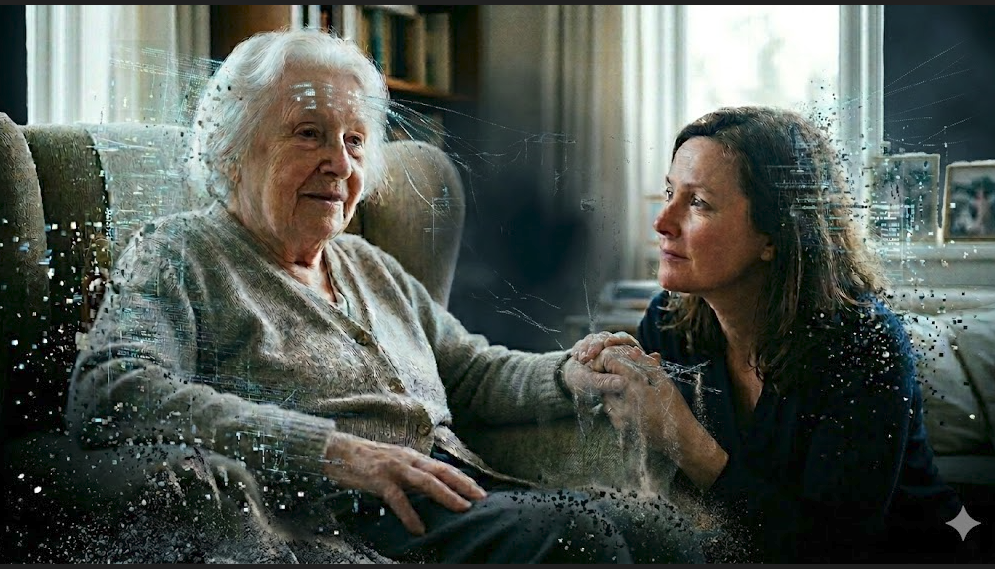
- image created with AI by kikasworld.com
What you call as ‘intellect’ is just a smart knife. It cuts everything to pieces to analyze it. But there is a deeper dimension of intelligence within you called Chitta, which is unsullied by memory. If your intellect is taken care of by machines, you will finally have the space to explore your true humanity—your capacity to love, to be conscious, and to simply exist.” Sadhguru.
Connecting that brilliant insight from Sadhguru to a devastating reality like Alzheimer’s disease is a profound leap. When you look at Alzheimer’s through the lens of the yogic framework of the mind, it completely alters how we perceive a person’s existence.
In mainstream understanding, Alzheimer’s is viewed purely as a tragic, destructive neurological failure. But if we expand our perspective to include dimensions beyond the rational brain, a different, deeply moving picture emerges.
1. The Separation of Intellect and Chitta
To understand this connection, we have to look at how the yogic tradition breaks down the human mind. It isn’t just one big bucket; it is categorized into distinct parts, primarily:
- Buddhi (The Intellect): The “smart knife” Sadhguru references. It functions like a computer—it needs data (Manas, or memory) to analyze, judge, and label the world.
- Chitta (Pure Intelligence): A deeper dimension of mind that is completely untouched by memory. It is the cosmic intelligence that keeps your heart beating, manages millions of cellular functions every second, and connects you directly to the source of life.
In Alzheimer’s disease, the physical brain suffers severe damage, which effectively destroys the filing cabinet of Manas (memory) and breaks the wiring of Buddhi (the intellect). The “smart knife” becomes dull and breaks.
However, Chitta cannot be destroyed by a physical disease. Because Chitta does not rely on memory to exist, the core life energy and the underlying consciousness of the individual remain fully intact, even when they can no longer remember their own name.
2. Is it Another Level of Being or Form of Existence?
From the outside, a person with advanced Alzheimer’s seems “lost.” But from a spiritual perspective, they haven’t vanished; rather, the bridge they used to communicate with our data-driven world has collapsed.
When the intellect and personal memory fade away, the person is stripped of their ego, their social conditioning, their grudges, and their anxieties about the future. They are forced into an absolute, radical state of “now.”
[Healthy State] --> Memory & Intellect dominate daily experience, obscuring Chitta.[Alzheimer's State] --> Memory & Intellect dissolve, leaving only the raw, existential core (Chitta).
Without the intellect constantly slicing the world into “me vs. you” or “past vs. future,” the person exists in a raw state of life. It is a different form of existence—one that is purely existential rather than psychological. They are no longer living in their minds; they are simply existing as a fragment of life itself.
3. Shifting Our Perspective on Alzheimer’s
When caring for or interacting with someone with Alzheimer’s, shifting to this perspective changes everything about how we treat them:
- Stop demanding intellectual interaction: We often cause distress by forcing them to use a broken tool—asking them “Do you know who I am?” or “What did you do today?” This forces them back into the broken intellect, causing frustration.
- Communicate through Chitta: Since Chitta is the seat of life energy and consciousness, it responds to things that require zero memory: presence, touch, eye contact, tone of voice, and pure emotion.
- The Capacity to Love Remains: Many families notice that even when a patient forgets who a person is, they still smile or feel a deep sense of safety around them. The intellect forgot the name, but the deeper life energy recognizes the love.
A Different Way to See It: Alzheimer’s is a tragic physical affliction, but it acts as a brutal, involuntary stripping away of the psychological ego. What is left behind is not an empty shell, but a human being reduced to their absolute, essential essence—pure life, waiting to be met with presence rather than logic.
Stepping back to view the rise of Alzheimer’s disease from a “larger perspective” takes us out of the clinic and into the realms of human evolution, sociology, and collective consciousness.
When you look at the macro-trends, global cases are skyrocketing—projected to grow from roughly 55 million to nearly 140 million by 2050. It is becoming a defining feature of the modern human landscape.
If nothing in the universe happens in a vacuum, what is this massive surge telling us about “the whole”? We can interpret this global shift through three distinct, grand lenses.
4. The Evolutionary Lens: The Cost of the “Smart Knife”
From an evolutionary standpoint, Alzheimer’s is almost uniquely human; other primates rarely experience anything like it. Evolutionary biologists note that as the genus Homo adapted to a “cognitive niche,” our brains underwent massive changes to support complex language, abstract planning, and deep autobiographical memory.
To achieve this, the human brain maximized synaptic plasticity (the ability to constantly rewire itself) and elevated its aerobic metabolism to extreme levels.
The Evolutionary Trade-off: The very brain regions responsible for our highly advanced intellect, self-awareness, and memory retention remain hyper-active and “juvenile” well into adulthood. The energetic cost of running this hyper-advanced machinery is massive oxidative stress. Over a long lifespan, this stress causes the biological wear-and-tear (amyloid plaques and tau tangles) we recognize as Alzheimer’s.
In the larger design, the rise of Alzheimer’s shows us the boundary of our biological evolution. We pushed the physical brain to its absolute limits to develop the “smart knife” of the intellect. The disease can be seen as the biological tax human beings pay for possessing such a devastatingly complex, analytical mind.
2. The Societal & Mirror Lens: A Reflection of Our Hyper-Intellectualism
Every era has a defining illness that mirrors its collective psychology. In a world completely obsessed with speed, productivity, data retrieval, and digital identities, what does a disease that deletes all data tell us?
Alzheimer’s acts as a massive, agonizing mirror to modern society:
- The Over-Valued Intellect: We live in a world where a person’s worth is often tied to their data-processing capacity (their degrees, their wit, their resume, their memories).
- The Global Correction: As the collective human mind becomes faster and more hyper-connected through technology, the universe is producing a massive surge in people who cannot participate in that game.
From a systemic perspective, the explosion of Alzheimer’s forces a hyper-logical, fast-paced world to halt. It demands that millions of healthy families slow down, step away from their screens, and sit in a room with a person who has no past, no future, and zero productivity. It forces the collective “Whole” to practice raw, non-transactional empathy—learning to care for a human being simply because they exist, not because of what they can intellectually produce.
3. The Karmic & Spiritual Lens: Forcing the Evolution of Love
If we return to Sadhguru’s framing—where machines are beginning to take over the work of our analytical intellect, leaving us room to explore true humanity—Alzheimer’s presents a parallel, albeit brutal, biological phenomenon.
What if the collective consciousness of humanity is being pushed to learn how to love without relying on the constructs of personal identity?
[Standard Relationship] --> "I love you because of our shared history, names, and mutual agreements." ↓ (Alzheimer's dissolves the data)[Transcendental Love] --> "I love you because our life-energies connect, entirely independent of memory."
When a parent or spouse forgets who you are, it shatters the psychological basis of love. If you continue to love and care for them, you are forced to transition from a love based on memory to a love based on presence. You are connecting with their Chitta (their underlying life force) rather than their ego.
The Bigger Picture
In the grand scheme of things, the rise of Alzheimer’s might not just be a random biological glitch. It can be interpreted as a severe existential counterweight. As humanity moves rapidly toward hyper-intellectualization, artificial minds, and data saturation, millions of individual human vessels are losing their data entirely.
It is forcing the human species to answer a massive collective question: When the data is completely erased, what are we worth to one another? The answer it demands is the realization of our true humanity—our capacity to love, to be conscious, and to simply exist.

