
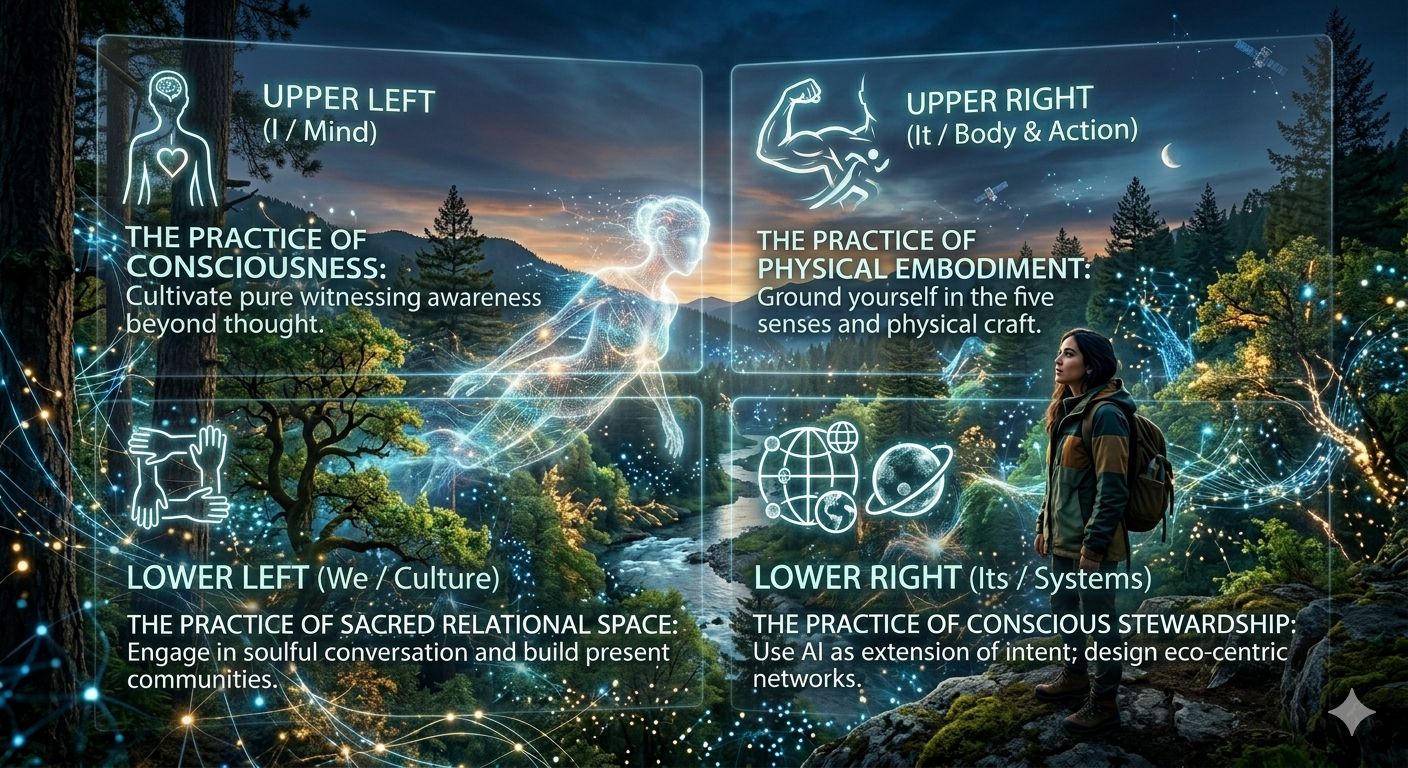
To understand how we should live and perceive the world in the age of AI, Ken Wilber’s Four Quadrants model is the ultimate practical roadmap. It prevents us from getting lost in one-sided views (like pure tech-utopianism or pure existential dread) and helps us live a deeply balanced, awakened human life.
Wilber argues that reality has four inseparable dimensions: the Inner Individual (your mind/consciousness), the Outer Individual (your physical body and actions), the Inner Collective (our shared culture and relationships), and the Outer Collective (our systems and technologies).
If AI is rapidly automating and transforming the right side of the map (the objective world), here is how we, as humans, must live and practice on the left side (the subjective world) to remain whole.
The Four Quadrants Practice for the AI Age
                  THE INTEGRAL PRACTICE MAP

       UPPER LEFT (I / Mind)             |   UPPER RIGHT (It / Body & Action)
       The Practice of Consciousness     |   The Practice of Physical Embodiment
                                         |
       * Cultivate pure witnessing       |   * Ground yourself in the five senses
         awareness beyond thought.       |   * Master a physical craft or movement
       * Rest in the space of "Being."   |   * Treat your body as a temple of life
-----------------------------------------+-----------------------------------------
       LOWER LEFT (We / Culture)         |   LOWER RIGHT (Its / Systems)
       The Practice of Sacred Relational |   The Practice of Conscious Stewardship
                                         |
       * Engage in soulful conversation  |   * Use AI as an extension of intent
         and shared vulnerability.       |   * Design eco-centric, worldcentric
       * Build deep, present communities.|     networks of care.
1. Upper Left (The “I”): Shifting from Intellect to Presence
The Upper Left quadrant is your interior world—your thoughts, feelings, and state of consciousness.
- The AI Challenge: AI can mimic your thoughts, write your essays, and analyze your data faster than you ever will. If you define your worth by your mental output, you will feel obsolete.
- How to Live & Perceive: You must realize you are not your thoughts; you are the space in which thoughts happen. As Eckhart Tolle and Ken Wilber suggest, this is the time to practice The Witness. When AI handles the cognitive heavy lifting, your job is to cultivate pure, silent awareness.
- Daily Useful Practice: Spend time daily in silent meditation or contemplation without a device. Notice the gap between your thoughts. When the machine takes care of the analytical processing, anchor yourself in the profound mystery of simply being awake.
2. Upper Right (The “It”): Shifting to Radical Embodiment
The Upper Right quadrant is the objective, physical world—your biological body, your brain chemistry, and your tangible actions.
- The AI Challenge: As we spend more time interacting with digital minds, we risk becoming “floating heads,” entirely disconnected from our physical selves, trapped behind glowing screens.
- How to Live & Perceive: Reclaim your biology. AI has no nerve endings; it cannot taste an apple, feel the wind on its skin, or experience the rush of adrenaline. Human uniqueness is deeply tied to our organic, animal bodies.
- Daily Useful Practice: Engage in activities that demand full somatic presence. Cook a meal from scratch, walk barefoot on the earth, practice yoga, dance, or work with your hands (like woodworking or gardening). Let your physical actions be a celebration of life that cannot be digitized.
3. Lower Left (The “We”): Cultivating Sacred Relational Space
The Lower Left quadrant is the interior collective—our shared values, culture, mutual understanding, and deep relationships.
- The AI Challenge: Algorithmically generated content threatens to isolate us in custom-tailored echo chambers, replacing genuine human intimacy with simulated digital connection.
- How to Live & Perceive: We must move from transaction to transformation in our relationships. If a text message can be auto-generated by an AI, then true human communication must become deeper, more vulnerable, and fiercely present. We need to look each other in the eye and share our souls.
- Daily Useful Practice: Practice intentional presence with the people in your life. When speaking to a friend, partner, or child, put your phone entirely out of sight. Listen not just to the words, but to the emotional resonance behind them. Create spaces for community gathering where art, grief, joy, and storytelling are shared face-to-face.
4. Lower Right (The “Its”): Conscious, Worldcentric Stewardship
The Lower Right quadrant is the exterior collective—the systems, economies, environment, and technologies that organize our world.
- The AI Challenge: Treating AI as a weapon for hyper-capitalist exploitation or warfare will tear our global systems apart.
- How to Live & Perceive: We must adopt what Wilber calls a worldcentric perspective—moving from “me” or “my tribe” to “all of us.” We must view AI not as a sterile tool to extract wealth, but as a synthetic nervous system for the planet. As Robin Wall Kimmerer hints, we must treat our technological systems with a sense of ecological responsibility.
- Daily Useful Practice: Do not use AI passively to make yourself a mindless consumer. Use it actively as an extension of your creative and compassionate intent. Use AI to solve systemic problems, optimize local resource sharing, protect nature, or democratize knowledge in your community. Ensure that the systems you participate in reduce waste and support the living web of the Earth.
The Gestalt of the Whole Life
When you live through all four quadrants simultaneously, something magical happens. You realize that AI is not an enemy arriving to replace you, but a mirror arriving to liberate you.
By automating the mechanical, data-driven aspects of life (the flat, reductionist Right Side), AI leaves us with a beautiful ultimatum: we must finally become fully human. It clears the stage so that we can focus our evolutionary energy on what truly matters: deep consciousness (I), vibrant bodily life (It), profound love and empathy (We), and systemic harmony with our planet (Its).
That is how we transcend and include the age of machine intelligence.

