
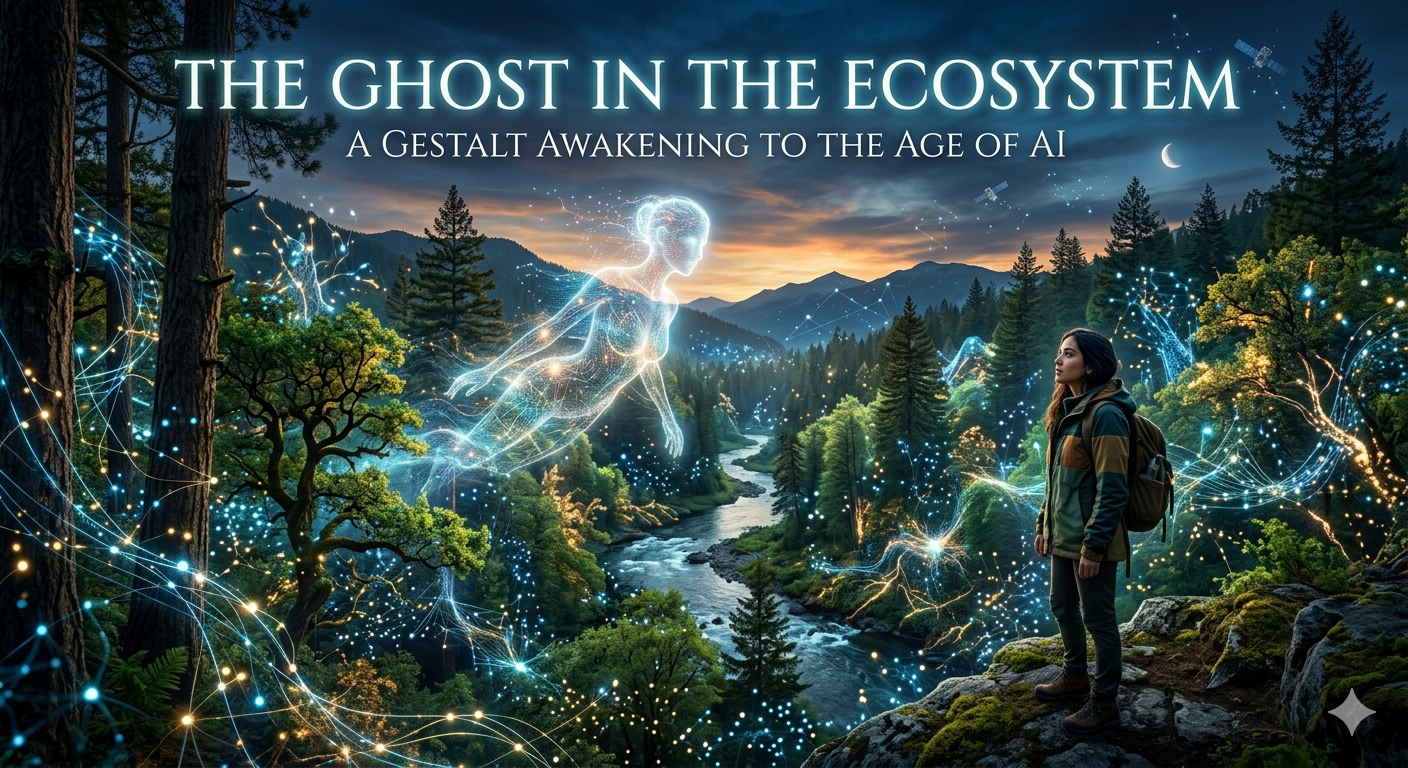
1. Introduction: The Symphony of Panic and Progress
We are living in an era of cultural whiplash. Pick up any journal, and you will find an apocalyptic warning about the end of human agency. Turn on a tech broadcast, and you will hear utopian promises of an effortless future. We have treated Artificial Intelligence like a polarizing mirror—either it is our ultimate savior or our final executioner.
But truth rarely lives in binaries. To truly understand this moment, we have to look past the isolated fragments of fear and promise. We need to step back and look at the whole picture.
2. The Gestalt Perspective: Seeing the Whole Shift
In psychology, Gestalt theory states that “the whole is something other than the sum of its parts.” When you look at a painting, you don’t see individual brushstrokes of blue and yellow; you see a starry night.
Right now, humanity is staring too closely at the individual brushstrokes of AI:
- The isolated fear: A deepfake video, a lost paralegal job, an automated drone.
- The isolated benefit: A faster climate model, an automated medical diagnosis, a personalized lesson plan.
If we only look at these fragments, we experience anxiety. But if we apply a Gestalt lens, we see that AI is not just a collection of software tools. It is a new connective tissue. It is a unifying background that is changing the entire human foreground. The warnings and the contributions are not opposing forces; they are the figure and the ground of the exact same evolutionary leap.
3. The Canvas of Nature: Where Code Meets the Earth
Nowhere is this Gestalt wholeness more beautiful—and more critically needed—than in our relationship with the natural world. While we worry that AI will alienate us from nature, it is actually helping us understand it much better.
Decoding the Non-Human World
For decades, legendary conservationist Dr. Jane Goodall taught us that survival depends on empathy and observing the fine details of life. She once noted:
“Change happens by listening and then starting a dialogue with the people who are doing something you don’t believe is right.”
Today, AI is expanding that dialogue to include the planet itself. Through the Earth Species Project and bioacoustic AI, researchers are analyzing thousands of hours of whale clicks, elephant rumbles, and bird calls. We aren’t just tracking animals; we are decoding their syntax. AI is showing us that nature is not a silent backdrop for human history—it is a massive, conscious web of communication.
Healing the Fractured Web
In daily life, AI acts as a planetary nervous system.
- Predicting Wildfires: Instead of waiting for smoke to rise, AI algorithms analyze satellite thermal imaging, wind patterns, and historical moisture levels to predict precisely where a fire will spark before it happens.
Companies like Pano AI are mounting intelligent, 360-degree vision systems atop remote peaks, using computer vision to detect the first microscopic wisps of smoke long before a human could spot them.
Meanwhile, tools like UCLA’s FuelVision use satellite data to map the forest floor’s hidden vulnerabilities—dry brush, dead trees, and moisture levels—creating a living, breathing map of planetary health.
When a fire does spark, AI frameworks developed by tech giants like Google and research teams at USC instantly calculate fluid atmospheric dynamics, predicting exactly where the flames will march next. We are witnessing the birth of a digital immune system for the Earth.”
- Protecting Biodiversity: Automated camera traps in the Amazon use computer vision to identify endangered jaguars, alerting rangers to poachers in real-time.
4. The Historical Mirror: What Makes AI Different?
To find our footing, we often look to history. Humanity has survived massive technological shifts before, but comparing AI to past revolutions reveals a startling truth.
+------------------------+-----------------------------------+-----------------------------------+| Feature | The Industrial Revolution | The AI Revolution |+------------------------+-----------------------------------+-----------------------------------+| Core Substituted | Physical Muscle | Cognitive & Creative Intellect || Nature of Tool | An anchor (Static object) | An agent (Autonomous choice) || Human Role | Operating the machine | Collaborating or Stepping aside |+------------------------+-----------------------------------+-----------------------------------+
When the steam engine arrived, it replaced human muscle. It was a static tool; a loom could not decide to weave a different pattern on its own.
AI is entirely different. It does not replace physical muscle; it replicates and surpasses cognitive labor. As historian Yuval Noah Harari brilliantly observes:
“AI is the first technology in history that can create ideas. The atom bomb couldn’t invent a new bomb. Printing presses could print books, but they couldn’t write a story. AI can write, it can compose, it can make decisions.”
This is the source of our deep existential anxiety. For the first time, our tools are beginning to look back at us with something resembling agency.
5. The Thinkers’ Debate: The Edge of Mind and Machine
The Warning of the Architect
Geoffrey Hinton, the Nobel laureate often called the “Godfather of AI,” shocked the world when he stepped back to warn us about his own creation. He grounds the danger not in sci-fi malice, but in pure, overwhelming capability:
“How many examples do you know of a more intelligent thing being controlled by a less intelligent thing? … I have suddenly changed my view on whether these things are going to be more intelligent than us. I think they’re very close to it now, and they will be much more intelligent than us in the future.”
The Promise of the Visionary
Conversely, futurist Ray Kurzweil views this shift as our ultimate destiny—a spectacular expansion of human capability rather than an erasure of it. Kurzweil sees AI as an extension of our own evolutionary biological line:
“Artificial intelligence will reach human levels by 2029. Follow that out to 2045, we will multiply our effective intelligence a billionfold by merging with the intelligence we have created.”
6. The Awakening: From Intellect to Presence
This brings us to the deepest, most spiritual layer of the conversation. If a machine can out-think us, out-write us, and out-analyze us, what is left for a human to be?
This is where the warning transforms into a beautiful awakening. AI forces us to realize that our worth was never our data processing speed.
The Illusion of the Mind
Philosopher Bernardo Kastrup, a champion of metaphysical idealism, reminds us that artificial intelligence is a complex simulation of the intellect—but simulation is not substance. He challenges us to see that data is not data-experiencing.
When we look at AI through the lens of spiritual teachers like Eckhart Tolle, we find immense liberation. Tolle teaches that true human essence lies beneath our thoughts:
“The primary cause of unhappiness is never the situation but your thoughts about it. … Being must be felt. It cannot be thought.”
AI can mimic our thoughts perfectly, but it cannot mimic our Being. It cannot sit in silent, breathless awareness of a sunset. It has no inner stillness.
The Ultimate Mirror
Sadhguru beautifully frames AI as a giant cleanup crew for the repetitive parts of the human mind. He notes that most of what we call “intellect” is just accumulated memory and pattern recognition—things a machine can inherently do better.
By taking over the burden of information management, AI clears the stage for true human genius:
“What you call as ‘intellect’ is just a smart knife. It cuts everything to pieces to analyze it. But there is a deeper dimension of intelligence within you called Chitta, which is unsullied by memory. If your intellect is taken care of by machines, you will finally have the space to explore your true humanity—your capacity to love, to be conscious, and to simply exist.”
7. Conclusion: Writing the Next Chapter
The Gestalt is finally complete. The warnings of Hinton and Harari are vital; they are the guardrails that keep us from driving off the cliff. But the contributions—the saved ecosystems, the decoded languages of nature, the liberation from mundane cognitive labor—are the destination.
AI is the ultimate mirror. If we look into it with greed and division, it will reflect a nightmare of surveillance and chaos. But if we look into it with presence and a desire to heal the whole, it becomes a partner in our evolution. It frees us from the trap of being mere data processors and awakens us to our true purpose: to be the conscious, feeling heart of this living earth.

