
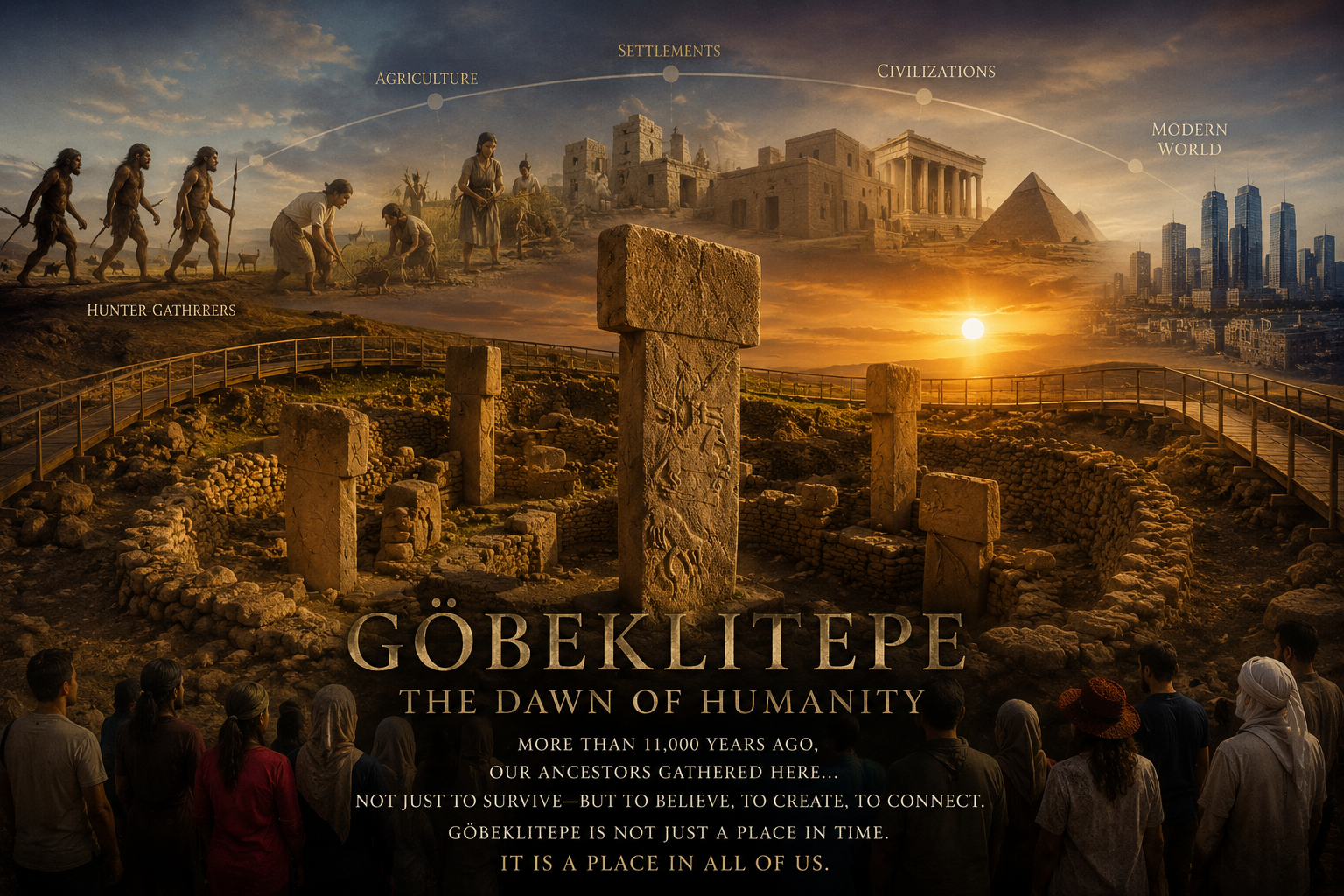
* Image created with AI by kikasworld.com
12,000 years ago, before cities, before writing, before the wheel — someone climbed a hill in southeastern Turkey and began moving mountains.
The Hill That Should Not Exist
On a limestone plateau rising above the plains of Şanlıurfa, there is a hill that looks, from a distance, like nothing more than a rounded mound in the Turkish landscape. For most of the twentieth century, that is exactly what people assumed it was. American archaeologists surveying the area in the 1960s noticed fragments of beautifully cut stone jutting from its surface, but the workmanship was so fine they concluded it must be Byzantine — too recent to be interesting — and moved on.
They were off by about ten millennia.
In 1994, German archaeologist Klaus Schmidt arrived at what locals called Göbeklitepe — “Pot Belly Hill” — and recognized something the earlier survey had missed. The cut stones were not the ruins of a medieval building. They were the tops of massive T-shaped pillars, the shoulders of something enormous still sleeping under the earth. Schmidt began excavating the following year, and what emerged from beneath the soil became arguably the most significant archaeological discovery of the twentieth century.
What he found was the world’s oldest known temple complex: a series of monumental circular enclosures built from limestone pillars weighing up to twenty tons, carved with extraordinary relief sculptures of animals, insects, and abstract symbols — all constructed more than 12,000 years ago, roughly 7,000 years before Stonehenge and 6,500 years before the Egyptian pyramids.
The site did not just add a chapter to the story of early civilization. It tore out the first chapter and demanded it be written again.
A Farmer’s Terraced Hill
Before Schmidt, before the archaeologists, before the world knew the name Göbeklitepe, there was a farmer named Mahmut Yıldız who worked the land on that hillside. His account of the site before excavation is a remarkable thing: a terraced field where wheat and barley once grew, where some T-shaped stones were already visible above the surface but were mistaken for old grave markers, where locals came not as tourists but as pilgrims — bringing offerings, making vows, believing the hill had healing energy.
The region around Şanlıurfa has been considered sacred for as long as people can remember. It is the city associated with the Prophet Abraham, the land of the Fertile Crescent, the place where the Tigris and Euphrates rivers find their northern reaches. That ancient sense of holiness, it turns out, may have very deep roots indeed.
A crucial step toward understanding Göbeklitepe had come a decade earlier, at a site called Nevali Çori, where Schmidt had been a team member during excavations in the 1980s. There, for the first time, researchers encountered T-shaped limestone pillars inside a special rectangular building — a discovery that gave them the interpretive key they needed. When Schmidt stood at Göbeklitepe and saw similar stones, he understood immediately what he was looking at. Nevali Çori was later submerged beneath the waters of the Atatürk Dam reservoir, but the knowledge it provided lived on, and made Göbeklitepe legible from the very first trowel-stroke.
What Was Found in the Ground
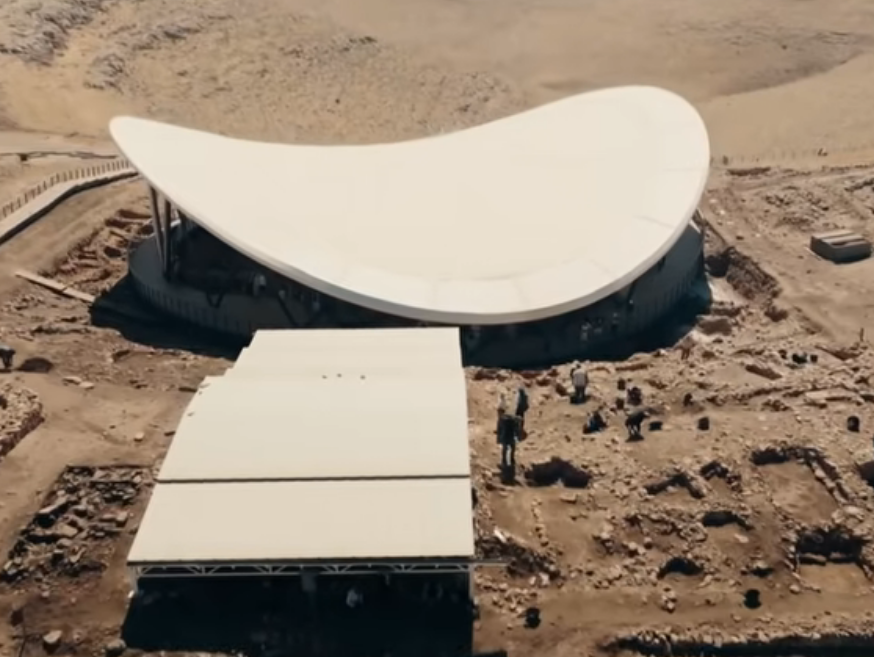
The scale of Göbeklitepe is not immediately obvious from photographs. The site covers an area of approximately 300 by 300 meters, with archaeological deposits reaching 15 meters in depth. What has been excavated so far — four main enclosures labeled A, B, C, and D — represents a small fraction of what ground-penetrating radar surveys show lies buried across the full extent of the mound.
The enclosures follow the same basic plan: roughly circular or oval walls of smaller stones enclosing pairs of massive T-shaped central pillars, with additional pillars set into the walls around the perimeter. Enclosure D is the best preserved, and its two central pillars stand nearly six meters tall. The quarries where these stones were hewn are visible within 200 meters of the main excavation area, meaning the builders didn’t have to transport the pillars enormous distances — but they did have to cut them from solid bedrock using only stone tools, shape them into precise forms, and raise them upright.
As Schmidt noted in his scientific lectures on the site, the T-shape itself is not merely architectural. At Nevali Çori, the excavators had already realized that T-shaped pillars represent stylized human beings seen in profile — the horizontal bar of the T is the head, the vertical shaft is the body. At Göbeklitepe, this reading is confirmed by details carved onto the pillars themselves: arms depicted along the sides of the shaft, hands meeting at the front near a belt, fox-pelt loincloths carved in flat relief. These are not abstract columns. They are people — colossal, stone people standing in circles, presiding over whatever happened inside these walls.
The floors of the enclosures are made of terrazzo — a polished, water-resistant surface formed from burnt lime. The enclosures had roofs. They were built to last, to be maintained, to be used repeatedly over a span of time.
The Art on the Stones
What makes Göbeklitepe genuinely astonishing, beyond its age and its engineering, is the art.
Carved across the surfaces of the pillars in flat and high relief are more than two hundred animals: foxes, snakes, wild boars, bulls, cranes, vultures, spiders, scorpions, insects, and birds of all kinds. They are not decorative. Schmidt was emphatic on this point: the reliefs are not ornament. They illustrate something. They tell stories. They are, in his words, myths and narratives of the Stone Age, carved in limestone because there was no other medium yet capable of preserving them.
Some pillars carry a single animal, rendered with the precision of a trained sculptor who had clearly drawn the same creature many times. Others carry complex compositions — Pillar 43, in Enclosure D, has been called the most elaborately decorated pillar ever found from this period, showing a headless human figure beside a vulture with wings spread, surrounded by scorpions and other animals, suggesting a scene of death, flight, and perhaps transformation. The motif of a large bird holding a human head appears multiple times at Göbeklitepe and at contemporary sites in the region — a recurring image that clearly carried deep symbolic weight.
There are also abstract symbols: H-shapes, crescents, and other signs whose meanings remain contested. Some of the pillars carry combinations of more than fifty individual animal and abstract motifs, all apparently organized according to an internal logic that archaeologists are still working to decode.
The sculpture in the round is equally compelling. Life-sized limestone heads of humans were found deliberately placed near the central pillars of Enclosure D. A stone boar, carved in full three dimensions, was discovered anchored into one of the benches of Enclosure C. High-relief sculptures of predators — lions, leopards — sit crouching on top of portal stones that once gave access to the enclosures, guarding the thresholds like sentinels.
Who Built This, and How?
The question that the discovery forced upon archaeology — and has never fully released — is this: who were these people, and how did they do it?
The archaeological evidence is clear on one point: Göbeklitepe was built by hunter-gatherers. There is no evidence of agriculture at the site during its earliest phases. No domesticated plants, no domesticated animals. The animal bones recovered from the site — over one hundred thousand of them — come exclusively from wild species: gazelle, wild cattle, wild boar, red deer. The people who quarried, transported, carved, and erected these stones were nomadic or semi-nomadic people who lived by hunting and gathering.
This is what shattered the existing model of how civilization worked.
The old theory, taught for generations, held that civilization emerged from agriculture: farming produced surplus food, surplus food allowed specialization, specialization allowed some people to become full-time builders and priests and administrators. The temple came after the farm. Göbeklitepe suggests the opposite. The temple came first. It may have been the reason people stayed, and eventually began to farm.
As Schmidt calculated, moving a single twenty-ton pillar required something like four hundred people pulling in coordinated effort. Feeding four hundred people required organization, planning, and probably a surplus of food. Some researchers have suggested that Göbeklitepe was the catalyst for the domestication of wild wheat, since extensive stands of wild einkorn wheat grow in the hills nearby — exactly the region where cultivated wheat is thought to have originated. The temple may have created the social pressure that turned foragers into farmers.
The enclosures were not houses. There are no hearths, no storage pits, no trash middens of the kind found at settlements. A single enclosure, with its narrow entrance and limited interior space, could hold only a few dozen people at most. The site appears to have been a gathering place — a center for ritual, ceremony, and the coordination of communities — rather than a place where people lived permanently. Populations from a wide surrounding region came here, Schmidt believed, for specific purposes: to work, to mark occasions, to maintain the structures, to participate in whatever ceremonies these enclosures were built to host.
The 2025–2026 Breakthroughs
For thirty years after Schmidt’s first excavation season, each field season at Göbeklitepe produced new discoveries. But in 2025, two finds in quick succession changed the picture more dramatically than anything since the site’s initial revelation.
In September 2025, archaeologists working on the restoration and excavation of Enclosure C uncovered a near life-sized human statue embedded horizontally into the foundation of one of the stone walls. The figure lay on its side, head and upper body intact, its legs deliberately absent — as though it had been built into the structure rather than placed there. The posture, the positioning of the hands, and the anatomical proportions bore close resemblance to human figures found at sister sites like Nevali Çori and Karahantepe. This was not an accidental burial. Someone had decided that this figure belonged inside the wall.
Then, one month later, at Karahantepe — a related site about fifty kilometers from Göbeklitepe — excavators uncovered a T-shaped pillar bearing something never seen in three decades of work across the broader region: a clearly rendered human face. Deep-set eyes. A straight nose. A defined jawline. After more than 12,000 years, the builders of this civilization looked back.
These two discoveries prompted researchers to deploy the full suite of modern geophysical technology across the entire Göbeklitepe area. Ground-penetrating radar, LiDAR, and high-resolution magnetic surveys were applied systematically for the first time. The results revealed numerous additional circular enclosures and — crucially — rectangular structures, a different architectural form suggesting organized domestic or functional spaces that had never been found before. The site was not just larger than expected. It was structurally more complex, suggesting a community organized enough to separate its ritual spaces from its living and working spaces.
Simultaneously, a team fed the entire visual archive of the site’s carvings — more than 2,500 high-resolution 3D images of 43 excavated pillars, along with over 400 distinct animal symbols and abstract signs — into a machine learning system. The AI found that the symbols were not randomly distributed. Foxes clustered together with specific signs across nine different pillars. Snakes and scorpions occupied predictable positions. Some compositions appeared only in specific enclosures. Certain arrangements showed correlations of over 80% with the positions of star constellations as they appeared 12,000 years ago. The carvings, the data suggested, were not art in any modern decorative sense. They were a recording system — pictorial language used to store and transmit information across generations.
What Did It Mean?
Göbeklitepe has never lacked for theories. What it has lacked is certainty.
The most archaeologically grounded interpretation sees the site primarily as a communal gathering center for the wide hunter-gatherer communities of the upper Euphrates and Tigris region — a place where different clans came together periodically for shared rituals, the exchange of knowledge and social bonds, and the reinforcement of a common symbolic vocabulary. The identical T-shaped pillar form, the same animal motifs, the same abstract signs appear across at least a dozen contemporary or near-contemporary sites in the region, suggesting a shared ideological system that connected communities across hundreds of kilometers.
A second strand of interpretation focuses on the sky. The enclosures at Göbeklitepe are oriented in slightly different directions, and some researchers have proposed that each faces the rising point of a significant star. The AI analysis strengthened this case: several compositions on the pillars correlate strongly with specific constellations as they appeared during the Younger Dryas period, suggesting that the builders were systematically mapping the heavens in stone.
A third theory, reinforced by the 2025 discovery of the embedded statue, proposes that Göbeklitepe was in part a house of the dead — a place where the power and presence of ancestors was physically incorporated into the architecture. The skull fragments found at the site, which bear deliberate incisions and perforations suggesting they were displayed or worn, point in the same direction. For the people who built Göbeklitepe, the skull appears to have been the seat of identity, wisdom, and spiritual power. Their dead were not simply buried and mourned. They were integrated into the ongoing life of the community through ritual and material culture.
These interpretations are not mutually exclusive. A site used over 800 years, by communities with a rich symbolic life, could have served all of these purposes at once.
Göbeklitepe Is Not Alone
One of the most important revisions forced by the ongoing excavations around Şanlıurfa is the recognition that Göbeklitepe was never an isolated phenomenon.
Prof. Dr. Necmi Karul, who leads the current excavations, describes the region as home to a dense network of Neolithic sites — some of them enormous, covering twelve hectares or more — all dating to the same general period between approximately 9,600 and 8,000 BCE, and all sharing the same symbolic vocabulary. Karahantepe, Sayburç, Karahan Tepe, Taş Tepeler — these are not peripheral footnotes. They are chapters of the same book.
Graham Hancock, visiting the site in 2013 shortly before Schmidt’s death, described the broader project in its correct scale: what Turkish archaeologists have named the Taş Tepeler (“Stone Hills”) civilization is not just Göbeklitepe — it is a web of sites connected by shared beliefs, shared symbols, and apparently intense communication. The same T-pillar form appears across all of them. The same animals recur. The communities behind these sites appear to have been in regular contact, sharing both material culture and ideology. Their settlements were as little as five kilometers apart in some cases — suggesting a regional population density that, as Karul has noted, is without parallel anywhere else in the world at this period.
The implication is striking. Göbeklitepe was not the work of a single inspired group. It was the monumental expression of a civilization — one that has no agreed-upon name yet, but whose traces extend across a wide swath of what is now southeastern Turkey and northern Syria.
Before Göbeklitepe: The Longer Thread
One of the most illuminating contributions to the understanding of Göbeklitepe in recent years has come not from Turkey at all, but from a site in southern Jordan called WF16, excavated by Professor Steven Mithen of the University of Reading.
WF16 is a Natufian and early Neolithic settlement in Wadi Faynan, roughly fifty kilometers south of the Dead Sea. It dates to a period between approximately 12,500 and 10,000 years ago — overlapping with and in some cases predating Göbeklitepe. What Mithen and his team found there was something archaeologists had been looking for without quite knowing it: the cultural antecedents of the Göbeklitepe world, appearing a thousand kilometers to the south.
At WF16, among the grinding stones and animal bones and mud-brick walls, researchers uncovered carved stone pestles covered in snakes. A sculpted gazelle head. Multiple phallic stones. Small human figurines, including a double-sided human face carved in stone — a two-faced form that appears at Göbeklitepe and at Jeff el-Ahmar and other sites across the region. Human skulls with deliberate perforations and painted markings. Hundreds of raptor bones — eagles, vultures, buzzards — stripped of their feathers for use in ritual costume.
And at the center of the site, a massive communal structure: an oval mud-brick building approximately twenty meters long and ten meters wide, with benches running around the edges and a central trough whose purpose remains unknown. In function, if not in material, it is a cousin of the Göbeklitepe enclosures.
Mithen’s conclusion is that the symbolic world visible in monumental stone at Göbeklitepe did not appear from nowhere. It was the culmination of an ideological tradition that had been developing across a wide region of southwest Asia for centuries, perhaps millennia, before the first pillar was raised at Pot Belly Hill. The same animals — snakes, vultures, birds of prey. The same concern with human skulls and ancestral presence. The same communal gathering structures. The same shamanic-inflected worldview, in which animals are not simply food but carriers of spiritual power, and in which the boundary between the human world and the animal world is permeable.
What Göbeklitepe did was not invent this tradition. It expressed it in stone, at massive scale, with a permanence and ambition that no previous community had attempted.
Why Was It Buried?
Sometime around 10,000 years ago — after roughly 800 years of construction, use, and elaboration — the builders of Göbeklitepe began filling in their own enclosures.
This was not abandonment. It was not neglect. The enclosures were deliberately, carefully backfilled with rubble, soil, and debris — sealed shut with intention. It is precisely this careful burial that preserved them so extraordinarily well. What looks like a destructive act was, paradoxically, also an act of preservation.
Why they did it remains one of the site’s deepest puzzles. Schmidt suggested the most likely explanation: a shift in the astronomical framework that had oriented the site’s construction. The enclosures appear to have been aligned to the positions of specific stars, and the slow precession of the Earth’s axis changes those positions over millennia. As the heavens shifted, the alignments became obsolete — and with them, perhaps, the ritual significance of the specific enclosures.
But the deliberateness of the backfilling suggests something more. Sites like Göbeklitepe, in the analysis of researchers like Mithen, were not merely functional: the power that resided in them — through the ancestors embedded in their walls, the symbols accumulated on their pillars, the ceremonies performed within them — was itself something that needed to be managed, and eventually retired. Sealing the enclosures may have been a way of closing a chapter: honoring what had been while deliberately preventing its continuation.
After the burial, life at Göbeklitepe did not end. A later phase of occupation began, with smaller, rectangular structures — a completely different architectural vocabulary — built on top of the earlier enclosures. By this time, agriculture was fully established in the region. The world the enclosures had helped bring into being had arrived, and the enclosures themselves were no longer needed.
Keeping the Stones Alive: Restoration Today
The ongoing work at Göbeklitepe is not only excavation. As more of the site is exposed, the task of preservation becomes increasingly urgent and increasingly complex.
Prof. Dr. Necmi Karul leads the excavation under the Taş Tepeler Project, coordinating work across ten different sites simultaneously. The restoration of Göbeklitepe itself is led by archaeologist Murat Akman, one of the most experienced restoration specialists in the region — a man who was present with Klaus Schmidt at the very first discovery of the site in the mid-1990s, and who later single-handedly relocated and reconstructed the special building of Nevali Çori before that site was lost to rising reservoir waters.
The restoration of Enclosure C — the largest enclosure at the site — is currently underway. The dry-stone walls, built without mortar and filled with compacted earth between courses, have been slowly losing that fill to weathering. Without intervention, the walls would collapse. The restoration team fills the gaps with a mortar made from the site’s own soil — mixed with local gravel and goat hair for binding and flexibility, a recipe that is deliberately as close as possible to what would have been used 12,000 years ago. Broken pillar fragments are cleaned, tested for fit, and slowly reassembled.
The T-shaped pillars themselves present the most delicate challenge. Some have cracked severely along internal fracture lines. Some have tilted from their original vertical position and must be carefully returned upright. Some bear high-relief carvings — including what appears to be a bull — whose surfaces have spalled away in sheets. Each fragment is individually documented, stabilized with injection grouting, and, where possible, returned to its original position.
The goal, as Karul describes it, is not reconstruction but legibility. When visitors walk into Enclosure C after the restoration is complete, they should be able to read the space — to understand the layout, to see the pillars in their proper relationship, to feel the scale of what was built here. At the moment, even an experienced archaeologist standing inside the enclosure finds it difficult to make sense of. What restoration does is not change the past. It makes the past visible.
What Still Lies Beneath
After more than three decades of excavation, more than 90% of Göbeklitepe remains underground.
The geophysical surveys have mapped the outlines of numerous additional enclosures, rectangular structures, and other features whose nature is not yet understood. Some of these structures, based on their position in the stratigraphy, may be older than the currently excavated enclosures — potentially pushing the construction of the site back further than the 9,600 BCE date currently given to Enclosure D.
Irving Finkel, the Assyriologist and curator at the British Museum, has pointed to a green stone seal found at the site bearing what appears to be pictographic signs — an object that, if correctly interpreted, would suggest that some form of writing or recording system was already in use at Göbeklitepe, thousands of years before writing is supposed to have appeared in Mesopotamia. The find is contested, but Finkel’s argument is characteristically incisive: a site of this organizational complexity, requiring the coordination of hundreds of workers across decades of construction, could hardly have managed without some system for recording, ratifying, and transmitting information.
Future seasons will bring new enclosures to light. New domestic structures are already emerging on the northern slopes of the mound. The ongoing Taş Tepeler excavations at Karahantepe, Sayburç, and the other sister sites continue to produce finds that reframe what we know of Göbeklitepe itself — each one adding a new face, a new symbol, a new layer of context to a civilization that is still being assembled from its own buried evidence.
A Message Across Twelve Millennia
Twelve thousand years is not an abstraction. It is the entire span of recorded human history — twice over. And yet Göbeklitepe reaches back that far and offers something recognizable: art of genuine skill and feeling, architecture of deliberate beauty, a symbolic world complex enough to have taken centuries to build and to have spread across a region the size of Western Europe.
The people who built this were not the primitive cave-dwellers of popular imagination. They were, as both Schmidt and Mithen independently insisted, people of fully modern minds — cognitively indistinguishable from us. They looked at the sky and tracked the stars. They organized collective labor at scales that required management, planning, and probably some form of leadership. They carved animals with such anatomical precision that we can identify the species with confidence. They had myths, and they encoded those myths in stone, and they maintained and elaborated those myths over many generations.
What Göbeklitepe demonstrates, above all, is that the impulse to build something larger than survival — to make something meaningful, something beautiful, something that might outlast the individual — is not a product of civilization. It is one of civilization’s causes.
The stones were not a sign that humanity had already arrived at some advanced state. They were the beginning. The first attempt, in permanent material, to say: we were here, this mattered, and we wanted you to know.
Twelve thousand years later, we are finally starting to listen.
Excavations at Göbeklitepe and the Taş Tepeler sites continue under the direction of Prof. Dr. Necmi Karul and the Turkish Ministry of Culture and Tourism. The site is open to visitors near Şanlıurfa in southeastern Turkey.
Who Has Sponsored and Funded the Göbeklitepe Excavations?
The funding and institutional support for Göbeklitepe has evolved across three distinct phases — early surveys, the Schmidt era, and the current Taş Tepeler period.
Phase 1 — The First Survey (1963)
The site was first identified during a joint survey by the University of Istanbul (Turkey) and the University of Chicago (USA). No excavation took place, but this American-Turkish collaboration put Göbeklitepe on the archaeological map.
Phase 2 — The Excavation Era (1995–2014)
In 1995, fieldwork began at Göbekli Tepe under the auspices of the Şanlıurfa Museum (director Adnan Mısır), with Harald Hauptmann of the German Archaeological Institute (DAI) as acting site director. From the very beginning, fieldwork was coordinated by Klaus Schmidt. Göbekli Tepe Research Project
Initial funding came from the sponsoring society ArchaeNova, and was later supplemented by the German Research Foundation (DFG). Göbekli Tepe Research Project
DFG funding continued until August 2025 under the long-term project “The Prehistoric Societies of Upper Mesopotamia and their Subsistence” (project number 165831460). MDPI
The core academic consortium during this period included:
- German Archaeological Institute (DAI) — Orient and Istanbul Departments (Germany)
- Ludwig-Maximilians-Universität München — Archaeozoology (Germany)
- Freie Universität Berlin — Geography (Germany)
- University of Cologne — Institute of Prehistoric Archaeology (Germany)
- Istanbul University — Archaeology Department (Turkey)
- Şanlıurfa Museum — excavation permit holder (Turkey)
- University of Heidelberg — Klaus Schmidt’s institutional base (Germany)
The Turkish Government also provided funding through the Ministry of Culture and Tourism, alongside the DFG and the Doğuş Group.
Phase 3 — Corporate Sponsorship (2016–present)
Doğuş Group, the Turkish-based international conglomerate, invested $15 million in Göbeklitepe. Their 20-year sponsorship was launched globally in January 2016 at the World Economic Forum in Davos, and included funding for ongoing excavations, a new visitor and exhibition centre, and a global communications campaign.
However, this phase attracted significant controversy. Critics alleged that after Doğuş Group assumed control, excavation work was suspended in favor of tourism development. Heavy machinery was used to build roads over the site, and afforestation efforts were carried out, raising alarm among archaeologists that tree roots could damage ancient stones.
Phase 4 — The Taş Tepeler Era (2021–present)
The Taş Tepeler Project is unprecedented in scale: 36 academic institutions — 15 from Türkiye and 21 international partners — are working concurrently across all sites, coordinating the efforts of 219 researchers.
New countries are actively joining. Japanese archaeologists are now beginning long-term excavations at Ayanlar Höyük, and China’s People’s Republic is undertaking its first-ever excavation project in Türkiye at Yoğunburç. The 2024 World Neolithic Congress in Şanlıurfa brought together over 1,000 scholars from 64 countries. Daily SabahDaily Sabah
Turkish Airlines is the main corporate sponsor of the Taş Tepeler project.
The Berlin exhibition (2026) received additional funding from the German Foundation Klassenlotterie, the Board of Trustees of the Prussian Cultural Heritage Foundation, and Freunde der Antike auf der Museumsinsel Berlin e.V.

