
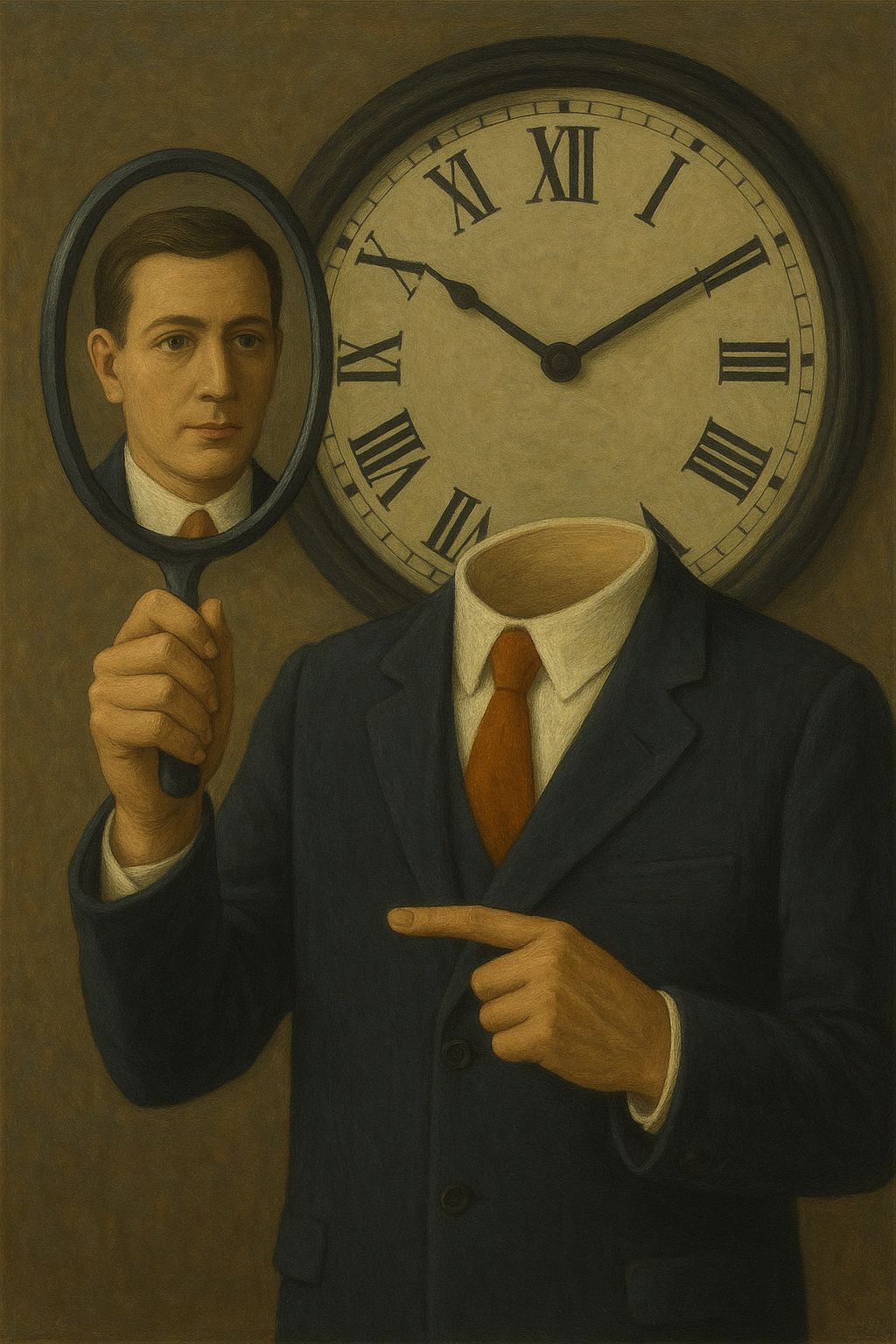
- Image created with AI by kikasworld.com
In 1991, a then 82-year-old Douglas Harding gave a powerful and humorous talk in Melbourne, Australia. Best known as the author of On Having No Head: Zen and the Rediscovery of the Obvious, Harding offered not doctrines or beliefs, but experiments—simple, firsthand inquiries that help individuals directly perceive their true nature.
His central premise? You are not what you look like.
Two Worlds: The As-Is vs. The As-If
Harding’s life work revolves around distinguishing between two realities:
- The As-Is World: the world as directly experienced, immediate, unmediated, “woven of blessings”.
- The As-If World: the socially constructed world shaped by language, convention, and external validation.
Most people, he says, live and die entirely within the “as-if” world—believing they are who others say they are, seeing themselves through the eyes of mirrors, photographs, and social roles. But through “headless” experiments, we can return to the as-is world, seeing the world not through thought or belief, but through direct observation.
“On Having No Head”: Seeing from Zero Distance
In his hallmark experiment, Harding invites us to look at what we’re looking out of. Do we really see two eyes in a face when we observe the world? Or do we see a seamless, frameless field of vision? Inwardly, we discover not a head, but an open, spacious awareness.
“What you look like to others, you are not. What you look out of, is who you really are.”
In a playful but profound way, Harding suggests we are transparent, spacious, awake capacity for the world.
The Experiments: First-Person Science
Throughout the talk, Harding insists we don’t believe him. Instead, we must test his claims through direct inquiry.
Examples include:
- Pointing experiments: Point at your feet, then your chest, then your face—what do you see? At your feet and chest, you see something. When you point to your own face, from your own perspective, what do you see? Nothing but space—awareness.
- Mirror experiments: The person in the mirror is a reflection, a role, a mask. But the viewer—the experiencer—is not a thing at all.
These are not mystical claims, he asserts—they are literal, physical, and present.
Theological Echoes: Mysticism Without the Myths
Harding connects his discoveries with the core mystical insights at the heart of the world’s great religions:
- Christian mysticism speaks of “Christ in you, the hope of glory.”
- The Upanishads declare “Tat Tvam Asi”—you are That.
- Islamic Sufism claims, “He is closer to you than your jugular vein.”
Harding calls this the most shocking and radical claim of all—that our true identity is not a product of the world, but its origin. “The One you really are,” he says, “is nearer than near, and is eternal.”
Practical Implications: Love, Energy, and Trust
This isn’t just philosophy. Harding argues that seeing through the illusion of separation has real-life consequences:
- Love becomes possible: True love isn’t confrontation between egos, but spacious presence meeting spacious presence.
- Energy increases: Maintaining a false self-image is exhausting. Seeing through it, we reclaim vitality.
- Inner peace: The “meatball” of the head is the source of stress. The headless reality is open, still, peaceful.
“We are not facing each other—we are space for each other.”
Harding’s friend Chris, present at the talk, echoes this: “There is no distance. There is no separation. And it frightens me. But it’s true.”
Who Was Douglas Harding?
Born in 1909 in Suffolk, England, Harding was raised in a strict Christian sect. In his 20s, he left that tradition and began a lifelong philosophical and spiritual quest. Trained as an architect, he later taught comparative religion at Cambridge, and wrote several books and gave workshops across Europe, Asia, and the United States.
His main books include:
- On Having No Head: Zen and the Rediscovery of the Obvious (1961) – His classic guide to “headless seeing.”
- The Little Book of Life and Death – A lucid and tender reflection on mortality.
- The Trial of the Man Who Said He Was God – A fictional courtroom drama that playfully unpacks identity.
More titles and details are available via the official Headless Way website.
Those Continuing the Path Today
Harding’s teachings didn’t die with him in 2007. His work lives on through an international community of “headless” explorers and teachers. Some key figures include:
- Richard Lang – A close friend and collaborator of Harding’s, who continues to lead workshops and maintain the Headless Way website.
- Rupert Spira – Though not a direct student, his non-dual teachings on awareness as our true identity echo Harding’s insights.
- Tony Parsons – His uncompromising view of non-duality aligns with Harding’s view of the illusory personal self.
- Sam Harris – While from a secular, neuroscientific background, his guided meditations often lead people to a similar realization of headlessness.
Conclusion: The One and Only Authority
Harding’s message is both radical and humble. He doesn’t claim to be a guru. He insists you don’t believe him. He simply invites you to look for yourself.
“You are the sole and final authority on what it’s like to be you.”
To Douglas Harding, spirituality isn’t about seeking a new self. It’s about seeing what’s always been here—this vast, open, empty presence.
A presence with no head.
A presence that can never perish.
A presence that is love itself.
 Kika's world