
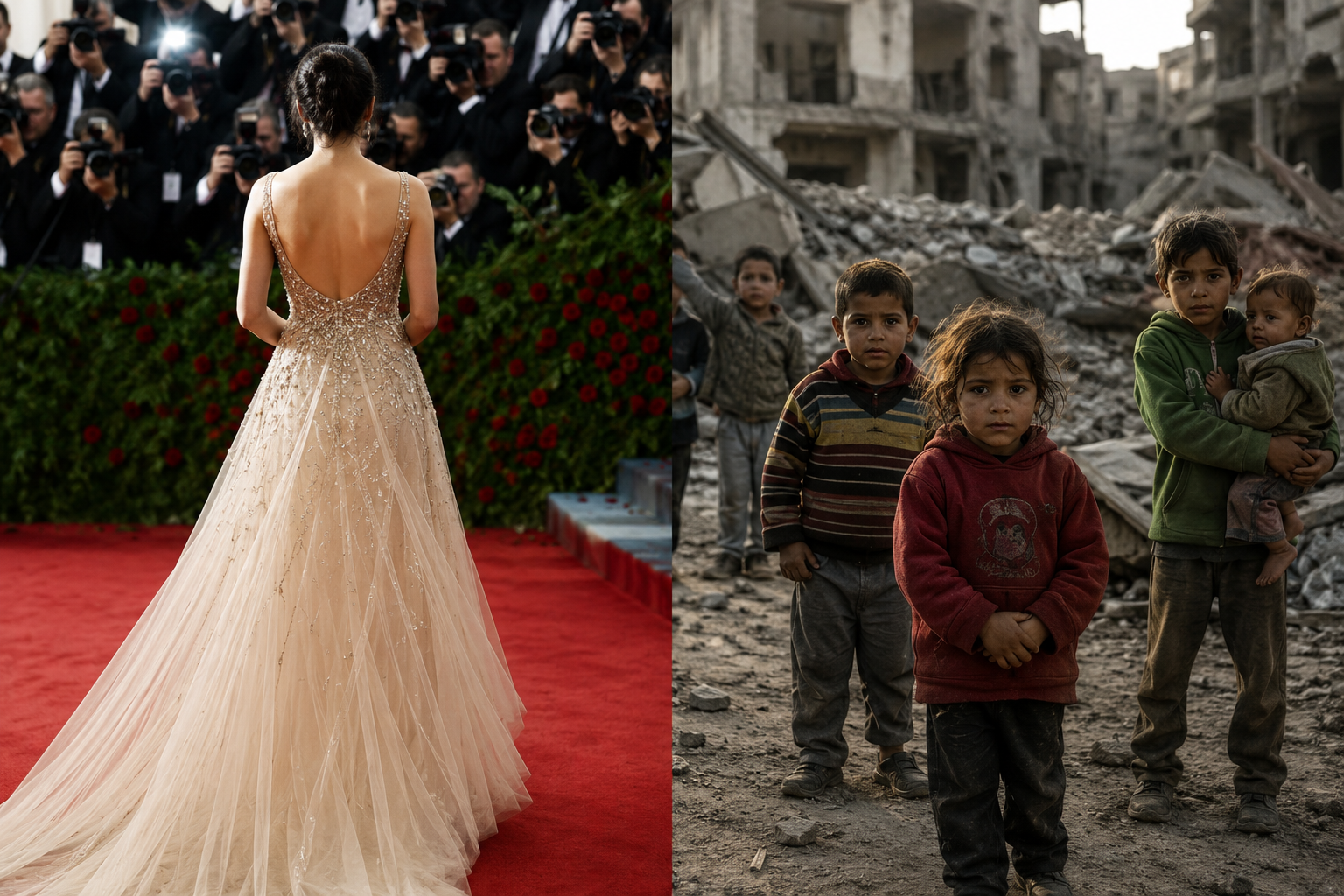
There are evenings when the world feels split into two irreconcilable realities.
On one side, cameras flash beneath chandeliers. Dresses worth more than a lifetime’s salary glide up museum stairs. Diamonds shimmer beneath curated lighting. The annual spectacle of the Met Gala floods our screens with beauty, extravagance, performance, and power. Every angle is documented. Every gesture analyzed. Every outfit debated as if civilization itself depended on fabric and spectacle.
On the other side of the same planet, children sleep beneath collapsed roofs. Mothers wait in lines for bread or water. Families flee war with plastic bags carrying what remains of their lives. Somewhere, tonight, a child dies not because humanity lacks resources, but because humanity lacks distribution, attention, and perhaps the emotional capacity to remain present with suffering for too long.
And between these two realities stands the modern human being — scrolling.
We scroll from couture to catastrophe in less than a second. One image celebrates excess. The next documents devastation. The nervous system was never designed for this kind of psychological whiplash. We absorb the suffering of the world while simultaneously witnessing unimaginable displays of privilege. Slowly, many people begin to feel emotionally paralyzed, cynical, numb, guilty, angry, or exhausted.
From a Gestalt perspective, this fragmentation is deeply significant.
Gestalt reminds us that human beings do not experience life as isolated events. We experience figures emerging from a ground. Whatever becomes emotionally charged steps forward into our awareness. Today, social media acts as a relentless machine of figure creation. It decides what will dominate our attention, what will disappear, what deserves outrage, and what deserves admiration.
The danger is not only the existence of wealth inequality. Humanity has always lived with contrast. The danger lies in how disconnected we have become from our own participation in the field.
In Gestalt theory, the individual cannot be separated from the environment. We co-create the emotional atmosphere we inhabit. We influence the field while simultaneously being shaped by it. Yet modern discourse often turns into a theater of accusation: politicians blame nations, nations blame corporations, corporations blame systems, individuals blame “the rich,” and everyone waits for someone else to become morally responsible first.
But Gestalt asks a more uncomfortable question:
What is my contact with this reality?
Not as an abstract opinion.
Not as a performance.
Not as a repost.
But as lived experience.
When we see images of suffering, what happens in the body? Do we tighten? Look away? Become overwhelmed? Distract ourselves? Judge others? Feel helpless? Become angry at billionaires? Secretly envy them? Fantasize about becoming one of them?
Gestalt invites us to notice these reactions without immediately escaping them.
Because often, beneath moral outrage, there is grief.
Beneath cynicism, helplessness.
Beneath endless online criticism, a longing to matter.
Modern culture trains people to monitor others obsessively:
Who donated?
Who stayed silent?
Who wore what?
Who said the wrong thing?
Who failed morally?
But awareness begins elsewhere.
It begins with the terrifyingly simple question:
“What is my relationship to the suffering and imbalance of the world?”
This question shifts the focus from spectacle to responsibility.
Responsibility in Gestalt does not mean carrying the entire world on one’s shoulders. It means recognizing one’s ability to respond. The word itself contains the answer: response-ability.
Can I respond consciously rather than react automatically?
Can I remain human in an environment designed to make me emotionally fragmented?
Can I contribute something — however small — to the field I complain about?
Because the paradox is this:
many people feel powerless precisely because they underestimate the significance of small, embodied actions.
A civilization is not shaped only by billionaires, presidents, celebrities, or institutions. It is also shaped by daily human contact. By language. By indifference. By generosity. By what becomes normalized. By whether people continue to care.
A teacher who supports one child.
A business owner who acts ethically.
A person who shares resources quietly.
Someone who chooses not to humiliate others online.
Someone who listens.
Someone who creates work instead of only consuming outrage.
Someone who remains emotionally available in a culture addicted to distraction.
These acts rarely trend.
But fields are built through repetition.
Gestalt psychology reminds us that unresolved experiences do not disappear. They remain unfinished in the collective psyche. Perhaps this is why modern societies feel so emotionally restless. Humanity is carrying immense unfinished business: inequality, war, exploitation, ecological destruction, loneliness, disconnection, inherited trauma. Social media amplifies awareness of these wounds but rarely creates the conditions necessary for digestion, mourning, or integration.
So people oscillate between overstimulation and numbness.
One moment rage.
Next moment shopping.
One moment heartbreak.
Next moment celebrity gossip.
One moment empathy.
Next moment exhaustion.
The psyche fragments when it cannot metabolize contradiction.
And yet life itself is contradiction.
A child is born while another person dies.
Beauty exists beside horror.
Art exists beside hunger.
Luxury beside displacement.
Tenderness beside violence.
The goal is not to eliminate contrast from life. Perhaps that has never been possible. The deeper question is whether humanity can remain conscious within contrast without losing its capacity for compassion.
From a Gestalt perspective, healing begins when awareness deepens.
Not performative awareness.
Not algorithmic outrage.
But embodied awareness.
The kind that asks:
Where have I become numb?
Where have I surrendered my agency?
How do I contribute to the emotional climate around me?
What do I normalize through silence?
What values shape my daily choices?
What kind of field do I create for others?
These questions are less seductive than judging celebrities on a red carpet. They bring no instant dopamine. No viral reward. But they return the individual to the only place real transformation can begin: contact with the self.
And perhaps this is the quiet tragedy of our era.
Humanity has never been more connected technologically, yet many people feel profoundly disconnected existentially — from themselves, from one another, from nature, from meaning, from responsibility.
The issue is no longer merely information.
We already know too much.
The issue is digestion.
Can we remain open-hearted without collapsing?
Can we witness suffering without turning away?
Can we witness privilege without drowning in resentment?
Can we transform awareness into participation?
Because ultimately, the world is not changed only through grand gestures.
Sometimes history shifts because enough ordinary people slowly refuse emotional unconsciousness.
And perhaps the most radical act today is not perfection, nor purity, nor ideological superiority.
Perhaps it is simply remaining deeply human in a world constantly pulling us away from ourselves.
AND WHAT WOULD PERLS HAVE SAİD?
Fritz Perls, one of the founders of Gestalt, would probably not begin with politics, morality, or ideology.
He would begin with awareness.
He might look at modern humanity scrolling between luxury and suffering and ask something provocative, uncomfortable, even irritating:
“What are you actually feeling right now?”
Not what you think.
Not your opinions about capitalism.
Not your intellectual position about celebrities or governments.
But your immediate experience.
Perls often challenged the human tendency to escape the present moment through abstraction, moralizing, blaming, analyzing, or intellectual storytelling. He believed people frequently avoid authentic contact with reality by moving into concepts instead of staying with lived emotional experience.
So when confronted with the contrast between a glamorous event like the Met Gala and starving children in war zones, Perls might notice how quickly people rush to:
condemn others,
perform outrage,
numb themselves,
distract themselves,
compare,
argue politically,
or emotionally shut down.
And then he might ask:
“Are you willing to stay with the discomfort long enough to discover what is underneath it?”
Because for Perls, awareness itself was transformative.
He often said that humans interrupt their own experience. Instead of fully digesting emotions, they deflect, project, rationalize, or avoid. In Gestalt language, unfinished emotional experiences remain unresolved and continue shaping behavior unconsciously.
Applied to today’s world, Perls might say modern society suffers from collective unfinished business.
We witness immense suffering daily, but we do not metabolize it. We consume it.
A war appears between advertisements.
A starving child appears between fashion campaigns.
A disaster appears beside vacation photos.
The psyche receives all of it, but processes very little.
Perls would likely see social media as a gigantic mechanism of interruption:
constant stimulation without digestion,
constant reaction without awareness,
constant exposure without integration.
And he might challenge both sides of the contrast.
To the wealthy elite displaying extravagance, perhaps he would ask:
“What emptiness are you trying not to feel?”
To those obsessively criticizing them online:
“What responsibility are you avoiding by focusing entirely on others?”
Because Perls distrusted moral superiority almost as much as emotional numbness.
One of his core ideas was projection — the tendency to disown parts of ourselves and place them onto others. Sometimes outrage toward “the rich,” “the selfish,” or “the unconscious” may also conceal our own relationship with greed, envy, helplessness, hunger for recognition, or desire for power.
This does not invalidate injustice.
It deepens the inquiry.
Perls was rarely interested in who was “good” or “bad.” He was interested in whether people were conscious or unconscious.
He might say the real danger is not wealth itself, but unconsciousness.
Not beauty itself, but disconnection.
Not luxury itself, but the inability to remain in contact with humanity while surrounded by excess.
And he would probably reject both extremes:
the compulsive pursuit of pleasure,
and the compulsive worship of suffering.
Gestalt is about wholeness.
Perls understood that human beings contain contradictions. We are capable of compassion and vanity, generosity and self-interest, tenderness and avoidance. The problem begins when people split themselves psychologically — identifying only with the socially acceptable parts while disowning the rest.
Modern culture encourages exactly this split:
to appear caring without truly feeling,
to appear moral without true self-confrontation,
to appear successful without inner grounding.
Perls might therefore ask one final unsettling question:
“What are you doing with your life energy?”
Not theoretically.
Not philosophically.
Practically.
Are you contributing to awareness or distraction?
To contact or performance?
To aliveness or numbness?
Because ultimately, Fritz Perls did not believe transformation begins by fixing “the world out there” first.
He believed transformation begins the moment a person stops escaping themselves.

