
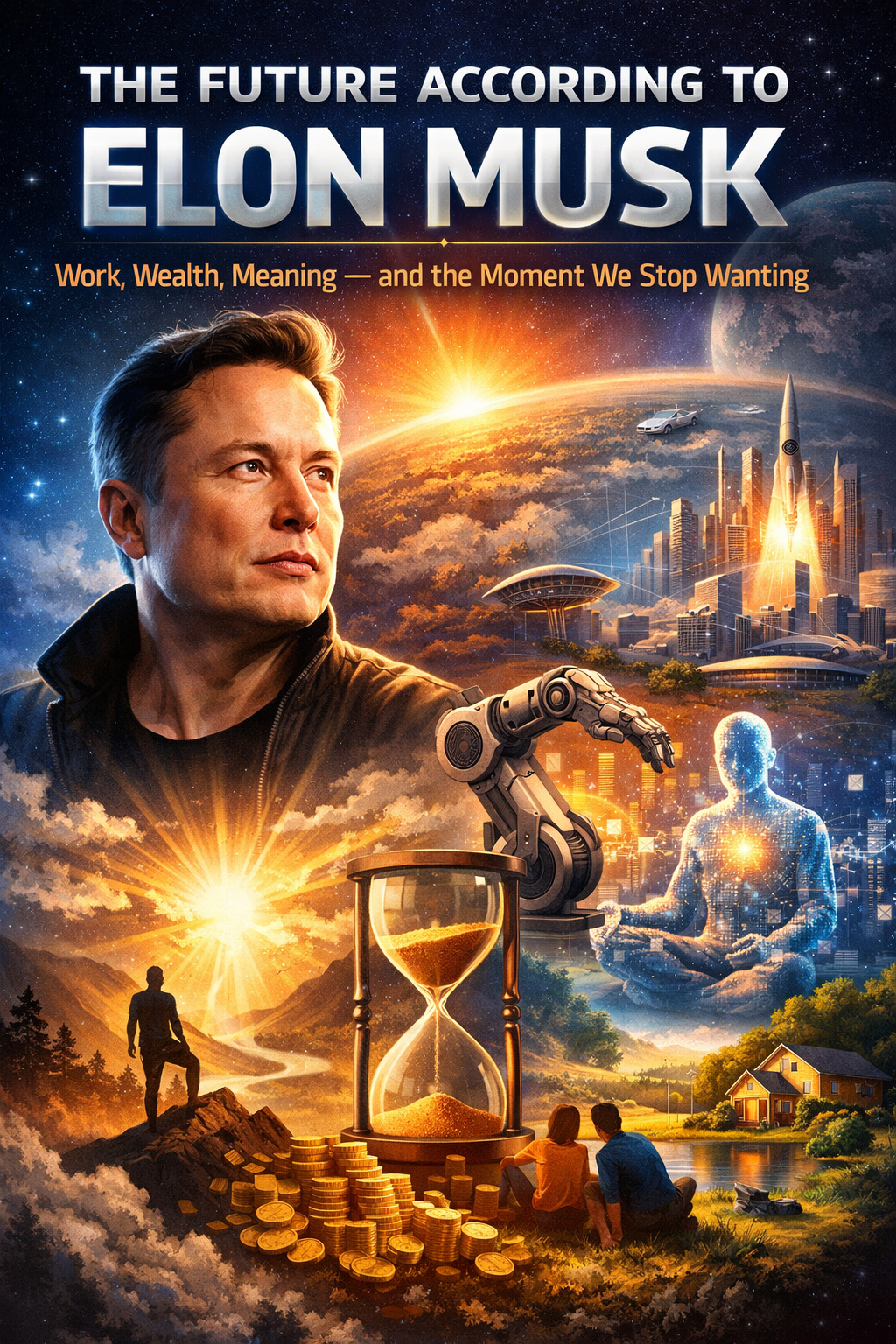
Elon Musk rarely speaks in polished manifestos. Instead, his future vision emerges in fragments: engineering logic mixed with philosophy, blunt realism softened by curiosity. When you place these fragments side by side, a surprisingly coherent picture appears — not just about technology, but about work, money, desire, and the ultimate “stopping point” of human ambition.
This article brings together the core ideas he has discussed and extrapolates their implications for business, society, and individual life paths.
1. Work Will Become Optional — Not Obsolete, but Voluntary
One of Musk’s clearest predictions is this:
“In less than 20 years, probably much sooner, working will be optional.”
This is not framed as a utopian wish but as a byproduct of AI and robotics productivity. As machines become capable of producing goods and services faster than humans can consume them, labor ceases to be economically necessary.
Key implications:
- Work shifts from survival to choice
- Jobs become more like hobbies, crafts, or self-expression
- High-effort work still exists — but only for those who want to push limits
Musk is careful here:
This does not mean ambition disappears. It means coercion disappears.
“You won’t have to be in a city for a job.”
Remote life, rural living, and decentralized lifestyles become viable once location is no longer tied to income.
2. Universal High Income (UHI), Not Universal Basic Income (UBI)
Musk distinguishes between basic and high income.
“I think it will be Universal High Income.”
Why? Because AI-driven production doesn’t just cover survival needs — it floods the system with abundance.
This reframes economic debates:
- Poverty becomes a technical problem, not a political one
- Scarcity economics no longer defines value
- Competition shifts from resources to meaning
But this introduces a deeper question.
3. If Everyone Has Enough… What Do We Compete For?
Humans evolved in scarcity. Status, hierarchy, and competition were survival mechanisms.
Musk openly admits uncertainty here:
“I’m not exactly sure what people will compete for.”
What he does suggest:
- Competition becomes relative, not necessary
- Desire saturates faster than we expect
- Marginal utility collapses (10 marshmallows are worse than one)
This leads to a crucial insight:
“If you can think of it, you can have it.”
And then — the paradox.
4. The Saturation Point: When Wanting Ends
Musk describes a future moment few futurists discuss openly:
AI will eventually run out of things to do for humans.
Not because AI fails — but because human desire has limits.
There is only so much:
- food you want to eat
- entertainment you want to consume
- comfort you can tolerate
At that point:
- AI produces for AI
- Systems become self-referential
- Humanity reaches a desire plateau
This is the real “stopping point” — not technological, but psychological.
5. Money Disappears — Energy Remains
In Musk’s long-term view, money is not eternal.
“Money is just a database for labor allocation.”
When labor allocation is automated, money loses relevance.
What replaces it?
Energy.
- Energy is the true currency
- You can’t legislate energy
- Civilizational progress becomes measurable by energy harnessed
He references the Kardashev Scale:
- Type I: planetary energy
- Type II: stellar (solar)
- Type III: galactic
“Energy is the fundamental currency of the universe.”
Bitcoin, in this framing, matters not because of finance — but because it is energy-based.
6. Business in the Future: Make Useful Things, Period
For entrepreneurs, Musk’s advice is strikingly non-glamorous:
“Just make useful products and services.”
He rejects hype cycles and short-term speculation.
Long-term value depends on:
- product quality
- team capability
- continuous improvement
Stock prices fluctuate.
Utility compounds.
“A company is just a group of people making products.”
This perspective quietly dismantles influencer capitalism, dopamine-driven platforms, and extractive business models.
7. Collective Consciousness Over Dopamine
Musk repeatedly criticizes platforms optimized for “dopamine hits.”
“That’s not a great way to spend time.”
His stated goal for X (formerly Twitter) is not addiction, but:
“A global town square… a collective consciousness.”
Why?
Because better information flow improves collective intelligence.
He compares humanity to:
- cells forming a body
- neurons forming a mind
Just as no single human can build a spaceship, no isolated individual can solve civilizational problems.
8. Simulation, Meaning, and Why This All Might Be a Game
Musk assigns a high probability that we are living in a simulation.
His reasoning:
- Games evolve toward realism
- AI characters become indistinguishable from humans
- Simulations multiply faster than base realities
Statistically, being in the “original” reality becomes unlikely.
His most unsettling idea:
“The most interesting outcome is the most likely outcome.”
Why?
Because boring simulations get shut down.
If that’s true, then:
- crises
- rapid change
- existential questions
are not bugs — they’re features.
9. Morality Without Dogma
Musk does not reject religion — but he rejects moral outsourcing.
He aligns loosely with Spinoza:
- morality can exist without commandments
- functional societies don’t need divine threats to avoid collapse
“A society where people murder each other won’t succeed.”
Ethics, in this view, are emergent properties of systems that want to survive.
10. A Surprisingly Optimistic Conclusion
Despite all the disruption, Musk ends on an unexpected note:
“The world today is actually pretty great.”
Compared to history:
- infant mortality
- plagues
- starvation
- violent death
Modern life is extraordinary.
The future, he believes, won’t be perfect —
but it will be less desperate.
Final Thought
Elon Musk’s vision is not about domination, escape, or transcendence.
It’s about this quiet shift:
From survival → to choice
From scarcity → to saturation
From wanting → to wondering
And when we no longer have to do anything…
the real question becomes:
What is worth doing anyway?
REFERENCE:
Elon Musk: A Different Conversation w/ Nikhil Kamath | Full Episode | People by WTF Ep. 16
 Kika's world