
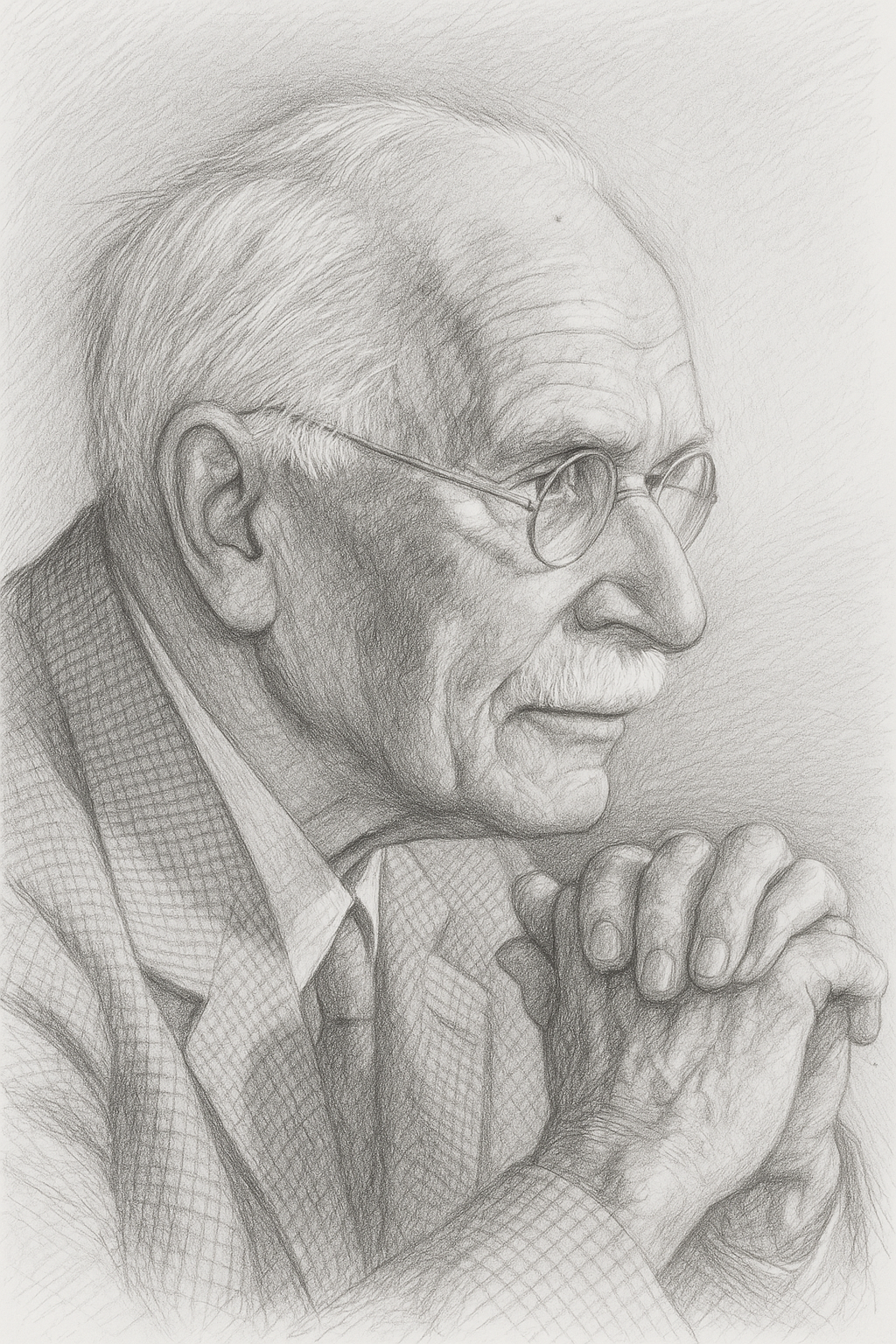
The following article distills a profound conversation with Carl Jung, focusing on his exploration of intuition, its mechanisms, and its manifestations in human behavior. Jung’s insights are illustrated through vivid anecdotes, theoretical distinctions, and connections to broader psychological and scientific inquiries.
1. Defining Intuition: Perception via the Unconscious
Subject: The nature and definition of intuition.
Jung’s Explanation:
Intuition, according to Jung, is a form of perception mediated by the unconscious. Unlike sensory perception, which relies on direct observation, intuition operates through “intermediate links”—subtle, unconscious associations that yield insights without conscious reasoning. Jung likened it to a “chain of associations” where only the final result surfaces in awareness.
“Intuition is a perception by ways or means of the unconscious. That is as near as I can get.”
Real-Life Example:
Jung recounted a story of two patients—a sensation-type man and an intuitive-type woman—who competed to spot diving birds on Lake Zurich. Despite the man’s attention to sensory details, the woman consistently predicted the birds’ resurfacing points through hunches, demonstrating intuition’s uncanny accuracy.
2. Intuitive Types: Extroverted vs. Introverted
Subject: Differences between intuitive-extroverts and intuitive-introverts.
Key Questions:
- How do intuitive-extroverts differ from intuitive-introverts?
- What are their real-world manifestations?
Jung’s Answers:
- Intuitive-Extroverts: These individuals focus on external possibilities. Examples include bankers, gamblers, and hunters who rely on hunches to navigate tangible opportunities or risks.
- Intuitive-Introverts: They perceive “subjective factors” or inner psychic realities. Their insights often involve symbolic or archetypal imagery but are harder to articulate. Jung shared the case of a young woman who envisioned a “golden snake” emerging from her body during therapy—a metaphor for her psychological transformation.
“The introverted intuitive has a very difficult life… [their experiences] are utterly strange to the ordinary individual.”
3. Intuition in Modern and Primitive Contexts
Subject: The role of intuition across environments.
Jung’s Observations:
- Primitive Settings: In unpredictable environments (e.g., uncharted forests), intuition becomes vital for survival. Hunches about favorable locations or unseen dangers guide decisions.
- Modern Life: Even in “safe” urban settings, intuition persists. For example, drivers might sense impending accidents through subliminal cues (e.g., patterns of pedestrian behavior).
Case Study:
Jung described a woman who unknowingly lived in a brothel yet remained oblivious to her surroundings. While she lacked sensory awareness, her intuitive hunches about her therapy’s timeline (e.g., predicting 10 sessions) proved eerily accurate.
4. Intuition and Science: Clashing Perspectives
Subject: The tension between intuition and empirical science.
Key Questions:
- Can intuition align with scientific frameworks like J.B. Rhine’s ESP research?
- How do statistical methods (e.g., Rhine’s experiments) validate intuitive phenomena?
Jung’s Stance:
Jung acknowledged overlaps between intuition and extrasensory perception (ESP), noting that Rhine’s statistical work demonstrated phenomena “beyond chance.” However, he criticized terms like “telepathy” as meaningless labels, emphasizing the need to view intuition as a relativization of time and space through the psyche.
“Rhine proves [intuition] is statistically graspable… a relativation of time and space through the psyche. That’s the fact.”
5. Practical Implications of Intuition
Subject: Intuition’s value in professions and daily life.
Jung’s Examples:
- Doctors: Intuition aids in diagnosing hidden complications.
- Financial Experts: Bankers and investors rely on hunches to navigate volatile markets.
- Everyday Decisions: Subtle warnings (e.g., unease while driving) prevent mishaps.
Takeaway:
While modern society undervalues intuition compared to sensory data, Jung argued that it remains a critical adaptive tool, particularly in professions requiring foresight.
Conclusion: Embracing the “Unseen”
Jung’s dialogue underscores intuition as a bridge between conscious reasoning and unconscious wisdom. Whether through a gambler’s hunch, a doctor’s gut feeling, or an introvert’s inner vision, intuition transcends logic, offering insights that shape human survival and creativity. As Jung concluded, dismissing intuition risks ignoring a fundamental dimension of the psyche—one that science is only beginning to quantify.
“The psychologist should know of such things. You see?”
 Kika's world