
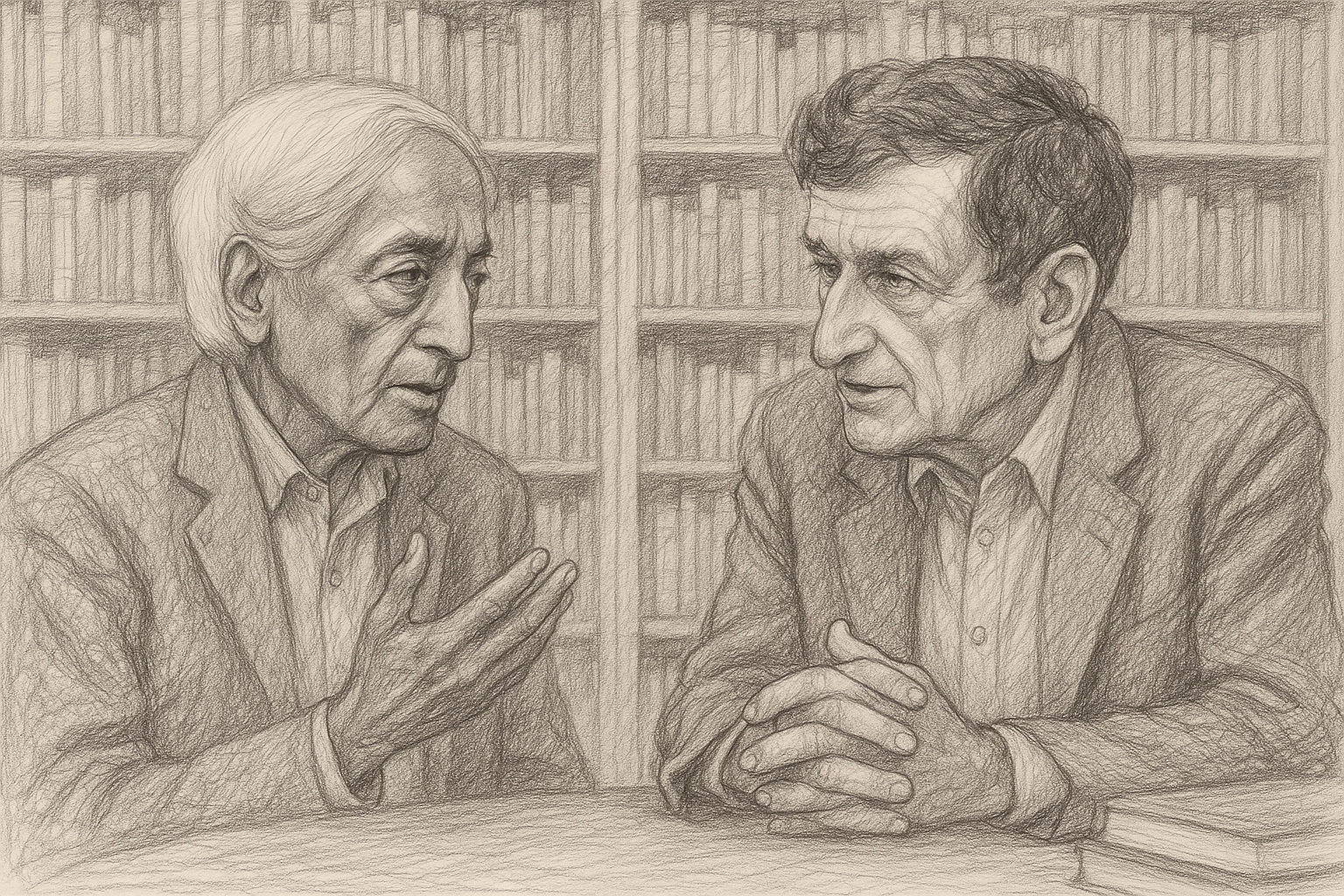
Exploring the Dialogue Between J. Krishnamurti and David Bohm on Insight, Brain Mutation, and Human Transformation (part 6)
The 1980 conversation between philosopher J. Krishnamurti and physicist David Bohm in Ojai, California, delves into profound questions about human consciousness, the nature of insight, and its transformative impact on the brain. Below is a breakdown of the key subjects, questions, and explorations from their dialogue:
1. The Nature of Brain Function and Radical Change
Subject: The brain’s reliance on memory, knowledge, and experience, and the need for a “radical revolution” in human psychology.
- Question: How can a fundamental mutation occur in the brain to break free from its conditioned patterns?
- Krishnamurti’s Perspective: Traditional methods (discipline, societal influence) operate within the same conditioned framework. True change requires insight, which is not a product of thought or will.
- Bohm’s Contribution: The brain’s structure, shaped by millennia of conditioning, resists superficial adjustments. A deeper, non-material force (insight) may be necessary to alter it.
2. Insight and Its Relationship to the Brain
Subject: Whether insight transcends material processes and how it affects brain cells.
- Question: Can insight, as a non-material phenomenon, physically alter the brain?
- Key Dialogue:
- Krishnamurti: Insight is “causeless” and not bound by time or thought. It dispels the “darkness” of conditioned thinking.
- Bohm: Scientifically, non-material entities influencing matter challenge causality. Yet, Krishnamurti argues insight acts like a “flash of light” that reorganizes the brain’s material processes.
- Metaphor: Insight is likened to a lightning bolt illuminating darkness—once the brain operates in this “light,” ignorance (the self-centered content) dissolves.
3. The Paradox of Dualities: Love vs. Hate, Peace vs. Violence
Subject: The independence of opposites like love/hate and their coexistence.
- Question: Can love or peace act upon hate or violence, or are they mutually exclusive?
- Exploration:
- Krishnamurti: Love and hate cannot coexist. Where love exists, hate cannot. Similarly, insight (causeless) cannot interact with conditioned thought (causal).
- Bohm: This challenges scientific reciprocity (action-reaction). Krishnamurti insists love and insight operate outside causal chains, making them transformative forces.
4. The Danger of Spiritual Assumptions
Subject: The risk of attributing insight to a “god within” or supernatural force.
- Question: Is there a part of the brain untouched by consciousness?
- Krishnamurti’s Warning: Assuming a “higher self” risks creating new illusions. The brain’s conditioned content often co-opts such ideas, leading to self-deception.
- Resolution: True insight avoids traps by recognizing the mind’s tendency to project separateness (e.g., “spirit” vs. “matter”).
5. Why Isn’t Insight Natural to Everyone?
Subject: The puzzling absence of innate insight in most humans despite its perceived naturalness.
- Questions:
- Why do societal conditioning and evolutionary instincts dominate?
- If insight is natural to some (e.g., Krishnamurti), why not all?
- Exploration:
- Krishnamurti: Rejects explanations like karma or elitism. Suggests humanity’s collective mind has taken a “wrong turn,” prioritizing causality (hate responding to hate).
- Bohm: Evolutionary survival may favor cause-effect responses, but insight’s sporadic emergence hints at latent potential in all.
6. Scientific and Philosophical Tensions
Subject: Bridging scientific materialism and metaphysical insight.
- Key Points:
- Bohm: Science struggles with non-material causality but acknowledges deeper layers of matter (e.g., quantum fields).
- Krishnamurti: Thought is a material process; insight transcends it. The brain, once illuminated, operates free from past conditioning.
Conclusion: Implications for Humanity
The dialogue leaves unresolved questions but posits that insight—a sudden, causeless clarity—holds the key to psychological mutation. For Krishnamurti, this is not mystical but a natural capacity obscured by humanity’s historical trajectory. The challenge lies in recognizing that insight cannot be cultivated—it arises when the “center of darkness” (the self) dissolves.
Final Reflection: If insight is indeed latent in all, as Krishnamurti implies, the task is not to seek it but to cease perpetuating the conditioned patterns that block it. The conversation remains a provocative invitation to explore beyond the limits of thought.
Analysis of the Krishnamurti-Bohm Dialogue Through a Gestalt Perspective
The dialogue between J. Krishnamurti and David Bohm explores profound themes of insight, brain mutation, and human transformation. By applying Gestalt psychology—a framework emphasizing holistic perception, figure-ground dynamics, and insight as restructuring—we can uncover deeper layers of their conversation.
1. Holistic Transformation vs. Fragmented Change
Gestalt Principle: The whole is greater than the sum of its parts.
- Dialogue Alignment:
Krishnamurti critiques incremental adjustments (e.g., societal reforms, discipline) as superficial, arguing instead for a “total insight” that restructures the entire brain. This mirrors Gestalt’s focus on holistic perception, where fragmented efforts fail to address the root of psychological conditioning. - Key Quote:
“Partial insight… is directed and limited. Total insight illuminates the whole field of consciousness.”
2. Figure-Ground Dynamics in Consciousness
Gestalt Principle: Perception involves distinguishing figures (salient elements) from ground (context).
- Dialogue Alignment:
The pair contrast “darkness” (conditioned thought, hate) with “light” (insight, love). Here, insight emerges as the figure against the ground of ingrained brain patterns. The mutation they describe is a perceptual shift where insight reorganizes the mental “ground.” - Metaphor:
“Insight is a flash of lightning—it illuminates the darkness, dissolving the self-centered content.”
3. Insight as Restructuring
Gestalt Principle: Problem-solving occurs through sudden insight (“Aha! moments”) that restructures perception.
- Dialogue Alignment:
Krishnamurti’s “flash of insight” parallels Gestalt’s “Aha!” experience. He describes it as a causeless, timeless event that dissolves ignorance, enabling the brain to operate outside conditioned frameworks. - Bohm’s Contribution:
Acknowledges the scientific challenge of non-material insight affecting matter but aligns with Gestalt’s view of cognitive restructuring: “The brain, once illuminated, begins to act differently.”
4. Contextual Interdependence and Field Theory
Gestalt Principle: Phenomena are understood within their context; the individual is part of a dynamic field.
- Dialogue Alignment:
Bohm’s reference to “deeper levels of matter” and Krishnamurti’s idea of humanity’s “wrong turn” reflect Gestalt field theory. The brain’s conditioning is a disrupted field, while insight represents a realignment with a latent, universal potential. - Key Tension:
“Why isn’t insight natural to everyone?” suggests a fractured field (society’s prioritization of causality) obscuring innate wholeness.
5. Paradox of Dualities: Transcendence vs. Integration
Gestalt Principle: Contradictions are resolved through integration.
- Dialogue Divergence:
While Gestalt seeks to harmonize opposites (e.g., love/hate), Krishnamurti asserts their mutual exclusivity: “Where love exists, hate cannot.” Here, transformation requires transcending duality rather than integrating it—a unique departure from Gestalt’s traditional resolution. - Implication:
Insight dissolves the “center of darkness” (self), eliminating duality’s root instead of reconciling its expressions.
6. Resistance to Conceptual Fragmentation
Gestalt Principle: Avoid fragmenting experience into artificial categories.
- Dialogue Alignment:
Krishnamurti warns against attributing insight to a “higher self” or “god within,” which would fragment consciousness. Similarly, Bohm critiques materialist science for reducing thought to brain chemistry, neglecting its holistic nature. - Key Warning:
“Assuming a ‘part of the brain untouched by content’ risks creating new illusions.”
Conclusion: A Gestalt-Informed Transformation
The dialogue embodies Gestalt principles through its emphasis on holistic insight, perceptual restructuring, and contextual interdependence. However, Krishnamurti challenges traditional Gestalt resolution by positing that dualities (love/hate) cannot coexist—transcendence, not integration, is the path. This analysis underscores the conversation’s alignment with Gestalt’s pursuit of wholeness while highlighting its unique stance on irreconcilable opposites.
Final Reflection:
The Krishnamurti-Bohm dialogue invites a Gestalt-informed understanding of human potential: insight as a spontaneous, holistic reorganization of consciousness, freeing the mind from fragmented conditioning. Yet, it pushes beyond Gestalt by framing transformation as a leap into non-duality—a call to perceive reality not as parts to integrate, but as a field to illuminate.
 Kika's world