
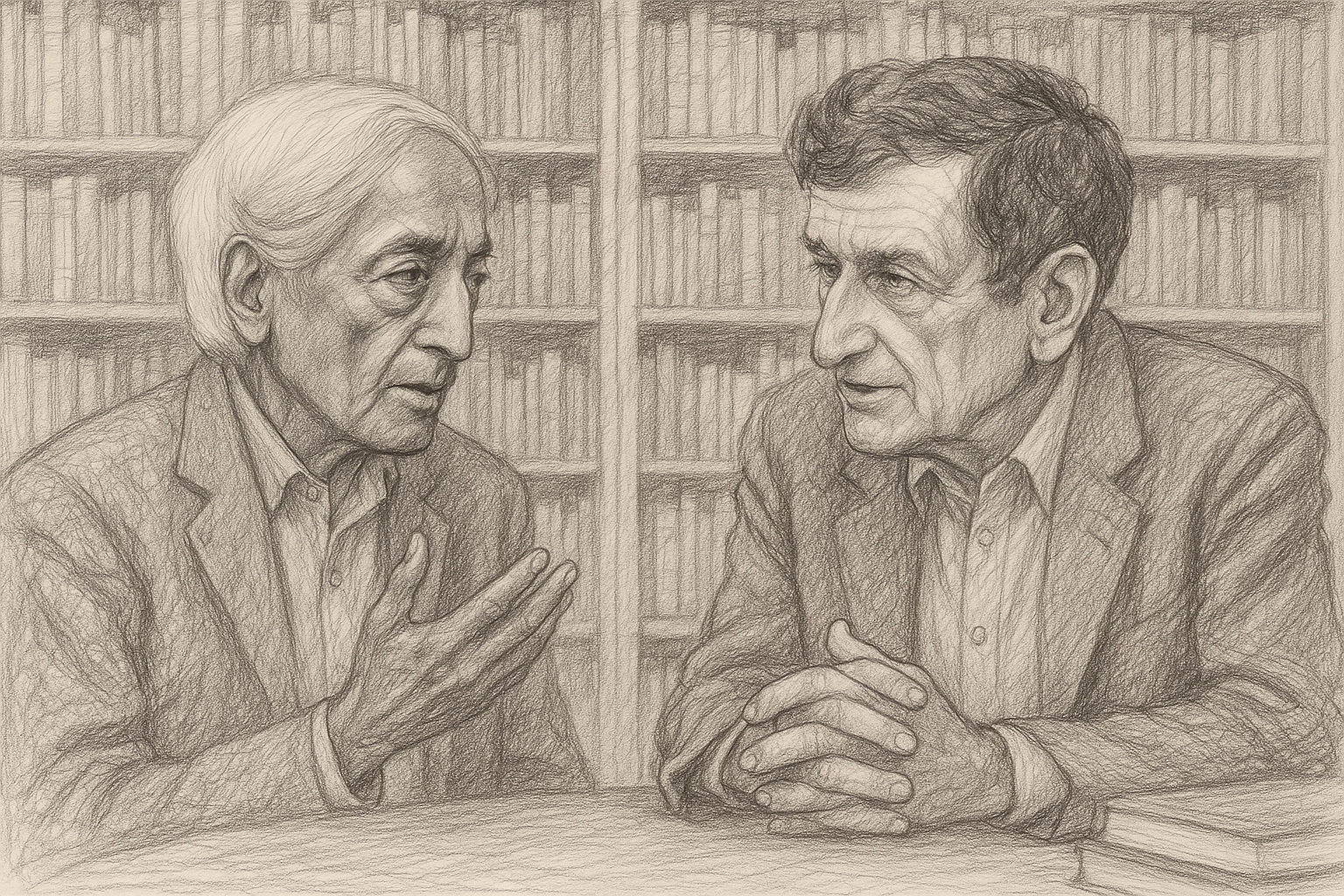
Ojai, 1980 – The Ending of Time, Conversation 5
Key Subjects and Themes
- The Nature of the “Ground”
- The dialogue revolves around the concept of an ultimate, immovable reality termed the “ground.”
- Krishnamurti questions whether this ground can be approached through ideas, philosophies, or knowledge. He asserts that the ground is beyond thought and conceptualization.
- Bohm adds that ideas are often mistaken for reality, creating illusions that obscure direct perception.
- Limitations of Knowledge and Ideas
- Both thinkers critique the overreliance on knowledge, particularly in Western thought. Krishnamurti argues that knowledge conditions the mind, trapping it in repetitive patterns.
- Krishnamurti: “Knowledge may be illusion itself… All my virtue, abstinence, and control are valueless.”
- Bohm agrees, noting that science and philosophy often mistake conceptual frameworks for truth.
- The Illusion of the Self
- Krishnamurti emphasizes that the self (the “center”) is a construct of accumulated knowledge and experience. This self perpetuates division, fear, and suffering.
- Krishnamurti: “The core of the mind remains unchanged even after a million years of effort… The center must be blasted away.”
- The dialogue concludes that the self cannot relate to the ground because it is inherently illusory.
- Religious vs. Philosophical Minds
- Krishnamurti distinguishes between a mind disciplined in philosophy (love of wisdom through concepts) and a religious mind (direct perception of truth).
- He critiques organized religion for reducing spirituality to dogma and rituals, akin to philosophy’s reliance on ideas.
- The Futility of Effort
- Both speakers explore the paradox of seeking truth: all efforts (prayer, meditation, asceticism) are rooted in the self’s desire for reward or certainty, perpetuating illusion.
- Krishnamurti: “When the ground says, ‘You have no relationship with me,’ it shatters the seeker… This shock births a new mind.”
- The Phoenix Metaphor
- The conversation likens liberation to the Phoenix rising from ashes. Letting go of all knowledge and effort allows a “new mind” to emerge, unburdened by the past.
Critical Questions and Insights
- Can the Ground Be Understood Through Thought?
- Answer: No. The ground transcends thought, concepts, and experience. Krishnamurti insists it cannot be “proven” or “shown,” as proof relies on knowledge.
- How Does One Transcend Conditioning?
- Krishnamurti: By realizing the futility of all accumulated knowledge. The mind must see that its efforts are “ashes” and cease striving.
- Bohm: The illusion of separation (self vs. ground) dissolves only when the mind stops seeking certainty.
- What Is the Relationship Between Humanity and the Ground?
- Answer: None. The self-centered mind cannot relate to the ground. True perception arises when the mind empties itself of all constructs.
- Is There Hope for Liberation?
- Krishnamurti: Yes, but not through effort. Liberation occurs when the mind fully acknowledges its limitations and “dies to the known.”
Eastern vs. Western Perspectives
- Eastern Thought: Vedanta’s “end of knowledge” aligns with Krishnamurti’s view but risks becoming another concept.
- Western Thought: Overemphasis on science and logic creates a barrier to perceiving the ground. Even religious frameworks (e.g., Christianity) reduce truth to ideas like “grace.”
Conclusion: The Birth of a New Mind
The dialogue culminates in a radical proposition: the mind conditioned by knowledge must end for the ground to manifest. This requires no effort, only the profound realization that all pursuits—spiritual, philosophical, or scientific—are futile. As Krishnamurti states, “When the center is gone, the mind is the ground.” This “new mind,” free from the past, embodies true creativity and compassion, unshackled by illusion.
Final Metaphor: Like the Phoenix, humanity must rise from the ashes of its accumulated knowledge to embrace a reality beyond time and thought.
“The ending of time is the ending of thought.” – J. Krishnamurti
Analyzing the Krishnamurti-Bohm Dialogue Through a Gestalt Lens
Integrating Holistic Perception and the “Here-and-Now”
Core Gestalt Principles Applied to the Dialogue
- Figure-Ground Dynamics:
- Key Insight: Gestalt psychology emphasizes that perception organizes experience into a “figure” (focal point) and “ground” (background context). Krishnamurti’s “ground” mirrors this—it is the undivided whole, while ideas, knowledge, and the self are transient “figures.”
- Dialogue Link: Krishnamurti argues that the mind’s fixation on figures (concepts, beliefs, efforts) obscures the ground. For example, seeking the ground through philosophy or religion is like fixating on a figure while missing the background. Bohm adds that mistaking ideas for reality reflects a failure to perceive the ground’s wholeness.
- Closure and Incompleteness:
- Key Insight: The mind seeks closure (completeness) through patterns. However, unresolved tensions (“unfinished business”) perpetuate suffering.
- Dialogue Link: The human craving for certainty—demanding “proof” of the ground—is an attempt to force closure. Krishnamurti critiques this as futile: “Proof relies on knowledge, which is incomplete.” Gestalt aligns here: True resolution comes not by forcing closure but by dissolving the need for it.
- The Here-and-Now:
- Key Insight: Gestalt therapy prioritizes present-moment awareness over past conditioning or future projections.
- Dialogue Link: Krishnamurti’s emphasis on ending time (“the ending of thought is the ending of time”) mirrors this. The “million years of effort” represent fixation on past/future; liberation arises when the mind operates in the immediacy of the now.
- Holism vs. Fragmentation:
- Key Insight: Gestalt rejects reductionism, advocating for integrated perception. Fragmentation (e.g., separating self from reality) creates dysfunction.
- Dialogue Link: The “self” (center) is a fragmented construct. Krishnamurti calls it an illusion; Bohm notes it perpetuates division. Gestalt therapy would aim to reintegrate this fragmented self into the whole (ground).
- Paradoxical Theory of Change:
- Key Insight: Change occurs not by striving but by fully experiencing “what is.”
- Dialogue Link: Krishnamurti’s “shock of futility”—realizing all effort is ashes—aligns with this. The mind changes only when it stops trying to change and instead confronts its actual state.
Gestalt Critique of the Dialogue’s Themes
- The Illusory Self as a Rigid Gestalt:
- The self is a fixed pattern (gestalt) formed by accumulated knowledge. Krishnamurti’s call to “blast the center” parallels Gestalt’s goal of dissolving rigid patterns to allow fluid awareness.
- Knowledge as Incomplete Figures:
- Western science and philosophy, critiqued in the dialogue, represent incomplete figures masquerading as the whole. Gestalt would argue that clinging to these figures prevents contact with the ground’s totality.
- The Role of Awareness:
- Gestalt emphasizes awareness as curative. Similarly, Krishnamurti insists liberation arises not from effort but from “seeing” the mind’s limitations. Both reject intellectualization in favor of direct perception.
- The Phoenix Metaphor as Gestalt Emergence:
- The Phoenix rising from ashes symbolizes the birth of a new gestalt. Letting go of old patterns (knowledge, self) allows a spontaneous, organic reorganization of consciousness.
Gestalt Solutions to the Dialogue’s Questions
- How to transcend conditioning?
- Gestalt Answer: Engage in dialogue (as Bohm and Krishnamurti do) to expose fixed patterns. Use experiments (e.g., empty-chair technique) to confront the “center” as an illusion.
- What is the relationship between humanity and the ground?
- Gestalt Answer: The relationship is not transactional but existential. Humanity is the ground when fragmentation ends.
- Can the ground be understood through thought?
- Gestalt Answer: No. Thought creates figures; the ground is perceived through holistic awareness.
Synthesis: A Gestalt Path to the Ground
- Dissolve Figures: Let go of ideas, beliefs, and efforts that dominate awareness.
- Embrace the Now: Shift focus from past/future to immediate experience.
- Reintegrate Fragments: Recognize the self as part of the whole, not separate.
- Allow Emergence: Trust that a new gestalt (the “ground”) arises organically when rigidity ends.
“The ground is not found—it is what remains when the mind stops creating figures.”
—A Gestalt Interpretation of Krishnamurti’s Insight

