
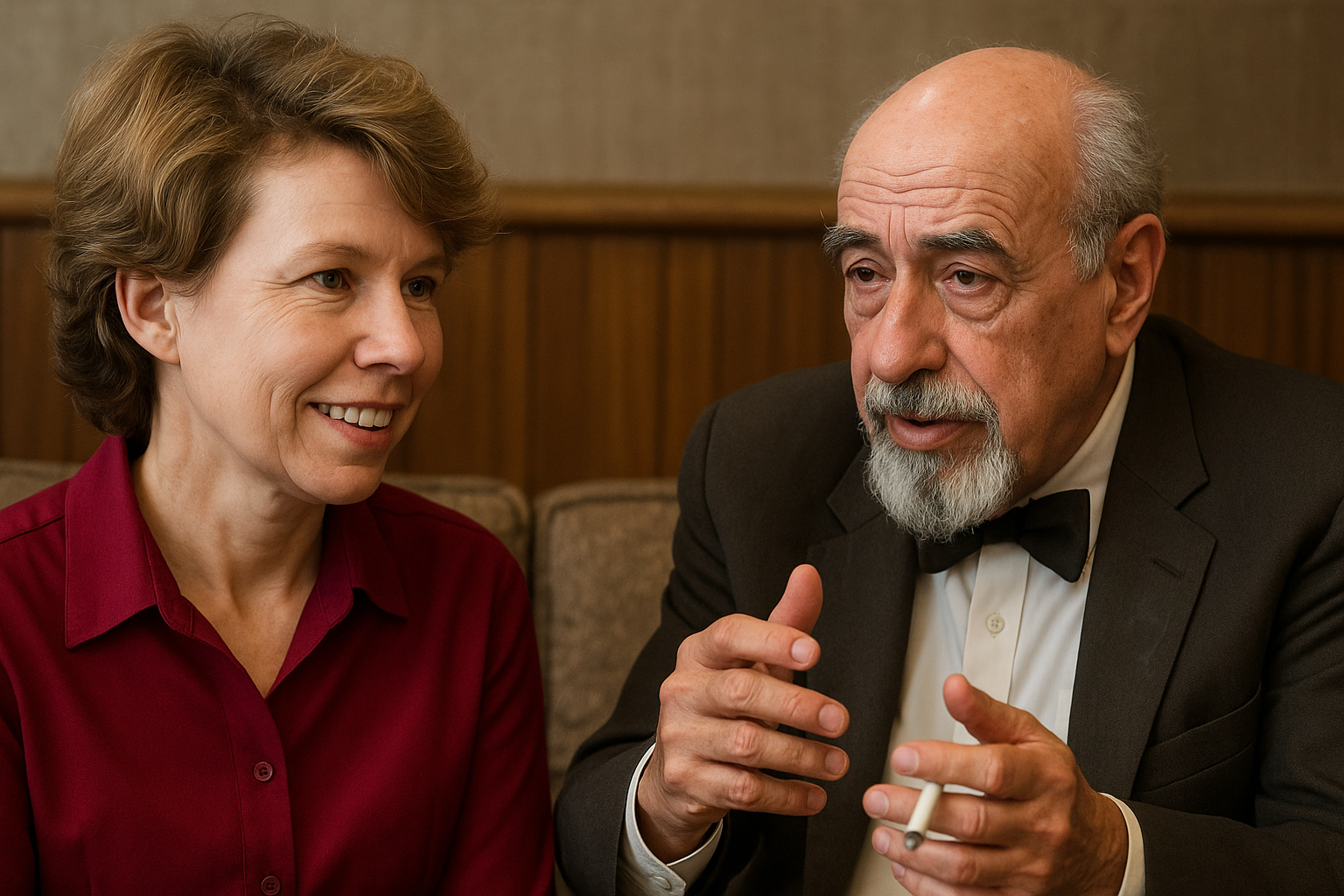
- (Image created by chatGPT)
A dialogue between physics and Gestalt therapy
Introduction: The Mystery of Time and Choice
There is something deeply human in pausing to wonder: What is time? Do I really choose my life?
We experience the passing of hours, the unfolding of days, and the weight of decisions. Yet, when physicists like Sabine Hossenfelder tell us that time may not “flow,” that free will is an illusion, and that consciousness does not magically collapse reality into being, our intuitive sense of life feels challenged.
At the same time, Gestalt Therapy—rooted in existential philosophy and awareness practice—invites us into the immediacy of “here and now.” It reminds us that while the universe may be deterministic, our lived reality unfolds through polarities, awareness, and the dance of contact between self and world.
In this blog, I want to bring these worlds into conversation: physics and therapy, the block universe and the therapeutic field, determinism and responsibility. Sometimes they speak in parallels, offering the same perspective with different words. At other times they reveal polarities—two opposing but complementary views on the same human question.
Part I: Time and the Block Universe
Physics: Time as Dimension
Sabine explains that Einstein’s theory of relativity dismantled our everyday view of time. Time, rather than being a universal flow, is just another dimension—woven together with space into a four-dimensional fabric. From this perspective, past, present, and future exist equally. The “now” is not universal but depends on the observer.
This gives rise to the block universe: a timeless structure where every event, from the birth of a star to your next breath, exists already. The future is not waiting to be born—it simply is.
Gestalt Parallel: The Field is Whole
Gestalt Therapy, though born from psychology rather than physics, speaks a similar language in its concept of the field. Everything is interconnected, part of a larger whole. The present moment is not isolated; it is the emergent figure against a vast ground of past experiences, cultural influences, and future anticipations.
Just as relativity says “now” depends on the observer’s frame, Gestalt says the figure you perceive depends on your perspective within the field. Reality is whole; what we notice is a slice.
Parallel: Both views deny a single, universal “now.” Both affirm that reality is a vast structure, and our experience is only one relational angle into it.
Part II: Free Will and Determinism
Physics: No Room for Free Will
Sabine’s argument is clear: the laws of physics are deterministic equations. Given initial conditions, the future is set—already written since the Big Bang. Even randomness in quantum mechanics doesn’t save free will, because randomness is not willed.
Free will, in the sense of “I could have done otherwise,” is an illusion. Our sense of choice comes only from not knowing the outcome of the brain’s calculation until it finishes.
Gestalt Polarity: Responsibility and Choice
Here Gestalt stands as a polar opposite. Gestalt Therapy places deep emphasis on choice and responsibility. Not in the metaphysical sense of being outside causality, but in the experiential sense: at each moment, I stand between polarities, and I choose how to move.
In Gestalt, freedom is not about escaping determinism; it is about becoming aware of the forces at play—internal, relational, societal—and responding authentically. Fritz Perls would say: “Awareness, per se, is curative.”
Polarity: Physics dismisses free will as incoherent; Gestalt reframes free will into lived responsibility.
Part III: Consciousness and the Observer
Physics: Consciousness Not Required
Many interpretations of quantum mechanics flirt with the idea that consciousness collapses the wave function. But Sabine remains skeptical: there is no evidence consciousness plays a special role in physics. The observer is simply a coordinate system, not a mystical mind.
Gestalt Parallel and Polarity
Here we find both parallel and polarity.
- Parallel: Gestalt, too, avoids mysticism. The “observer” in therapy is simply the part of us that becomes aware of experience. Like physics’ coordinate system, it structures perception but does not create reality.
- Polarity: Yet Gestalt honors consciousness as transformative. When a client brings unconscious patterns into awareness, the field shifts. Not because consciousness collapses reality, but because it changes the figure/ground of experience, altering what becomes possible in relationship.
Part IV: Living in Polarities
Gestalt Therapy teaches that life is lived in polarities: yes and no, self and other, freedom and necessity. Growth is not about erasing one side but about holding both.
Physics, too, lives with paradox: wave and particle, determinism and randomness, space and time fused into one.
In this sense, both disciplines encourage us to live with tension rather than resolution. To accept that reality is larger than simple categories.
Part V: Stories of Parallels and Polarities
Let’s weave a few human stories:
- A client feels stuck, replaying regrets from the past. Physics whispers: the past still exists as real as the present. Gestalt asks: What figure from that past is still unfinished, seeking closure now?
- A scientist insists free will is nonsense. A therapist responds: Perhaps. But what do you do when you feel anger? Do you deny choice, or do you take responsibility for how you express it?
- A meditator experiences timeless presence. Sabine’s block universe offers a rational twin: all times coexist. Gestalt nods: awareness is the gateway into that felt timelessness.
Part VI: Towards an Existential Softness
The convergence of physics and Gestalt is not about solving mysteries, but softening our stance toward them.
- If time is a block, then each moment is already written. But Gestalt reminds us: even if written, living it consciously is transformative.
- If free will is an illusion, then responsibility is simply another pattern of the universe. But in our experience, it matters.
- If consciousness does not collapse the wave, it still reshapes the story we tell ourselves.
Life, then, is not about control but about participation—being aware, being present, and embracing the paradoxes.
Part VII: Probability – Between Certainty and Possibility
Physics: Randomness Without Will
In Sabine’s explanation, the universe is governed by deterministic equations with occasional quantum jumps. These jumps are probabilistic—they follow strict mathematical distributions, but no one, not even the particle itself, “decides” the outcome.
Probability here is not about freedom; it’s about structured uncertainty. The dice are loaded by the laws of physics, yet the outcome remains unpredictable in detail.
Gestalt Parallel: The Field of Possibilities
Gestalt Therapy resonates with this. Each moment in the therapeutic encounter is a field of possibilities: how the client responds, what figure emerges, what word is spoken next. Nothing is entirely free, because each option is shaped by history, context, and the relational field. But there is unpredictability—newness can appear.
Probability, then, is a parallel: in both physics and Gestalt, the future is not fully open, nor fully closed. It is a distribution of likelihoods.
Gestalt Polarity: Predictability vs. Surprise
Gestalt also highlights the polarity: we long for certainty, yet we thrive on surprise. Therapy is not about making life predictable, but about expanding awareness so that more possibilities become visible.
Here, physics and therapy diverge:
- Physics says: probability is mathematical, impersonal, without meaning.
- Gestalt says: probability is lived as uncertainty, and in that uncertainty lies the possibility of creativity, change, and growth.
Story Example
Imagine tossing a coin. Physics tells us the trajectory is deterministic if we knew all initial conditions, but practically we treat it as 50/50 probability. In Gestalt terms, life is like that coin toss: structured by the past, but open enough that new configurations emerge.
Part VIII: Chaos – Order at the Edge
Physics: Chaos Without Freedom
In physics, chaos does not mean randomness. It means deterministic systems that are highly sensitive to initial conditions. A tiny change at the start produces wildly different outcomes—like the famous butterfly effect.
Sabine stresses this: chaos may make prediction impossible, but it does not open the door to free will. The system still follows deterministic laws, just in a way that looks unpredictable from our limited perspective.
Gestalt Parallel: Sensitivity of the Field
In Gestalt Therapy, the human field is just as sensitive. A single word, a glance, an interruption can shift the whole process of a session. Like chaotic systems, relationships and inner processes amplify small differences into large transformations.
Here is a parallel: both physics and Gestalt show us that complexity grows from sensitivity, not randomness.
Gestalt Polarity: Chaos vs. Stability
Gestalt also explores the polarity between chaos and order in personal growth. Change often begins with a disruption, a chaotic period when old structures break down. The therapist knows: don’t rush to fix the chaos. Stay with it. Out of disorganization emerges a new figure, a new order.
This polarity is life-giving:
- Too much stability → rigidity, stagnation.
- Too much chaos → fragmentation, overwhelm.
- The dance between them → creativity, growth, transformation.
Story Example
Think of a client who suddenly feels their life is “falling apart.” From a physics lens, we could say: you are in a chaotic system, still following laws, but unpredictable in outcome. From a Gestalt lens: this chaos is part of the growth cycle, a fertile void where something new can be born.
Part IX: Questions for the Reader
To make this exploration interactive, I invite you to reflect:
- When you hear that the past, present, and future exist equally in a block universe, how does that change your relationship to regret or hope?
- If free will is an illusion, what does responsibility mean for you? Is it still real in your lived experience?
- In what ways does your awareness reshape your reality, even if physics says consciousness is not special?
- What polarities in your life are you currently holding—freedom vs necessity, self vs other, hope vs despair?
- Can you live with paradox without rushing to resolve it? What does it feel like to simply stay with the tension?
Conclusion
Physics gives us equations; therapy gives us meaning. Together, they sketch a world that is both determined and alive, fixed and open, whole and fractured.
Sabine Hossenfelder’s sharp clarity and Gestalt Therapy’s experiential wisdom do not cancel each other—they enrich each other. They remind us that while the universe may be a block of spacetime, our lived reality is a dance of awareness, responsibility, and paradox.
Perhaps the task is not to decide whether free will or time’s flow are “real,” but to ask: How do I live in this mystery? How do I bring awareness to the polarities shaping my experience?
In the end, the story is not about escaping determinism. It is about living consciously in the field, knowing that awareness itself—though not magical—is profoundly transformative.
REFERENCES:
You don’t have free will, but don’t worry.
I don’t believe in free will. This is why
What if the Effect Comes Before the Cause?
Sabine Hossenfelder – What’s the Deep Meaning of Probability?
 Kika's world