
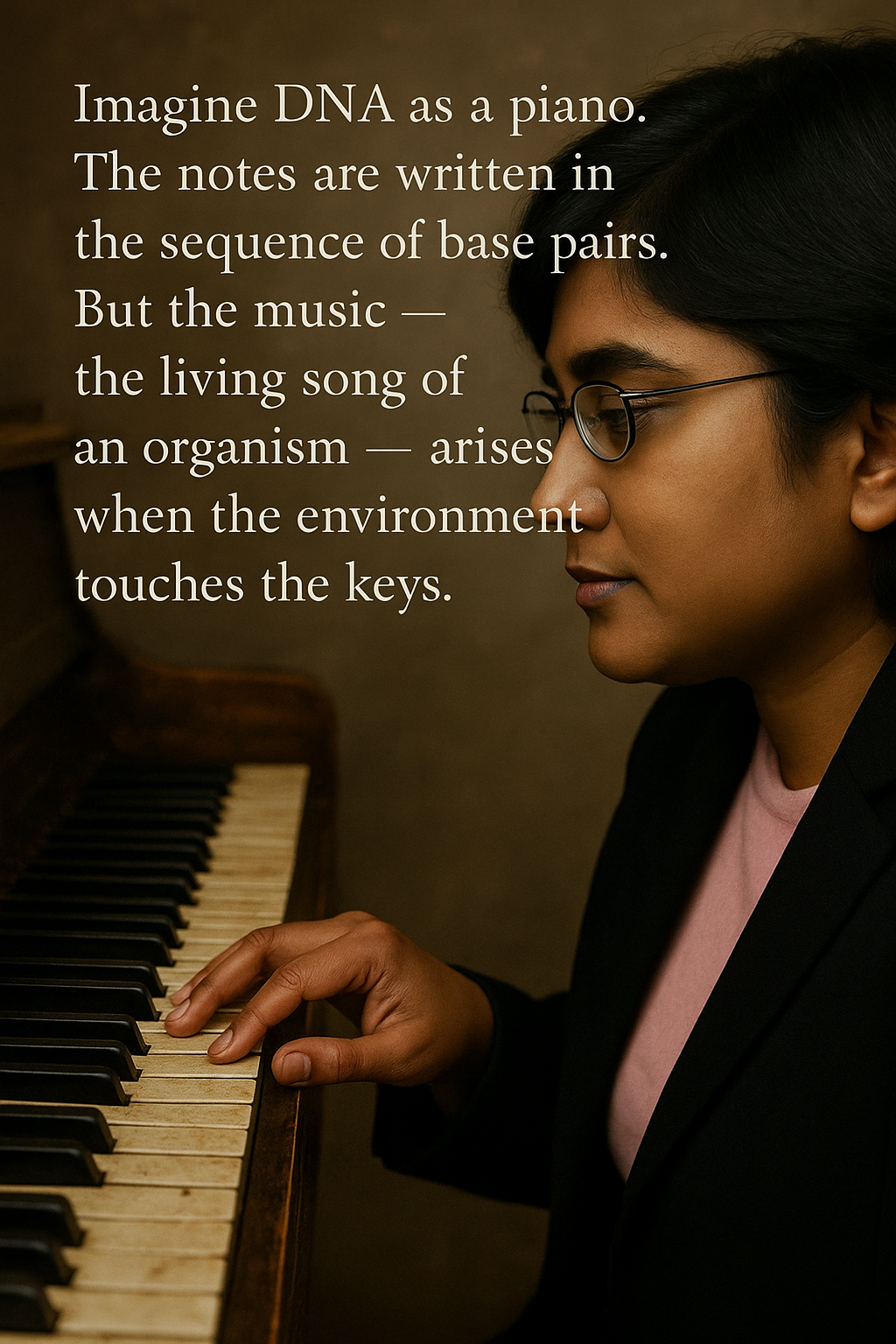
Image created by ChatGPT
What if the code of life is not merely written in molecules, but sung in quantum harmonies? What if our DNA is not only chemistry, but also consciousness listening to the whispers of the cosmos?
For centuries, physics has spoken in the language of matter and energy. It has measured stars, split atoms, built computers, and carved the industrial age. Yet, in all its brilliance, it has turned away from the greatest mystery of all: life itself.
Living systems are not closed machines. They are open symphonies — exchanging matter, energy, and information with their environment. They are far from equilibrium, resisting entropy by weaving patterns of self-organization. They breathe, they feel, they know. But physics, for the most part, has left them aside, comfortable in the predictable realm of inanimate systems.
Dr. Anita Goel, physician, physicist, and pioneer in nanotechnology, stands at the edge of this frontier. Her vision is bold: the molecular machines that copy our DNA — tiny nanomotors whirring inside every cell — may not merely follow chemical laws. They may be quantum computers, maintaining coherence long enough to sense, process, and decide.
DNA as the Piano, the Environment as the Pianist
“Imagine DNA as a piano,” Goel says. “The notes are written in the sequence of base pairs. But the music — the living song of an organism — arises when the environment touches the keys.”
Two people may carry the same gene, one that predisposes them to illness. Yet only one falls sick. Why? Because beyond the static code lies the milieu — the world of signals, forces, and fields that shape expression.
Is mutation purely random, as Darwin taught? Or could the environment influence how the nanomachines make mistakes, correct errors, and evolve? Here, Lamarck whispers back into science, suggesting that life may be more responsive, more tuned to context than we dared admit.
Nanomachines: Quantum Engines of Life
Consider this: the DNA polymerase, a motor that reads and writes genetic code, operates with an efficiency of 99.99%. No car, no human invention, comes close. To copy a single base of DNA, it performs an estimated hundred billion internal steps in just milliseconds.
What is it “thinking” about?
Could it be searching through possibilities, like a quantum algorithm finding the right match in a sea of candidates? Could it be listening to quantum whispers from its environment, sensing fields beyond our classical imagination?
If so, then the most essential machinery of our bodies is not only chemical — it is quantum mechanical. And this would mean that life itself is quantum poetry in motion.
The Double Slit Dream
In physics, the double slit experiment revealed the quantum world: particles that behave as waves, collapsing into certainty when observed. Goel dreams of performing a similar experiment on living systems — to catch DNA nanomachines in the act of maintaining coherence, showing interference patterns, proving their quantum nature.
It is a moonshot. It requires technologies of exquisite precision. But if achieved, it would be a scientific earthquake: demonstrating that the building blocks of biology live in the quantum domain.
Information: The Third Element
Einstein gave us matter and energy, bound by the elegance of E = mc². But Goel suggests we must add a third: information.
Information is not abstract. It is as real as a stone, as physical as light. It shapes how molecules move, how systems organize, how life emerges. The universe may not be built only from atoms and waves, but also from patterns, codes, and symmetries.
John Wheeler, the great physicist, once said: “It from bit.” Goel takes it further: matter, energy, and information dance together in an inseparable triad.
Something Missing in Quantum Mechanics
For all its triumphs, quantum mechanics remains unfinished. It explains the dance of particles, builds lasers and computers, and predicts experiments with uncanny precision. Yet even its founding fathers — Einstein, Schrödinger, and later Roger Penrose — felt a quiet dissatisfaction.
Einstein never believed the story was complete. “God does not play dice,” he insisted, pointing to the mystery of randomness at the heart of the quantum world. Schrödinger, too, felt unease. His famous thought experiment of the cat — alive and dead at once until observed — was not meant as a celebration, but as a warning: this theory leaves something unresolved. Penrose has echoed the same: quantum mechanics works, but it may be hiding a deeper layer of reality.
Dr. Goel adds her voice to this lineage of doubt. She sees that the equations of quantum mechanics describe probabilities for ensembles, but not the trajectory of a single molecule. The wave function, elegant though it is, lacks resolution. It is a low-definition picture of a high-definition universe.
And so she asks: What if our physics is incomplete because it has not yet come to terms with life, living systems, and consciousness?
To pretend we have a “theory of everything” while ignoring these phenomena, she argues, is premature. A true unification must embrace the very fabric of experience — the way cells exchange matter, energy, and information with their environment, and the way awareness itself arises.
Something is missing in quantum mechanics. Perhaps it is the recognition that consciousness is not outside the equation, but inside it — woven into the heart of reality itself.
The Secret Life of DNA Strings
DNA is not a static code carved in stone. It is a living string, a dynamic thread constantly responding to the environment. In Dr. Goel’s experiments, she shows that the very speed at which DNA is read can be tuned — slowed, halted, or even reversed.
With lasers stretching the delicate strand, her team has observed how tension changes the polymerase motor’s behavior. Under certain conditions, the nanomachine comes to a stop. With more force, it shifts into reverse, unzipping the DNA, correcting mistakes, erasing errors as though pressing a cosmic backspace key.
This is more than mechanics. It is music.
The DNA string is like a violin string, vibrating differently depending on how it is played. The environment — mechanical forces, electromagnetic fields, even quantum signals — acts as the bow. Together, they produce the melody of life.
Two people may carry the same genetic mutation, yet one falls ill while the other thrives. Why? Because the “song” of their DNA depends not only on the sequence of notes, but on how the environment touches the strings.
Here lies a radical idea: evolution may not be purely random. The environment may leave its fingerprints on DNA in real time, guiding change, whispering corrections, playing the organism like an instrument in the orchestra of existence.
The Hard Problem of Consciousness
Science often tells the story this way: matter came first. From the Big Bang arose physics, chemistry, biology, and finally — after billions of years — consciousness.
But what if the pyramid is upside down? What if consciousness is fundamental, and matter, energy, and spacetime arise from it?
This is not only philosophy. It is a call to rewrite physics itself, so that our theories do not merely calculate probabilities of particles, but honor the lived reality of awareness.
Murray Gell-Mann once told Goel over lunch: yes, consciousness is thought of as emergent complexity. But when she asked, “What if we could build a physics where consciousness is primary?” — he paused, and said: If you could do that, I’d agree.
Living Systems as Quantum Sensors
If DNA nanomachines truly maintain coherence, they are not only engines but sensors. They could pick up quantum information from their environment — entanglement, subtle fields, non-local signals.
In this view, each cell in our body is a listening station, tuned to the music of the universe. Evolution then is not blind randomness, but a dialogue — between organism and cosmos, code and context, self and whole.
Toward a Conscious Civilization
Our age, shaped by reductionism, has given us dazzling technologies, but also a narrow story: humans as machines, utility as purpose, resources as finite commodities. It leads to a dystopia where AI replaces labor, and humans question why they exist at all.
But if we shift the paradigm — if consciousness is woven into the very fabric of reality — then life is not a machine, but a miracle. Humans are not isolated egos, but participants in a cosmic web.
Such a worldview births responsibility: to care for the Earth as our own body, to see ethics as science, to build technologies that honor life rather than diminish it.
A Call to Curiosity
The quest is not easy. It is filled with skepticism, experiments yet to be built, theories yet to be born. But as Goel reminds us, progress begins with questions:
- What if DNA is a quantum piano?
- What if information is as real as matter and energy?
- What if consciousness is not emergent, but fundamental?
We stand at the threshold of a new physics — one that may finally embrace life, consciousness, and the wholeness of existence.
Perhaps the future of science is not to reduce the universe into parts, but to listen to its music.
And perhaps, when we do, we will hear not only the song of DNA, but the echo of consciousness itself, playing through us like a cosmic instrument.
Stay curious. The frontier is not out there — it is within us, written in the quantum notes of our very cells.
REFERENCE
Towards A New Physics Of Living Systems and Consciousness / Essentia Foundation
 Kika's world