
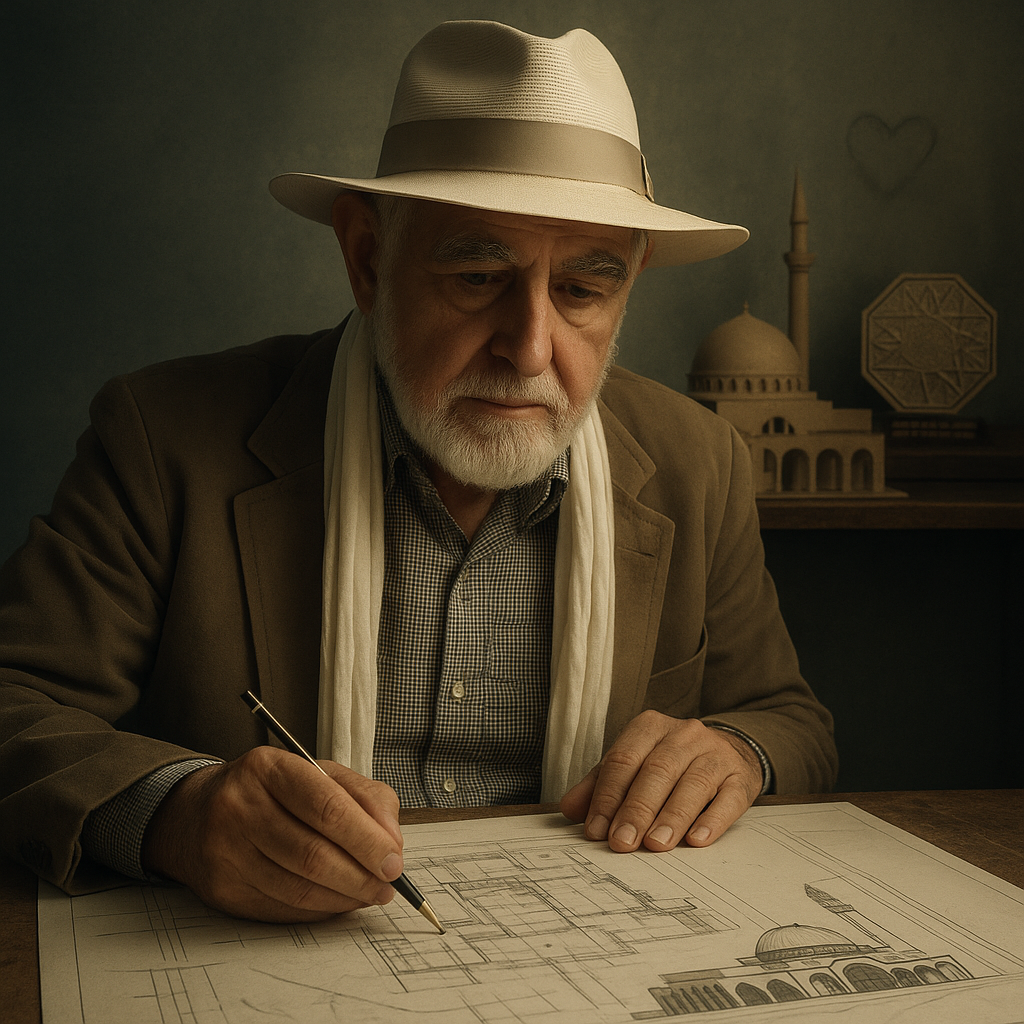
Abdel Wahed El-Wakil Image created by ChatGPT
Some architects are remembered for their buildings. Others are remembered for their philosophy. But a rare few, like Abdel Wahed El-Wakil, are remembered for both—and for the way their work transforms the very meaning of what architecture can be.
To encounter El-Wakil’s vision is to be reminded that buildings are not inert structures but living beings, breathing with the spirit of their makers and their communities. In his words:
“A house without a courtyard is like a man without a soul. The courtyard is the soul of the house.”
A Childhood of Revolution and Displacement
Born in Egypt in the 1940s, El-Wakil grew up in a world of upheaval. His earliest memories were of war, revolution, and a nation caught between its ancient soul and the alluring promises of Western modernity. At ten years old, he witnessed the 1952 revolution that toppled the monarchy. But the new republic, instead of recovering Egypt’s cultural dignity, began copying the West.
He recalls:
“The revolution talked of nationalism, of identity, of everything. But all they did was copy the West. In architecture, it was the same thing.”
This sense of loss—of people abandoning their own traditions for alien models—became the question that would haunt his career: How can architecture serve the identity of a people?
The Hidden Master: Hassan Fathy
At university, the curriculum praised Renaissance, Gothic, and Baroque architecture. Islamic architecture, the tradition of his own land, was either ignored or dismissed as “non-historical.” It was as if Egypt’s soul had been erased from the very discipline that shaped its cities.
Then, by chance, El-Wakil heard of Hassan Fathy, a man whispered about but never officially taught. Fathy had already achieved international recognition, yet in Egypt his name was silenced. El-Wakil sought him out.
What he found was a revelation. Fathy’s buildings, made of mudbrick, were luminous and beautiful, despite being built from what many considered “the material of the slums.” El-Wakil recalls:
“It was like seeing Rodin’s Thinker sculpted not in marble, but in mud. Suddenly I understood—the nobility of a material lies not in itself, but in how it is handled.”
This encounter gave El-Wakil a compass: architecture rooted in tradition, made from the earth, responsive to climate and culture, yet transcendent in form.
Against the Tide of Modernism
In the 1960s, when the world celebrated the moon landing and dreamed of capsule cities and flying cars, El-Wakil resisted the allure of futurism. For him, the sterile glass towers and concrete blocks of modernist architects like Mies van der Rohe were impoverished compared to the spiritual resonance of a mosque dome or a vaulted adobe home.
“Architecture without philosophy becomes engineering. Architecture without aesthetics becomes engineering. Compare a glass box to Notre Dame, to an Indian temple, to a mosque. One speaks to your heart, the other says nothing.”
He called it “T-square architecture”—lines without soul, forms without meaning. In contrast, his architecture was alive with courtyards, domes, vaults, and gardens—spaces designed to mirror the harmony of creation itself.
Architecture as Identity and Spirit
El-Wakil insists that architecture is not merely a style fixed in time, but a living language rooted in space and identity. Traditional Islamic architecture, he explains, adapts not to fashion but to environment. The mosque in Cairo, the house in Aleppo, the courtyard in Isfahan—each different in form but united in spirit.
“Our architecture is not caught in the vortex of time. It is placed in space. It is not something of the past—it is a living reality.”
At its highest level, architecture becomes a recognition of the Creator. Courtyards are not just climate solutions—they are metaphysical centers, bringing God’s creation, nature, into the heart of human dwellings.
“A house without the courtyard is like a man without a soul. The courtyard is the soul of the house.”
“The rooms are built around the court. What is the court? It is the open garden. What is the garden? It is the world created by God. What is the building? It is the world fashioned by man. The house places God’s creation in the center.”
The Teacher and the Mason
His path was not without struggle. When he tried to introduce Islamic architecture at university, 15 professors attacked him, forcing him to resign. Later, working with master masons, he realized how far academia had drifted from the realities of building.
One mason once told him:
“When you make a mistake as an architect, you erase it with a pencil. When I make a mistake under a dome, we both die.”
This humility before craft shaped El-Wakil’s teaching. For him, knowledge is not in papers and theories but in practice, apprenticeship, and learning from those who touch the materials of earth.
Symbolism in Architecture: Speaking Beyond Form
El-Wakil often reminds us that architecture is not mute. Every element—dome, arch, minaret, or courtyard—speaks in symbols, carrying meaning that transcends material. For him, symbolism is not decoration, but essence.
The dome, for example, is not simply a roof. It is the image of the heavens, the vault of creation hovering over the faithful. The courtyard is not an empty square—it is the ordered garden, the echo of Paradise placed at the heart of human dwelling.
Even the act of carving stone becomes symbolic:
“When you dress a stone, you remove the superfluous and keep the essential. You are spiritualizing the stone—and spiritualizing yourself.”
In this sense, his buildings are not designed only for the eye but for the soul. They embody the unseen, reminding those who enter that the material world is always pointing beyond itself, to the eternal.
Works of Spirit: Domes and Courtyards
Among his most celebrated works are the King Saud Mosque in Jeddah, with its daring 20-meter dome built without steel reinforcement; the Island Mosque, praised for its purity of form; and his villas on the Alexandria coast, including the Agamy house, which won him the Aga Khan Award in 1980.
The Agamy house became a symbol of his philosophy. Built traditionally with local craftsmen, it drew international acclaim. Yet the most moving testimony came not from critics but from the client, a businessman. He confessed to El-Wakil:
“It is the first time I fell in love with something. All my life was money. But from the day you built that house, my wife and children never left it. It became our soul.”
Copying, Originality, and Ego
In an era obsessed with originality, El-Wakil redefines the word. “Original means returning to the origin. Creative means designing according to the created order of God—not twisting buildings into eggs, horns, or crescents to feed the ego.”
For him, copying tradition is not plagiarism—it is honor. A true masterpiece is when the student copies the master so faithfully that he becomes indistinguishable from him. This was how he understood his own early works, often mistaken for those of Hassan Fathy.
Legacy and Recognition
El-Wakil’s courage to resist modernist trends earned him international recognition. He received the Aga Khan Award for Architecture twice, and in 2009 he was honored with the Driehaus Prize, one of architecture’s highest accolades for traditional design. His mosques across Saudi Arabia, his houses in Egypt, and his teaching in England and beyond stand as living testaments to his philosophy.
But for El-Wakil, awards are secondary. What matters is the survival of meaning in architecture—the reminder that buildings must speak to the heart, not just to the eye.
Toward the Eternal
Perhaps the essence of his philosophy is captured in his reflections on ancient Egypt. Pharaohs built their palaces in mudbrick, like their people, so none survive today. Only the temples remain. Why? Because sacred buildings, embodying spirit, outlast the material.
“Our homes, like our bodies, return to earth. But our mosques, our sacred monuments, remain—because spirit does not die.”
In the end, Abdel Wahed El-Wakil does not simply build. He reminds us that to build is to pray, to carve stone is to spiritualize oneself, and to dwell is to recognize our Creator. His architecture stands not as nostalgia, but as prophecy: that a future without soul will collapse, but a future rooted in spirit will endure.
REFERENCES
Documentary: Architect Abdelwahed El-Wakil / Caravane Earth
Abdel Wahed El-Wakil in conversation with Lucien Steil / Caravane Earth
Человек, который работает на Бога. / The man who works for God. / Russian Hour
Middle Ground / Middle East: Religious Sites in Urban Co / Archnet
 Kika's world