
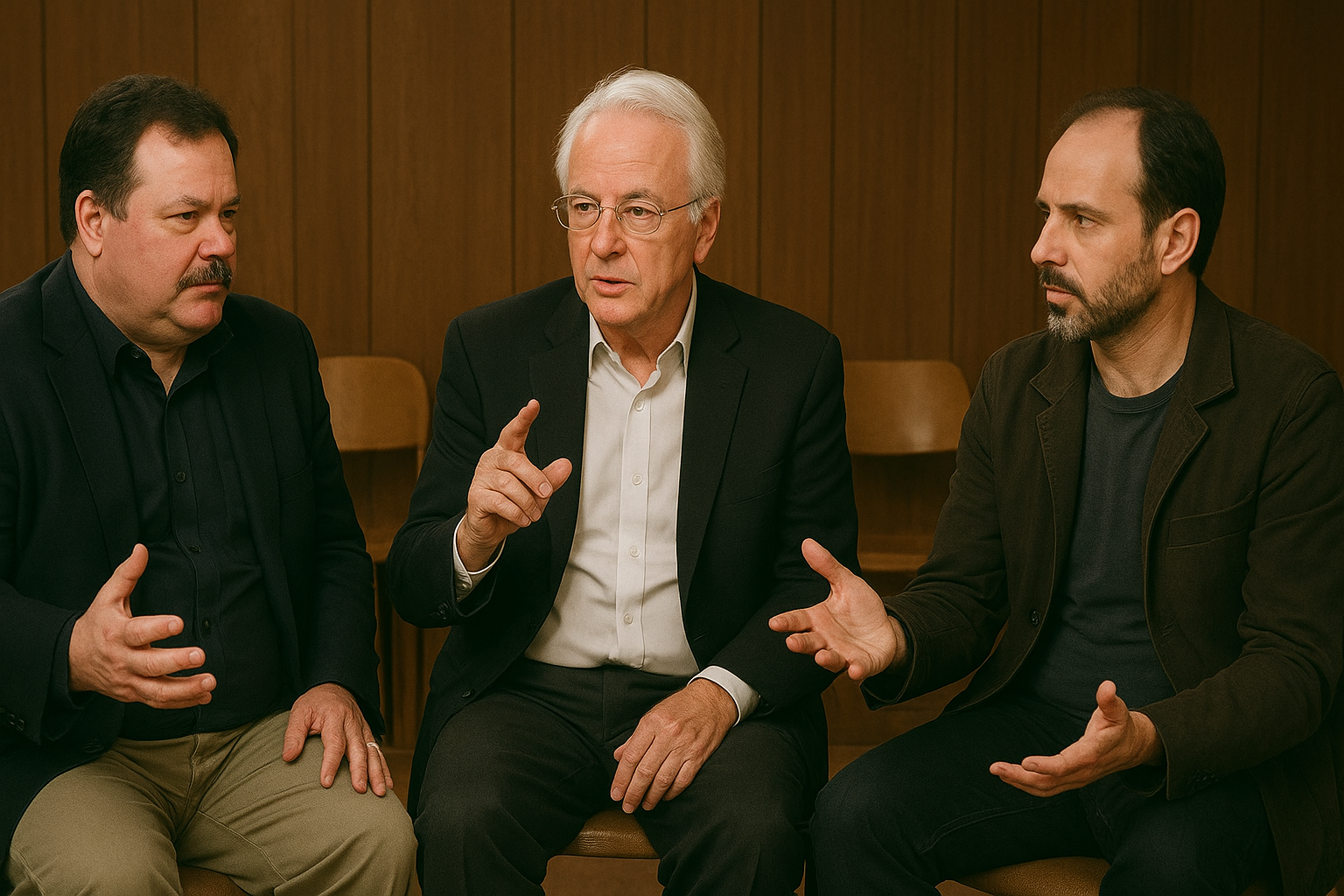
(Image created by ChatGPT)
The provided text summarizes profound ideas from three leading thinkers – Chris Langan, Federico Faggin, and Bernardo Kastrup – challenging conventional scientific and philosophical views of reality, consciousness, and existence. Here’s a breakdown of their core arguments and key insights:
1. Chris Langan (Cognitive-Theoretic Model of the Universe – CTMU): God as the Fundamental Processor
- Core Subject: Reality is a self-aware computational system (“self-simulation”), with God as the essential, conscious, processing core.
- Key Concepts & Sentences:
- “God exists… properties match those of God as described in most of the world’s major religions… omniscience, omnipotence, and omnipresence.” Langan asserts God’s existence isn’t just belief, but a logical necessity derived from the structure of reality itself via the CTMU.
- “We’re living in the display of that simulation… God captures both the display and the processor.” Reality has two aspects: the observable “display” (like a computer screen) and the underlying “processor” (God). God transcends and encompasses both.
- “Reality is actually generative… everything is being created all the time.” The universe isn’t static; it’s constantly being processed and recreated moment by moment.
- “This table is conscious… generically conscious.” Consciousness is fundamental and exists at all levels, even inanimate objects, via “identity operators” (fundamental units of processing).
- “You will persist after you die… Where you go depends on who [you] really is… God is going to cut you off.” Afterlife existence depends on one’s relationship with God. Hell is self-created separation from God’s sustaining processing power.
- “Angels are real demons are real is the devil real oh yes.” Evil (Satan) exists as a necessary antithesis to God’s perfection, gaining coherence through human structures (governments, corporations).
2. Federico Faggin (Inventor of the Microprocessor): Consciousness as Foundational Quantum Field
- Core Subject: Consciousness is fundamental, not emergent from the brain. The brain is a receiver/translator for a deeper quantum field of consciousness. Matter is an appearance generated by consciousness interacting with this field.
- Key Concepts & Sentences:
- “Consciousness is beyond matter beyond this space and time.” Consciousness is primary; matter and spacetime are secondary phenomena.
- “Particles are not objects particles are states of a field.” Quantum physics reveals that fundamental reality is fields, not discrete particles. Cells and bodies are complex expressions of quantum fields.
- “Quantum information… cannot be copied or cloned… behaves more like experience than data.” Subjective experience (qualia) is akin to quantum information – unique, uncopyable, and collapses upon measurement.
- “The collapse of the wave function is the representation of… free will… observation itself… is what finalizes reality.” Conscious observation isn’t passive; it actively participates in collapsing quantum possibilities into actuality, linking consciousness and free will to the core of reality.
- “When the body dies… consciousness doesn’t disappear it simply loses its local connection… ‘Oh my god I there is another world here.'” Death is the disconnection of consciousness from the body/brain interface, allowing awareness to shift back to its fundamental field state, potentially perceiving a broader reality (supported by NDEs).
- “Each conscious being feels like an eye because each one is a distinct viewpoint within the greater whole.” Individuality arises as unique perspectives (“facets”) within the unified field of consciousness.
3. Bernardo Kastrup (Analytic Idealism): Reality as Mental, Matter as Dashboard
- Core Subject: Consciousness is fundamental. The physical world (“matter”) is merely the appearance of mental processes within universal consciousness (“Mind at Large”) when observed across dissociative boundaries. There is only one mind.
- Key Concepts & Sentences:
- “Everything is inherently mental… matter is a dashboard representation.” The physical world is like the dials on a plane’s dashboard – a useful representation of a deeper reality (the “sky”), not the reality itself. Without an observer (dashboard), there is no “matter” as we perceive it.
- “The brain is simply what mental activity looks like when observed from the outside.” The brain doesn’t produce consciousness; it is the external appearance of localized conscious activity within the dissociated “alter” (individual).
- “We are not machines we’re not separate we are fields of consciousness each one a unique way the universe sees itself.” Individuals are dissociated alters of the single universal consciousness (“Mind at Large”), creating the illusion of separation.
- “God… is the only thing that exists and it’s you and it’s me and it’s the cat… the whole shebang.” Kastrup identifies God with this universal consciousness (Mind at Large + all alters), possessing the traditional attributes (omnipresent, omniscient, omnipotent) by definition.
- “Time and space exist only in here we create time and space as a sort of a filing system.” Time and space are not fundamental aspects of external reality but mental constructs for organizing experience within consciousness.
- “You have agency but your choice is determined by that which you are… the universe is computationally irreducible.” Free will exists as agency, but choices flow deterministically from one’s current state. Even God cannot predict choices before they are made; the universe must “play itself out.”
Critical Convergences & Challenges:
- Consciousness is Fundamental: All three thinkers reject materialism. Consciousness isn’t generated by the brain; it’s primary (Faggin, Kastrup) or an inherent property of reality’s structure (Langan).
- Beyond the Physical: They posit realities beyond the measurable physical universe – God’s processing domain (Langan), the quantum field of consciousness (Faggin), or Mind at Large (Kastrup).
- Death is Not the End: Consciousness persists beyond bodily death (Langan, Faggin explicitly; implied by Kastrup’s universal consciousness).
- Reality is Participatory: Observation/consciousness isn’t passive; it plays an active role in shaping reality (Faggin’s wave collapse, Langan’s processing).
- Challenges Materialist Science: They argue science, by focusing solely on the measurable “dashboard” (Kastrup) or classical information (Faggin), misses the deeper, conscious foundation of reality. True AI consciousness is deemed impossible under these models.
This text synthesizes radical perspectives that fundamentally challenge our understanding of existence, suggesting consciousness, not matter, is the bedrock of reality, intimately connected to concepts of God, free will, and our ultimate destiny.
 Kika's world