
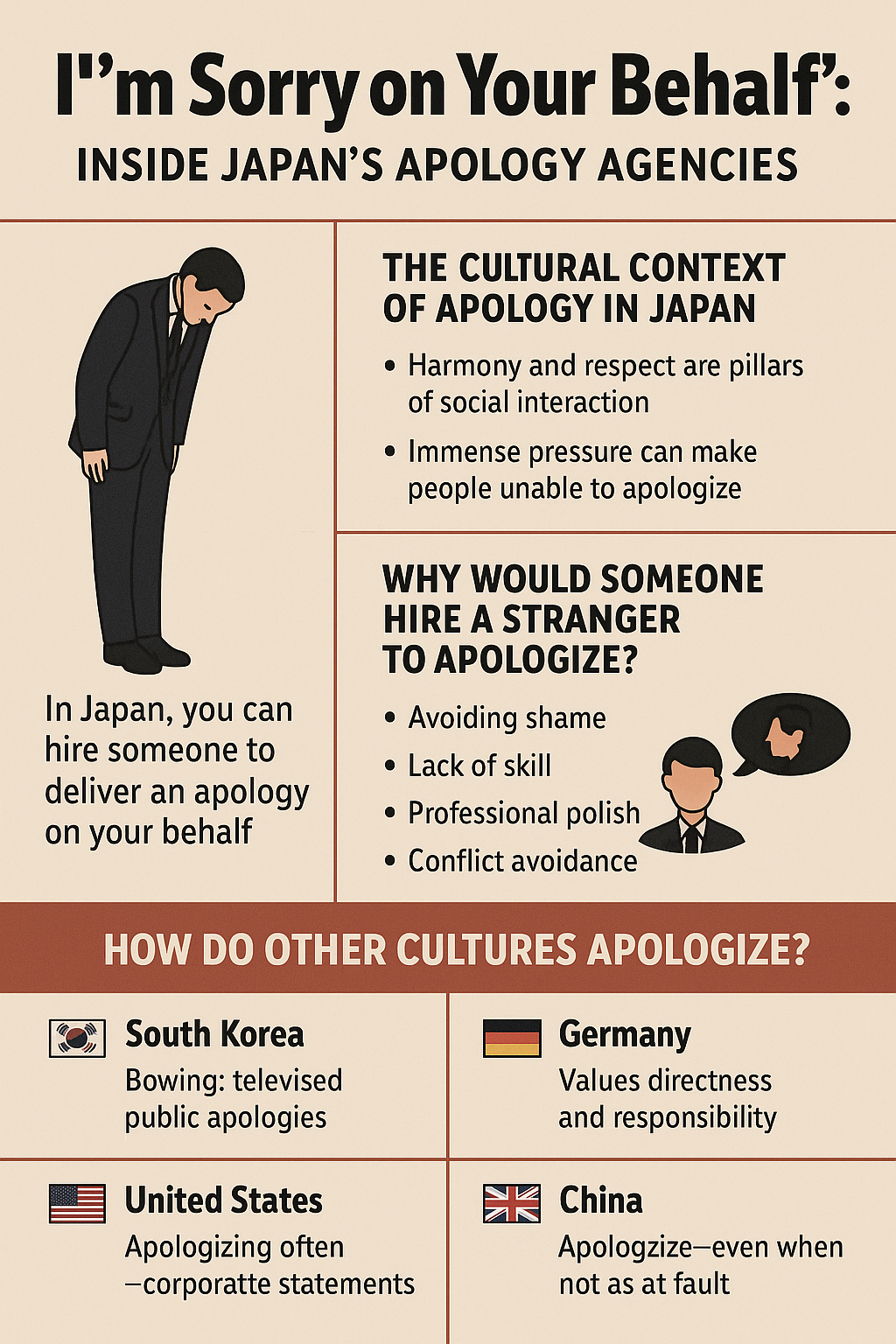
Intro: Imagine hurting someone’s feelings, missing a deadline, or breaking up with someone—and instead of crafting an apology, you hire someone to do it for you. In Japan, that’s not just an intriguing concept, it’s a business. Apology agencies, known as “shazai daikou” (謝罪代行), offer a unique service: they deliver apologies on behalf of clients, whether face-to-face, by phone, or even by letter. But what does this say about social norms, shame, and emotional labor in modern Japan?
1. The Cultural Context of Apology in Japan In Japanese society, harmony and respect are pillars of social interaction. The act of apologizing is not merely about admitting fault—it’s a ritual that restores balance and maintains face. The phrase “sumimasen” (すみません) is used frequently and fluidly to express regret, gratitude, or humility.
This deeply rooted culture of apology can also create immense pressure. People may feel unable to apologize due to shame, fear of confrontation, or simply being overwhelmed. That’s where apology agencies come in.
2. What Do Apology Agencies Do? These agencies act as emotional intermediaries. Services range from formal in-person apologies (complete with bows and suits) to letters that convey remorse with carefully crafted wording. Some even offer crying actors to show the depth of regret. Yes—there are professional apologists who can cry on command.
Situations vary:
- A man hiring an agency to apologize to his ex-girlfriend for cheating.
- A company using an agency to deliver a public apology to disgruntled customers.
- A student who plagiarized an essay and wants someone to apologize to the professor.
3. Why Would Someone Hire a Stranger to Apologize? The reasons are surprisingly relatable:
- Avoiding shame: Especially in cases involving deep embarrassment or personal failure.
- Lack of skill: Some simply don’t know how to apologize effectively.
- Professional polish: A carefully staged apology might carry more weight.
- Conflict avoidance: When emotions run high, a neutral third party can prevent escalation.
4. Ethics and Emotional Authenticity But doesn’t this make apologies less sincere? Critics argue that outsourcing regret commodifies a deeply personal emotion. Others see it as a pragmatic solution in a high-context culture where the form can sometimes matter as much as the feeling.
Can a stranger really capture the pain behind an apology? Or is sincerity in Japan more about gesture and effort than raw emotion?
5. What This Tells Us About Modern Life Apology agencies offer a mirror to modern pressures—emotional outsourcing, growing loneliness, and the clash between tradition and efficiency. While it may seem bizarre from a Western perspective, it opens up broader questions about how societies manage conflict, shame, and reconciliation.
6. How Do Other Cultures Apologize? Apology is universal—but how it’s expressed varies dramatically across cultures. While Japan’s apology culture is formal and ritualized, other nations have their own fascinating approaches:
- South Korea
Much like Japan, apologies in Korea are crucial to social harmony. A sincere bow and the word “joesonghamnida” (조성합니다) are standard. Public apologies from celebrities or corporations are often televised, with kneeling and tears expected. - Germany
Germans value directness. Apologies are straightforward, honest, and responsibility-focused. “Es tut mir leid” means “I am sorry,” often paired with an explanation or solution. - United States
Americans apologize often—even for things they aren’t responsible for. “Sorry” can mean sympathy more than guilt. Public apologies are frequently shaped by legal concerns. - United Kingdom
British people are famously apologetic. “Sorry” is used to maintain politeness, sometimes even when they are not at fault. - China
In China, saving face is critical. Apologies may be avoided in public to prevent embarrassment, but gifts or symbolic acts can express remorse effectively. - New Zealand & Maori Culture
The Maori concept of muru involves community rituals to restore harmony. Forgiveness is about healing the group, not just the individuals involved. - Rwanda
Post-genocide Rwanda used traditional Gacaca courts, where public apologies and reintegration efforts were part of a national healing process.
Final Thought: Every culture has its own rhythm for reconciliation. Whether through a bow, a legal statement, a quiet word, or a community ritual, the essence is the same: restoring human connection. And sometimes, as Japan shows us, even that can be outsourced—but never entirely replaced.
 Kika's world