
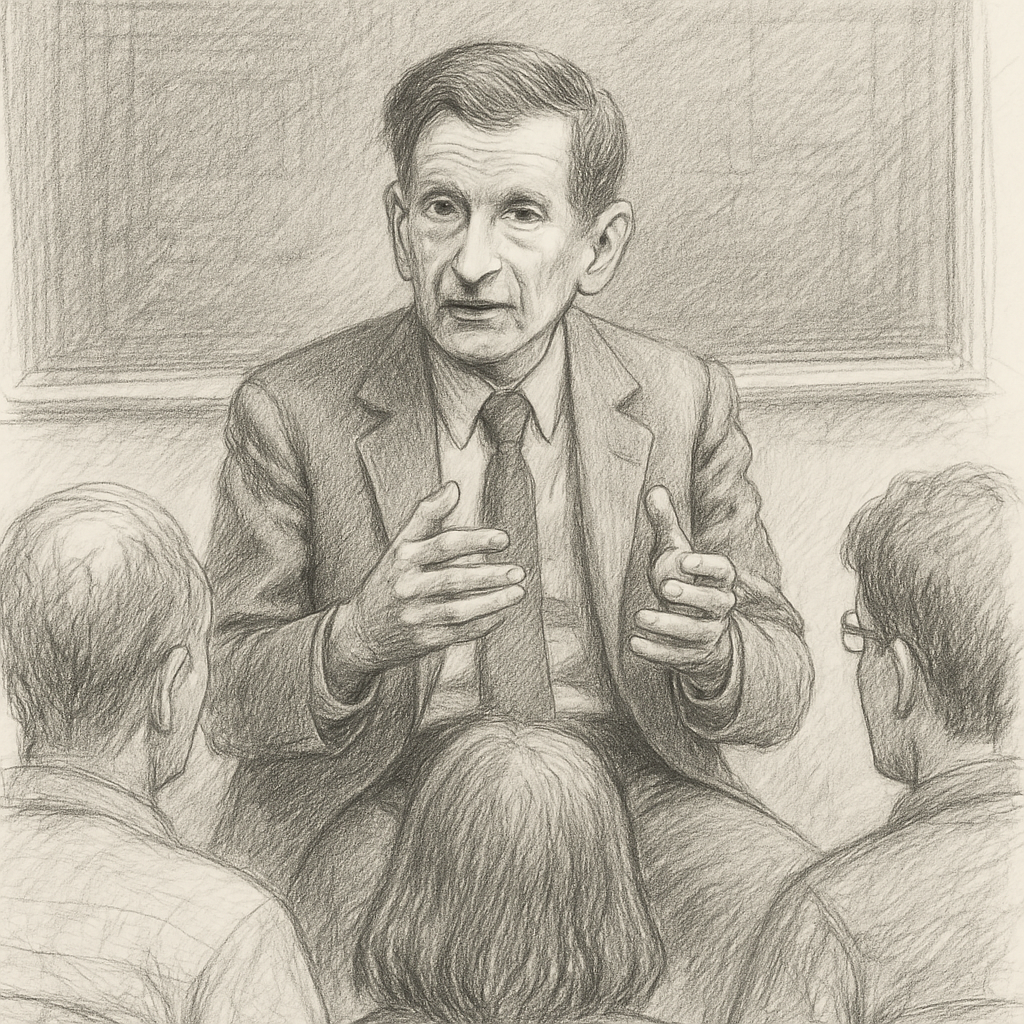
The Paradox of “I Am”: Unpacking David Bohm’s 1988 Exploration of Representation, the Unlimited Self, and the Roots of Conflict
David Bohm’s 1988 seminar “I’m And Me” (Disk 9 of the series) is a profound dive into the core structures of human thought, perception, and identity. Centered on the crucial distinction between representation (mental concepts, symbols, thoughts) and presentation (direct perception, experience, the “thing itself”), Bohm explores how these mechanisms shape our understanding of reality, particularly the concepts of the “unlimited” (infinity, totality, God) and the self (“I” vs. “me”). This exploration reveals deep contradictions with significant psychological and societal consequences.
Core Subjects Explored:
- Representation vs. Presentation: The fundamental distinction. Representation is our mental construct (e.g., the concept “chair”), while presentation is the direct experience or perception of the thing represented. Representation inherently limits and defines.
- The Nature of the Unlimited (Infinite/Totality/God): Concepts like “all,” “forever,” “never,” “absolutely,” “infinite,” and “God” inherently imply the unlimited – that which has no boundaries, cannot be contained or fully known. Bohm highlights the immense emotional power these concepts hold.
- The Paradox of the Self (“I” vs. “Me”):
- The “I” (Subject): Represented as the unlimited source: the knower, the definer, the limiter, the experiencer of the whole world, fundamentally simple and identical. It points towards the “I am” of Moses’ burning bush – pure, unlimited being.
- The “Me” (Object): Represented as limited: the physical body, social identity, defined qualities (rich/poor, member of group), mortal, pushed around by society and circumstance. It’s the self seen as an object by others and oneself.
- The Contradiction of Identification: The core problem arises when the unlimited “I” is identified with the limited “me”. This creates an inherent and unresolvable conflict within the psyche (“How can the unlimited be limited?”).
- The Origin and Danger of Egotism: This identification paradox fuels egotism (individual and collective – “we-go”). The limited “me” feels inadequate compared to the sense of the unlimited “I” it identifies with, driving a compulsive need to become more, possess more, and magnify itself (“I am wonderful,” “We are the greatest”) to try and bridge the gap. This drive overrides rationality, truth, and ethical considerations.
- The Limitations and Ambitions of Literal Thought: Literal thought (scientific, reductive, objectifying) excels at representing and manipulating limited objects. However:
- It implicitly claims universality, believing it can eventually grasp everything (e.g., “theory of everything,” AI replicating consciousness), thereby denying the truly unlimited.
- It inherently limits everything it represents, defining it as “this, not that.”
- It struggles with the contradiction of thought itself: if thought grasps everything, what grasps thought? It implicitly places itself as the ultimate “limiter” (akin to God).
- Its representation as reality (presentation) blinds us to evidence that might challenge its assumptions, especially if disturbing.
- The Societal Imperative: Society requires us to function as limited objects (“me”) for organization, yet the inner sense (“I”) feels unlimited. This creates constant tension.
- The Question of Coherence: How can we develop a coherent representation of the unlimited that doesn’t lead to contradiction, conflict, and egotism?
Key Questions Posed by Bohm:
- How can we know the Unlimited? (“How do you ever get to know about [all]?”; “can we know the unlimited?”; “I cannot be put in knowledge”)
- What is the nature of the Self? Is the self (“I”) truly unlimited? (“what about the subject the self the me the eye… in principle it sounds as if that’s represented as unlimited”; “the I seems to be simple… identical always the same… in contact with everything”)
- What is the source of the contradiction in the Self? (“when I is identified with me right otherwise… how can we experience the two is the same?”)
- Why does this contradiction cause suffering and disorder? (“if it’s represented as a contradiction you’re going to experience a contradiction”; “this makes no sense when you looked at but still… the discovery that we are limited creates the demand to get more”; “this is really at the source of the stream of the pollution of the stream”)
- What is the origin of Egotism? (“there’s an urge that within this representation there is an urge to magnify yourself… to extend and extend”; “in this problem of the unlimited there is the origin of agate ISM [egotism]”)
- Can Literal Thought encompass everything? (“within literal thought there is a tendency to keep on spreading and saying literal thought can cover everything”; “thought can only grasp what is in a concept… and that is limited”; “if literal thought is accepted in this way the process of thought itself is not going to work… properly”)
- What is the relationship between the Unlimited and the Limited? (“the unlimited includes the limited”; “the true being of the limited is the unlimited”)
- How can we achieve a coherent representation? (“how can we get a coherent representation of the unlimited?”; “clearing this up would be a step”)
- What is Reality? Exploring the etymology linking “res” (thing), “real,” and “reor” (to think), suggesting reality, in one sense, might mean “that which can be thought about” (the limited), distinct from the unlimited “that which is.”
- What is the significance of “I Am”? (“I am as the pure subject”; “I am as the name of God”; “I am by itself… suggests something unlimited”; “as soon as you attach something to it then it gets limited”)
Bohm’s Proposed Answers and Insights:
- The Unlimited must be a Thought/Representation: Since the unlimited (“all,” God) cannot be presented in perception, it must be a representation, a concept born of thought. (“all cannot be presented in perception right therefore how do you ever get to know about it right so all must be a thought right”; “all is a representation”).
- The “I” is Represented as Unlimited, the “Me” as Limited: Our language and thought structure inherently represent the subjective “I” as the unlimited source and center, while the objective “me” is the limited entity in the world. This is the root of the paradox.
- Identification Causes Conflict: The fundamental problem is the identification of the represented unlimited “I” with the represented limited “me”. This creates an unresolvable internal contradiction manifested as psychological unease and the drive of egotism. (“if it’s represented as a contradiction you’re going to experience a contradiction”).
- Literal Thought Cannot Grasp the Unlimited: Literal thought, by its nature, deals in limits, definitions, and categories. It cannot grasp or represent the truly unlimited without falsifying it or falling into contradiction (e.g., claiming thought itself is unlimited while reducing everything else to limited mechanisms). Its ambition to explain everything is fundamentally flawed. (“thought can only grasp what is in a concept what is in a category what can be given a name and so on and that is limited”; “literal thought implicitly denies all that”).
- Egotism is a Misguided Attempt to Resolve the Contradiction: The ego’s drive for more power, status, or possessions stems from the limited “me” trying to live up to the sense of unlimitedness inherited from the identified “I”. It’s a doomed attempt to make the representation of the self as unlimited plausible. (“egotism is trying to make a representation of the self as unlimited”).
- A Coherent Representation: The Unlimited Includes the Limited: Bohm suggests a potential resolution: The unlimited is not separate from the limited; it includes it. The limited is not an absolute boundary against the unlimited, but a form within it. The “true being of the limited is the unlimited”. The representation itself is limited, but points towards action within the unlimited. (“there is no boundary the unlimited includes the limited”; “the unlimited limits itself”; “representation is not that which is all that it is is representation… it guides our action”).
- Clarity is Essential for Order: Regardless of whether we can directly “know” the unlimited, clarifying this fundamental confusion in representation – disentangling the “I” and “me,” understanding the limits of thought, recognizing the source of egotism – is crucial. It reduces the “turbulence” in the brain/mind and allows for more coherent perception and action. (“clearing this up would be a step… because as long as thought goes in all that gyrations the brain is going to be so turbulent”; “this is really at the source of the stream of the pollution of the stream”).
Conclusion: The Urgency of Examining Representation
Bohm’s seminar is not merely an abstract philosophical discourse. It diagnoses a core dysfunction at the heart of human thought and identity. The misrepresentation of the self, the misunderstanding of the unlimited, and the inherent limitations of our dominant mode of thinking (literal thought) are not just intellectual errors; they are the wellsprings of individual neurosis, collective egotism (nationalism, tribalism), and the dangerous belief that thought can control everything. By highlighting the paradox of “I am” and the “me,” Bohm points to the urgent need to examine how we represent reality and ourselves. Only by understanding the nature and limits of representation itself, and by exploring the possibility that the limited exists within the unlimited, rather than opposed to it, can we begin to find a way out of the conflicts and contradictions that plague both our inner lives and the world we create. The power of names (“I am”) and concepts demands profound responsibility, for as we represent, so we present, and so we act.
 Kika's world