
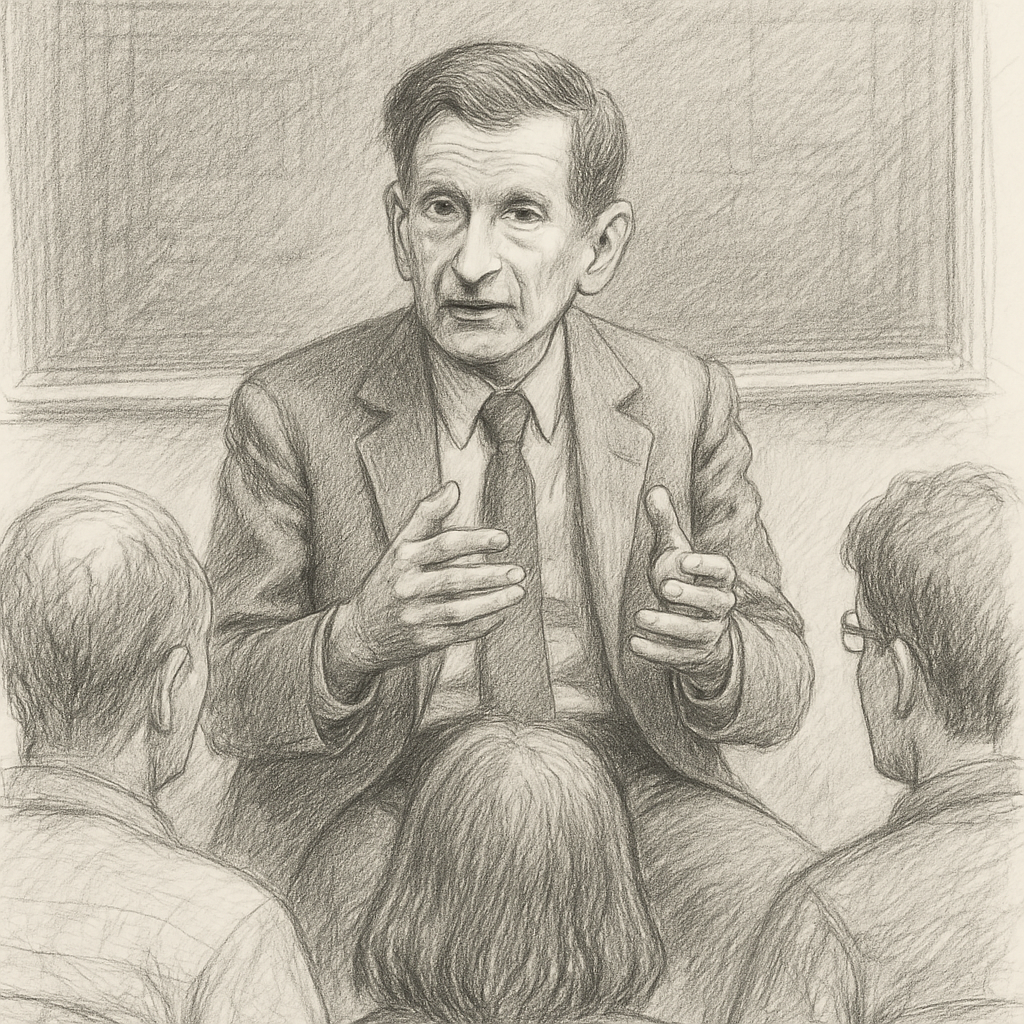
David Bohm’s Friday Evening Seminar: Thought as the Source of Crisis and Fragmentation
—A Dialogue on the Roots of Global Chaos and the Path to Systemic Change—
Key Subjects Explored
David Bohm’s seminar delves into the paradox of human thought: the very tool we use to solve problems is also the root of global crises. Below are the core themes and questions raised, along with Bohm’s insights:
1. The Crisis of Fragmentation
Subject: Bohm identifies fragmentation as the central flaw in human thought. Thought divides reality into artificial boundaries—nations, religions, professions—creating divisions where none inherently exist.
- Examples:
- National borders (e.g., Middle Eastern nations drawn by colonial powers) fuel endless conflict.
- Academic and professional silos prevent holistic understanding.
- Separation of intellect, emotion, and body, leading to incoherent actions.
Bohm’s Insight:
“Thought pretends there’s a sharp division here… but everything is unified. We introduce fictional ways of thinking.”
Fragmentation creates false divisions and false unities, perpetuating cycles of conflict and ecological destruction.
2. The Systemic Fault in Thought
Subject: Thought operates as a self-reinforcing system encompassing emotions, societal structures, and even bodily states. This system is inherently flawed, generating unintended consequences.
- Examples:
- Technology designed for progress (e.g., refrigerants) damages the ozone layer.
- Nationalism, intended to unify, breeds hatred and war.
Bohm’s Insight:
“The system has a systemic fault… it’s everywhere and nowhere.”
Attempts to solve problems using the same fragmented thinking only deepen crises. Thought cannot fix itself without recognizing its participatory role in creating reality.
3. Thought vs. Thinking: The Role of Emotion and Body
Subject: Bohm distinguishes thinking (active, present-moment inquiry) from thought (past, conditioned reflexes). Emotions and bodily states are inseparable from this process.
- Examples:
- Anger dissolves when a thought changes (e.g., realizing a delay was caused by a late train).
- Chronic stress from fragmented thinking manifests as physical ailments (e.g., ulcers).
Bohm’s Insight:
“Thought runs you… while giving the false impression that you control it.”
Emotions and thoughts are two sides of the same neural process, mediated by connections between the cortex and deeper brain regions.
Provocative Questions and Answers
Q1: Can thought become aware of itself?
Bohm:
“Thought cannot fix itself. We need a deeper perception—proprioception of thought—to observe its mechanics without distortion.”
Awareness requires stepping outside the system, akin to scientific insights that shattered paradigms (e.g., Newton’s gravity).
Q2: Is fragmentation taught or intrinsic?
Bohm:
“It’s both. Some analysis is necessary, but education and culture amplify division. The brain may have a tendency to classify, but we institutionalize it.”
He critiques educational systems that prioritize categorization over holistic understanding.
Q3: How do we address incoherence in intentions?
Participant: “We profess good intentions but act against them. Why?”
Bohm:
“Hidden intentions—often tied to power, profit, or fear—override conscious goals. Sustained incoherence arises when we refuse to question assumptions.”
Example: Nations claim ecological concern but prioritize economic growth, accelerating climate collapse.
Q4: Is there hope for systemic change?
Bohm:
“Insight—non-verbal, immediate perception—can break the cycle. Newton’s gravity revelation didn’t rely on past thought but on observing incoherence.”
He suggests embracing confusion and discomfort as opportunities to unlearn conditioned patterns.
Implications for the Future
Bohm’s dialogue challenges us to:
- Question Assumptions: Recognize how thought’s “fictional boundaries” shape reality.
- Embrace Incoherence: Sit with discomfort to allow new insights.
- Cultivate Holistic Awareness: Integrate emotion, body, and intellect to transcend fragmentation.
In a world teetering on ecological and social collapse, Bohm’s message is urgent: Thought created this chaos; only a revolution in thinking can undo it.
Final Reflection:
“The system is not monolithic. It’s a process we sustain—and can transform. But first, we must see it.” —David Bohm
 Kika's world