
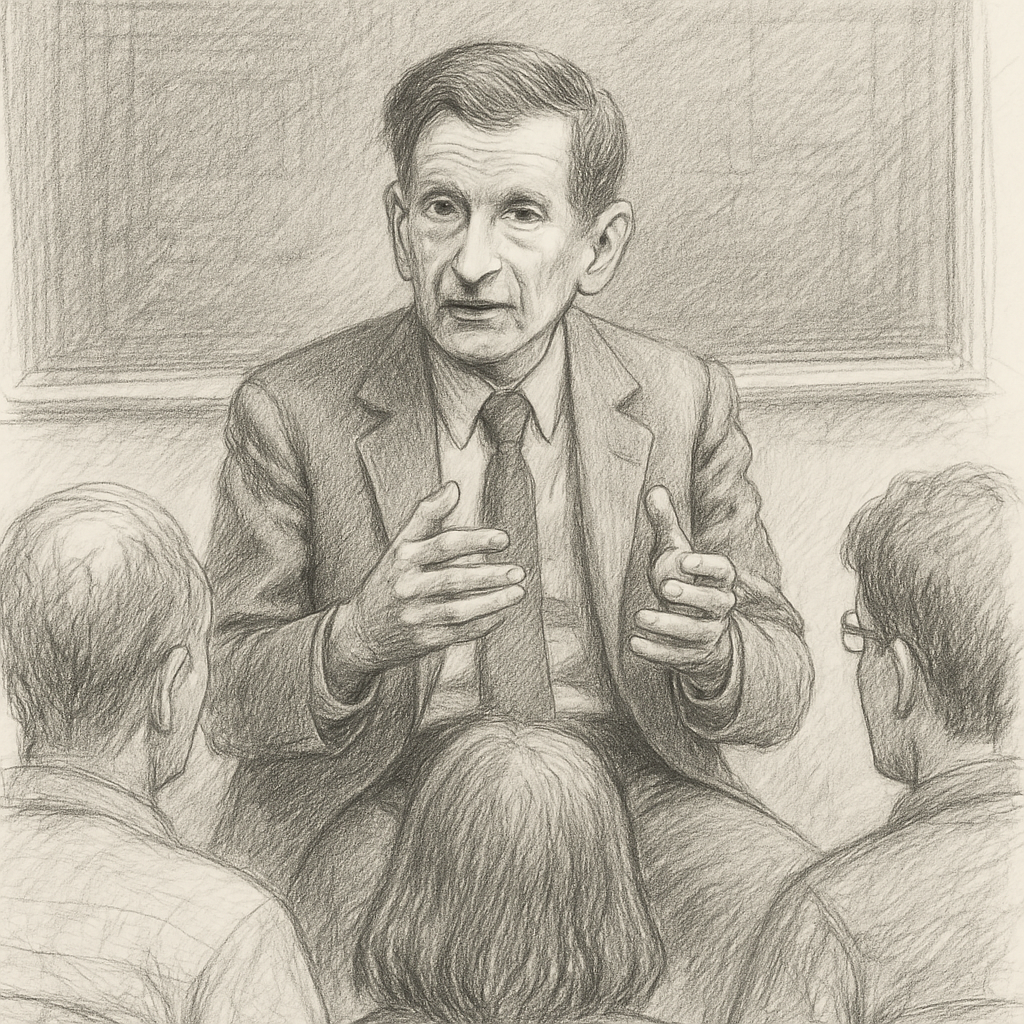
The 1990 seminar led by physicist and philosopher David Bohm offers a profound exploration of thought as a systemic force shaping human perception, emotion, and societal structures. The discussion, rich with philosophical inquiry and practical implications, challenges conventional understandings of consciousness and reality. Below is a detailed analysis of the key subjects, questions, and insights raised during the seminar.
Core Subjects
- Thought as a Reflexive System
- Bohm posits that thought is not merely an intellectual process but a complex system involving emotions, bodily states, and societal conditioning. Like reflexes, thoughts arise automatically, often without conscious awareness.
- Example: Anger is not an isolated emotion but a product of interconnected thoughts, bodily reactions, and linguistic triggers. By “suspending” anger—observing it without repression or expression—we can study how thoughts, feelings, and physiology interact.
- Language and Representation
- Language acts as a tool to “objectify” experiences, transforming abstract emotions or memories into observable states. Words like “table” or “anger” evoke representations that simplify reality but also limit understanding.
- Critique: Bohm warns that language creates illusions of objectivity. For instance, the word “table” reduces a complex physical object (atoms, forces) to a mental image, masking its true nature.
- Perception and Thought’s Participation
- Thought actively shapes perception. Bohm argues that representations (e.g., symbols, images) merge with sensory input, creating a distorted sense of reality.
- Analogy: A rainbow is perceived as an object, but physics reveals it as light interacting with raindrops. Similarly, social constructs like “General Motors” exist only because collective thought sustains them.
- Proprioception of Thought
- Borrowing from bodily proprioception (awareness of movement), Bohm suggests thought should develop self-awareness. Just as we sense our limbs without looking, we might learn to “feel” thought’s influence on perception and behavior.
- Challenge: Modern culture separates thought from bodily experience, making this awareness difficult.
- Limits of Knowledge
- Scientific knowledge, while powerful, is inherently incomplete. Bohm critiques the illusion of “absolute necessity” (e.g., Newtonian physics being overturned) and emphasizes humility: “Knowledge is a representation, not the thing itself.”
Provocative Questions
- How Does Thought Deceive Us?
- Thought creates narratives that masquerade as reality. For example, paranoia arises when internal projections (e.g., “my boss hates me”) fuse with perception. Bohm notes, “Thought is us. We are the deceivers and the deceived.”
- Can We Observe Thought Without Distortion?
- Participants grapple with whether suspending reactions (e.g., anger) allows genuine observation. Bohm argues that language and reflexivity are tools to “hold thought in front of you,” but cultural conditioning often obstructs clarity.
- Is There an Unconditioned Awareness Beyond Thought?
- Bohm hints at a “stream of consciousness” deeper than thought—a form of awareness untainted by reflexes. However, he avoids mysticism, framing it as a potential for proprioceptive insight.
- How Do Media and Society Amplify Thought’s Flaws?
- Media disseminates thought-seeds (e.g., political ideologies) that become societal reflexes. Bohm warns this creates systemic delusions, such as conflating “docudramas” with factual reality.
- Can Thought Recognize Its Own Limits?
- Healthy thought, Bohm argues, requires acknowledging uncertainty: “At most, we can say, ‘As far as I know…’” Yet societal structures (religion, science, politics) often reject this openness.
Key Insights
- The Illusion of Separation
- Thought divides reality into categories (self/other, mind/body), but Bohm stresses interconnectedness. A table’s “solidity” is a mental construct; atoms and empty space define its physical truth.
- Dynamic Thinking vs. Static Thought
- Bohm distinguishes thinking (active, adaptive engagement) from thought (fixed reflexes). Thinking allows questioning assumptions; thought perpetuates conditioning.
- The Role of Suffering
- Emotional pain (e.g., fear, depression) signals incoherence in thought. Rather than escaping, Bohm advises “staying with” discomfort to observe systemic flaws.
- Cultural Conditioning as a Barrier
- Western culture’s emphasis on “objective thought” denies thought’s participatory role. Indigenous cultures, Bohm notes, once recognized this interplay but overprojected meaning (e.g., totem rituals).
Conclusion: A Call for Proprioceptive Thought
Bohm’s seminar culminates in a radical proposition: thought must evolve to recognize its own mechanics. Just as the body senses movement, thought could develop awareness of its patterns, biases, and societal impacts. This “proprioception of thought” might dissolve illusions of separation and foster coherence.
Yet, the path remains murky. How do we cultivate such awareness? Bohm offers no formula but urges inquiry: “We are learning, not achieving an objective.” In a world drowning in misinformation and reflexive thinking, his insights remain a beacon—a reminder that humility, observation, and systemic awareness are keys to navigating the labyrinth of thought.
Final Thought: “Thought is the artist, the canvas, and the illusion. To see beyond, we must first see the brushstrokes.” —Adapted from Bohm’s metaphors.
Analyzing David Bohm’s Seminar Through a Gestalt Perspective
Gestalt psychology emphasizes holistic perception, the integration of parts into meaningful wholes, and the active organization of sensory experiences. Applying this lens to Bohm’s seminar reveals profound alignments and opportunities for deeper exploration of his ideas about thought, perception, and societal systems.
Key Gestalt Principles and Their Alignment with Bohm’s Ideas
- Wholeness and Integration
- Gestalt: The whole is greater than the sum of its parts; perception organizes fragments into coherent wholes.
- Bohm’s Insight: Thought is a reflexive system where emotions, language, and bodily states interconnect. Anger, for example, is not an isolated emotion but a gestalt of thoughts, physiological reactions, and linguistic triggers.
- Alignment: Bohm’s systemic view mirrors Gestalt’s emphasis on interconnectedness. His call to “suspend” anger and observe its components reflects Gestalt therapy’s focus on integrating fragmented experiences into awareness.
- Figure-Ground Relationships
- Gestalt: Perception distinguishes objects (figures) from their context (ground).
- Bohm’s Insight: Thought shapes perception, creating illusions like the rainbow (figure) obscuring its physical reality (ground: light and raindrops). Similarly, societal constructs (e.g., corporations) exist only through collective thought.
- Alignment: Bohm critiques how thought prioritizes symbolic representations (figures) over holistic realities (ground), a distortion Gestalt seeks to resolve through awareness.
- Closure and Simplification
- Gestalt: Minds “close” gaps to perceive complete forms (e.g., seeing a circle from a dotted outline).
- Bohm’s Insight: Language simplifies complexity (e.g., “table” reduces atoms and forces to a mental image). Scientific knowledge, while useful, is incomplete.
- Alignment: Both highlight how humans simplify reality. Bohm’s critique of “absolute necessity” in science parallels Gestalt’s warning against oversimplification (Prägnanz).
- Proprioception and Embodied Awareness
- Gestalt: Bodily awareness is integral to perception (e.g., sensing movement without visual cues).
- Bohm’s Insight: Thought lacks “proprioception”—self-awareness of its influence. He advocates for a “proprioceptive thought” akin to bodily kinesthesia.
- Alignment: Gestalt therapy’s focus on embodied experience (e.g., grounding techniques) aligns with Bohm’s call to integrate thought and somatic awareness.
- The Here-and-Now
- Gestalt: Emphasizes present-moment awareness to resolve past conditioning.
- Bohm’s Insight: Observing thought without repression (“staying with” discomfort) reveals systemic flaws.
- Alignment: Both reject passive acceptance of conditioning. Bohm’s “suspension” of anger mirrors Gestalt’s empty-chair technique, where clients engage directly with unresolved emotions.
Divergences and Critiques from a Gestalt Lens
- Cultural Conditioning as a Perceptual Barrier
- Bohm: Highlights societal structures (media, politics) as thought-seeds that distort reality.
- Gestalt Critique: While Bohm addresses systemic issues, Gestalt would stress individual phenomenological experience. How do societal constructs feel in the body? A Gestalt approach might use role-playing to externalize and interrogate these “thought-seeds.”
- The Role of Language
- Bohm: Language objectifies experience but risks illusion.
- Gestalt Addendum: Gestalt therapy often bypasses language to focus on nonverbal cues (e.g., posture, tone), offering a path to awareness less mediated by symbolic distortion.
- Proprioceptive Thought as Practice
- Bohm: Proposes the concept but lacks methodology.
- Gestalt Solution: Techniques like “focusing” (Eugene Gendlin) or body scans could operationalize Bohm’s vision, training individuals to sense thought’s somatic imprint.
Synthesis: Toward a Gestalt-Informed Praxis
Bohm’s seminar and Gestalt psychology converge on the need for holistic, embodied awareness to transcend fragmented perception. A Gestalt-informed approach to Bohm’s ideas might:
- Use experiential exercises (e.g., mindfulness, role-play) to “hold thought in front of you.”
- Prioritize somatic awareness to detect thought’s physiological effects (e.g., tension during anger).
- Challenge cultural conditioning through group dialogues that expose collective perceptual biases.
Final Insight:
Bohm’s systemic critique and Gestalt’s experiential methods form a potent synergy. By merging Bohm’s intellectual rigor with Gestalt’s embodied practices, we might cultivate the “proprioceptive thought” he envisions—a thought process aware of its own patterns, distortions, and capacity for wholeness.
 Kika's world