
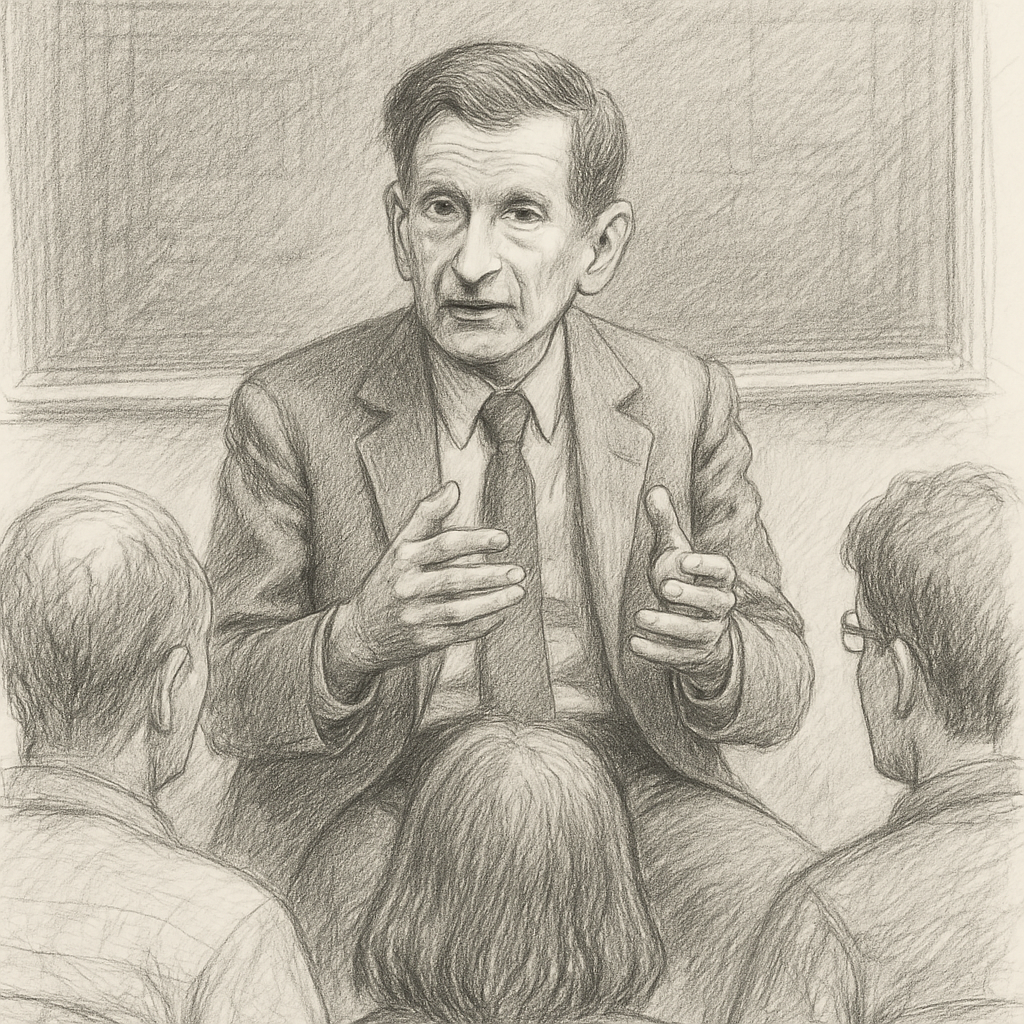
The transcript from David Bohm’s seminar offers a profound exploration of thought as an interconnected system, revealing its pervasive flaws and their implications for personal and global challenges. Below, we dissect the key subjects, questions, and insights from this dialogue, inviting readers to rethink how thought shapes reality.
1. Thought as a Unified, Flawed System
Subject: Bohm posits that thought is not merely intellectual but a holistic process intertwined with emotions, bodily states, and societal interactions. This system perpetuates global crises because addressing symptoms (e.g., war, inequality) without confronting systemic incoherence only deepens problems.
Key Insight:
“Once we see something wrong with a part of the system, we bring another part to bear to correct it, but it adds more trouble.”
Attempts to “fix” issues through fragmented solutions—like positive thinking or policy reforms—fail because they ignore the underlying systemic flaw: thought itself.
2. Incoherence: The Root of Conflict
Subject: Incoherence arises when thought contradicts reality, creating stress, confusion, and conflict. Bohm likens it to cancer—an “incoherent growth” that disrupts the whole organism.
Q&A Highlight:
- Question: “Is incoherence analogous to disease?”
- Answer: “Yes. Cancer is incoherent with the body. Violence or stress reflects incoherence in thought.”
Bohm emphasizes that incoherence manifests as contradictions (e.g., seeking peace through war) and sustains itself through conditioned reflexes.
3. The Reflexive Nature of Thought
Subject: Bohm compares thought to Pavlovian reflexes—conditioned responses ingrained through repetition. These reflexes govern emotions, beliefs, and even societal norms.
Key Insight:
“Thought is a set of reflexes. The knee-jerk reaction is not so different from defending a belief.”
Q&A Highlight:
- Question: “Can we mutate conditioning to allow new thoughts?”
- Answer: “Possibly, but it requires perceiving incoherence without resistance. Intellectual understanding alone won’t shift reflexes.”
4. The Trap of Positive Thinking and Addiction
Subject: Bohm critiques “positive thinking” as a superficial fix that masks deeper incoherence. He links addiction—whether to substances or reassuring thoughts—to the brain’s reliance on endorphins.
Key Insight:
“Positive thinking is incoherent. Negative thoughts remain, causing trouble elsewhere.”
Q&A Highlight:
- Question: “Can endorphins from positive thoughts become addictive?”
- Answer: “Yes. Reassuring thoughts chemically soothe, creating dependency. But like morphine, the relief is temporary and illusory.”
5. Necessity vs. Contingency
Subject: Bohm identifies “necessity” (beliefs deemed unchangeable) as a driver of conflict. Nations, religions, and individuals cling to absolutes (e.g., sovereignty, dogma), stifling dialogue.
Key Insight:
“Necessity is a reflex. Assuming something ‘cannot be otherwise’ traps us in incoherence.”
Q&A Highlight:
- Question: “How do assumptions of necessity harm dialogue?”
- Answer: “They create rigid reflexes. Negotiation requires admitting contingency—that even ‘absolutes’ can adapt.”
6. Moving Beyond Conditioning: Awareness and Dialogue
Subject: Bohm suggests that true inquiry—observing thought without judgment—might bypass conditioning. Dialogue, not debate, allows collective exploration of incoherence.
Practical Steps:
- Name the Reflex: Translate implicit assumptions into explicit words (e.g., “When someone yells, I assume I’m bad”).
- Stay with Discomfort: Observe bodily and emotional reactions without resistance.
Key Insight:
“Learning, not fixing, is the goal. Awareness loosens reflexes, creating space for unconditioned insight.”
Conclusion: A Call for Systemic Inquiry
Bohm’s seminar challenges us to see thought not as a tool but as a system requiring scrutiny. By recognizing incoherence, questioning necessity, and engaging in open dialogue, we might shift from reflexive reactions to transformative awareness.
Final Provocation:
“Is your anger, fear, or belief a reflex—or a doorway to deeper inquiry?”
In a world entrenched in systemic crises, Bohm’s work invites us to dissolve the boundaries between mind, body, and society, fostering coherence through relentless curiosity.
This article synthesizes Bohm’s seminar into a roadmap for personal and collective transformation, urging readers to confront the invisible architecture of thought.
 Kika's world