
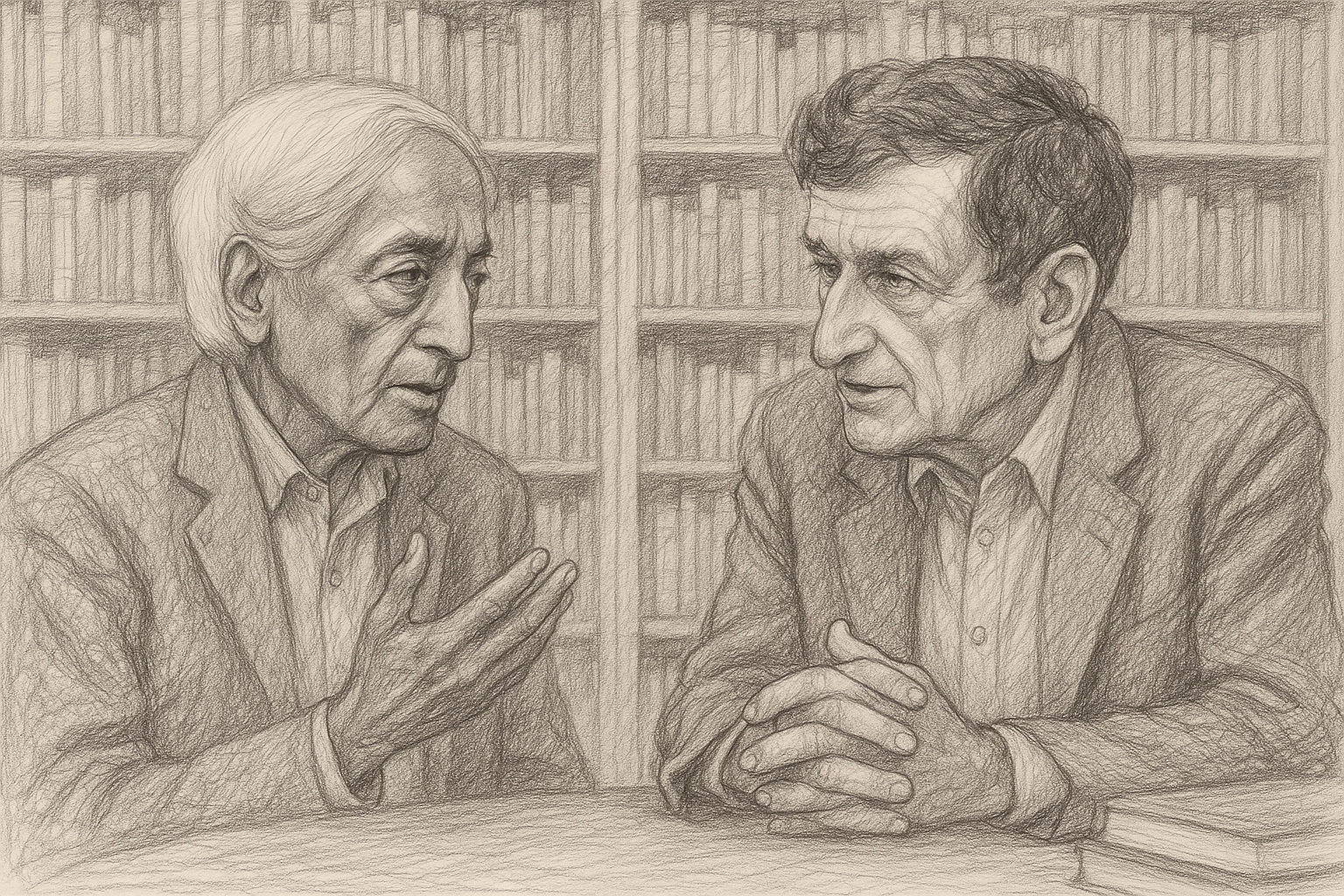
Exploring the Depths of Human Consciousness – A Summary of Krishnamurti and Bohm’s Dialogue, part 11
In their 1980 conversation at Brockwood Park, J. Krishnamurti (K) and physicist David Bohm (B) delve into profound questions about the nature of existence, the human mind, and the possibility of transcending psychological and societal disorder. Below is a structured breakdown of their dialogue, highlighting key subjects, questions, and insights.
Key Subjects
- The Origin and Ground of Existence
- Question: Is there an ultimate source or “ground” from which nature, humanity, and the universe originate?
- Discussion:
- K and B hypothesize a timeless, complete order beyond human comprehension—a “ground” untouched by time or human constructs.
- Bohm notes science seeks this through studying matter but remains limited by its focus on measurable order.
- Order vs. Disorder
- Human-Made Order:
- Question: Can societal or personal order resolve existential chaos?
- Answer: While necessary, such order is limited. K calls it a “small affair” compared to universal order.
- Cosmic Order:
- Question: Is there an inherent, universal order beyond human influence?
- Answer: Yes. Nature operates in intrinsic order; human interference creates fragmentation (e.g., religious or ideological divides).
- Human-Made Order:
- The Role of Insight
- Question: Can insight dissolve psychological disorder?
- Answer:
- Total Insight: A non-intellectual, immediate understanding of attachment, fear, or division ends their hold.
- Example: Insight into attachment (to beliefs, habits) eradicates dependence without gradual effort.
- Limitation: Most cling to conditioned patterns, lacking energy or courage to act on insight.
- The Nature of the Mind
- Question: Can the human mind transcend its conditioning?
- Answer:
- Damaged Mind: The “man-made mind” (conditioned by fear, desire, and measurement) perpetuates disorder.
- Transformation: Profound insight liberates the mind, aligning it with a “ground” beyond thought.
- Paradox: The conditioned mind must inquire into its own limitations to dissolve them.
- Meditation and Measurement
- Question: Is meditation a tool for understanding disorder?
- Answer:
- Meditation, defined as “observation without measurement,” reveals the roots of disorder (e.g., comparison, control).
- Measurement (e.g., goals, comparisons) is itself the source of psychological chaos.
- A Mind Beyond Human Constructs
- Question: Is there a mind untouched by human thought?
- Answer:
- Yes: A mind free of desire, illusion, and time exists but cannot be conceptualized.
- Relationship to Human Mind: This transcendent mind has no direct relationship to human-made illusions but understands their origin.
Key Questions and Answers
Q1: Why is societal order insufficient?
- Answer: Societal order addresses symptoms (e.g., conflict) but not the root cause: the fragmented self. True change requires dissolving the “me” (ego).
Q2: How does insight differ from intellectual analysis?
- Answer: Insight is immediate and holistic, bypassing memory or logic. It reshapes the brain’s structure by ending disordered thought patterns.
Q3: Can love dispel hatred?
- Answer: Love has no direct relationship to hatred. However, understanding hatred’s origin (e.g., conditioning) through insight ends it, allowing love to emerge.
Q4: Is communication possible between liberated and conditioned minds?
- Answer: A liberated mind can share insights, but transformation depends on the listener’s willingness to observe without resistance.
Conclusion
Krishnamurti and Bohm challenge listeners to move beyond superficial fixes and confront the roots of disorder: the self. They propose that total insight—free from time, thought, and measurement—can align humanity with a universal order. While their dialogue raises more questions than answers, it underscores the urgency of inner transformation to address global chaos.
Final Reflection: The conversation transcends intellectual debate, inviting a radical shift in perception—one where the mind, liberated from its conditioned shackles, touches the timeless.
Gestalt Analysis of Krishnamurti and Bohm’s Dialogue
The conversation between J. Krishnamurti (K) and David Bohm (B) aligns closely with core Gestalt principles, particularly in its emphasis on holism, present-moment awareness, and the integration of fragmented perceptions. Below is a breakdown of their dialogue through a Gestalt lens:
1. Holism vs. Fragmentation
Gestalt Principle: The whole is greater than the sum of its parts; fragmented perceptions create disorder.
Dialogue Connection:
- K and B critique societal and psychological disorder as symptoms of a fragmented self (e.g., attachment to beliefs, divisions like “me vs. you”).
- Example: K states, “The source of disorder is the ‘me’… unless that is dissolved, there is no order.” This mirrors Gestalt’s focus on integrating split-off parts of the self to achieve wholeness.
Key Insight:
The dialogue treats the human mind as a gestalt (unified whole) disrupted by conditioned patterns. True order arises not from fixing parts (e.g., societal reforms) but dissolving the illusion of separation.
2. Figure-Ground Dynamics
Gestalt Principle: Perception organizes experience into foreground (figure) and background (ground).
Dialogue Connection:
- Disorder as Figure: The visible chaos (e.g., conflict, fear) emerges from an unseen “ground” of universal order.
- Example: B notes, “What we call disorder in nature is part of the order.” This reflects Gestalt’s view that apparent chaos is contextual, not absolute.
Key Insight:
K and B suggest that insight shifts perception: the “figure” of disorder dissolves when the mind reconnects to the timeless “ground” (universal order).
3. Here-and-Now Awareness
Gestalt Principle: Healing occurs through present-moment awareness, not analysis of the past.
Dialogue Connection:
- K emphasizes “observation without measurement”—a direct, non-judgmental engagement with the present.
- Example: “Insight is not a movement from knowledge… but pure observation.” This mirrors Gestalt therapy’s emphasis on awareness as curative.
Key Insight:
The dialogue rejects intellectualizing disorder (e.g., “Why am I attached?“) in favor of immediate, embodied observation.
4. Unfinished Business and Closure
Gestalt Principle: Unresolved experiences (“unfinished business”) perpetuate dysfunction.
Dialogue Connection:
- Attachment, fear, and desire are framed as unresolved cycles (e.g., clinging to beliefs to avoid existential loneliness).
- Example: K argues that “insight into attachment… clears it with one blow,” akin to Gestalt’s concept of achieving closure through awareness.
Key Insight:
The “damaged mind” (Bohm’s term) perpetuates disorder until incomplete patterns (e.g., dependence) are fully seen and released.
5. The Paradox of Change
Gestalt Principle: Change occurs when one becomes what they are, not by trying to be different.
Dialogue Connection:
- K asserts that “effort to bring order into disorder is disorder.”
- Example: Trying to control the mind (e.g., through discipline) reinforces fragmentation. True change arises organically from insight.
Key Insight:
The dialogue aligns with Gestalt’s paradox: transformation happens not by striving, but by fully inhabiting the present state.
6. Dialogic Relationship
Gestalt Principle: Meaning emerges through relational dynamics and co-created dialogue.
Dialogue Connection:
- K and B’s exchange models Gestalt’s “I-Thou” interaction. Their mutual inquiry—“Is there such a ground?”—creates a shared field of discovery.
- Example: B’s role as a scientist grounding K’s metaphysical claims mirrors Gestalt’s emphasis on balancing subjective and objective truth.
Key Insight:
The dialogue itself is a gestalt—a living process where insight arises through collaborative presence.
Conclusion
Through a Gestalt lens, Krishnamurti and Bohm’s dialogue becomes a dynamic exploration of wholeness, immediacy, and relational authenticity. Their inquiry into universal order mirrors Gestalt’s goal of integrating fragmented selves into a coherent whole. By emphasizing present-moment awareness and rejecting mechanistic solutions, they echo Fritz Perls’ axiom: “Lose your mind and come to your senses.”
Final Gestalt Reflection:
The conversation embodies the Gestalt belief that “the only way out is through”—true order emerges not by escaping disorder, but by fully encountering it.
 Kika's world