
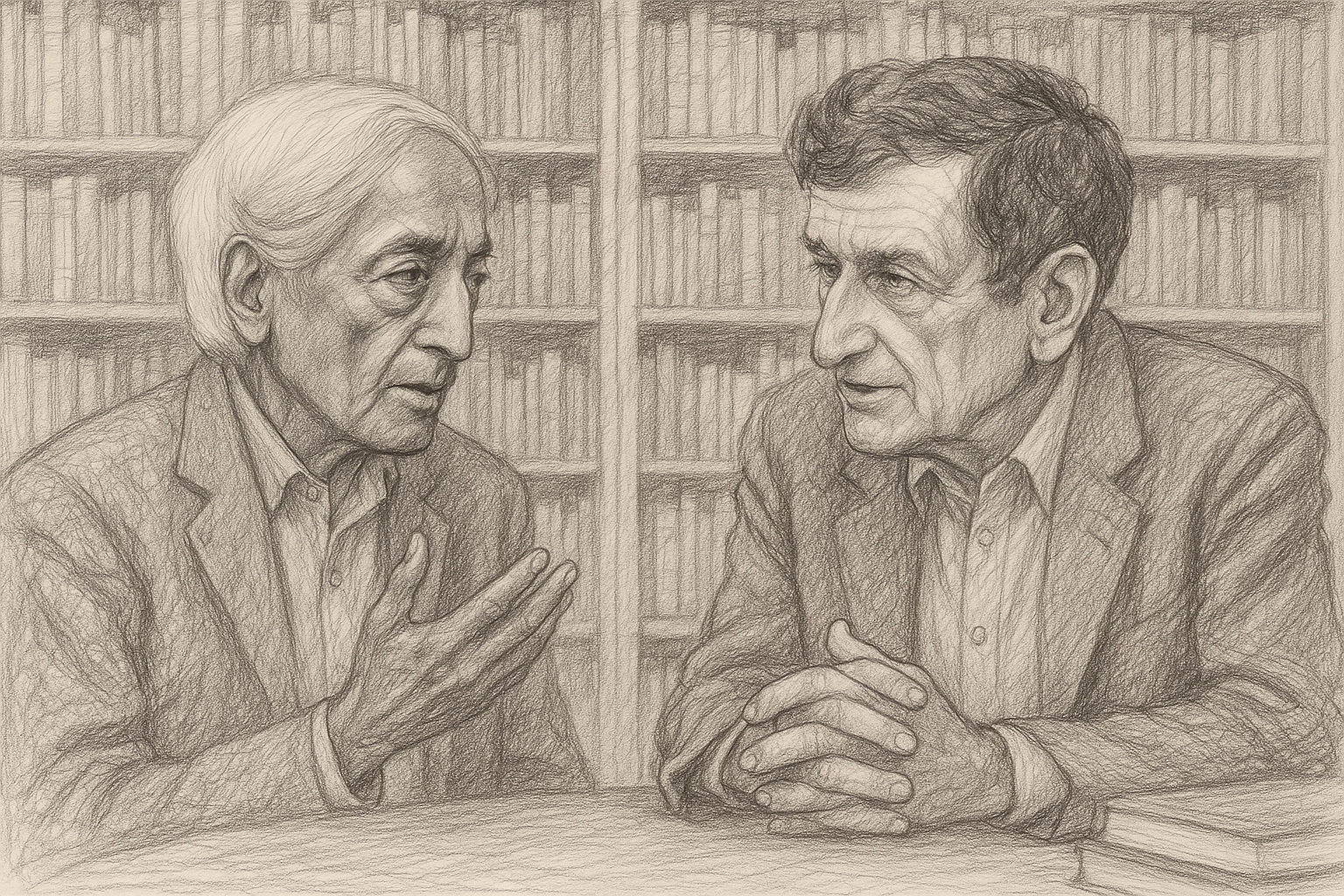
Exploring the Human Brain, Time, and Renewal – Insights from Krishnamurti and David Bohm
The 1980 conversation between Jiddu Krishnamurti and David Bohm at Brockwood Park delves into profound questions about the human brain, its potential for renewal, and the barriers imposed by psychological patterns and time. Below is a breakdown of their key subjects, questions, and insights:
1. The Deterioration and Renewal of the Human Brain
Question: Is the human brain deteriorating due to repetitive patterns, and can it rejuvenate itself?
- Krishnamurti argues that the brain, shaped by millennia of evolution, is trapped in divisive, selfish patterns (e.g., religious dogma, professional routines). These patterns shrink the brain’s capacity through mechanical repetition.
- Bohm agrees, noting that repetitive tasks—whether in clerical work, meditation, or rational thinking—lead to physical brain shrinkage. However, he highlights that rational thinking in new contexts (e.g., lawyers solving unique cases) may delay senility.
- Key Insight: The brain’s stagnation arises from occupation—constant mental engagement with fears, desires, and routines. Freedom from occupation could unlock renewal.
2. Psychological Knowledge vs. Factual Knowledge
Question: Does psychological knowledge (self-image, relational biases) harm the brain more than factual knowledge?
- Krishnamurti distinguishes between:
- Factual knowledge: Necessary for survival (e.g., driving a car) but risks becoming mechanical.
- Psychological knowledge: Self-centered narratives (e.g., “my relationship,” “my career”) that trap the brain in destructive patterns.
- Bohm adds that psychological knowledge creates rigid identities, leading to inner conflict and societal division.
- Key Insight: While factual knowledge is additive, psychological knowledge is time-binding—it perpetuates division and suffering.
3. Breaking Free from Psychological Time
Question: Can the brain escape the illusion of time to prevent degeneration?
- Krishnamurti asserts that psychological time—the ego’s attachment to past experiences and future projections—fuels suffering. Ending this illusion allows the brain to operate beyond time, enabling renewal.
- Bohm clarifies that this does not negate clock time (e.g., appointments) but challenges the psychological need for certainty and identity.
- Key Insight: Time creates the illusion of individuality. Freedom from time dissolves the self, ending divisive patterns.
4. Insight and Meditation as Catalysts for Change
Question: How can insight or meditation transform the brain?
- Krishnamurti defines insight as a timeless, immediate perception of truth (e.g., seeing the danger of greed). This “flash” bypasses analysis and dissolves psychological content.
- Meditation, in its true form, is not ritualistic but the emptying of consciousness from time-bound content. This emptiness releases trapped energy, rejuvenating brain cells.
- Bohm questions how to communicate this to scientists, who demand empirical proof. Krishnamurti responds that direct perception, not theory, is transformative.
- Key Insight: Insight is not an intellectual exercise but a visceral realization that rewires the brain.
5. The Challenge of Communicating Transformation
Question: How can these ideas reach a skeptical world?
- Both acknowledge the difficulty. Modern society prioritizes occupation, and scientific communities often dismiss non-measurable claims.
- Krishnamurti stresses that seeing the danger of time-bound living is as urgent as avoiding a physical threat. Once seen, the brain cannot regress.
- Bohm warns of illusions resurfacing in new forms (e.g., substituting one dogma for another), requiring perpetual awareness.
Conclusion: A Universal Brain and Hopeful Renewal
Krishnamurti and Bohm conclude that the brain is not individual but a universal product of evolution. Its renewal hinges on:
- Ending occupation: Freeing the mind from repetitive patterns.
- Timeless insight: Direct perception beyond psychological knowledge.
- Meditation as emptiness: A state devoid of content, releasing boundless energy.
While scientific validation remains elusive, their dialogue offers a radical vision: the human brain, freed from time and self, can transcend its limitations—ushering in a new consciousness.
“The ending of suffering comes when the self, built through time, is no longer there.” – J. Krishnamurti
Gestalt Analysis of the Krishnamurti-Bohm Dialogue
The conversation between Jiddu Krishnamurti and David Bohm can be analyzed through a Gestalt lens, emphasizing how their ideas coalesce into a unified exploration of human consciousness, time, and brain renewal. Here’s a structured breakdown using core Gestalt principles:
**1. Figure-Ground Relationship
- Figure: The dominant theme is psychological time—how the brain’s fixation on past and future traps it in destructive patterns. This “figure” emerges sharply against the ground of societal norms, routines, and scientific materialism.
- Example: Krishnamurti’s assertion that “time creates the self” stands out against Bohm’s grounding in neurological decay, creating tension between spiritual insight and empirical observation.
**2. Proximity and Grouping
- Interconnected Themes:
- Deterioration (repetitive patterns, brain shrinkage)
- Renewal (insight, meditation, emptiness)
- Communication Barriers (skepticism, scientific validation)
- These themes are grouped closely, forming a coherent narrative: The brain’s decline is tied to psychological habits, but transcendence is possible through holistic perception.
**3. Similarity and Recurrence
- Recurring Motifs:
- Occupation: The brain’s constant engagement with fears/desires.
- Insight: A flash of understanding that dissolves time-bound constructs.
- Emptiness: The meditative state free of psychological content.
- These motifs create thematic unity, reinforcing the idea that liberation arises from non-occupation and direct perception.
**4. Closure and Incompleteness
- Unresolved Tensions:
- How to empirically validate “emptiness” or “timeless insight.”
- Bridging the gap between Krishnamurti’s experiential truths and Bohm’s scientific rigor.
- These gaps invite the reader to “close” the narrative by contemplating the interplay of spirituality and science.
**5. Continuity and Flow
- Logical Progression:
- Problem Identification: Brain deterioration via patterns.
- Root Cause Analysis: Psychological time and knowledge.
- Solution Exploration: Insight, meditation, emptiness.
- Challenges: Communicating transformative ideas.
- The dialogue flows seamlessly from diagnosis to remedy, maintaining momentum.
**6. Emergent Whole
- Gestalt Synthesis: The dialogue transcends individual arguments to propose a holistic view of consciousness:
- The brain is not an isolated entity but a universal product of evolution.
- Renewal requires dissolving the illusory self (a Gestalt of psychological constructs) to access a timeless, unified state.
- Key Insight: The whole—universal mind—is greater than the sum of its parts (individual brains, societal norms).
**7. Negative Space
- What’s Absent:
- Detailed methodologies for achieving “emptiness.”
- Concrete steps to bridge science and spirituality.
- These silences highlight the limitations of language and rational frameworks, pointing to the need for direct experience.
Conclusion: The Gestalt of Transformation
The Krishnamurti-Bohm dialogue exemplifies Gestalt principles by integrating fragmented ideas into a cohesive vision:
- Deterioration and renewal are two poles of the same perceptual field.
- Time and self are illusions that dissolve when the brain perceives itself holistically.
- True transformation emerges not from isolated efforts but from seeing the whole—a Gestalt shift from fragmentation to unity.
“The ending of time is the beginning of perception.”
—A Gestalt rephrasing of their dialogue.
 Kika's world