
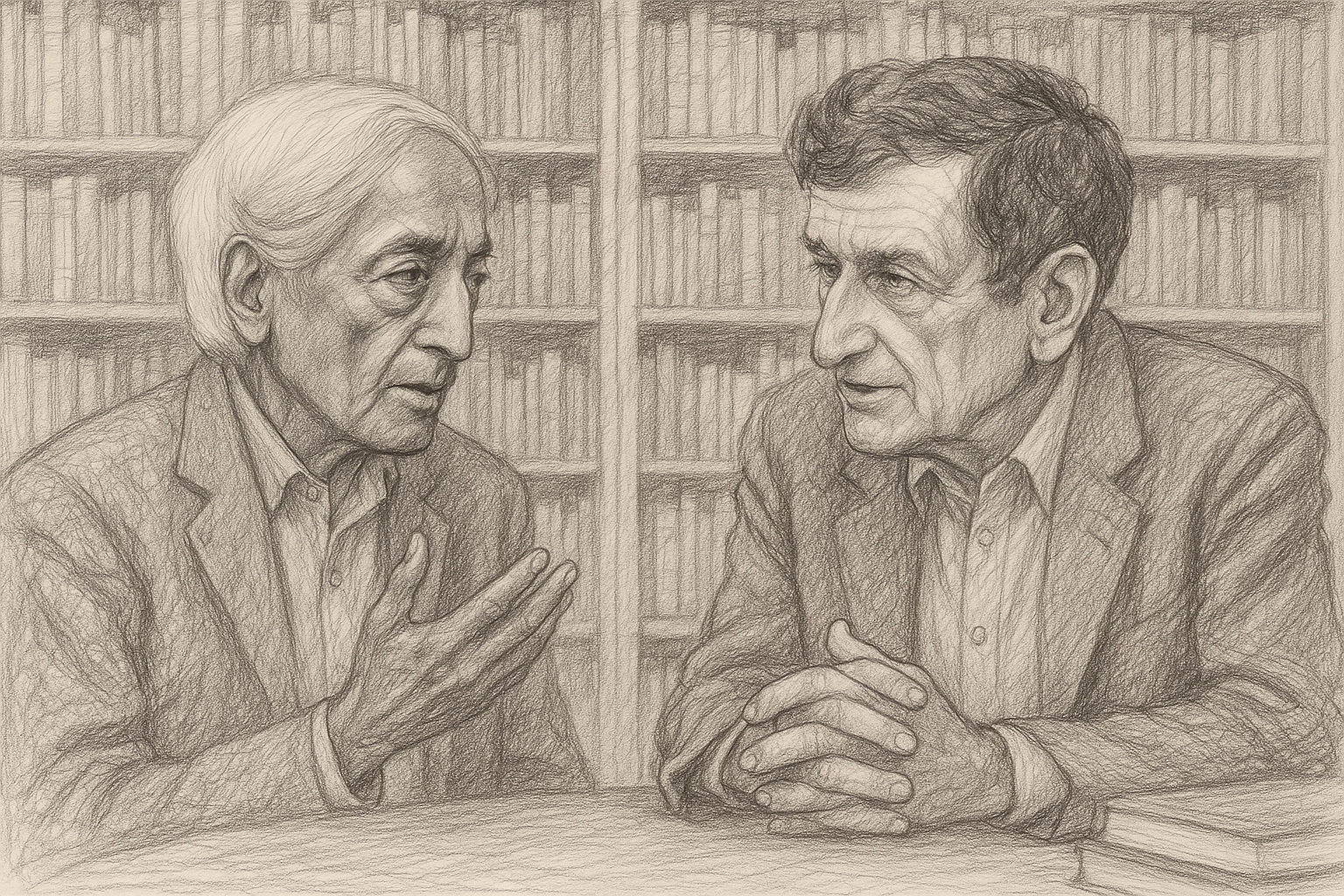
The Ending of Time – A Dialogue on Non-Movement, Enlightenment, and Society
J. Krishnamurti & David Bohm – Ojai 1980 (Conversation 8)
Context
In their eighth dialogue, philosopher J. Krishnamurti and physicist David Bohm explore profound questions about enlightenment, societal transformation, and the paradox of action versus non-movement. The conversation centers on the state of a hypothetical individual (‘X’) who has transcended societal conditioning and “walked out of darkness,” and how such a person relates to a world still trapped in struggle and ignorance (‘Y’).
Key Subjects Explored
1. The Nature of Non-Movement
- Definition: Non-movement refers to a state of being free from the psychological processes of “becoming” (ambition, desire, division). It is not static but a “movement without division” rooted in the “ground”—a universal, timeless reality.
- Krishnamurti: “The ground is movement, yes… but it is movement without division.”
- Bohm: Suggests non-movement implies constancy and wholeness, not passivity.
2. The Enlightened Individual (‘X’) in Society
- Daily Life: How does ‘X’ function in a world dominated by conflict, war, and materialism?
- Krishnamurti: “What is his action with regard to war and the whole world… a world living in darkness?”
- Resolution: ‘X’ engages in “non-action”—not participating in societal constructs of greed or division but acting from insight and compassion.
3. Skill, Livelihood, and Societal Norms
- Question: Does ‘X’ need traditional skills to survive?
- Bohm: Basic skills (e.g., driving, carpentry) are necessary but must not serve exploitative systems.
- Krishnamurti: Challenges societal divisions between “living” and “working,” suggesting ‘X’ operates beyond transactional frameworks.
4. The Paradox of Teaching
- Role of ‘X’: While ‘X’ may teach or write, these actions are deemed “petty” compared to the immensity of their state.
- Bohm: “The prime task is to awaken intelligence… but this is not enough.”
- Krishnamurti: “The function of many ‘X’s’ is to dispel darkness… but there is something much greater.”
5. The Immensity of the Ground
- Metaphysical Impact: ‘X’ embodies a universal intelligence that must affect humanity’s consciousness, even if imperceptibly.
- Krishnamurti: “Light must affect darkness… [It] has to operate at a much greater level.”
- Bohm: Draws an analogy to a catalyst—’X’ enables change simply by existing.
6. The Challenge of Communication
- Barriers: ‘Y’ (ordinary individuals) demand proof, results, or tangible benefits, reducing ‘X’s’ immensity to “petty” terms.
- Krishnamurti: “You cannot translate the immensity into human terms… ‘Y’ will worship, kill, or neglect ‘X’.”
Critical Questions & Answers
Q1: What is the relationship between ‘X’ and society?
- Answer: Superficial interaction (e.g., obeying laws) but no fundamental alignment with societal values. True relationship exists only when ‘Y’ transcends darkness.
Q2: Can ‘X’ directly transform society?
- Answer: Not through conventional means. However, a collective of undivided ‘X’s’ could spark revolutionary change by radiating intelligence and compassion.
Q3: Does the “ground” require human agency?
- Answer: The ground—universal and timeless—does not need humans, but ‘X’ becomes a conduit for its expression.
Q4: Why does societal darkness persist despite ‘X’s’ existence?
- Answer: The impact is subtle and non-linear. As Bohm notes, “Ten undivided people could exert a force never seen in history.”
Implications & Conclusions
- Beyond Conventional Activism: True transformation arises not from societal reform but from individuals embodying undivided consciousness.
- The Power of Collectives: A small group of enlightened beings could shift humanity’s trajectory away from destruction.
- Language’s Limits: The dialogue underscores the inadequacy of words to capture transcendent states, urging direct insight over intellectualization.
Krishnamurti closes with cautious optimism: “Light must affect darkness… but somebody must listen.” The conversation leaves unresolved the tension between the immensity of ‘X’s’ state and the stubborn inertia of societal darkness, yet it offers a vision of hope rooted in awakened intelligence.
Analysis of the Krishnamurti-Bohm Dialogue Through a Gestalt Perspective
The Gestalt psychological framework emphasizes understanding phenomena as integrated wholes rather than isolated parts, focusing on patterns, relationships, and the dynamic interplay between figure (focal points) and ground (context). Applying this lens to Krishnamurti and Bohm’s conversation reveals profound insights into their exploration of non-movement, enlightenment, and societal transformation.
1. Figure-Ground Dynamics
- The “Ground” as Universal Context:
Krishnamurti’s repeated reference to the “ground” (a timeless, undivided reality) aligns with the Gestalt concept of the ground—the backdrop against which all phenomena arise. This ground is not passive but a dynamic field of movement without division.- Implication: Individual actions (“figures”) like teaching or writing gain meaning only in relation to this universal ground.
- ‘X’ and ‘Y’ as Figure-Ground Tension:
- ‘X’ (Enlightened Individual): Embodies a figure that emerges from the ground, distinct yet inseparable from it. ‘X’ operates in society but is not defined by societal norms (e.g., “non-movement” as a figure transcending the ground of time and becoming).
- ‘Y’ (Ordinary Individual): Represents figures trapped in the societal ground of darkness (division, fear, materialism). The dialogue highlights the struggle for ‘Y’ to perceive the ground through fragmented figures (e.g., demands for proof, skill-based living).
2. Wholeness and Integration
- Non-Dualistic Perception:
The conversation rejects binary categories (action/non-action, skill/no skill) in favor of an integrated view. For instance, “non-movement” is not passivity but a holistic state where action arises naturally from insight, untainted by societal fragmentation.- Bohm’s Catalyst Analogy: The enlightened individual (‘X’) acts as a catalyst, enabling transformation without being consumed by the reaction—a Gestalt principle where the whole (societal change) emerges from the interplay of parts (‘X’ and ‘Y’).
- Closure and Unresolved Tension:
The dialogue leaves unresolved the paradox of how ‘X’ impacts society. Gestalt’s “law of closure” suggests listeners must reconcile this tension by intuiting the immensity of the ground. Krishnamurti’s statement—”Light must affect darkness”—invites closure through experiential insight rather than intellectual resolution.
3. Emergence and the Principle of Prägnanz
- Emergence of Collective Transformation:
The idea that “ten undivided ‘X’s” could revolutionize society reflects Gestalt’s emphasis on emergent properties. Just as a melody emerges from individual notes, societal awakening arises from the harmonious presence of enlightened beings. - Simplicity (Prägnanz):
Krishnamurti critiques reducing the “immensity” of the ground to petty human terms (e.g., skill-based living). This mirrors Gestalt’s preference for the simplest, most unified perception. True understanding requires seeing beyond fragmented societal constructs to the simplicity of undivided consciousness.
4. The Field of Consciousness
- Interconnectedness:
Bohm’s analogy of the ground influencing humanity’s collective consciousness aligns with Gestalt’s view of the perceptual field as interconnected. ‘X’s’ existence subtly shifts the entire field, even if ‘Y’ cannot perceive it.- Krishnamurti: “The immensity must affect the consciousness of mankind… but it cannot be put into words.”
- Reorganization of Perception:
The dialogue urges a Gestalt-like shift in perception: moving from ‘Y’s’ fragmented view (e.g., “prove it to me”) to ‘X’s’ holistic awareness. This reorganization is not intellectual but experiential, akin to suddenly seeing a hidden image in a puzzle.
5. Paradox and Ambiguity
- Non-Action as Fullness:
The concept of “non-action” embodies Gestalt’s embrace of paradox. It is not inertia but a state of being so attuned to the ground that action flows without effort or division. - Ambiguity of Impact:
The unresolved question—”Why does societal darkness persist?”—reflects Gestalt’s tolerance for ambiguity. Transformation operates non-linearly, much like how a figure emerges unpredictably from a complex ground.
Conclusion: A Gestalt Vision of Awakening
The Krishnamurti-Bohm dialogue exemplifies Gestalt principles by framing enlightenment as a perceptual shift from fragmented figures (societal norms, individual striving) to an integrated ground (timeless reality). ‘X’ embodies the Gestalt ideal of wholeness, where action and non-action coalesce, and societal change emerges organically from the field of consciousness. The conversation challenges listeners to reorganize their perception, moving from ‘Y’s’ demand for proof to ‘X’s’ silent radiance—a call to see the whole, not just the parts.
Final Gestalt Insight: Just as a vase and faces alternate in a classic figure-ground illusion, enlightenment reveals the fluid unity of self and universe, where societal darkness and transcendent light coexist as aspects of the same ground.
 Kika's world