
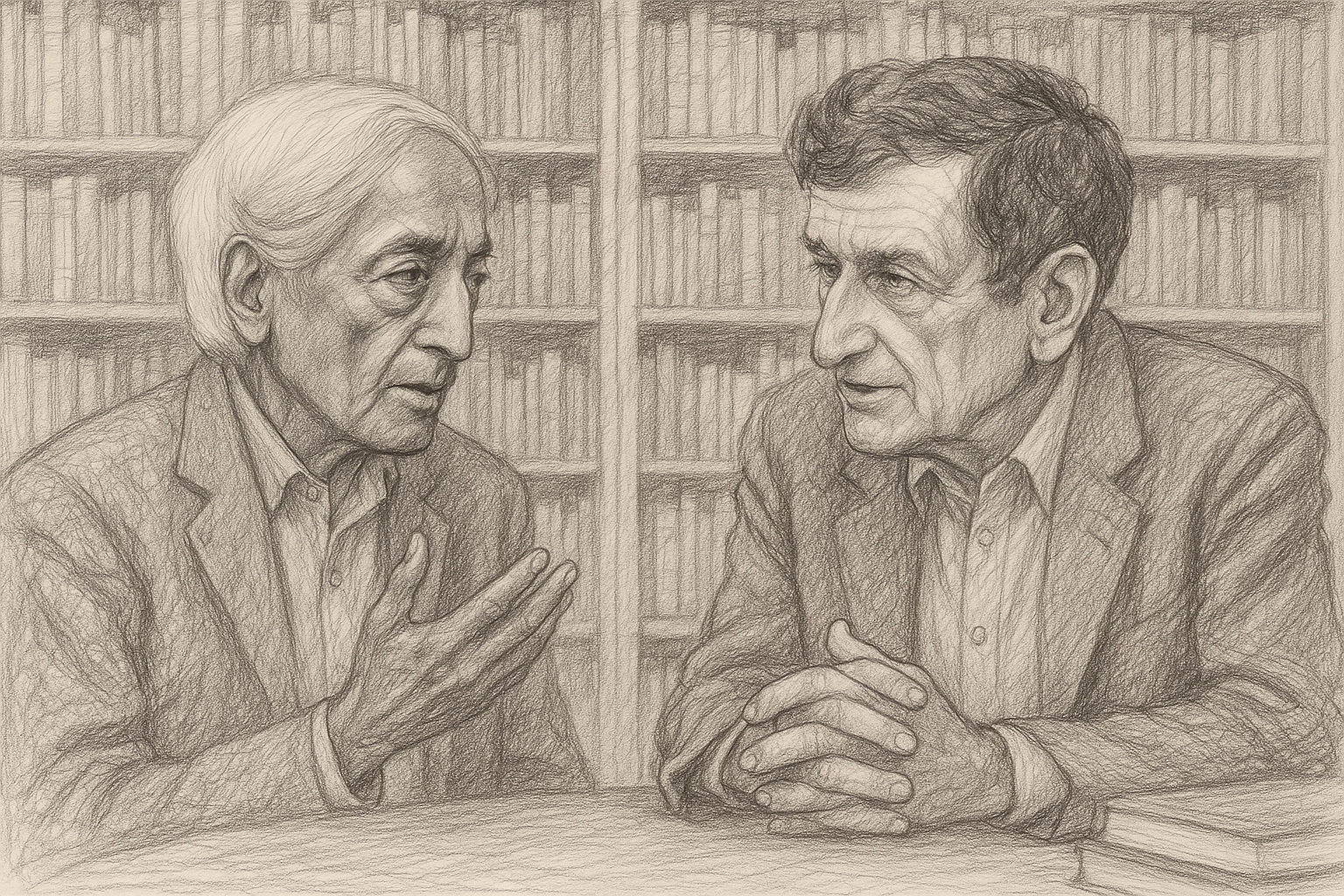
Exploring the Depths of Insight and Division in Krishnamurti and Bohm’s Dialogue
The seventh conversation between J. Krishnamurti (K) and David Bohm (DB) in their 1980 Ojai series, The Ending of Time, delves into profound philosophical and existential themes. Below is a structured breakdown of the key subjects, questions, and answers explored in their dialogue.
1. Human Instincts and Thought
Subject: The persistence of primal instincts in modern humans.
- Question: Are humans still governed by animal instincts, amplified by thought?
- Answer:
- K & DB: Yes. Animal instincts like aggression, fear, and pleasure are intensified by thought, leading to subtler and more dangerous behaviors. Thought creates a “darkness” that sustains these instincts, making them harder to escape.
2. The Nature of Insight
Subject: Insight as a transformative force.
- Question: How does insight dispel darkness and alter the brain?
- Answer:
- K: Insight is a sudden “flash” that eliminates the self-centered darkness. It reorganizes the brain, enabling perception free from rules or logic.
- DB: Insight is not mechanical; it allows the mind to function with “freely flowing reason” rooted in perception, not rules.
3. Division and Its Illusion
Subject: The artificial separation between individuals and concepts.
- Question: Is the division between those with insight and those without fundamental?
- Answer:
- K: No. Division is created by the self through thought. The statement “there is no division” can shatter this illusion, breaking the pattern of darkness.
- DB: Division is not intrinsic but arises from repeated “wrong turns” in thought. Returning to the source (timeless awareness) dissolves division.
4. Time and the Wrong Turn
Subject: Humanity’s perpetual misdirection.
- Question: Why do humans constantly take the “wrong turn” into darkness?
- Answer:
- K & DB: The mind, entangled in thought, perpetuates division. This cycle is not rooted in time but in a timeless error—a failure to perceive reality without the self’s interference.
5. Practical Implications of Insight
Subject: Applying insight to daily life.
- Question: How can one sustain insight amidst societal pressures?
- Answer:
- K: Insight cannot be forced through effort, systems, or external roles (e.g., becoming a monk). It arises naturally when the mind perceives the falseness of division.
- DB: Rationality alone fails; only direct perception of order (via insight) transforms behavior.
6. Death and the Ground of Being
Subject: Overcoming the fear of death.
- Question: What happens when insight abolishes the division between life and death?
- Answer:
- K: Death loses significance. The brain, freed from conflict, may decay slower, but the mind becomes part of a timeless “movement” beyond duality.
- DB: The mind merges with a universal ground—neither light nor dark, but a totality enveloping all.
7. The Role of Compassion
Subject: Compassion as an emergent quality.
- Implicit Conclusion:
- True compassion arises from insight, not effort. It is not a separate virtue but a natural expression of undivided perception.
Key Takeaways
- Insight vs. Thought: Insight transcends thought’s limitations, offering a direct perception of reality.
- Non-Division: The assertion “there is no division” challenges societal norms and self-centered existence.
- Timeless Movement: The “ground” of being is a dynamic, undivided flow where mind, matter, and energy converge.
- Death as Illusion: Fear of death dissolves when the mind aligns with this timeless movement.
Conclusion
Krishnamurti and Bohm’s dialogue underscores the transformative power of insight to dismantle humanity’s deepest illusions. By confronting division, time, and fear, they propose a radical reorientation of consciousness—one that aligns with a universal, undivided reality. This conversation remains a timeless invitation to perceive beyond the self’s darkness and embrace the ground of being.
Analysis of the Krishnamurti-Bohm Dialogue Through a Gestalt Lens
1. Whole Over Parts: Unity and Holism
Gestalt Principle: The whole is greater than the sum of its parts.
Application:
- The dialogue critiques fragmented human perception (e.g., division, fear, time-bound thought) and posits insight as the integrative force that reorganizes fragmented “parts” (instincts, thoughts) into a unified whole.
- “No division” reflects the Gestalt ideal of wholeness, where perceived separations (self vs. other, life vs. death) dissolve into a coherent field of awareness.
2. Figure-Ground Dynamics
Gestalt Principle: Perception organizes experience into foreground (figure) and background (ground).
Application:
- Darkness (ground): Represents the pervasive, self-generated confusion from thought and instinct.
- Insight (figure): Emerges abruptly, restructuring perception. Like a gestalt shift (e.g., duck-rabbit illusion), insight reconfigures the “ground” of darkness into clarity.
- “Movement without division”: Symbolizes a holistic field where figure and ground are inseparable, aligning with Gestalt’s emphasis on dynamic interdependence.
3. Closure and Incomplete Gestalts
Gestalt Principle: The mind seeks resolution for incomplete patterns.
Application:
- “Wrong turns” and division: Represent unresolved gestalts—persistent psychological tensions (e.g., fear of death, aggression) stemming from fragmented perception.
- Insight as closure: A sudden “flash” of understanding resolves these tensions, completing the gestalt. Partial insights fail because they leave the core “darkness” (incomplete pattern) intact.
4. Present-Centered Awareness
Gestalt Therapy Principle: Emphasis on the “here and now.”
Application:
- Krishnamurti’s dismissal of time (“insight is not time-bound”) mirrors Gestalt therapy’s focus on present-moment awareness.
- Animal instincts vs. insight: The struggle between automatic, past-conditioned responses (old patterns) and immediate, holistic perception (new gestalt).
5. Reorganization of Perception
Gestalt Principle: Perception is dynamic and reorganizes based on context.
Application:
- “Movement” as a timeless ground: Analogous to the perceptual field in Gestalt theory, which is fluid and context-dependent. Insight allows the mind to perceive this movement without imposing divisions.
- Brain cells and decay: Metaphorically, fragmented thoughts (incomplete gestalts) strain the brain, while insight’s reorganization fosters coherence, potentially slowing decay through reduced psychological conflict.
6. Tension and Resolution
Gestalt Principle: Incomplete forms create tension; resolution brings equilibrium.
Application:
- Human suffering: Stems from unresolved tensions (e.g., division, fear) perpetuated by thought.
- “There is no division”: Acts as a gestalt intervention, dissolving tension by revealing the illusory nature of separation.
Key Gestalt Insights from the Dialogue
- Holism Over Fragmentation: Human suffering arises from perceptual splits; insight restores unity.
- Dynamic Shifts: Insight is a gestalt shift—a sudden reorganization of perception.
- Present-Moment Clarity: Timeless awareness (Gestalt’s “here and now”) dispels inherited patterns.
- Resolution of Tension: Completing the gestalt (via insight) resolves existential and psychological conflicts.
Conclusion
Through a Gestalt lens, Krishnamurti and Bohm’s dialogue maps onto principles of perceptual organization, wholeness, and dynamic resolution. The “darkness” of division and thought represents fragmented, incomplete gestalts, while insight embodies the moment of closure where the mind perceives reality as an undivided, ever-moving field. This analysis underscores the transformative power of holistic awareness to dissolve illusion and align consciousness with the totality of existence.
 Kika's world