
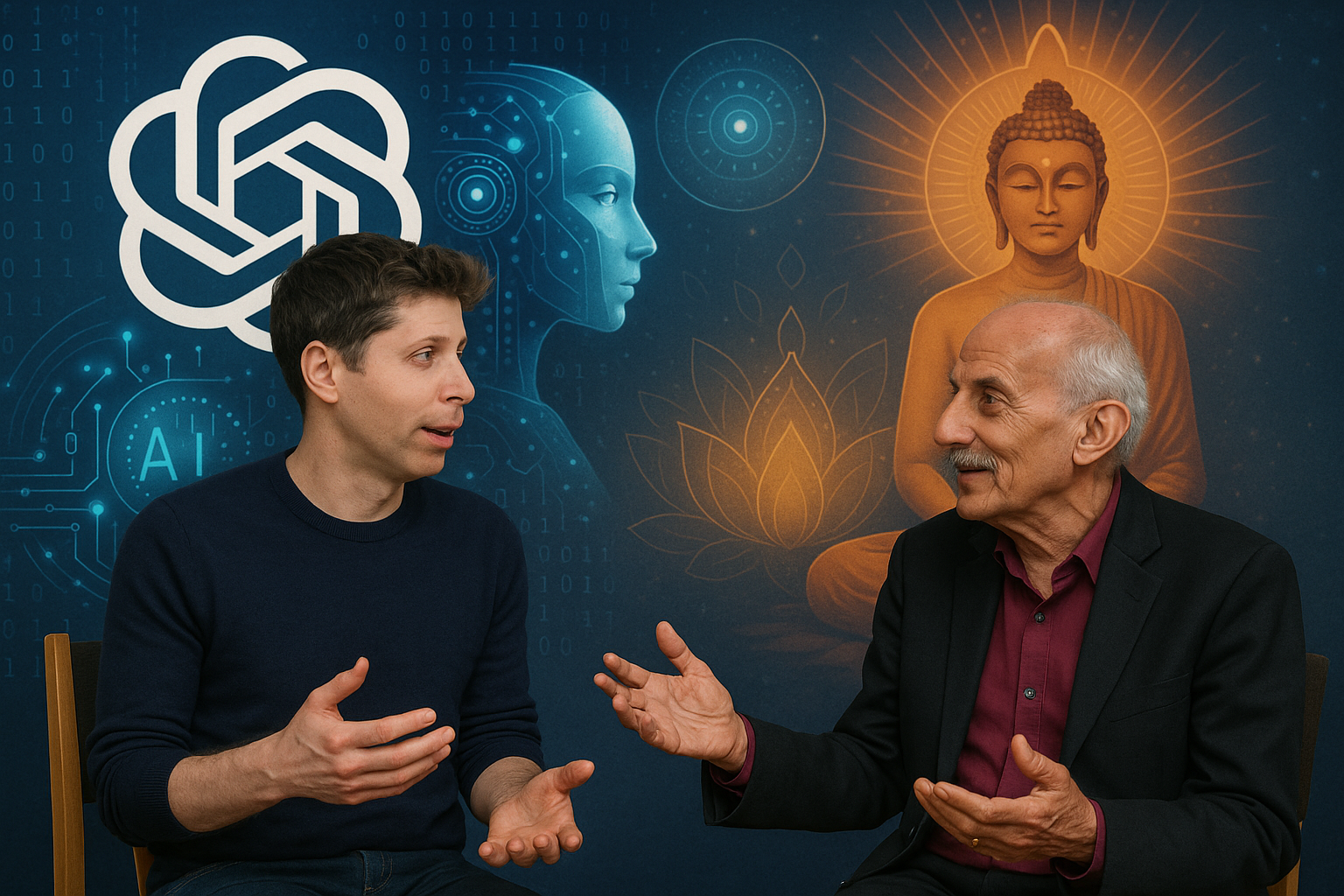
- visual created by ChatGPT for kikasworld.com
The this text captures a profound dialogue between OpenAI CEO Sam Altman and renowned Buddhist teacher Jack Kornfield, moderated by Soren Gordhamer. This conversation explores the intersection of transformative artificial intelligence, human consciousness, ethics, and the role of mindfulness in navigating an uncertain future. Here’s a breakdown of the key subjects and pivotal insights:
Core Subjects & Highlights
- The Motivation & Shared Values:
- Subject: Why Altman and Kornfield engaged in this dialogue.
- Key Insight: Their connection stems from shared meditation practice and deep conversations about consciousness and ethics. Kornfield initiated the idea to explore “mindfulness, AI, and the future of life.” Altman agreed primarily because of his respect for Kornfield (“I would be delighted to come hang out with Jack for an hour on literally any topic”).
- Important Sentence: Kornfield describes Altman as a “servant leader” with a “pure heart” and an “inner sense of values and care for life,” crucial for stewarding powerful technology. He emphasizes the need for AI development to come from a “place of consciousness.”
- AI’s Potential Benefits & Vision:
- Subject: How AI (like ChatGPT) can positively transform humanity.
- Key Insight: Altman sees current AI as an early preview of immense potential. He highlights user stories: learning, spiritual progress, problem-solving, efficiency, and acting as a tutor or coach. His vision extends to accelerating scientific progress, curing diseases, solving environmental problems, and creating abundance.
- Important Sentence: “I am a firm believer that if you give people better tools their creative energy will always surprise you on the upside… I think we’re already seeing that but it’s going to go much much further.”
- Fears, Risks & the Need for Governance:
- Subject: Addressing societal anxieties about AI (misuse, bias, job loss, AGI control) and proposed solutions.
- Key Insight: Both acknowledge valid fears. Altman advocates for openness (releasing tech early) to foster global understanding and adaptation. He stresses the necessity of:
- Technical Alignment: Solving the “alignment problem” to ensure AI does what humans want.
- Global Governance: An international regulatory body (like an “IAEA for advanced AI”) with authority over training and deployment.
- Democratic Input: Collective human wisdom determining AI’s core values and boundaries (“as democratically shared among all the people of earth as much as possible”).
- Equitable Access & Benefit Sharing: Distributing access to AI’s power and economic benefits widely (e.g., slicing global compute for each person). OpenAI’s “capped profit” structure aims to prioritize humanity’s benefit over shareholder value.
- Important Sentences:
- “This is going to be such a massive change… we need the world as a whole… to understand this, to weigh in on it.”
- “I cannot come up… with a super high conviction path that does not involve something like [an international organization].”
- “How we are going to distribute access to these systems… will become super important over time.”
- Consciousness, Values & Programming Ethics:
- Subject: Can/should AI embody ethical values (like compassion)? How do we define consciousness?
- Key Insight: Their initial conversations centered on consciousness. Kornfield suggests programming AI with values akin to the Buddhist “bodhicitta vows” (compassion for all beings) or Asimov’s laws. Altman envisions AI learning collective human moral preferences through interaction and feedback, allowing individual customization within broad societal bounds. He sees AI as a tool to help humans become less biased.
- Important Sentences:
- (Kornfield) “How can that [values like non-harming] be programmed in some way in the deepest way?”
- (Altman) “Out of that… the system can learn the collective moral preferences of humanity… within that… individuals should have a huge amount of autonomy.”
- The Role of Mindfulness & Inner Development:
- Subject: The importance of spiritual practice for leaders and society amidst technological upheaval.
- Key Insight: Altman credits meditation with providing a “reserve of calmness” crucial for navigating intense pressure. Kornfield stresses meditation fosters presence, spaciousness, and wiser decision-making (“the mind creates the abyss… the heart crosses it”). They agree that abundant AI could free time for spiritual practice (“instead of going to work, you’re going to go to work on yourself”). A core challenge is balancing immersive tech with human connection and inner growth.
- Important Sentences:
- (Altman) “I am really happy for all of the time I’ve spent meditating because… having a reserve of calmness to draw on… has been a very nice thing to have.”
- (Kornfield) Meditation allows you to “get present and tuned in… there’s a spaciousness… from which you can make decisions that are wiser.”
- Societal Revolution, Capitalism & the Future:
- Subject: AI as more than a tech revolution; its impact on economics and social structures.
- Key Insight: Altman believes AI represents a profound “societal revolution” demanding new thinking. He critiques capitalism’s inequality and envisions a “much much better” post-scarcity system, prioritizing eliminating poverty. He hopes AI can “amplify” individual will and help design lives focused on connection and meaning.
- Important Sentences:
- “I think in some sense AI will be bigger than a standard technological revolution… much closer to a societal revolution.”
- “I hope in a world with the level of abundance… we find something much much better than capitalism.”
- “What I hope is that… [AI] prioritize[s] amplification of your individual will for yourself.”
Conclusion: Collaboration & Hope
The dialogue concludes with a call for collective responsibility. Kornfield emphasizes this is “us. It’s not Sam, and it’s not a small group of people.” Altman expresses gratitude for the global conversation now happening, seeing it as essential for shaping a positive future. While acknowledging the significant challenges and speed of change (“scary times,” “massive change”), both express fundamental optimism about humanity’s ability to navigate this transition collaboratively and consciously.
Core Takeaway: The path forward requires integrating technological prowess with deep ethical consideration, democratic input, global cooperation, and a commitment to inner development (mindfulness) to ensure AI truly benefits all of humanity and elevates human consciousness.
 Kika's world