
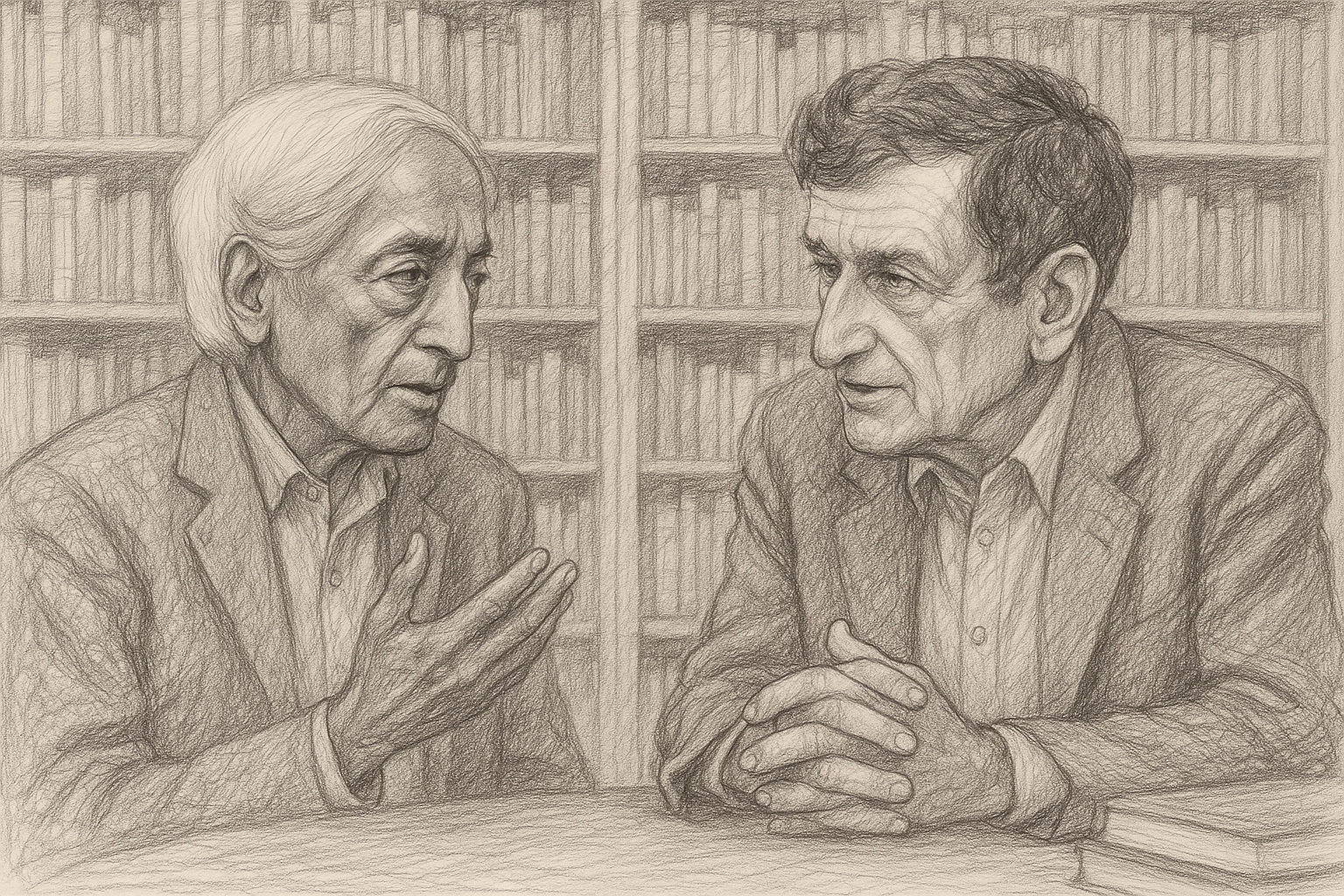
J. Krishnamurti & David Bohm – Ojai 1980 – The Ending of Time (Conversation 4)
An Exploration of Fundamental Change, Resistance, and the Role of Insight
Key Subjects Discussed
- The Question of Fundamental Change:
- Why do humans, despite enduring crises, wars, and personal suffering, fail to undergo radical transformation?
- The role of psychological conditioning, particularly the egocentric self, in resisting change.
- The Limitations of Knowledge and Time:
- How reliance on accumulated knowledge, memory, and time-bound processes (e.g., “becoming”) perpetuates stagnation.
- The distinction between partial insights (e.g., art, science) and total insight, which transcends time and the self.
- Resistance to Letting Go:
- The subconscious clinging to familiar patterns, even when irrational or destructive.
- The failure of traditional methods (religion, philosophy, communism) to address the root of human suffering.
- The Role of Passion and Insight:
- Insight as a transformative force that dissolves the “me” (the self) and connects to the “ground” (a state beyond thought).
- The inadequacy of explanations, rewards, or punishments in fostering genuine change.
- The Metaphor of the Immovable (‘X’):
- Confronting an unchanging truth or reality that challenges habitual patterns.
- The necessity of discarding psychological knowledge to embrace a new way of being.
Central Questions & Answers
Q1: What prevents humans from changing despite repeated crises?
- Krishnamurti: The ego-centric self, reinforced by psychological conditioning, remains rigid. External shocks (wars, sorrows) only temporarily disrupt this pattern.
- Bohm: The mind resists perceiving the “meaninglessness” of its own conflicts, clinging to hope in struggle.
Q2: Why do intellectual explanations fail to catalyze change?
- Krishnamurti: Explanations operate within the framework of thought and time, which are part of the problem. True insight is non-verbal and immediate.
- Bohm: Abstract understanding lacks the energy to dismantle deeply ingrained habits; rationality alone cannot penetrate subconscious resistance.
Q3: How can one break free from the cycle of conditioning?
- Krishnamurti: By discarding all psychological knowledge and patterns, leading to a “total insight” that ends the self.
- Bohm: Recognizing the futility of existing methods is the first step, but this requires a passionate, non-negotiable shift in perception.
Q4: What role does “the ground” play in transformation?
- Krishnamurti: The ground represents a state beyond time and thought, accessible only when the self dissolves. It is not an abstraction but a living reality.
- Bohm: Rationality must lead to contact with this ground, but the irrational mind blocks this connection.
Q5: Can encountering an immovable truth (‘X’) provoke change?
- Krishnamurti: Meeting an unyielding reality forces confrontation with one’s own patterns. This “irrevocable” encounter disrupts habitual thinking.
- Bohm: Such a meeting exposes the impossibility of continuing old ways, creating a “shock” that reorients the mind.
Notable Insights
- The Paradox of Knowledge: While knowledge is essential for survival, psychological knowledge traps the mind in repetition.
- Emptiness as Energy: Total insight leads to emptiness—a silent, dynamic state free from the self’s constraints.
- The Illusion of Progress: Historical attempts to reform society (e.g., communism) failed because they operated within the same egocentric framework.
- Passion Over Explanation: Transformative insight arises not from logic but from a passionate, direct perception of reality.
Conclusion
Krishnamurti and Bohm’s dialogue underscores the urgency of transcending humanity’s self-centered trajectory. They argue that true change requires abandoning reliance on time, knowledge, and thought—systems that perpetuate division and suffering. Instead, a radical, insight-driven awakening to the “ground” of being offers a path beyond the ego. Their conversation challenges listeners to confront the immovable truth of their conditioning and step into a new paradigm of existence, free from the weight of the past.
“When you meet something immovable, either you walk away or it transforms you. There is no middle ground.” – J. Krishnamurti
Analyzing the Krishnamurti-Bohm Dialogue Through a Gestalt Perspective
1. Holistic Perception and Figure-Ground Dynamics
- Figure-Ground Relationship: The dialogue positions core themes (figure) like resistance to change and the role of insight against the broader context of human conditioning (ground). The immovable “X” serves as a distinct figure challenging the shifting ground of habitual thought patterns.
- Prägnanz: The article simplifies complex ideas (e.g., “ending time”) into coherent wholes, reflecting Gestalt’s tendency to reduce complexity to essential forms. For example, “emptiness as energy” encapsulates a profound truth in minimalist terms.
2. Emergent Wholes and Insight
- Aha! Moments: Krishnamurti’s concept of “total insight” mirrors Gestalt’s sudden perceptual shifts, where understanding arises holistically rather than incrementally. The dialogue itself becomes an emergent whole, transcending individual contributions to create new meaning.
- Closure: The article fills gaps in the dialogue (e.g., unresolved tensions between knowledge and insight) by synthesizing Krishnamurti and Bohm’s ideas into a unified narrative, satisfying the mind’s need for completeness.
3. Patterns and Relationships
- Similarity & Proximity: Recurring themes (e.g., “limitations of knowledge”) are grouped to form patterns, emphasizing their interconnectedness. The dialogue’s structure—questions followed by answers—creates rhythmic continuity, guiding the reader toward synthesis.
- Fertile Void: The notion of “emptiness” aligns with Gestalt’s “fertile void,” where potential arises from letting go of rigid structures. Krishnamurti’s call to discard psychological knowledge parallels the Gestalt process of clearing space for new configurations.
4. Tension and Integration
- Polarities: The tension between movable self and immovable truth reflects Gestalt’s focus on reconciling opposites. The article highlights unresolved dichotomies (e.g., individual resistance vs. collective change), inviting integration rather than resolution.
- Dialogue as Process: The back-and-forth between Krishnamurti and Bohm exemplifies Gestalt’s emphasis on relational dynamics. Their interaction becomes a therapeutic process, where meaning emerges through engagement rather than static analysis.
5. Present-Centered Awareness
- Here-and-Now: The critique of time-bound solutions (“becoming”) aligns with Gestalt’s focus on present awareness. Krishnamurti’s insistence on “ending time” mirrors the therapeutic goal of grounding clients in the immediacy of experience.
- Resistance as Avoidance: The article frames resistance as a subconscious avoidance of confronting the “immovable,” akin to Gestalt’s exploration of how clients sidestep uncomfortable truths.
6. Restructuring Perception
- Deconstructing Patterns: The call to abandon psychological knowledge echoes Gestalt’s aim to dismantle maladaptive patterns. Both emphasize how we perceive (process) over what we perceive (content).
- Passion Over Explanation: The article prioritizes direct experience (“passion”) over intellectualization, mirroring Gestalt’s preference for experiential learning over theoretical analysis.
Conclusion: A Gestalt Synthesis
The Krishnamurti-Bohm dialogue and its analysis embody Gestalt principles through their focus on holistic perception, emergent insight, and the integration of paradox. The article’s structure and themes—resistance, insight, and the immovable—reflect Gestalt’s core tenets:
- Wholeness: The dialogue transcends fragmented ideas to reveal a unified vision of human potential.
- Process Over Content: Emphasis on how change occurs (e.g., insight, confrontation) aligns with Gestalt’s process-oriented approach.
- Creative Adjustment: The invitation to discard old patterns and embrace the “ground” mirrors Gestalt’s goal of fostering adaptability and authentic presence.
“The immovable ‘X’ is not an obstacle but a doorway—a Gestalt shift where the whole reconfigures around what once seemed unyielding.”
 Kika's world