
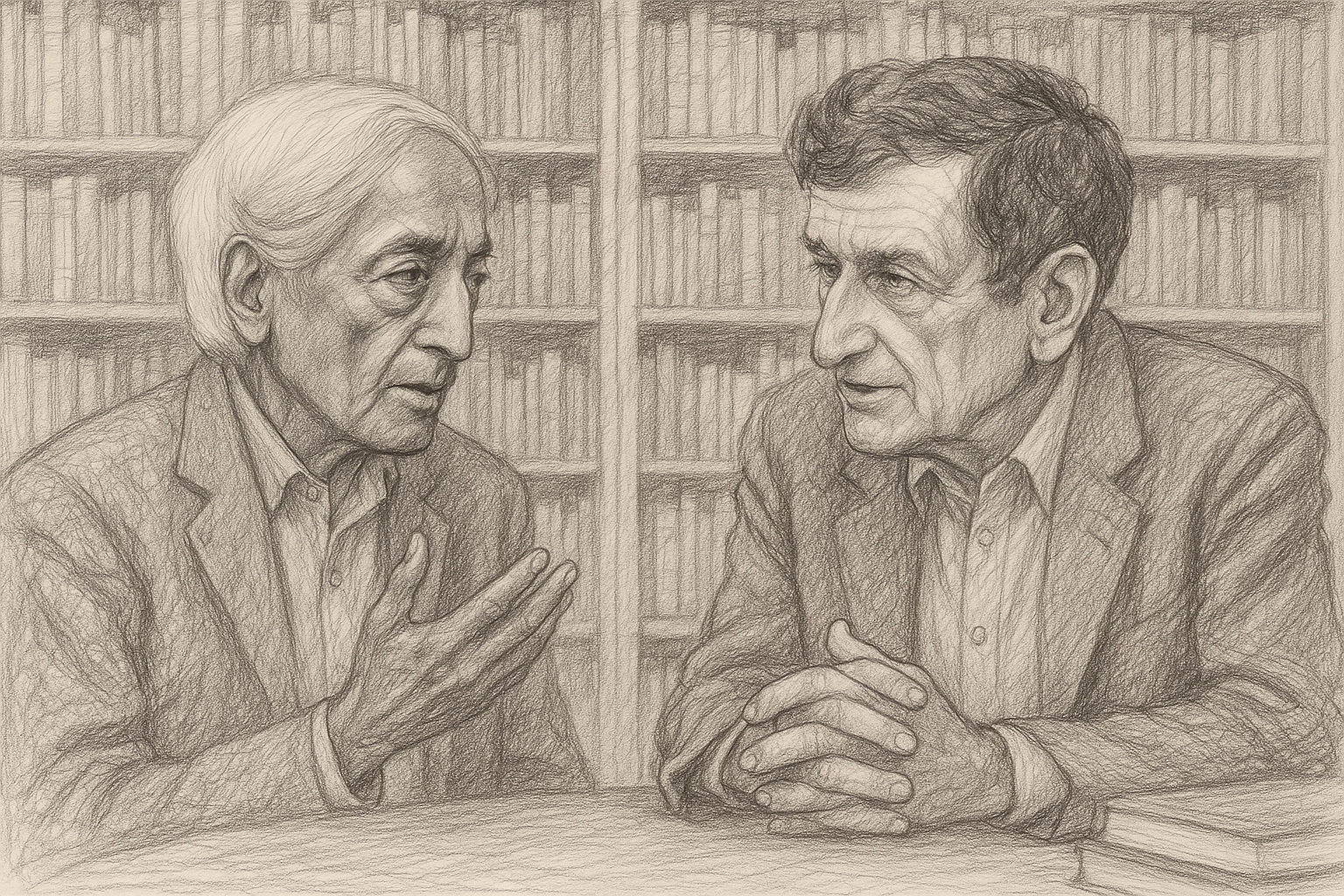
In their 1980 conversation in Ojai, J. Krishnamurti (K) and physicist David Bohm (DB) delve into profound questions about existence, meaning, and the human condition. Below is a breakdown of their dialogue, highlighting key subjects, questions, and insights.
1. The Universe’s Meaninglessness and the Search for Ground
Subject: The scientific view of the universe as “pointless” and the quest for a deeper existential ground.
- Bohm: Scientists reduce reality to matter (atoms, DNA), but this leaves life devoid of deeper meaning. Religious traditions historically provided meaning through concepts like God, but modern skepticism rejects these as implausible.
- Krishnamurti: Questions whether religious meaning was invented to compensate for existential void. Asks, “How does one find out if there is something more than the merely physical?”
Key Question:
- Is there a “ground” of existence beyond matter, and is it indifferent to humanity?
Insights:
- The physical universe appears indifferent to human survival, but religious traditions posited a non-indifferent “ground” (e.g., God).
- K: To discover this ground, one must transcend ego and conditioned thought.
2. Rationality, Irrationality, and the Role of Thought
Subject: The conflict between scientific rationality and human irrationality.
- Bohm: Scientists assume rationality in their work but remain irrational in personal lives (e.g., jealousy, conflict).
- Krishnamurti: True rationality requires “absolute silence, emptiness, and eradication of the self.”
Key Questions:
- Why do humans prioritize thought, leading to irrationality?
- Can thought itself become rational through insight?
Insights:
- K: Thought, rooted in memory and time, perpetuates division and suffering. To access the ground, “psychological time must end.”
- DB: Thought becomes irrational when disconnected from insight. Rational thought must serve as an instrument of holistic perception.
3. Time, Insight, and Ending Psychological Suffering
Subject: Time as a barrier to understanding the ground.
- Krishnamurti: Psychological time (e.g., becoming, regret, projection) sustains suffering. “Insight is free of time and acts without thought.”
- Bohm: Scientific inquiry implicitly relies on time as a framework, but the ground may transcend it.
Key Question:
- How can the mind free itself from time to perceive reality directly?
Insights:
- Ending psychological hurt requires “non-temporal awareness.” Example: Dissolving the ego’s attachment to past injuries without mental separation.
- K: “Insight is action”—immediate and free of deliberation.
4. Practical Steps Toward the Ground
Subject: The path to discovering the ground.
- Krishnamurti: Emphasizes “listening without prejudice” and communal rationality. A group of individuals committed to self-inquiry could validate the ground’s existence.
- Bohm: Highlights the challenge of overcoming conditioned beliefs.
Key Questions:
- Can humans relinquish attachment to theories and beliefs?
- Is communal rationality possible?
Insights:
- K: “Observation without theory” is critical. Suffering, conflict, and fear are universal facts requiring no theoretical framework.
- DB: Scientific theories organize facts but obstruct psychological clarity.
5. The Paradox of Thought and Action
Subject: The interplay between insight and thought.
- Krishnamurti: Insight transcends thought but may use it pragmatically (e.g., practical tasks). However, “primary action stems from insight, not thought.”
- Bohm: Rational thought must align with insight to avoid fragmentation.
Key Insight:
- True rationality arises when thought serves insight, not memory or desire.
Conclusion: A Radical Shift in Perception
Krishnamurti and Bohm converge on the necessity of a perceptual revolution:
- Ending Psychological Time: Letting go of becoming, regret, and ego.
- Communal Inquiry: Collaborative exploration by individuals committed to self-awareness.
- Ground as Reality: A non-dualistic, timeless reality accessible through silence and direct observation.
Their dialogue challenges both scientific materialism and religious dogma, advocating for a path beyond thought and time to discover life’s deepest significance.
Final Quote from Krishnamurti:
“Insight doesn’t use thought. It acts. And because insight is rational, action is rational.”
Analysis of the Krishnamurti-Bohm Dialogue Through a Gestalt Perspective
Gestalt psychology and therapy emphasize holistic perception, the primacy of the present moment, and the interplay between figure (focal point) and ground (context). Applying this lens to the Krishnamurti-Bohm dialogue reveals striking parallels and insights into their exploration of consciousness, meaning, and the “ground” of existence.
**1. Figure-Ground Dynamics and the Search for Meaning
Gestalt Principle: Perception organizes experience into meaningful wholes, where the “figure” (salient aspect) emerges from the “ground” (background context).
Dialogue Link:
- The scientists’ focus on matter as the “ground” (context) renders life’s meaning a fragmented “figure.” Krishnamurti critiques this, arguing that reducing existence to physical laws ignores the deeper, unified ground of consciousness.
- Gestalt Insight: Just as a figure loses meaning without its ground, reducing reality to atoms or DNA fragments human experience. True meaning arises from perceiving the whole—consciousness interwoven with existence.
**2. Here-and-Now Awareness
Gestalt Principle: Psychological health depends on attending to the present moment, free from past conditioning or future projections.
Dialogue Link:
- Krishnamurti’s emphasis on ending psychological time aligns with Gestalt’s focus on the “now.” He states, “Insight is without time and acts without thought,” mirroring Gestalt’s goal of dissolving mental constructs (e.g., regret, anxiety) that distort present awareness.
- Unfinished Business: The dialogue’s discussion of unresolved hurt and irrationality reflects Gestalt’s concept of “unfinished business”—unprocessed emotions that fragment the self.
**3. Holism vs. Fragmentation
Gestalt Principle: Wholeness arises from integrating fragmented parts of the self.
Dialogue Link:
- Bohm notes that scientists exhibit rationality in their work but irrationality in personal lives—a split Gestalt therapists term disintegration. Krishnamurti’s call for “absolute silence, emptiness, and eradication of the self” seeks to dissolve this fragmentation.
- Paradox of Thought: The dialogue critiques thought as both a tool and a barrier. In Gestalt terms, thought becomes pathological when it dominates the field (e.g., over-intellectualization), blocking holistic perception.
**4. The Role of Perception and Phenomenology
Gestalt Principle: Reality is shaped by subjective perception; truth emerges through direct experience.
Dialogue Link:
- Krishnamurti’s insistence on “observation without theory” mirrors Gestalt’s phenomenological approach. Both reject abstract theories in favor of “what is actually happening.”
- Field Theory: Bohm’s “ground” parallels the Gestalt idea of the field—the interconnected context shaping behavior. Just as the ground of existence is indifferent in science, an unexamined psychological field perpetuates suffering.
**5. Resistance and Contact Boundaries
Gestalt Principle: Growth occurs at the “contact boundary” where the self interacts with the environment. Resistance (e.g., denial, projection) blocks healthy contact.
Dialogue Link:
- The scientists’ attachment to theories reflects resistance to confronting existential voids. Krishnamurti’s challenge—“Am I willing to let go of all egotism?”—invites dissolving boundaries between self and ground.
- Creative Adjustment: The dialogue’s call for “communal rationality” mirrors Gestalt’s emphasis on relational repair. A group committed to self-awareness could foster a shared “field” of contact.
Divergences and Limitations
- Metaphysical Ground vs. Psychological Field: While Krishnamurti’s “ground” hints at a transcendent reality, Gestalt focuses on immanent, experiential fields.
- Ending Time: Gestalt works within temporal processes (e.g., resolving past trauma), whereas Krishnamurti seeks to end psychological time entirely—a more radical, non-linear goal.
Conclusion: A Gestalt Path to the Ground
The dialogue’s themes resonate deeply with Gestalt principles:
- Integrate Fragmentation: Move from scientific/material reductionism to holistic perception.
- Embrace the Now: End psychological time by attending to present wounds without narrative.
- Dissolve Boundaries: Let go of egoic resistance to contact the “ground” as a unified field.
As Krishnamurti states, “Insight is action”—a Gestalt maxim urging immediacy over analysis. Both frameworks converge on a radical truth: meaning emerges not from theories, but from undivided attention to the living moment.
Gestalt-Inspired Reflection:
“The ground of existence is not ‘out there’—it is the undivided field of awareness, where figure and ground dance as one.”
 Kika's world