
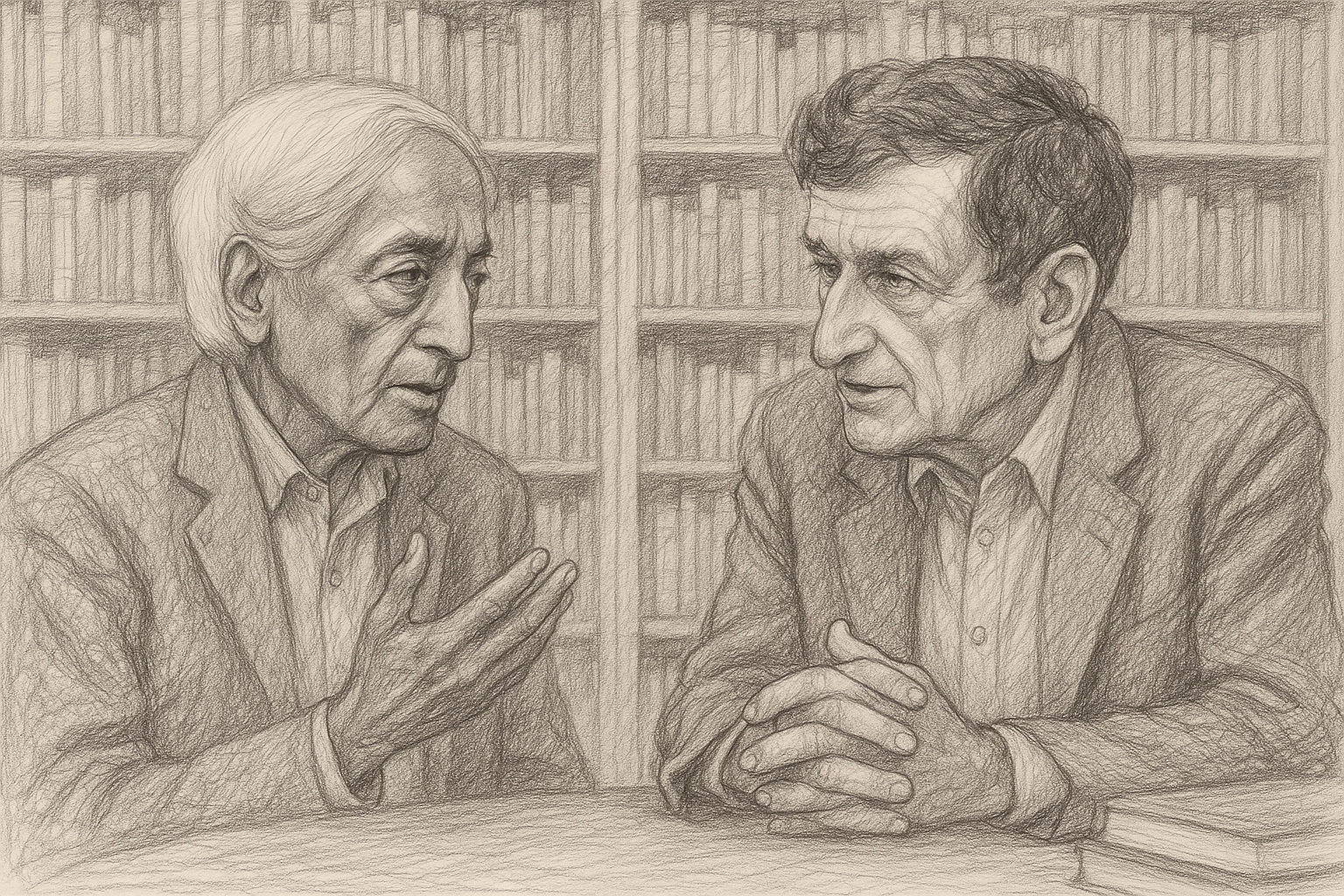
In their 1980 dialogue in Ojai, California, philosopher J. Krishnamurti and physicist David Bohm delved into profound questions about time, human conflict, consciousness, and the nature of reality. Their conversation traversed existential inquiries, critiques of societal structures, and the possibility of transcending psychological limitations. Below is a breakdown of the key subjects, questions, and insights from their exchange.
1. Psychological Time as the Root of Conflict
Subject: The nature of time and its role in human suffering.
- Question: Why has humanity, from its inception, followed a path entrenched in psychological time, leading to perpetual conflict?
- Krishnamurti: Psychological time—the sense of past, present, and future tied to the ego—is the “enemy of man.” It perpetuates division, desire, and the illusion of progress through conflict.
- Bohm: Agreed, noting that even religions and political systems, while aiming for eternal values, have failed to address this core issue.
Key Insight: Time, as the “me” or ego, must end for conflict to cease. This requires a radical shift in human consciousness.
2. The Failure of Institutions
Subject: The inadequacy of religions, politics, and education in resolving existential suffering.
- Question: Why have religions and other systems not succeeded in guiding humanity beyond psychological time?
- Krishnamurti: Religions anchor followers in beliefs (e.g., Jesus, rituals) rather than direct experience. These structures perpetuate division and illusion.
- Bohm: Even mystical traditions, like Buddhism or Christian mysticism, remain bound to cultural frameworks, limiting their ability to transcend time.
Key Insight: True transformation requires abandoning all anchors—beliefs, ideals, and attachments—to confront reality directly.
3. Ending the Ego: Emptiness and Universal Mind
Subject: The dissolution of the “I” and the emergence of a universal consciousness.
- Question: What remains when the ego, as psychological time, ends?
- Krishnamurti: The ending of the “me” reveals emptiness—a state of pure energy and silence. This emptiness is not void but the “universal mind,” free of division.
- Bohm: The universal mind transcends individual thought, encompassing nature and the cosmos. It is the ground from which all phenomena arise.
Key Insight: Emptiness is not nihilistic; it is the undiluted energy of existence, untainted by desire or thought.
4. Beyond Emptiness: The Absolute Ground
Subject: Exploring reality beyond even the universal mind.
- Question: Is there something beyond emptiness, energy, and silence?
- Krishnamurti: Tentatively, yes—an “absolute ground” without cause or end. It is neither substance nor emptiness but the source of both.
- Bohm: This ground defies language and logic. It is akin to Aristotle’s “unmoved mover” but transcends philosophical constructs.
Key Insight: The absolute is ineffable, beyond perception or description. It is the beginning and end of all things, yet eternally present.
5. Practical Implications for Humanity
Subject: Bridging the absolute with ordinary human life.
- Question: How does this metaphysical exploration relate to everyday suffering?
- Krishnamurti: Most people cling to the ego’s illusions (desires, hopes, fears). Ending conflict requires total relinquishment of the “I,” not incremental change.
- Bohm: The barrier is humanity’s refusal to confront its conditioning. Without dissolving the ego, life remains devoid of meaning.
Key Insight: The absolute ground has no direct relationship with humanity as long as individuals remain trapped in psychological time. Yet, recognizing this truth offers liberation from suffering.
6. The Challenge of Communication
Subject: Articulating the ineffable without falling into illusion.
- Question: Can language convey truths beyond time and mind?
- Krishnamurti: Words are limited and risk reducing truth to abstractions. Communication must arise from direct perception, not intellectualization.
- Bohm: Even scientific inquiry hints at realities beyond measurement, but language struggles to encapsulate them.
Key Insight: Authentic understanding emerges only when thought and desire cease, allowing the mind to “listen” without projection.
Conclusion: A Call to Radical Transformation
Krishnamurti and Bohm’s dialogue challenges humanity to confront its deepest illusions. Their exploration underscores that:
- Conflict is rooted in psychological time, sustained by the ego’s ceaseless becoming.
- Institutions fail because they operate within the same fragmented consciousness they seek to resolve.
- Liberation lies in ending the “I”, revealing a universal mind and, ultimately, an absolute ground beyond all duality.
For ordinary individuals, this demands courage to relinquish attachments and embrace the unknown. As Krishnamurti poignantly notes, “There must be a cleansing of the mind of the accumulation of time.” Only then can humanity align with the cosmic order, transcending conflict to embody true creativity and peace.
Gestalt Perspective Analysis of the Dialogue Between Krishnamurti and Bohm
Gestalt psychology emphasizes perceiving wholes over isolated parts, focusing on patterns, relationships, and the organization of elements into coherent structures. Applying this lens to the Krishnamurti-Bohm dialogue reveals profound insights into how their ideas interconnect and mirror Gestalt principles.
1. Figure-Ground Dynamics
- Figure: Psychological time, the ego (“I”), and human conflict dominate as foreground themes. These represent the immediate concerns of individual suffering and societal dysfunction.
- Ground: The “universal mind” and “absolute ground” form the background, symbolizing the undivided reality underlying all existence.
- Insight: Just as Gestalt theory posits that figures emerge against a backdrop, Krishnamurti argues that resolving the “figure” of ego-driven conflict requires recognizing the “ground” of universal consciousness. The dialogue shifts focus between these layers, urging holistic awareness.
2. Proximity and Similarity
- Proximity: Clustered concepts like time as conflict, failure of institutions, and ending the ego are presented in tight succession, highlighting their interdependence.
- Similarity: Recurrent motifs—emptiness, energy, silence—are treated as variations of the same truth, akin to Gestalt’s principle that similar elements are grouped. For example, “emptiness” and “universal mind” are not separate but facets of a unified reality.
3. Closure and Continuity
- Closure: Open-ended questions (e.g., What lies beyond emptiness?) invite readers to mentally “complete” the ideas. This mirrors Gestalt’s closure principle, where the mind fills gaps to perceive completeness. The dialogue’s unresolved tension between the ineffable “absolute” and human language encourages active engagement.
- Continuity: The flow from psychological time → universal mind → absolute ground creates a seamless narrative arc. Gestalt’s continuity principle explains how readers follow this progression as a logical, interconnected journey rather than disjointed fragments.
4. Holism vs. Fragmentation
- Holistic Vision: The dialogue rejects fragmented thinking (e.g., separating inner/outer, individual/universal). Krishnamurti’s insistence that “there is no division” aligns with Gestalt’s emphasis on integrated wholes.
- Critique of Fragmentation: Institutions (religions, politics) are criticized for perpetuating division, mirroring Gestalt’s warning against reducing reality to isolated parts.
5. Emergence and Insight
- Emergence: Just as Gestalt highlights sudden perceptual shifts (e.g., seeing a hidden image), the dialogue posits that ending the ego leads to an emergent understanding of reality—”the ending of time is the beginning of creation.”
- Insight Over Analysis: Krishnamurti’s rejection of intellectualization (“words are not the thing”) parallels Gestalt’s focus on immediate insight. True understanding arises not through dissection but through perceiving the whole.
6. Relational Dynamics
- Dialogue as Relationship: The conversational format embodies Gestalt’s relational focus. Krishnamurti and Bohm co-create meaning through interaction, reflecting how perception is shaped by context and collaboration.
- Paradox and Tension: The tension between describable concepts (emptiness) and the indescribable (absolute) mirrors Gestalt’s exploration of paradoxes (e.g., figure-ground reversals). Resolution comes not by choosing sides but by holding the tension.
Conclusion: A Gestalt of Reality
The dialogue embodies Gestalt principles by:
- Framing human suffering as a figure against the ground of universal consciousness.
- Structuring ideas through proximity, similarity, and continuity to create a cohesive whole.
- Inviting readers to “close” metaphysical gaps through direct insight rather than intellectual closure.
- Advocating for a holistic perception of reality where divisions (ego/universe, time/eternity) dissolve.
Ultimately, Krishnamurti and Bohm’s exchange mirrors the Gestalt view that truth emerges not from analyzing parts but from perceiving the interconnected whole. Their call to “end psychological time” is a call to shift from fragmented seeing to unified awareness—a quintessentially Gestalt transformation.
 Kika's world