
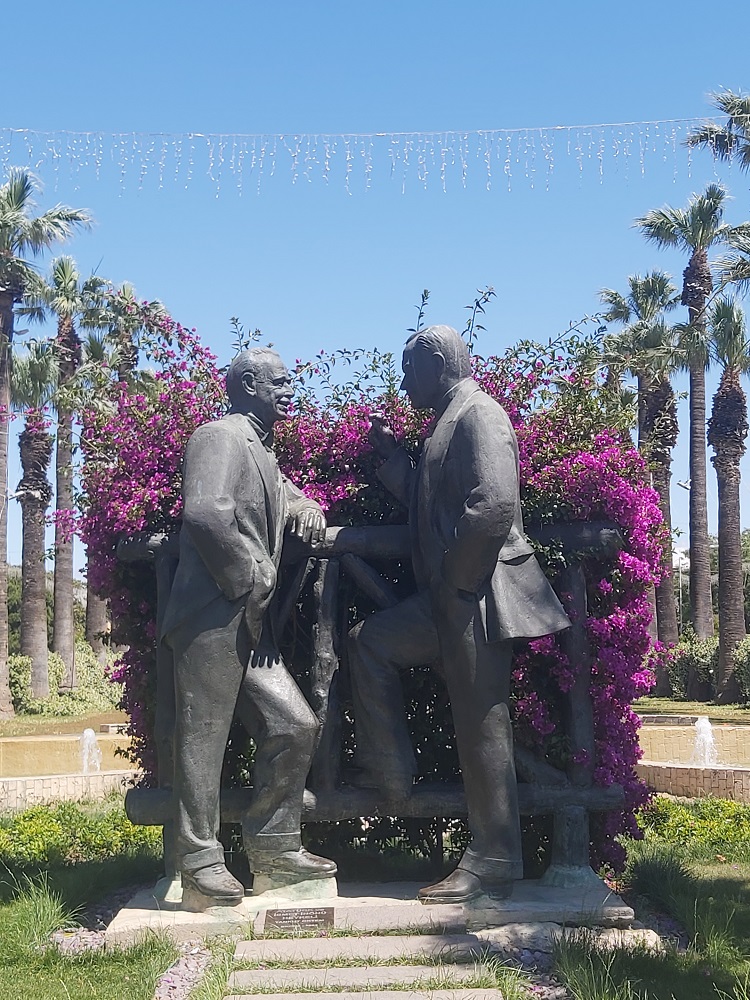
Atatürk and İsmet İnönü bronze sculpture by Öktem Aykut, 1993
Kültürpark in İzmir stands as a testament to the city’s resilience and commitment to modernization following the devastation of the early 20th century. Established in the aftermath of the catastrophic 1922 Great Fire of Smyrna, the park has evolved into a central hub for culture, art, and community life.

Prime Minister İsmet İnönü, from the opening speech of the İzmir Fair:
“After seeing every part of the Izmir fair, there is no doubt that we are standing before a successful achievement. Just a few years ago, this place was an empty and ruined area as we knew it. The idea of transforming it into a meeting point for economic activities and a model exhibition for the country’s industry, as well as cultivating a culture park here, is a noble and lofty vision.”
Origins and Historical Context
The Great Fire of Smyrna in September 1922 razed much of the city, particularly the Armenian and Greek quarters, leading to significant loss of life and displacement. In response to this devastation, the Turkish Republic initiated urban renewal projects to rebuild and modernize İzmir.
On January 1, 1936, under the leadership of Mayor Behçet Uz, Kültürpark was founded on a 360,000 m² area previously devastated by the fire. The park was officially opened to the public on September 1, 1936, coinciding with the 6th İzmir International Fair.
The Visionaries Behind Kültürpark: Behçet Uz and Suad Yurdkoru
The creation of Kültürpark was not just an act of urban planning—it was a bold cultural vision driven by two remarkable figures: Dr. Behçet Uz, then Mayor of İzmir, and Suad Yurdkoru, an urban planner and bureaucrat whose planning foresight shaped early Republican Turkey.
Dr. Behçet Uz: The Doctor Who Healed a City
A pediatrician by profession and a passionate public servant, Dr. Behçet Uz took over as mayor of İzmir in 1931 during a time of recovery after the devastating 1922 fire. He viewed urban regeneration not only as a matter of infrastructure, but also as a form of public health and civic healing. Kültürpark was his most ambitious project—meant to transform the ashes of the city center into a beacon of modern, secular, and collective life for all citizens.
His vision for Kültürpark included green spaces, cultural buildings, educational functions, and international exhibitions. As a forward-thinking Republican, he believed that public spaces should reflect the new identity of the Turkish Republic—modern, healthy, progressive, and united. He also prioritized the inclusion of a Health Museum within the park, emphasizing his belief that knowledge and hygiene were central to social development.
Later serving as Turkey’s Minister of Health, Dr. Uz continued to advocate for public wellness and city planning as essential components of national progress. His legacy in İzmir remains deeply tied to Kültürpark, which is often described as “his most beautiful prescription.”
Suad Yurdkoru: The Mind Behind the Master Plan
An influential figure in the early years of the Turkish Republic, Suad Yurdkoru was appointed by Atatürk to create city plans that reflected the ideals of a new, modern Turkey. He was one of the architects of the 1933 İzmir Urban Plan, which placed Kültürpark at the symbolic and literal center of the redesigned city.
Yurdkoru’s planning approach was influenced by European urbanism, especially the idea of integrating culture, education, and green space into urban design. Kültürpark’s layout—with its wide promenades, exhibition halls, and multifunctional buildings—mirrored international fairgrounds and modernist design principles of the time.
The collaboration between Behçet Uz and Suad Yurdkoru was a synthesis of idealism and practicality: a doctor’s humanitarian dream brought to life by a planner’s technical expertise. Together, they ensured that Kültürpark would not only be a physical park but also a cultural institution—a living monument to the resilience, aspirations, and civic pride of İzmir.
Cevat Şakir Kabaağaçlı’s Importance in Kültürpark and İzmir’s Cultural Landscape
1. Cultural Curator and Educator
In the late 1930s and early 1940s, Cevat Şakir was invited to İzmir by Dr. Behçet Uz, the then-mayor and one of the chief visionaries behind Kültürpark. Behçet Uz was actively trying to build İzmir into a modern, Western-oriented, culturally rich city, and he saw Cevat Şakir as an ideal cultural figure to help shape that vision.
Cevat Şakir contributed to Kültürpark’s cultural programming, especially in educational and artistic domains:
- He helped curate exhibitions and public lectures on Anatolian civilizations and Mediterranean culture.
- He gave talks on mythology, history, and marine life, themes central to his writing.
- He worked to increase ecological and historical awareness through storytelling and visual materials, fitting the educational goals of Kültürpark’s mission.
2. Contributions to the Museum and Literary Life
Cevat Şakir was also closely linked with the first exhibitions in the İzmir City Museum, which was housed in Kültürpark after 1939. His deep knowledge of Aegean maritime history and mythology enriched the museum’s interpretive storytelling — especially in sections related to ancient coastal cities like Erythrai (Ildırı), Teos, and Phokaia (Foça).
He was also instrumental in writing and editing educational materials for fair visitors and students, aiming to bridge the gap between science, history, and storytelling — a style that later defined much of Turkish popular history writing.
3. Symbol of the Mediterranean Spirit
Cevat Şakir, through his writing and public persona, embodied the Mediterranean humanism that Kültürpark tried to cultivate. The fair was not only about economy and industry — it was also meant to project a cultural image of openness, creativity, and peace.
As an advocate for:
- Harmony between humans and nature,
- Cultural plurality (he praised Anatolia’s multicultural past),
- And respect for the sea and rural life,
Cevat Şakir’s ideals resonated with the values of Kültürpark, especially as it tried to heal the wounds of the 1922 fire and present a modern, peaceful face of İzmir to the world.
Legacy
While Cevat Şakir did not permanently reside in İzmir, his influence remains embedded in the city’s cultural memory:
- His writings were often displayed at the fair’s cultural pavilions.
- Some of his lectures were later published and inspired generations of Aegean-focused thinkers and environmentalists.
- He is remembered as a bridge figure between folklore and science, East and West, past and future — just like Kültürpark itself.

- Lozan gate entrance
Entrances and Symbolism
Kültürpark is enclosed by walls and features five main gates, each bearing historical significance:
- Lozan Gate: Named after the Treaty of Lausanne, which recognized the boundaries of the modern Turkish state.
- Montrö Gate: Refers to the Montreux Convention, granting Turkey control over the Bosporus and Dardanelles Straits.
- 9 Eylül Gate: Commemorates September 9, 1922, the date İzmir was liberated during the Turkish War of Independence.
- Cumhuriyet Gate: Symbolizes the proclamation of the Republic of Turkey in 1923.
- 26 Ağustos Gate: Marks the beginning of the Battle of Dumlupınar on August 26, 1922, a decisive victory in the War of Independence.
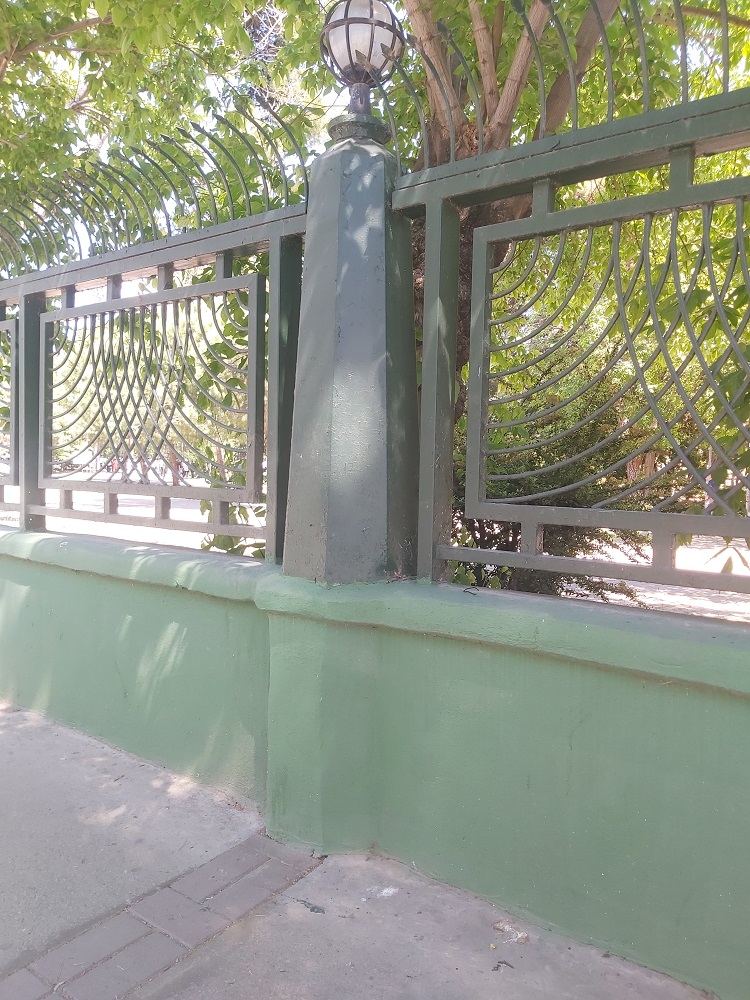
The History of the Walls Surrounding Kültürpark
One of the most compelling yet largely forgotten facts about Kültürpark is that its surrounding walls were built using debris from the Great Fire of İzmir in 1922.
After the devastating fire that followed the War of Independence and the liberation of İzmir, an estimated 70% of the city center, including the Armenian and Greek quarters, was reduced to ashes. Massive amounts of rubble and charred building materials were left behind in the city’s core. When Kültürpark was planned and construction began in the 1930s, a symbolic and pragmatic decision was made: the rubble of destruction would be turned into the foundation of renewal.
Instead of discarding the remains of the catastrophe, municipal workers and planners recycled bricks, stones, and other salvaged materials from the ruins to build the walls surrounding the newly envisioned park — a project designed to embody rebirth, modernity, and collective hope.
This transformation reflects the spirit of early Republican ideology: to reclaim a painful past and reshape it into a modern future. The very walls that today seem ordinary to passersby are, in fact, silent monuments — physically and metaphorically linking the past trauma of İzmir’s destruction to the hope that Kültürpark symbolized in the 1930s.
Today, few İzmir residents are aware of this hidden layer of history. Yet once known, it adds a deeper emotional and symbolic meaning to walking around Kültürpark — where every brick in the wall carries a story of fire, loss, and rebirth.
Cultural and Social Impact
Kültürpark has significantly influenced İzmir’s social life.
Ada Gazinosu: The Cultural Jewel of Kültürpark
Ada Gazinosu, built on a small island in the artificial pond at the heart of Kültürpark, was not merely a venue — it was a social revolution in action. Opened in the early years of the Republic as part of the park’s broader cultural vision, Ada Casino became one of the most iconic symbols of modern urban leisure in İzmir and Turkey.
🌟 A Place Where Modernity Took the Stage
Designed as a space for performances, concerts, and elegant evening entertainment, Ada Gazinosu represented a new way of life that the Republican government aimed to promote: modern, secular, Western-oriented, yet accessible to the public.
Here, visitors encountered new norms of social behavior:
- Public dancing, accompanied by live orchestras — a novelty at the time.
- Formal dining, where European-style cuisine and table etiquette were introduced.
- Dress codes, encouraging the adoption of Western-style clothing for both men and women.
- Mixed-gender socializing in a respectful and elegant atmosphere.
The venue normalized urban leisure culture, blending refinement with public accessibility — something that had been rare or reserved for elite Levantine and non-Muslim circles in Ottoman İzmir.
🎤 Where Legends Began
Ada Gazinosu also holds legendary status in Turkey’s musical history. Among the many famous performers who graced its stage, Zeki Müren — the “Sun of Art” — gave one of his first major concerts here, stunning audiences with his unmatched vocal talent and charismatic style. Ada Gazinosu thus became a launchpad for many stars of Turkish classical and popular music.
Other important names who performed there include:
- Müzeyyen Senar
- Safiye Ayla
- Behiye Aksoy
- Tanju Okan
- Bedia Akartürk
🌿 A Setting Unlike Any Other
The casino’s unique island location created a magical ambiance. Visitors reached it by crossing a footbridge, and performances took place under the stars, with reflections shimmering on the water and breezes from the Aegean. The surrounding landscape, carefully curated with flowers, fountains, and elegant lighting, added to the romantic, refined air of the venue.
🕰️ A Symbol of a New Era
Ada Gazinosu wasn’t just about entertainment. It was part of a larger state-led project to:
- Encourage public education through culture
- Elevate the tastes and habits of citizens
- Provide a safe, modern environment for leisure
Its presence within Kültürpark — itself a symbol of national rebirth — underlined the importance placed on accessible cultural sophistication in early Republican Turkey.
Though the building’s function has shifted over the decades, the cultural memory of Ada Gazinosu endures, often invoked with nostalgia by İzmir’s older generations who remember it as a time when the city was a vibrant hub of refinement and modernity.
Museums and Exhibition Spaces in Kültürpark at the Time of Its Opening (1936)
1. Sağlık Müzesi (Health Museum)
- Purpose: Educate the public about hygiene, disease prevention, and modern medical practices.
- Vision: Spearheaded by Dr. Behçet Uz, the museum was part of a broader campaign to promote public health and modern lifestyles in line with the ideals of the early Turkish Republic.
- Exhibits: Included models, diagrams, and visual aids to teach about tuberculosis, hygiene in homes and workplaces, nutrition, and vaccinations.
- Current Status: The building no longer functions as a health museum and was closed down in the late 20th century.
- Legacy: While the structure may no longer exist in its original form, its spirit lives on through the continued public health legacy of Behçet Uz and the use of exhibitions for educational purposes in modern İzmir institutions.
- Replacement: Parts of its mission have shifted to other health awareness initiatives and institutions in İzmir.
2. Tarım ve Sanayi Pavyonları (Agriculture and Industry Pavilions)
- Purpose: Showcase Turkey’s agricultural products, industrial development, and technological advancement.
- Vision: These exhibition halls functioned as educational spaces where visitors could learn about innovations in farming, machinery, and local products.
- Note: Though not museums in the classical sense, these were structured and curated like permanent exhibits.
- Current Status: These were temporary exhibition spaces that were either demolished or significantly altered.
- Replacement: The Atatürk Open Air Theater, Izmir Art Center, and other newer buildings like Fair halls (4, 5, 6) took over their footprint for modern events.
3. Milli Müdafaa Pavyonu (National Defense Pavilion)
- Purpose: Inform the public about the Turkish military and promote national pride and readiness.
- Exhibits: Military uniforms, maps, defense equipment, and visuals promoting the strength of the newly reformed Turkish Armed Forces.
- Current Status: This building no longer exists.
- Legacy: The focus on military education was phased out from the fair’s cultural emphasis after the 1950s.
4. Eğitim ve Kültür Pavyonu (Education and Culture Pavilion)
- Purpose: Present educational reforms and cultural modernization in the early Republic.
- Exhibits: Educational materials, books, school models, and displays about Atatürk’s alphabet and language reforms.
- Current Status: Demolished or repurposed. The building structure as it was in the 1930s does not exist today.
- Replacement: Some of its functions were absorbed into Kültürpark Fair Library and various educational and fair buildings that came later.
5. Sanat Pavyonu (Art Pavilion) → Now: İzmir Resim Heykel Müzesi ve Galerisi (İzmir Museum of Painting and Sculpture)
- Purpose: Showcase Turkish fine arts and introduce the public to modern art.
- Highlights: Included works from emerging Republican artists and traveling exhibitions from other countries during the fair.
- Current Status: Still exists and is actively used as an art gallery and museum.
- Function: Exhibits Turkish painters, sculpture, and visual art. It’s one of the most important cultural institutions in the park today.
- Significance: This museum is a direct continuation of the original mission to promote modern Turkish art and was relocated within the park over time.
- Additional Notable Sites Within Kültürpark Today:
- Atatürk Açıkhava Tiyatrosu (Atatürk Open-Air Theater): A popular venue for concerts and performances.
- Celal Atik Sports Hall: Built later on, this replaced some older buildings and added a sports dimension to the park.
- Museum of History and Art (Tarih ve Sanat Müzesi): Located near the park’s edge, focusing on archaeological artifacts from western Anatolia, though not an original 1936 building.
Additional Notes:
- These museum-like pavilions often served dual purposes—hosting both permanent educational exhibitions and temporary displays during the İzmir International Fair.
- The Health Museum remained one of the most notable permanent institutions in the park’s early years, reflecting Dr. Behçet Uz’s deep commitment to public health.
- Some of the structures were designed with modular architecture to accommodate rotating exhibitions and fairs, reflecting the influence of European fairground design.
Fuat Saylam and the Health Museum in Kültürpark: A Vision of Public Health Education
👨⚕️ Who Was Fuat Saylam?
Dr. Fuat Saylam was one of Turkey’s foremost public health pioneers, known for his work in preventive medicine, hygiene education, and disease control. As the founding director of the General Directorate of Public Health (Umumi Hıfzıssıhha), he believed that healthcare was not only about treating illness but also about educating the public.
His influence was instrumental in shaping Turkey’s early public health policy, and he left his mark in İzmir through the founding of the Health Museum at Kültürpark, opened during the İzmir International Fair.
🧬 The Purpose of the Health Museum
Established in the late 1930s as part of the Ministry of Health’s public education initiative, the Health Museum (Sağlık Müzesi) inside Kültürpark had a bold and revolutionary aim:
“To teach the public how to protect themselves from disease through knowledge, not just medication.”
Inspired by European hygiene museums, the Health Museum in İzmir was a first of its kind in Turkey, combining science, architecture, and public accessibility.
🔍 What Was Inside?
- Anatomical models and interactive exhibits explaining how the human body works
- Displays on infectious diseases, sanitation, nutrition, oral hygiene, and maternity care
- Films, photographic panels, and explanatory posters shown during the İzmir Fair
- Live demonstrations on tooth brushing, mosquito prevention, first aid, and more
🧼 Public Engagement and Legacy
The museum attracted thousands of visitors during the annual fair, many of whom had never received any health education before. Especially impactful were the:
- Rural outreach programs, where visitors from surrounding villages learned about hygiene for the first time.
- Special sections for children, with visuals and simplified language.
Fuat Saylam’s work showed that:
- Public health wasn’t just for hospitals—it was for homes, schools, and daily life.
- Museums could be tools of social transformation, not just collections of old objects.
🏥 Connection with Kültürpark’s Philosophy
The Health Museum was not an isolated feature—it was part of a holistic civic vision:
- Next to the Children’s Breakfast Hall, education pavilions, and gardens, it created a complete model of healthy, modern civic life.
- Its design followed the idea that health, art, and nature must coexist in urban spaces.
📜 Legacy Today
While the original structure of the Sağlık Müzesi no longer exists in its former form, its legacy lives on in contemporary health education programs. Fuat Saylam’s early work paved the way for:
- School-based health education
- Public vaccination campaigns
- Modern mobile health exhibitions organized by the Ministry of Health
Architects and Their Contributions to Kültürpark
1. Suad Yurdkoru
- Role: Urban planner and architect
- Contribution: Developed the initial master plan for Kültürpark in 1934, transforming the area devastated by the 1922 Great Fire into a modern cultural and exhibition space.

2. Bedri Tümay and Algrandi
- Role: Architects
- Contribution: Designed the İzmir Parachute Tower, constructed between 1935 and 1937. The 48-meter-high tower became a prominent feature of Kültürpark.
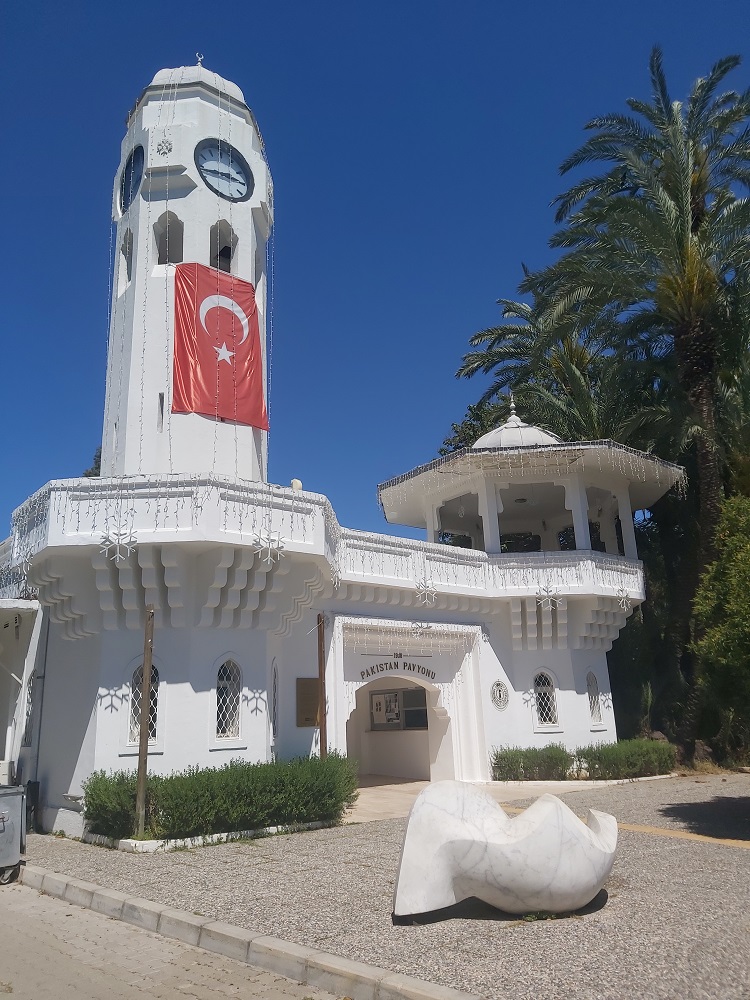
3. Harbi Hotan
- Role: Architect
- Contribution: Designed the Pakistan pavilion within Kültürpark during the 1950s and 1960s, contributing to the park’s modernization.
4. Hasan Yelmen
- Role: Architect
- Contribution: Participated in the renovation and development of the Luna Park area within Kültürpark, enhancing its recreational facilities.
5. Bruno Taut
German architect Bruno Taut, known for his modernist and expressionist designs, played a significant role in shaping the architectural landscape of the early Turkish Republic. Although Taut’s direct involvement with Kültürpark is not explicitly documented, his influence on Turkish architecture during this period is noteworthy. He emphasized the integration of modern design with cultural identity, a philosophy that resonated with the objectives of Kültürpark.
Taut passed away in Istanbul in December 1938 and was buried at the Edirnekapı Martyr’s Cemetery, an exception as he was the only non-Muslim buried there, reflecting the respect he garnered in Turkey.
6. Hasan Halit Femir
Building: İzmir City Museum (İzmir Şehir Müzesi)
Importance: The first municipal city museum in Turkey, opened in 1939 within Kültürpark.
Contribution: Hasan Halit Femir designed the museum as part of the educational and civic mission of the park. The structure reflected modernist values, focusing on accessibility, clarity, and civic pride.
Legacy: The museum housed documents, maps, models, and artifacts relating to İzmir’s urban, social, and architectural development. It inspired later city museums in Istanbul and Ankara.
7. İzmir Municipality Architectural Team
- Role: Municipal architects
- Contribution: Over the years, the team has been responsible for the restoration and maintenance of various historical buildings and pavilions within Kültürpark, ensuring their preservation and continued use.
The Exhibition of the “Glass Man” at Kültürpark
In 1938, during the 8th İzmir International Fair, Kültürpark hosted one of the most extraordinary scientific and artistic exhibitions of its time: the display of the “Glass Man” (Cam Adam), a transparent anatomical model that captivated audiences worldwide. This exhibition was meticulously documented by researcher and collector Aybala Yentürk, who highlighted its significance in both Turkey’s medical education and exhibition history.
Origins of the Glass Man
The “Glass Man” was first introduced to the public in 1930 at the Second International Hygiene Exhibition in Dresden, Germany. Created by Franz Tschackert in collaboration with the German Hygiene Museum, the model was constructed from a then-novel material called Cellon (cellulose acetate). This transparent figure showcased the human body’s internal structures—organs, bones, blood vessels, and nerves—in vivid detail, with arteries painted red, veins blue, and nerves green. The model was illuminated internally, and each organ could light up sequentially, accompanied by recorded explanations of their functions.
Journey to Turkey
Following its success in Europe, the Glass Man made its way to Turkey in 1938. Its first stop was the Domestic Goods Exhibition at Galatasaray High School in Istanbul. The exhibit included not only the Glass Man but also an extensive collection of anatomical displays, providing Turkish audiences with an unprecedented educational experience. The model was even adapted to speak Turkish, enhancing its accessibility and impact.
Exhibition at İzmir International Fair
Later that year, the Glass Man was transported to İzmir for the International Fair. The exhibit was housed in the newly constructed Agriculture Museum within Kültürpark, which was specially prepared to accommodate the display. Visitors were guided through a series of educational materials before entering a darkened room where the Glass Man stood illuminated, offering a captivating demonstration of human anatomy. Brochures in Turkish and French provided detailed explanations, ensuring the exhibit’s educational value reached a broad audience.
Legacy and Significance
The Glass Man’s exhibition at Kültürpark symbolized the Turkish Republic’s commitment to public health education and modernization. It aligned with the government’s efforts to combat infectious diseases and promote hygiene through public awareness. Although specific attendance records are scarce, the exhibit’s presence at the fair underscored İzmir’s role as a hub for innovation and cultural exchange. Today, the Glass Man remains a remarkable example of early 20th-century scientific outreach and the transformative power of public exhibitions.

Ege Güneşi: The Iconic Ferris Wheel of Kültürpark
Among the many beloved symbols of Kültürpark, the ferris wheel — affectionately known as “Ege Güneşi” (Aegean Sun) — holds a special place in the hearts of generations of İzmir residents. Much more than an amusement ride, it came to represent joy, progress, and modern urban entertainment in a recovering city.
Built to Shine Over İzmir
The ferris wheel was constructed during a time when Kültürpark was expanding its role beyond education and trade into a more inclusive cultural and recreational space. Although Kültürpark’s original concept focused on exhibitions, science, and public health, by the late 1950s and early 1960s, fair organizers began incorporating more entertainment structures to attract families, children, and tourists.
The Ege Güneşi was commissioned and built by Elektrik İşleri Etüt İdaresi in collaboration with local İzmir engineers and modeled after European-style fairground wheels. Its striking name, “Aegean Sun,” was meant to symbolize modernity, brightness, and the dynamic spirit of the Aegean coast.
Opening Day Excitement
The ferris wheel officially opened during the İzmir International Fair in 1964. The opening was marked by a spectacle of lights and fireworks, drawing huge crowds. The city’s mayor at the time made a symbolic first ride, joined by children and local artists, and the event was covered in national newspapers as a sign of İzmir’s joyful and forward-looking identity.
It was one of the tallest structures in the city at the time and gave panoramic views over Kültürpark, Alsancak, and even the Gulf of İzmir. For many young couples, it became a romantic landmark, and for children, a thrilling gateway to a dreamlike park experience.
Cultural and Emotional Significance
The Ege Güneşi wasn’t just a ride — it was part of the collective memory of İzmir. Over the years, it appeared in:
- Family photo albums, postcards, and tourism brochures,
- Films and television series set in İzmir,
- And even local poetry and songs, celebrating the playful and hopeful atmosphere it created.
What Happened to It?
In later decades, with the evolution of urban planning and safety standards, the original ferris wheel was eventually dismantled. However, for many İzmir locals, it remains an enduring symbol of their childhood and the golden days of the İzmir International Fair.
Today, references to “Ege Güneşi” are often evoked in nostalgic exhibitions and oral histories of Kültürpark. Some have even called for its reconstruction as a cultural monument to celebrate İzmir’s modern heritage.
Notable Statues in Kültürpark
1. Atatürk Statue (Mustafa Kemal Atatürk)
- 📍 Location: Near the Atatürk Open-Air Theater
- 🗿 Description: A powerful, formal statue of the founder of the Turkish Republic.
- 📅 Installed: Early Republican period
- 🎯 Symbolism: Represents modernity, republican ideals, and the park’s dedication to civic education.
2. Zübeyde Hanım Statue (Atatürk’s Mother)
- 📍 Location: Close to the main fair entrance (often near Lozan Gate)
- 🗿 Description: A graceful statue of Zübeyde Hanım in traditional dress.
- 🎯 Symbolism: Reflects maternal values, patriotism, and Atatürk’s deep love for his mother and family roots.
3. Woman with a Dove (Güvercinli Kadın Heykeli)
- 👤 Artist: Turgut Pura
- 📍 Location: Near the Art and Sculpture Museum
- 📅 Installed: 1954
- 🗿 Description: A modernist female figure releasing a dove.
- 🎯 Symbolism: Peace, freedom, and the modern Turkish woman.
- 📚 Historical Note: Part of a post-1950s effort to include more feminine symbols in public sculpture.
4. Standing Woman with Cloth (Elinde Kumaşla Kadın Heykeli)
- 👤 Artist: Mehmet Şadi Çalık
- 📍 Location: Inner garden near pavilions
- 📅 Installed: 1954
- 🗿 Description: A modernist statue of a woman holding fabric or textile.
- 🎯 Symbolism: Emphasizes labor, beauty, and productivity, associated with the rise of modern industries and fair themes.
5. Worker Statues (İşçi Heykelleri)
- 📍 Location: Various points around the fairground zones
- 🗿 Description: Stylized, robust figures in dynamic poses.
- 🎯 Symbolism: Honor the contribution of Turkish laborers and industrial modernization.
6. Lions at Lozan Gate
- 📍 Location: Lozan Kapısı (Lausanne Gate)
- 🗿 Description: A pair of stylized stone lions guarding the main entrance.
- 🎯 Symbolism: Strength, protection, and dignity. A motif common in Republican monumental design.
7. Bust of Dr. Behçet Uz
- 📍 Location: Often near one of the entrances or in a dedicated garden.
- 📅 Installed: After his death in 1986
- 🗿 Description: A bust commemorating the founder of Kültürpark and visionary mayor.
- 🎯 Symbolism: Recognition of civic contribution and urban vision.
8. Cultural & Historical Busts
- 📍 Location: Sculpture garden or near cultural buildings
- 🗿 Description: Busts of Turkish artists, writers, or scientists featured during various years of the International Fair.
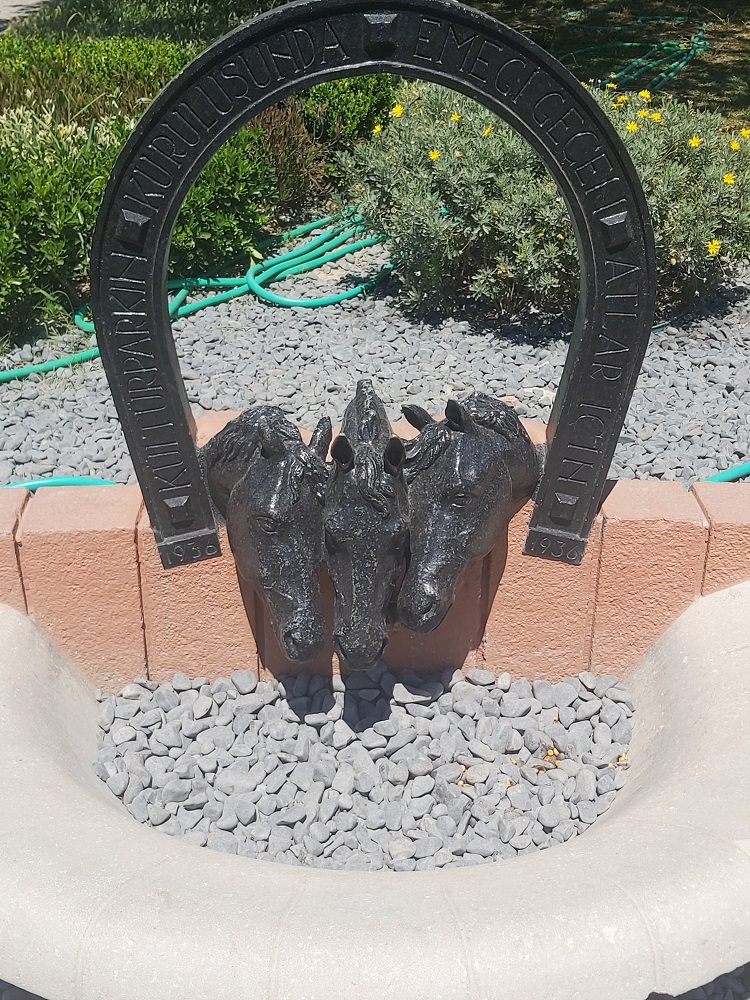
9. Horse Sculpture (At Heykeli)
- Artist: Mehmet Şadi Çalık
- Year: 1940
- Location: Near one of the central axes of Kültürpark
- Description:
This emotionally significant sculpture was commissioned by Mayor Dr. Behçet Uz as a tribute to the horses that lost their lives during the construction of Kültürpark. Following the devastating 1922 Great Fire of Smyrna, the area had to be cleared of massive debris, and horses were used extensively to carry rubble and materials. Many of them died from exhaustion and harsh working conditions.
The sculpture, often referred to as “At Başı” (Horse Head), was created by Prof. Mehmet Şadi Çalık, one of Turkey’s leading sculptors of the 20th century. It symbolizes gratitude for the unrecognized sacrifices made by animals during the rebuilding of the city and is one of the few animal-themed public monuments in the country.
🧭 Notes:
- Many of the sculptures were installed during the 1950s–1970s, a period when modern sculpture was promoted by the Ministry of Culture and supported by the fair committee.
- Several works were created by prominent Turkish sculptors trained in the new Republican academies.
- Some statues are permanent, while others were rotated or added temporarily for international exhibitions.

Botanical Significance of Kültürpark
- Diverse Flora: The park is home to over 7,700 trees, encompassing a wide variety of species. Each plant is meticulously tagged, and the trees are insured, highlighting the city’s commitment to preserving its green spaces.
- Levantine Influence: The Levantine community, comprising European settlers in İzmir, significantly influenced the city’s horticultural practices. They introduced European garden designs and imported various plant species, contributing to the city’s botanical diversity. Their gardens often featured geometric and floral designs made with black and white pebbles, a style known as “Rhodes-made,” which is characteristic of the Aegean region.
- Cultural Integration: The establishment of Kültürpark incorporated these Levantine
- horticultural elements, blending them with local flora to create a unique botanical landscape that reflects İzmir’s multicultural heritage.
Kültürpark’s botanical richness not only offers aesthetic pleasure but also serves as a living testament to the city’s historical and cultural evolution, showcasing the harmonious integration of diverse horticultural traditions.
The Kurtbağrı tree, the first tree planted in Kültürpark
The Kurtbağrı tree (Ligustrum), also known as privet, holds historical significance as the first tree planted in İzmir’s Kültürpark. On January 1, 1936, during the park’s foundation ceremony led by then-Mayor Dr. Behçet Uz, the Kurtbağrı was symbolically planted to mark the beginning of the transformation of a fire-ravaged area into a vibrant urban park.
Kurtbağrı is known for its adaptability and resilience, thriving in various soil types and urban conditions. Its dense foliage and tolerance to pruning make it a popular choice for hedges and ornamental plantings in parks and gardens.
The replanting of Kurtbağrı in recent years reflects İzmir’s commitment to preserving its green heritage and honoring the historical roots of Kültürpark. This act serves as a living reminder of the city’s dedication to environmental stewardship and cultural memory.
Interesting Facts & Historic Firsts of Kültürpark
Kültürpark is more than just a park—it’s a living archive of Turkey’s modernization efforts, urban renewal, and cultural ambition. Here are some fascinating facts and historic “firsts” that Kültürpark represents:
🏛️ 1. Turkey’s First City Museum
- İzmir City Museum, founded in 1939, was Turkey’s first museum dedicated to a city’s own history.
- It offered a modern, civic view of urban heritage, inspired by similar European city museums.
- The museum was an integral part of the education and exhibition mission of Kültürpark.
🎡 2. First Ferris Wheel of İzmir: Ege Güneşi
- The famous “Ege Güneşi” Ferris Wheel was introduced to Kültürpark by Hüseyin Ercan.
- Its inauguration was a grand event, symbolizing modernization and European-style leisure.
- It became a landmark of funfair culture in İzmir and left a lasting mark on generations of visitors.
👗 3. Changing Social Norms – Modernization Through Ada Gazinosu
- The Ada Gazinosu (Island Casino) was more than a place of entertainment—it introduced modern eating and dressing manners to Izmir society.
- Women and men began socializing more freely; western-style dress codes became normalized.
- The space hosted famous concerts, including Zeki Müren’s early performances, revolutionizing the musical and cultural life of the city.
🎓 4. Kültürpark as a Model for Urban Regeneration
- Kültürpark was built on the ruins of the 1922 Great Fire, transforming destruction into a vision of modern urban space.
- It served as a model of green, multi-functional public space in the early Republican period.
- The park inspired other cities in Turkey and beyond to reclaim devastated areas for public use.
🌳 5. Botanical Innovation – Trees Are Insured
- Over 7,700 trees in Kültürpark are registered and insured, a rare and forward-thinking policy for urban parks.
- The park functions as a botanical garden, with species tagged and monitored.
- The first tree planted was Kurtbağrı (Privet), symbolizing rebirth and continuity.
🧠 6. First Health Museum of İzmir
- Kültürpark hosted İzmir’s first Health Museum, intended to educate the public about hygiene, disease prevention, and modern medicine.
- It was part of a broader mission of the park to improve public welfare and civic education.
🪞 7. The “Cam Adam” (Glass Man) Exhibition
- The park featured an exhibit known as “Cam Adam”, displaying a life-sized glass human with visible organs.
- It was meant to educate citizens on anatomy and public health—one of the first public science installations of its kind in Turkey.
- Documented in the research of Aybala Yentürk, the installation was both a medical curiosity and a modernist statement.
🗿 8. Commemorating Animals – One of Turkey’s Only Animal Memorials
- A horse sculpture by Şadi Çalık stands in Kültürpark as a memorial to the horses who died clearing rubble after the fire.
- It is one of the few monuments in Turkey dedicated to animal labor and sacrifice, reflecting human-animal solidarity.
🌍 9. International Inspiration
- The vision of Kültürpark was inspired by global expositions and fairs like Paris Expo and Vienna Prater.
- Conversely, Kültürpark also inspired urban planners from Middle Eastern and Balkan countries, who visited to observe modern urban planning in action during the early Republic era.
The First Children’s Breakfast Hall in Turkey: A Social Revolution in Kültürpark
One of the most heartwarming and socially progressive initiatives born out of Kültürpark was the establishment of Turkey’s first “Children’s Breakfast Hall” (Çocuk Kahvaltı Salonu). Spearheaded under the leadership of Dr. Behçet Uz, this initiative reflected a deep awareness of post-disaster health and nutrition needs, and it became a cornerstone of public welfare in early Republican İzmir.
🌟 Why Was It Founded?
After the 1922 Great Fire of Smyrna, İzmir was left devastated. Thousands of families lost their homes, jobs, and security. The health conditions, especially among children, were dire. Malnutrition, disease, and poverty were widespread.
As a pediatrician and visionary mayor, Dr. Behçet Uz believed that no civic progress could be made without addressing children’s health and development. When Kültürpark was founded in 1936, it was not only a cultural and recreational space, but also a platform to serve basic needs—nutrition being one of them.
Thus, the “Children’s Breakfast Hall” was established within the park as a free, hygienic, and well-organized space where children from low-income families could start their day with a healthy meal.
🥣 What Did It Offer?
- A full, balanced breakfast served in clean conditions.
- Education about nutrition and hygiene, including handwashing and food cleanliness.
- A supervised, safe space where children could socialize, rest, and recharge before going to school or playing in the park.
👩⚕️ Social and Health Impacts
- Improved child health outcomes: The program significantly helped in combating malnutrition and poor health.
- Increased school attendance: Children were more likely to attend school after receiving proper meals.
- Social equity: It helped bridge the gap between rich and poor children, giving all equal access to a fundamental right—nutrition.
💡 A Model for Other Cities
The success of the Breakfast Hall caught the attention of public health professionals and municipalities across Turkey. Similar models were later replicated in Ankara and Istanbul, making İzmir a pioneer in child welfare policy.
🧒 Part of a Bigger Vision
The Children’s Breakfast Hall wasn’t just a charity kitchen—it was part of a broader social design:
- Adjacent to children’s play gardens, the Children’s Theatre, and educational exhibitions in the park.
- Linked with public health awareness campaigns organized at the Health Pavilion and Museum of Hygiene.
🌱 Legacy Today
While the original hall no longer serves breakfast, the idea behind it lives on in public school nutrition programs and municipal soup kitchens. The Kültürpark initiative remains a symbol of how architecture, social vision, and human empathy can merge into meaningful, lasting change.
References:
 Kika's world