Question: How can one differentiate between a persistent thought rooted in intuition versus ego?
Answer:
Ego-driven thoughts arise from external validation (e.g., “I want to be seen as a writer”) or superficial desires (e.g., the 17-year-old girl aspiring to be a brain surgeon for prestige, not passion).
Intuition emerges from a deeper, formless place within. It feels like a quiet, peaceful knowing, often accompanied by a sense that something “wants to be born through you.” Tolle emphasizes that intuition is not tainted by fear, anger, or conditioning.
The Creative Process and Resistance:
Question: How to navigate resistance when pursuing creative endeavors like writing a book?
Answer:
Create space: Dedicate regular, uninterrupted time for creativity, even if progress feels slow. Honor the process by showing up consistently.
Resistance as momentum: Resistance often stems from the inertia of habitual life. Persist through it to build creative momentum.
Formlessness to form: Creativity begins as inspiration (formlessness) and requires the mind to shape it into tangible work (form).
Trusting Feelings vs. Emotional Reactivity:
Question: Can we trust our feelings and intuition?
Answer:
Acknowledge, don’t blindly trust: Feelings rooted in fear, past conditioning, or misinterpretations (e.g., the woman fearing Tolle might harm her) are unreliable guides.
True intuition arises from presence. It carries a quiet strength and clarity, free from nervous energy or negativity.
Non-Reactivity and Presence:
Example: Tolle’s story of the woman who initially rejected living with him due to fear. By responding non-reactively (“That’s fine”), he avoided ego-driven conflict.
Lesson: Reactivity amplifies problems. Presence allows simplicity and avoids reinforcing the ego’s need to “make others wrong.”
Ego’s Role in Conflict and Storytelling:
Question: Why do we often feel “right” while others are “wrong”?
Answer:
The ego thrives on narratives that reinforce separation and superiority (e.g., complaining about others’ faults).
Zen master parable: By refusing to engage in defending himself against false accusations, the master avoided ego-driven drama. The lesson: Detach from stories that fuel conflict.
Practical Takeaways
For Creativity:
Prioritize consistency over perfection. Even minimal daily progress (e.g., writing three words) builds momentum.
Recognize whether your motivation is egoic (external validation) or intuitive (an inner urge to express).
For Relationships and Reactivity:
Pause before reacting. Ask: Am I adding unnecessary drama to this situation?
Avoid amplifying conflicts by retelling stories that paint others as “wrong.”
For Trusting Intuition:
Notice the quality of your feelings. Intuition feels calm and certain; ego-driven emotions are chaotic or fear-based.
Cultivate presence through meditation or mindful observation to access deeper wisdom.
Conclusion
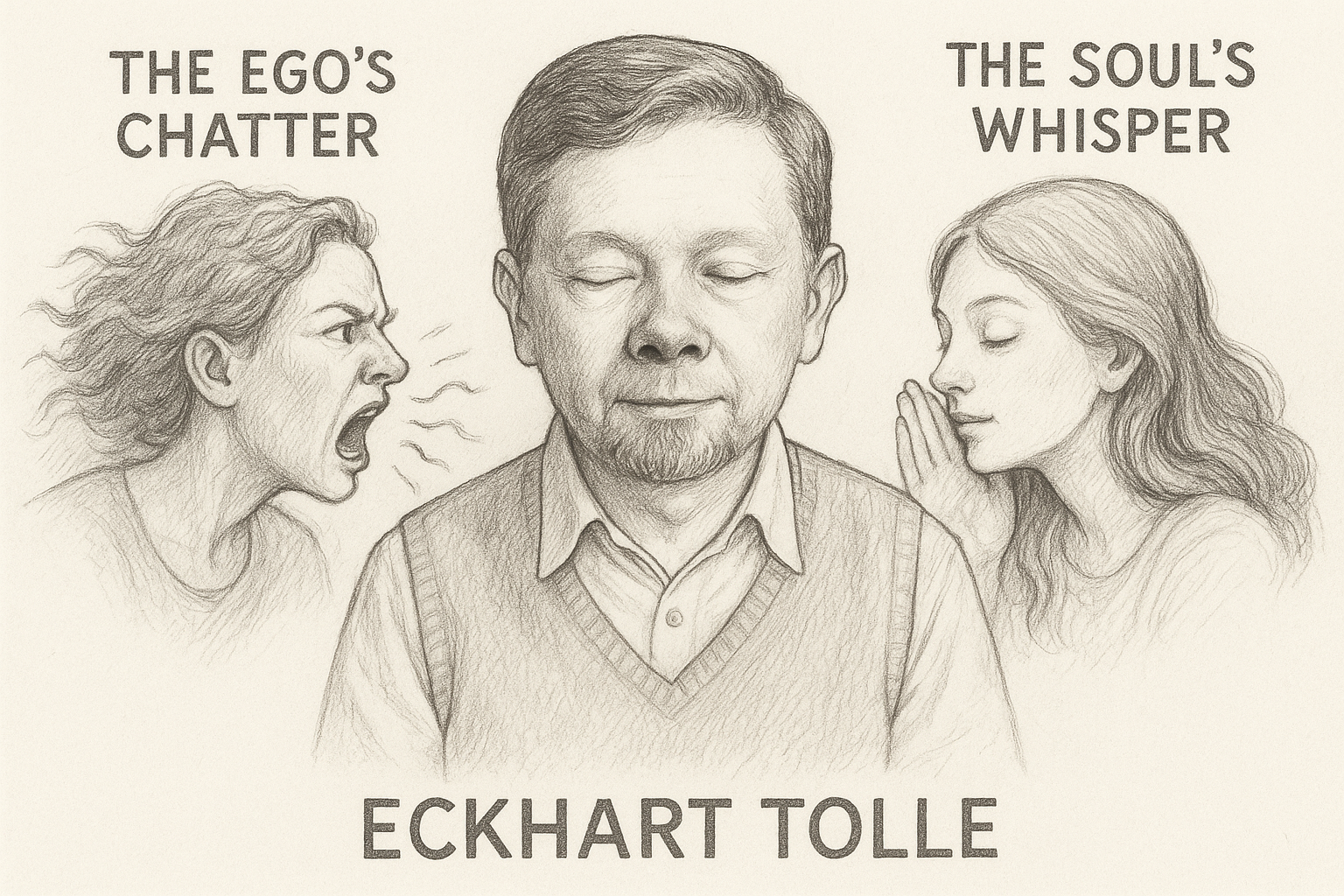
Eckhart Tolle’s insights remind us that authenticity arises when we discern the ego’s chatter from the soul’s whisper. By creating space for creativity, practicing non-reactivity, and grounding ourselves in presence, we align with intuition—the quiet force that guides us toward meaningful action. Whether writing a book, navigating relationships, or facing resistance, the key lies in honoring the formless within and letting it take shape without ego’s interference.
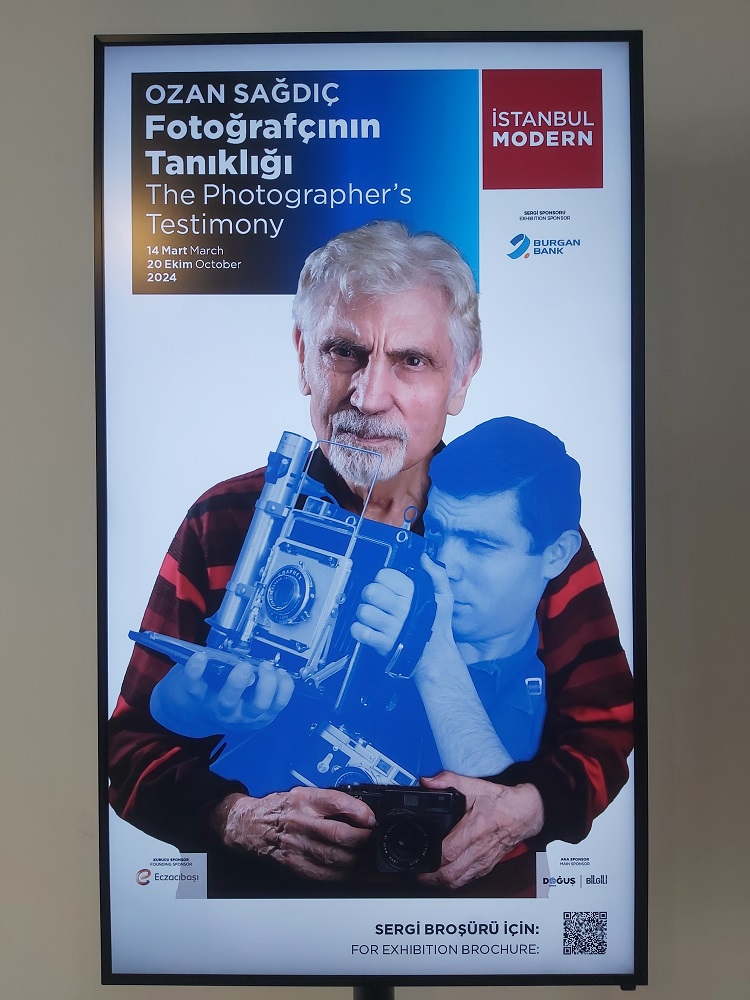
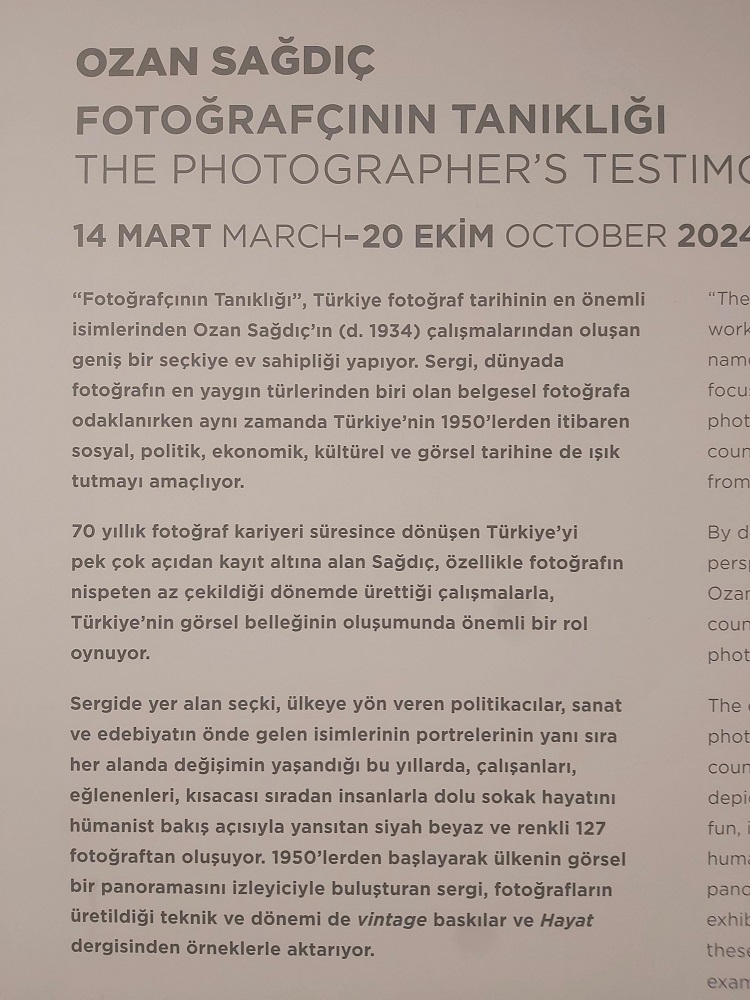
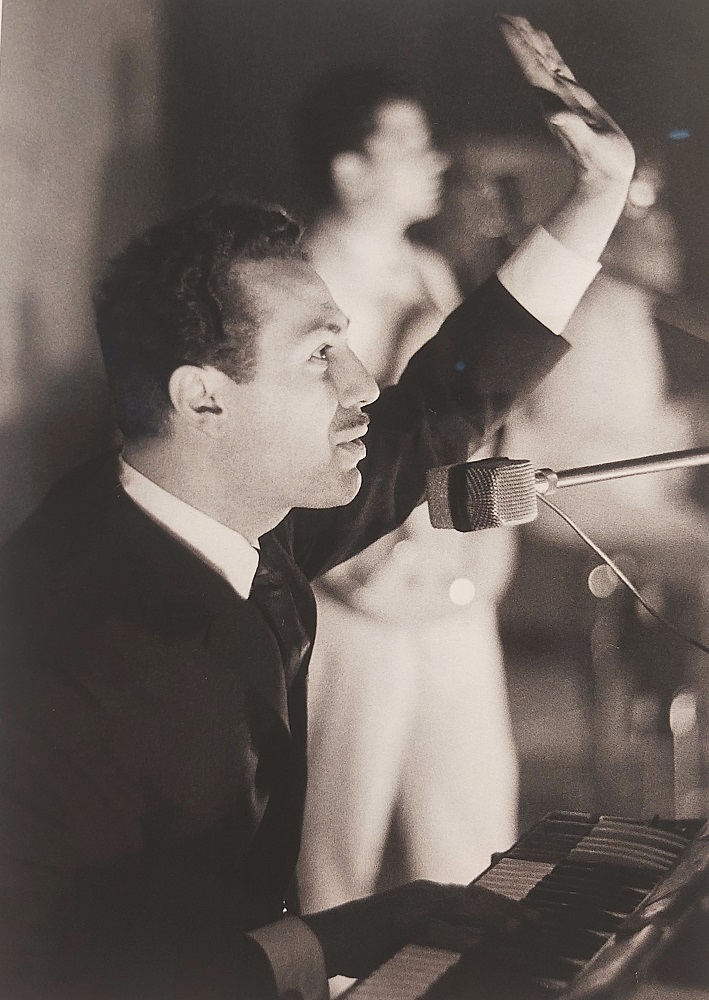
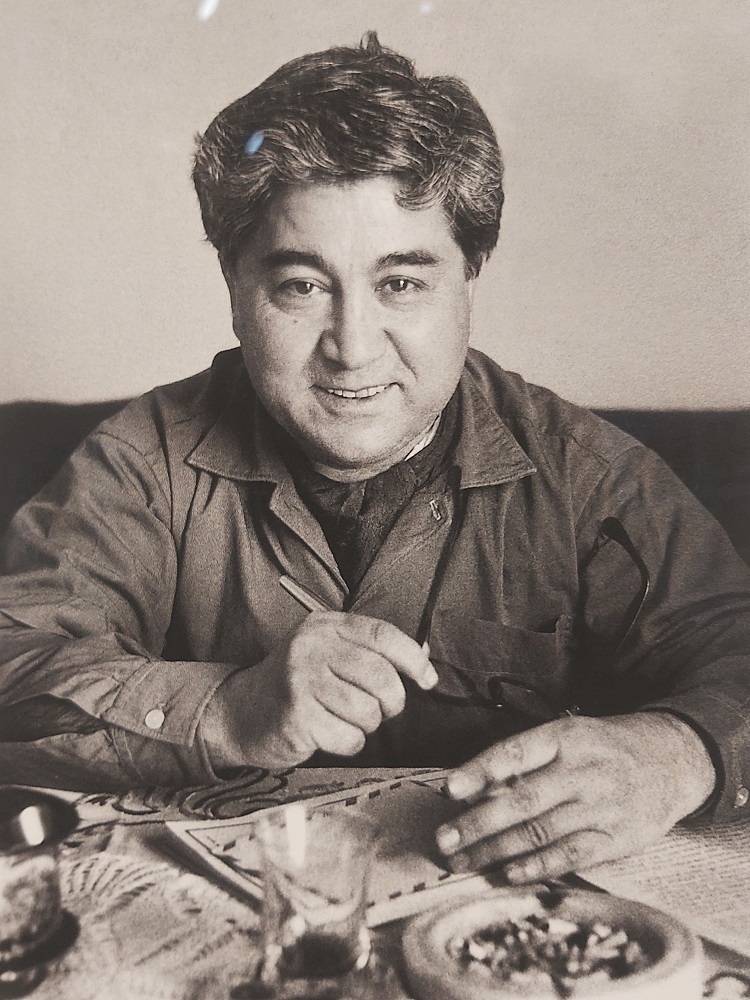
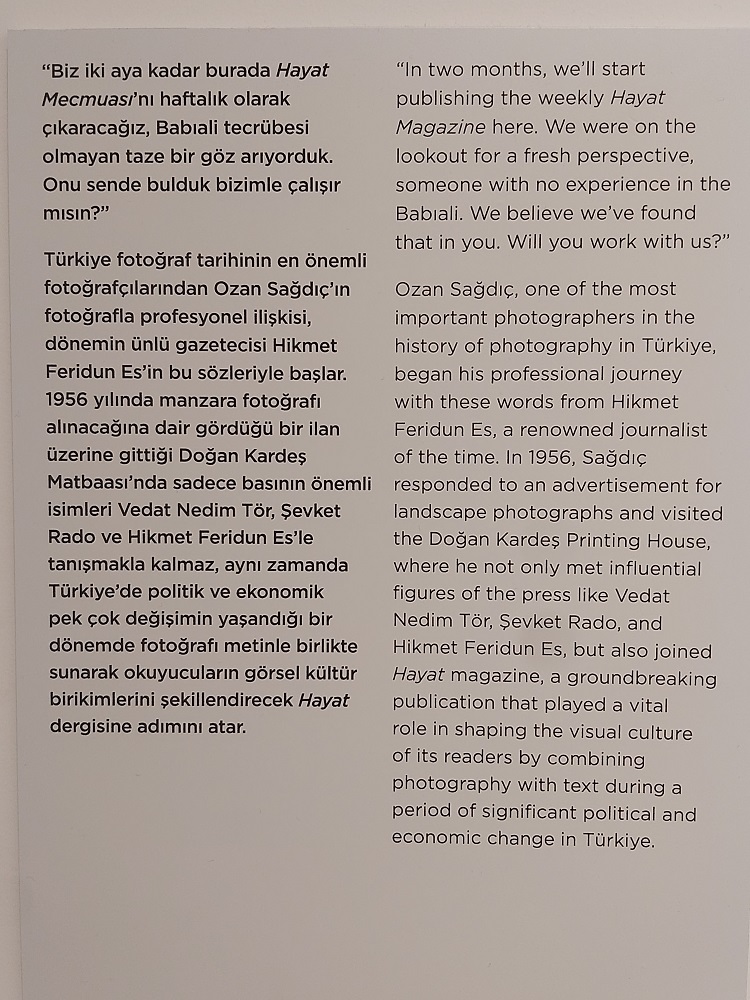
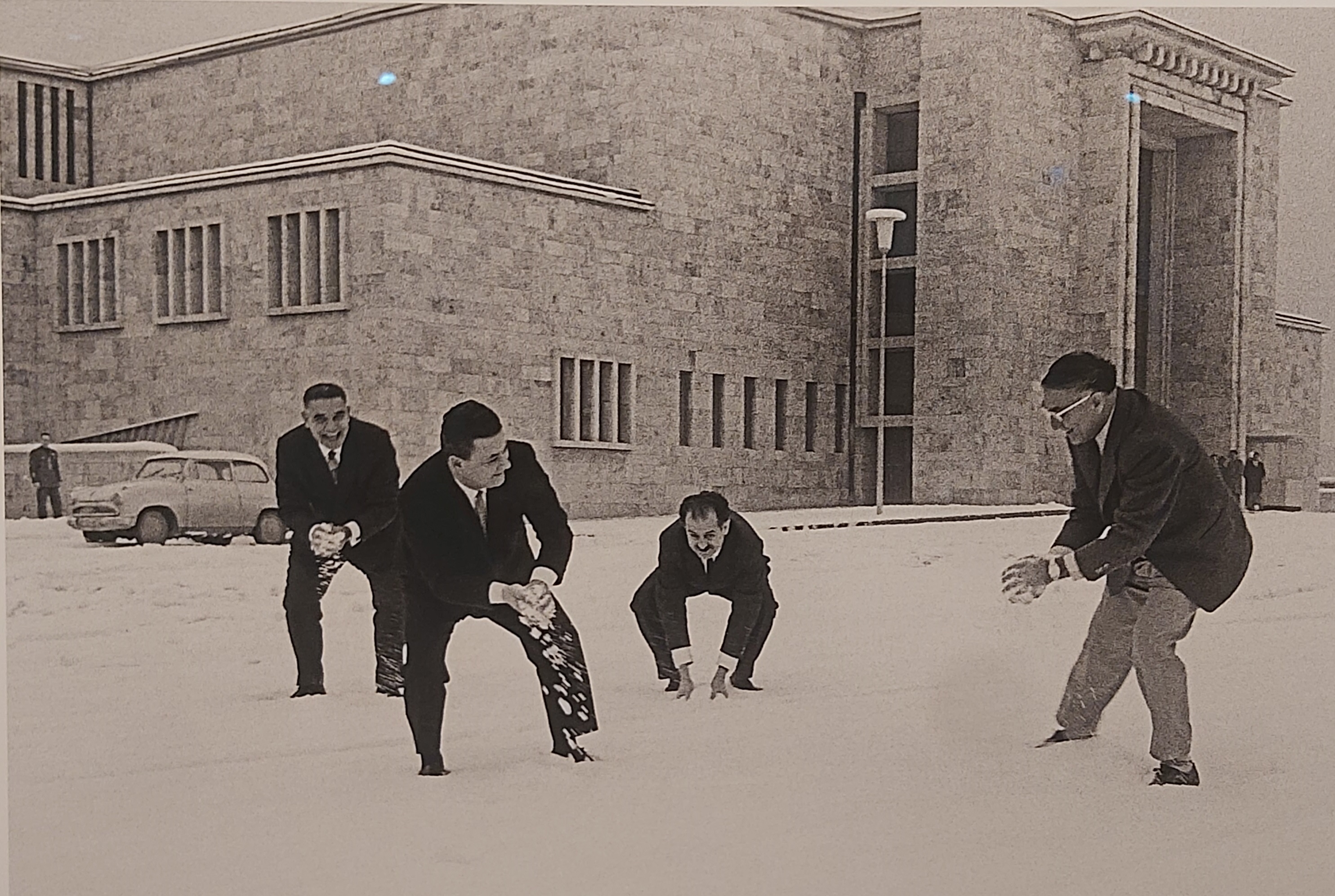
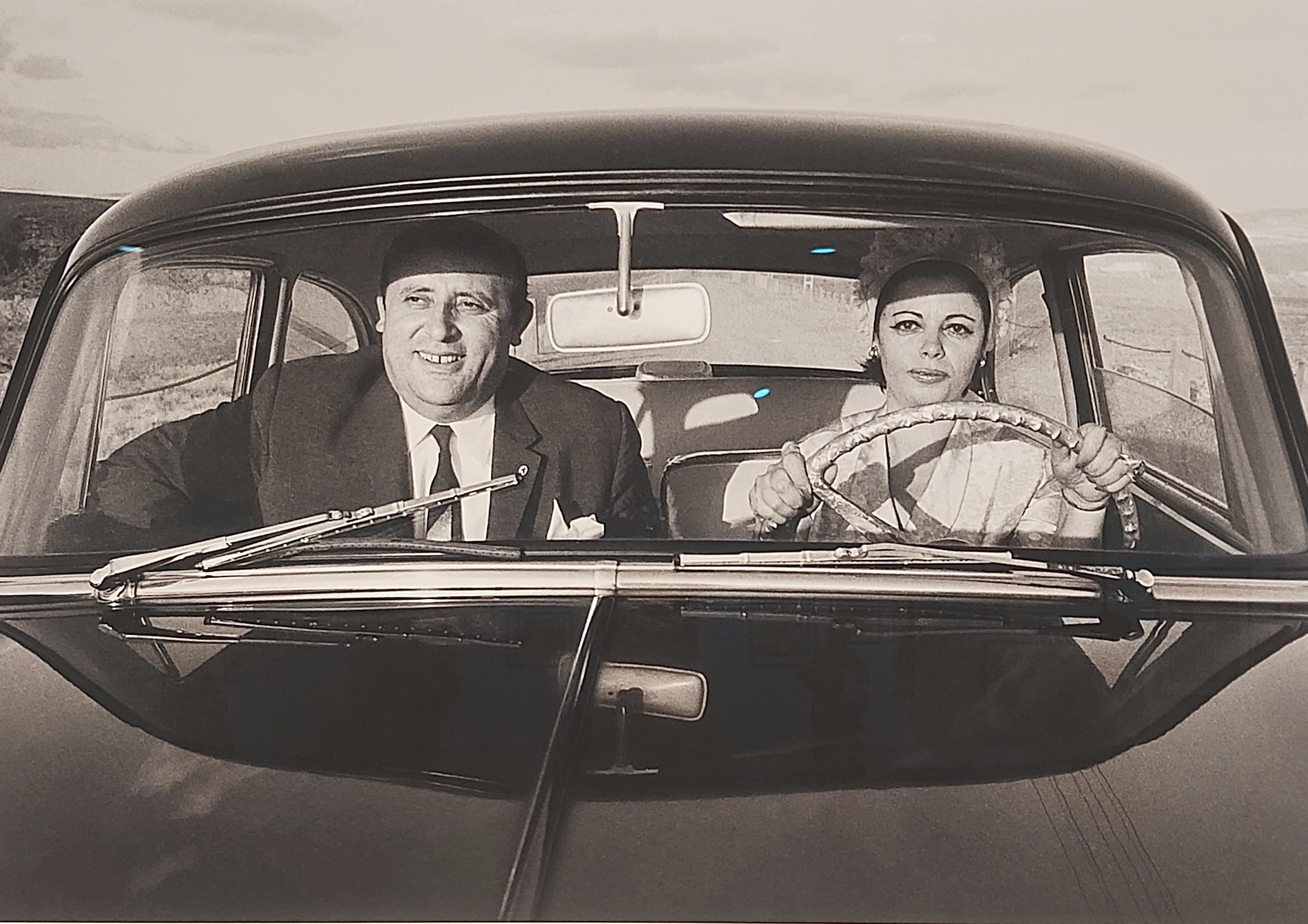
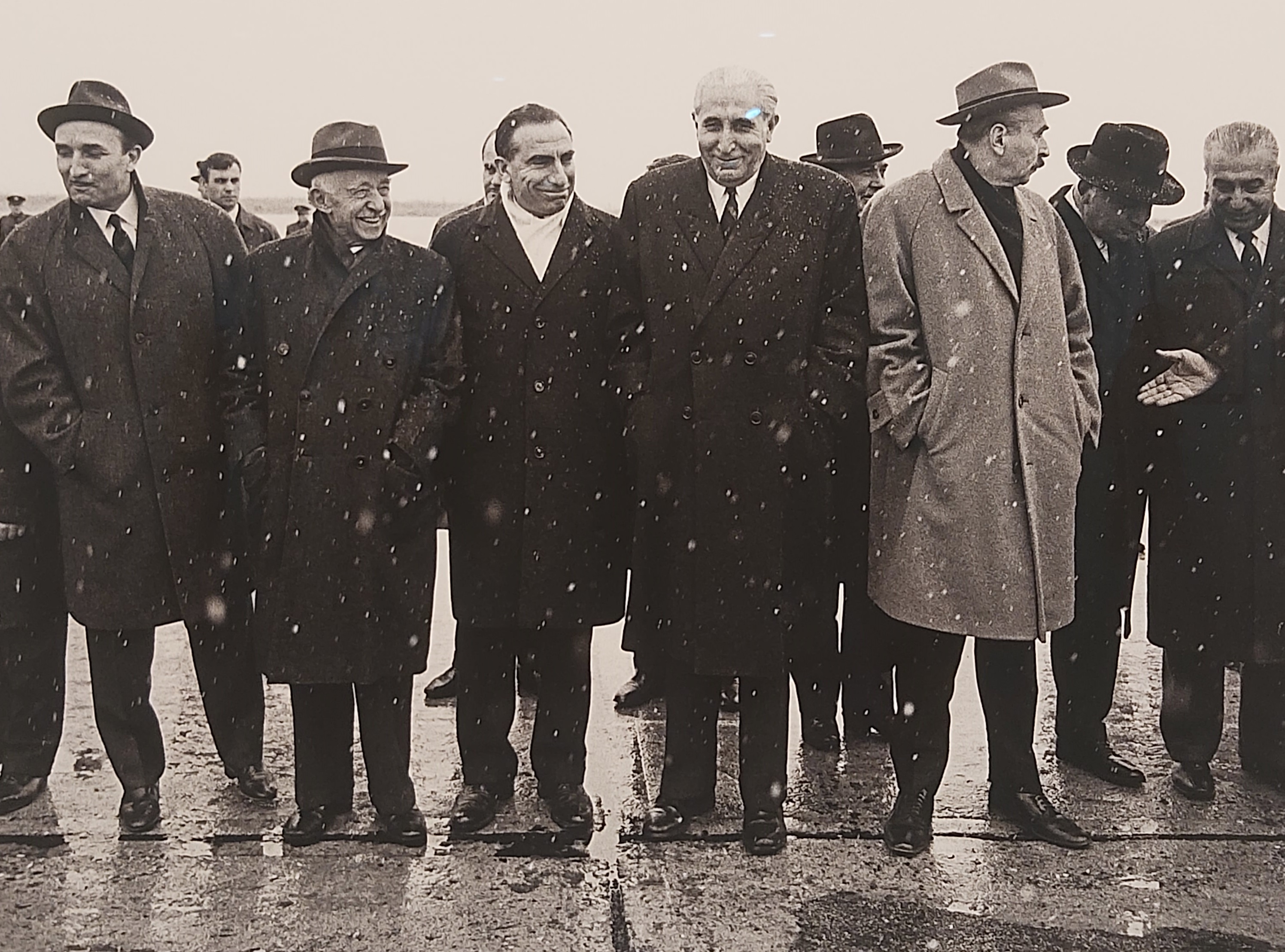
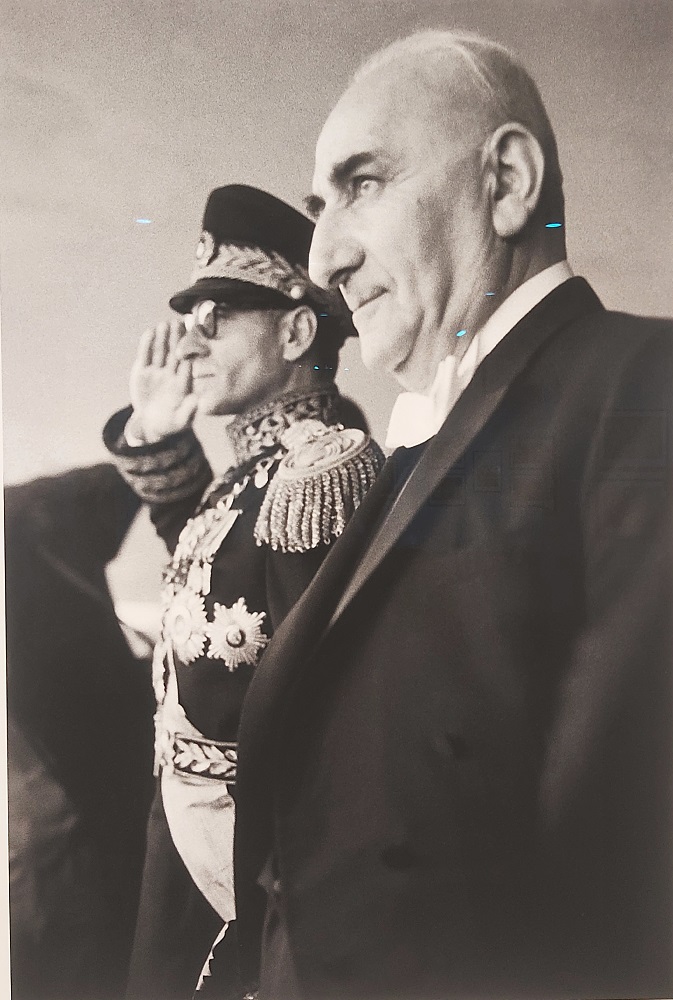
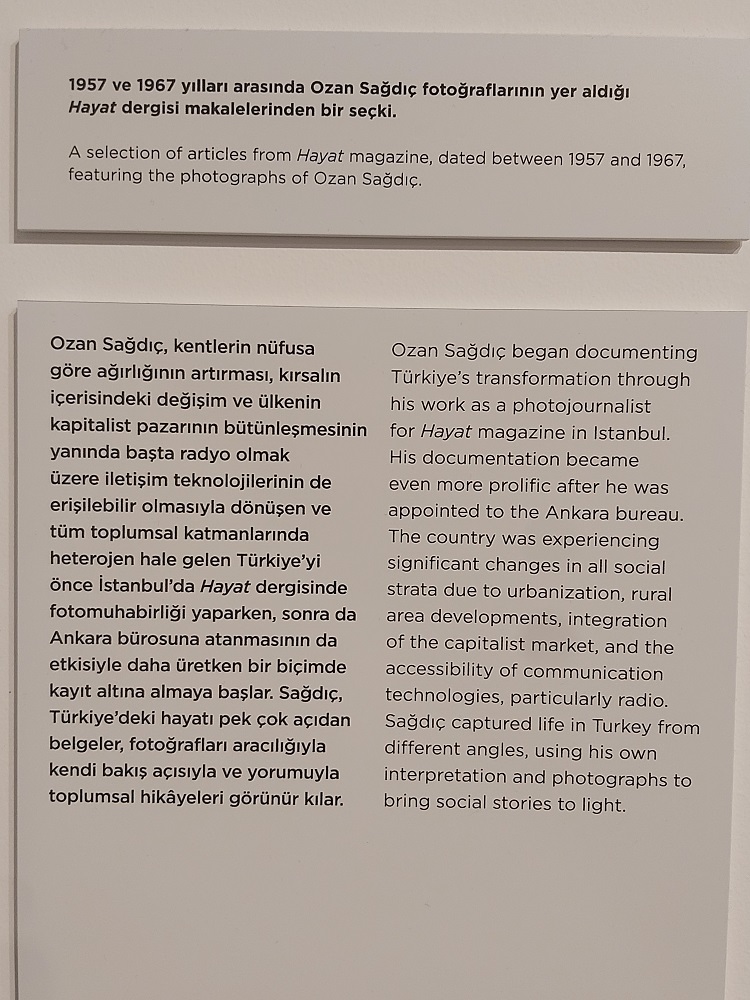
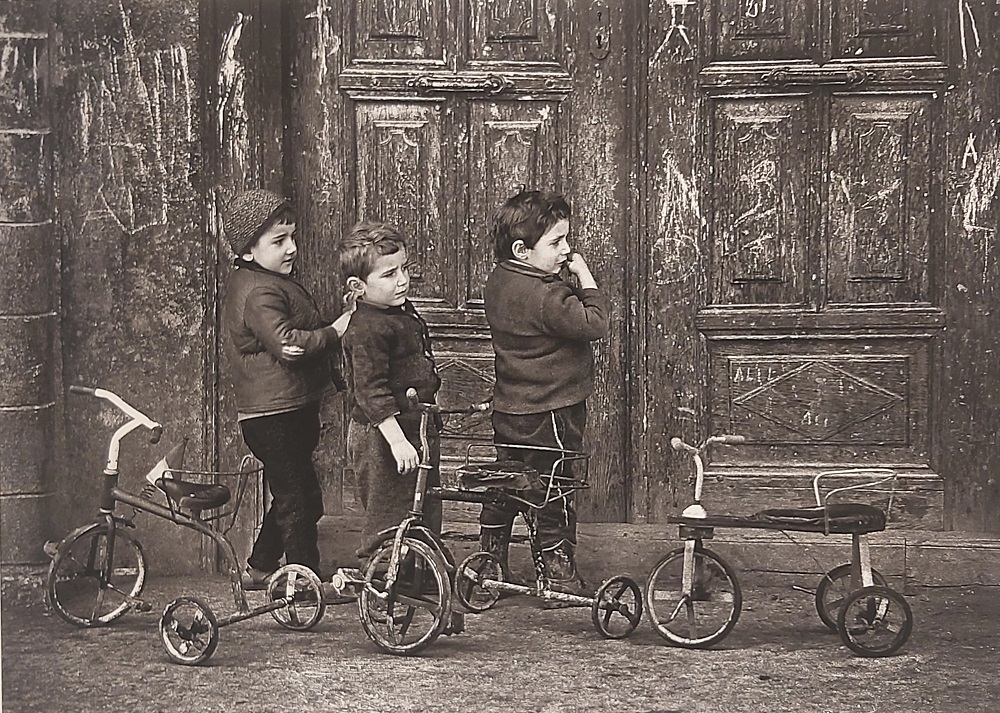
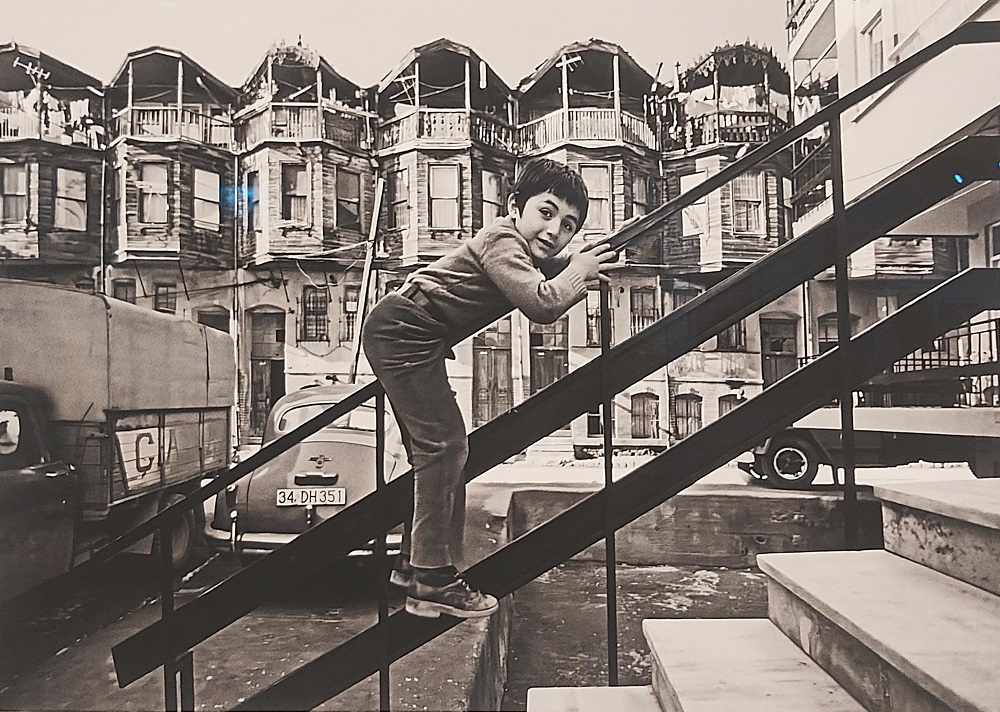
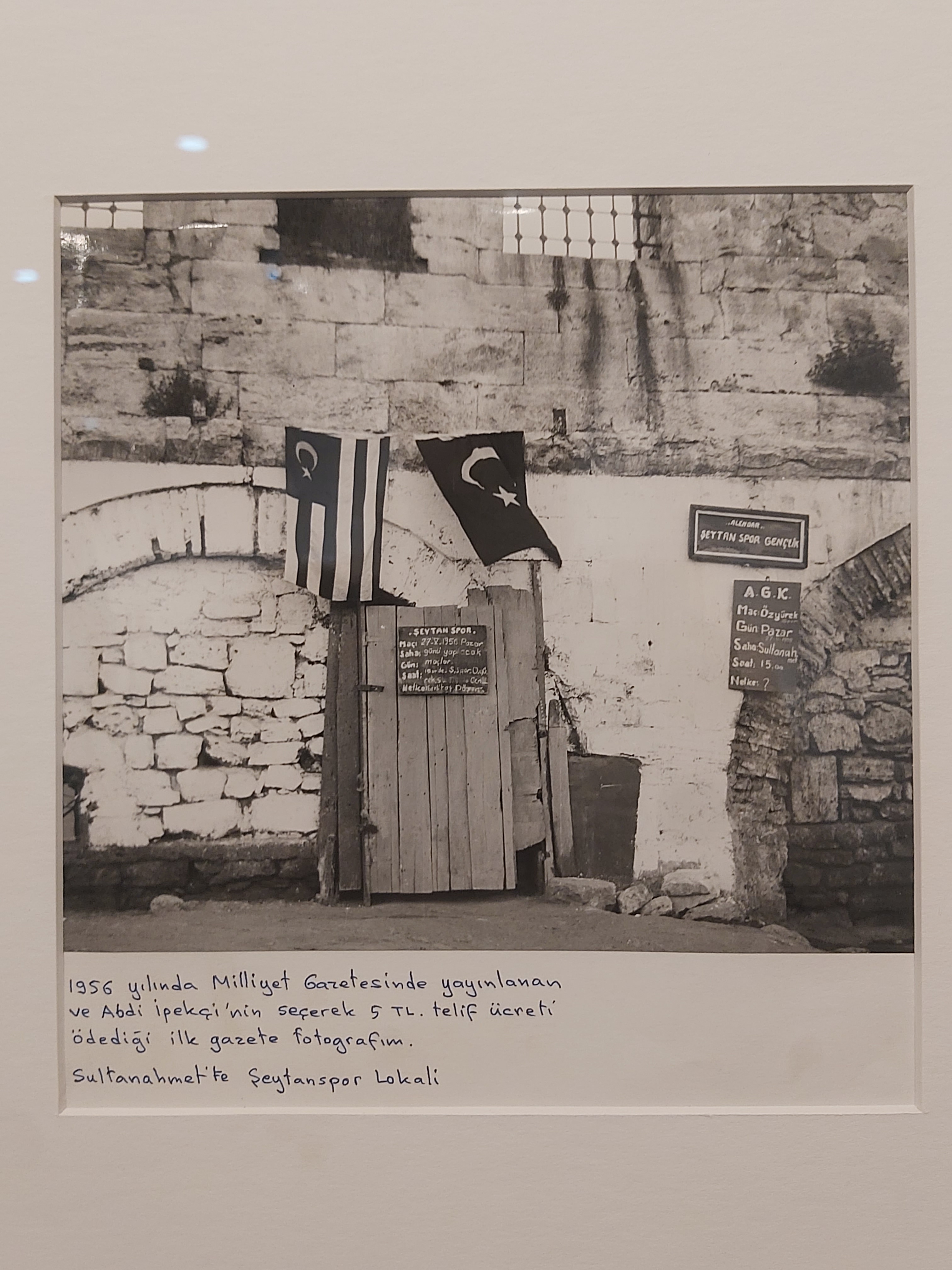
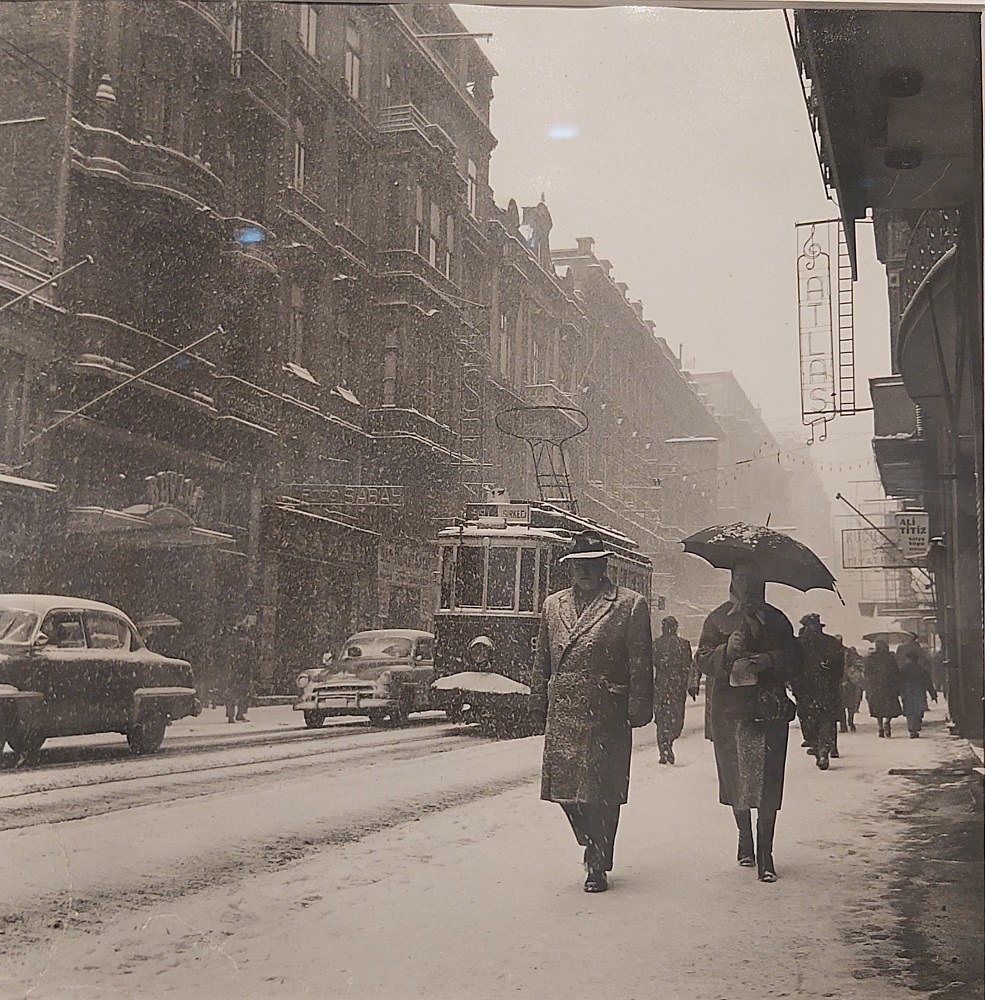
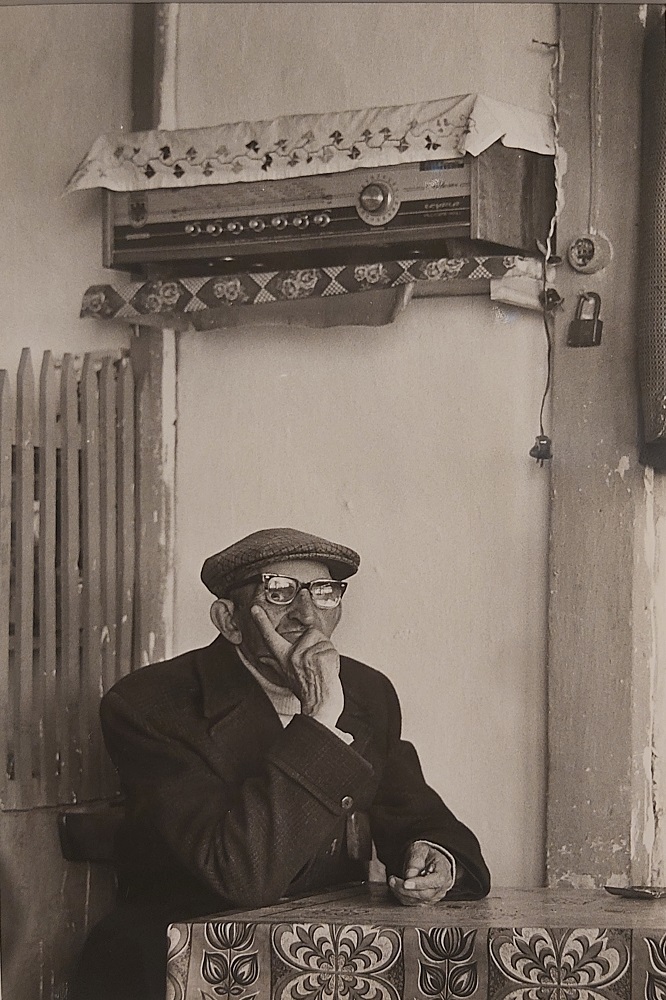
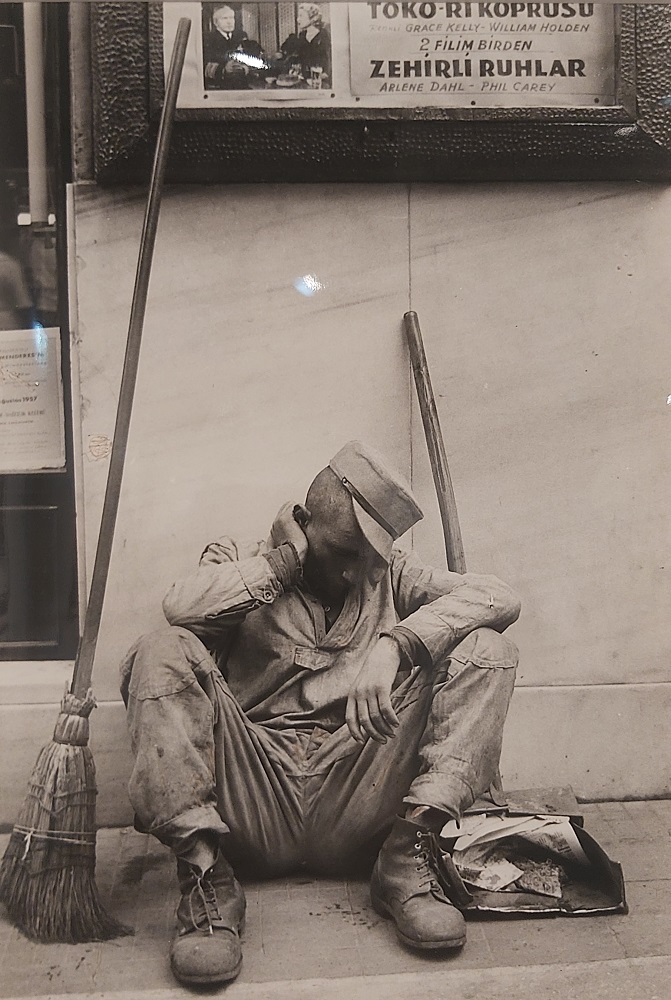
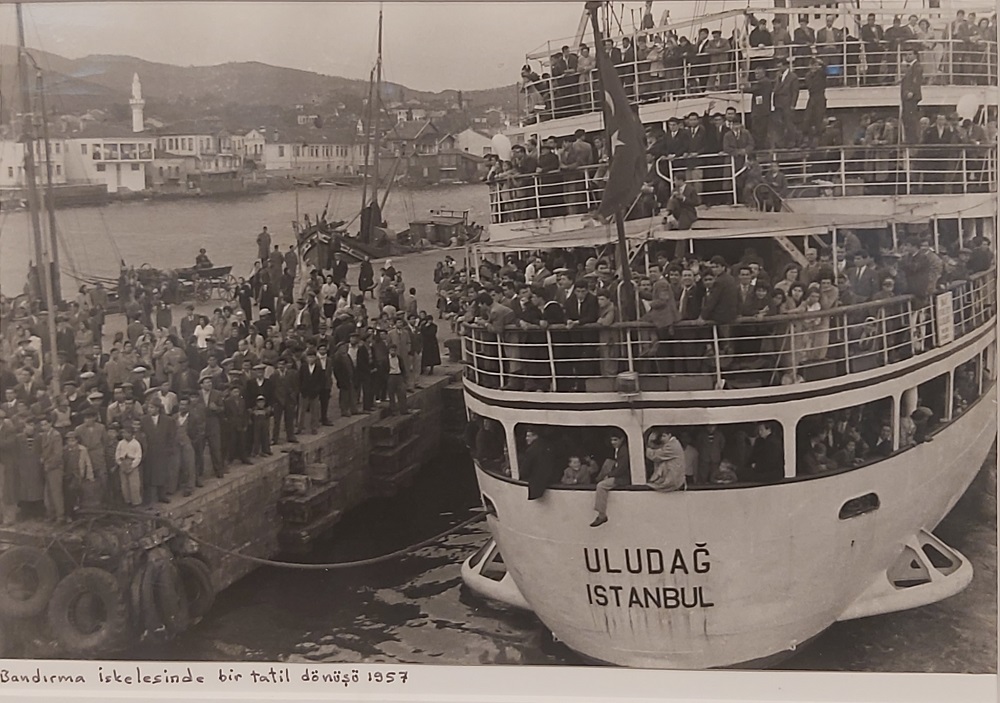
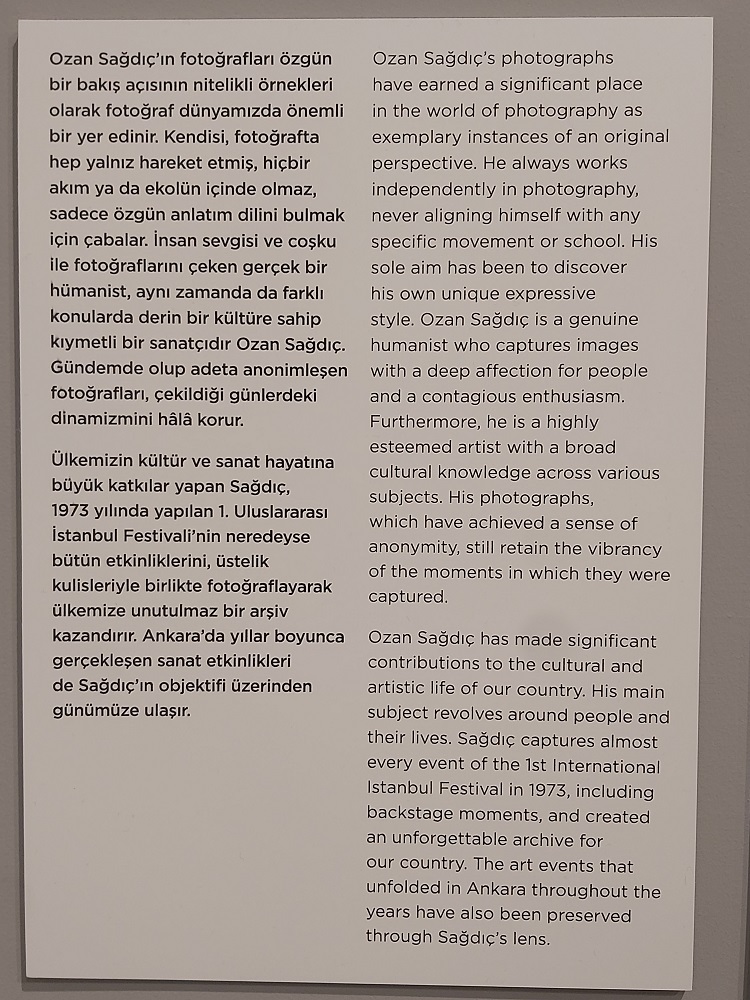
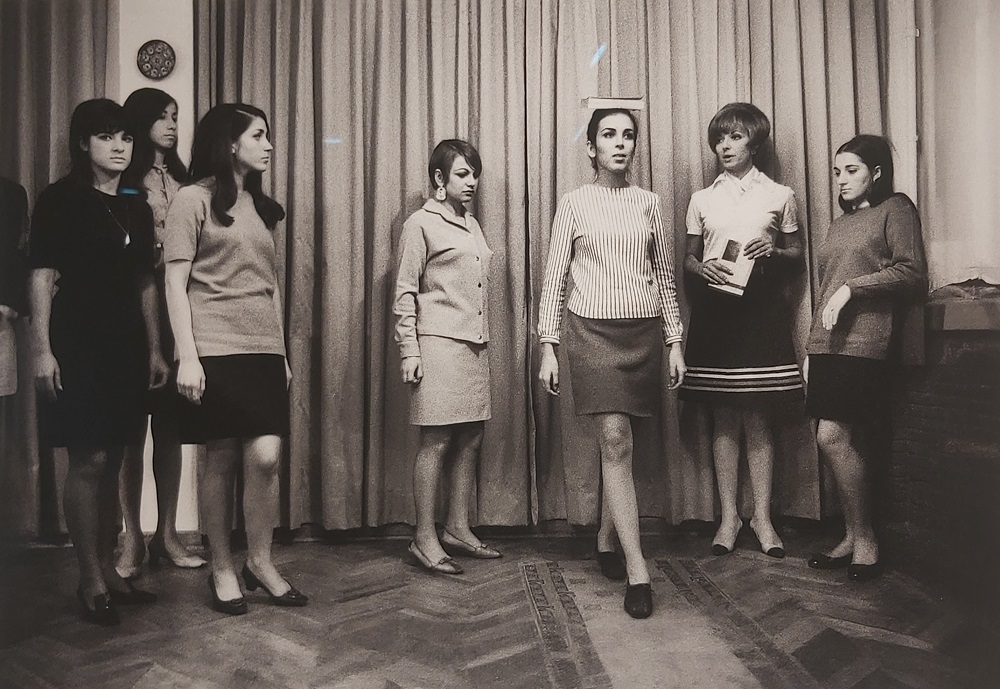
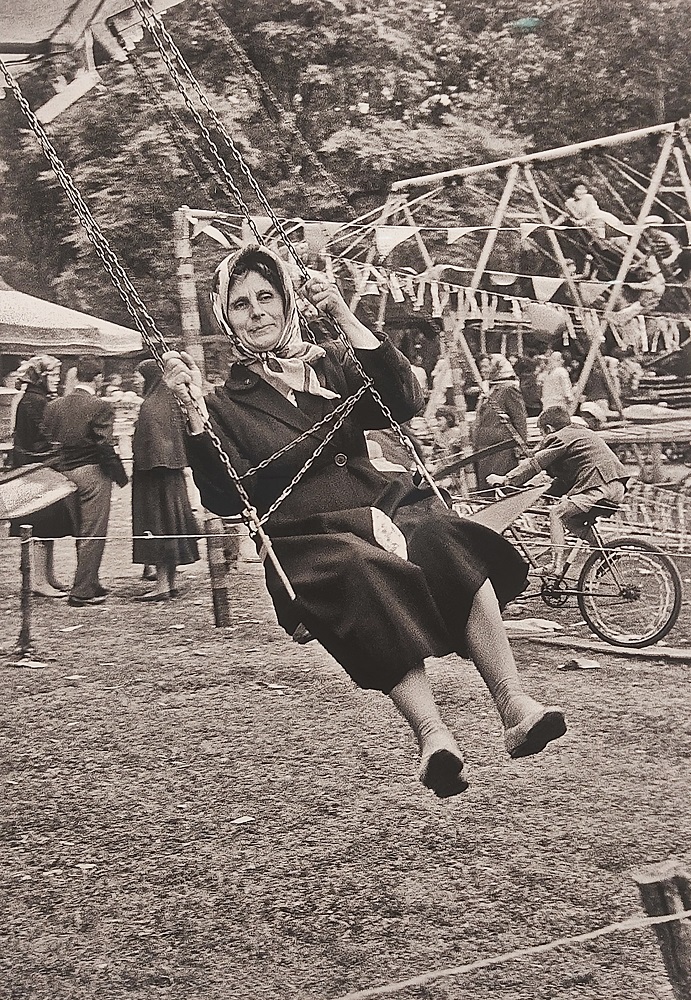
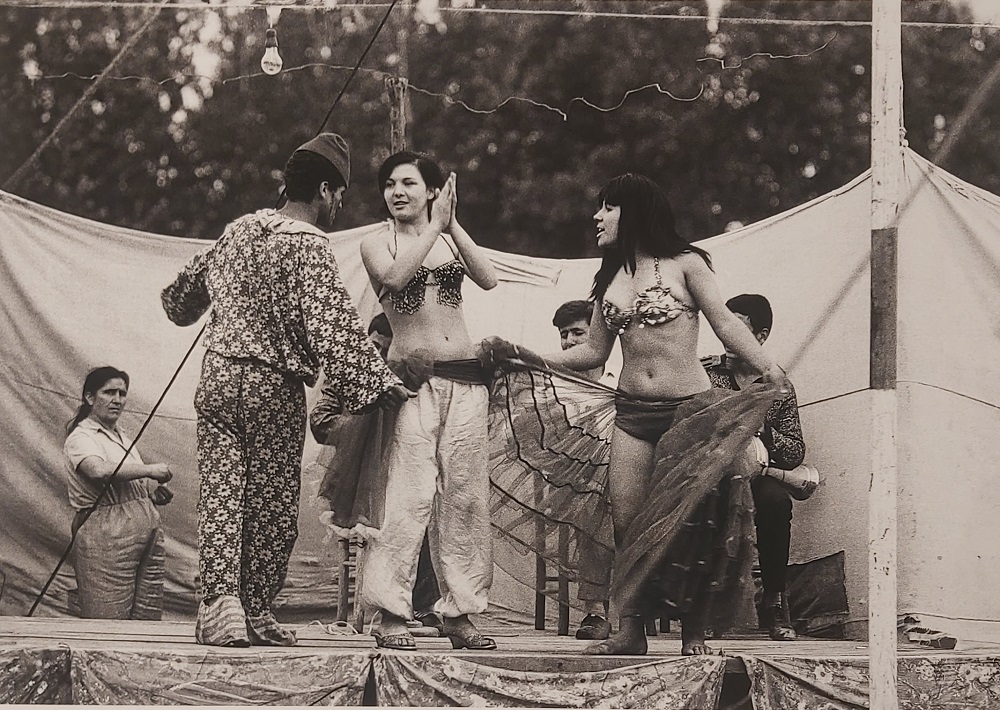
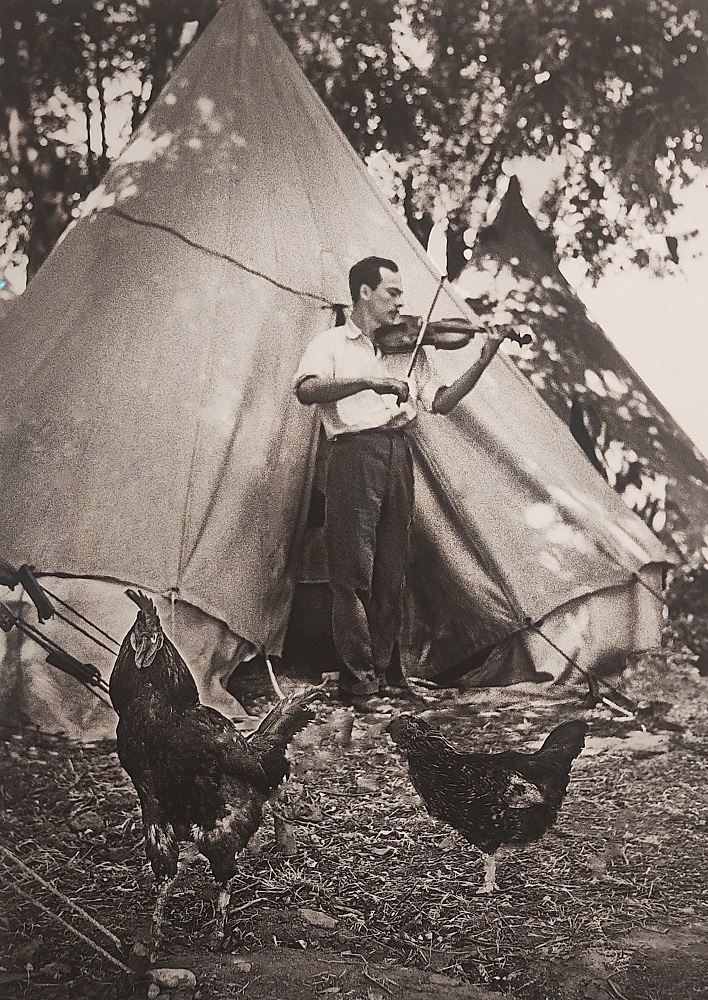
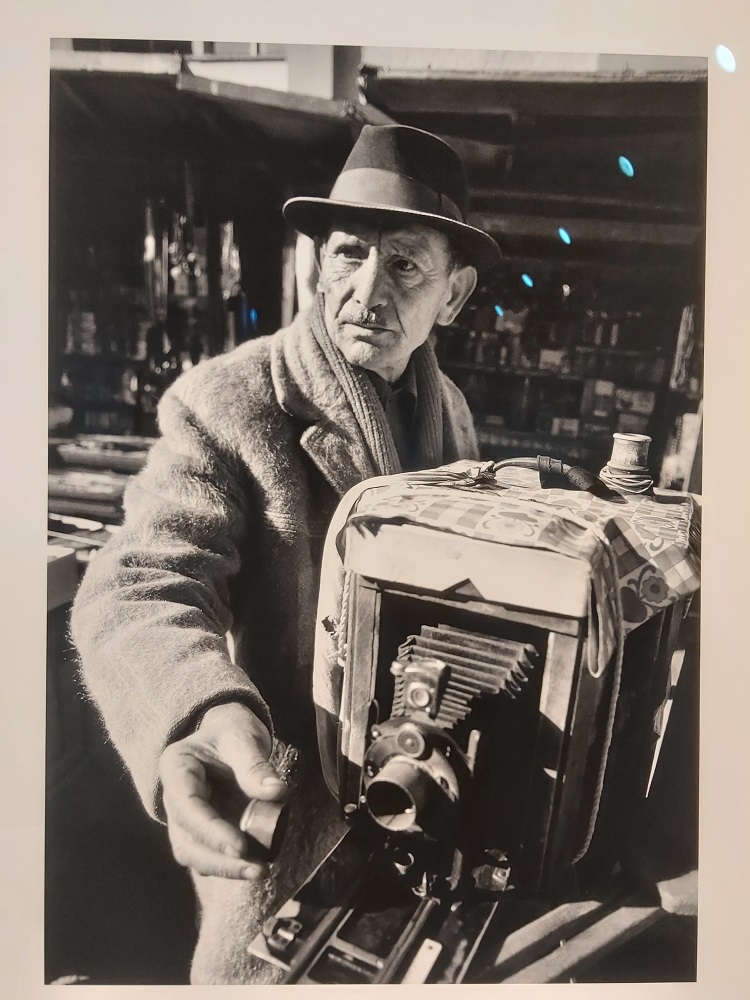
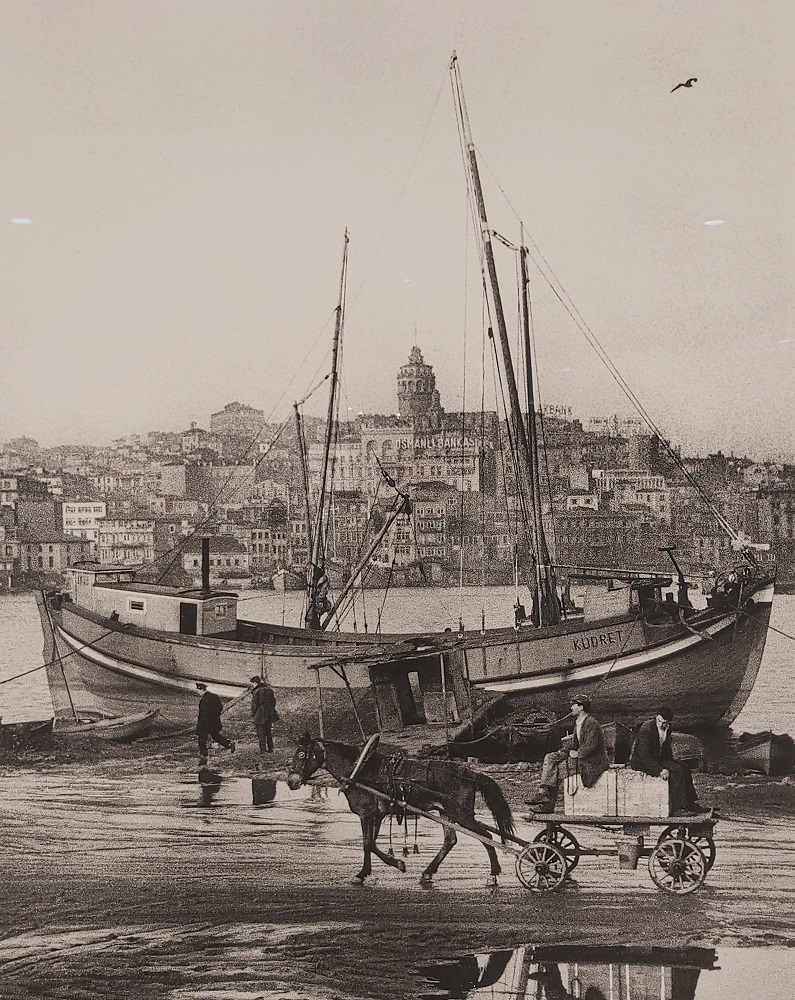
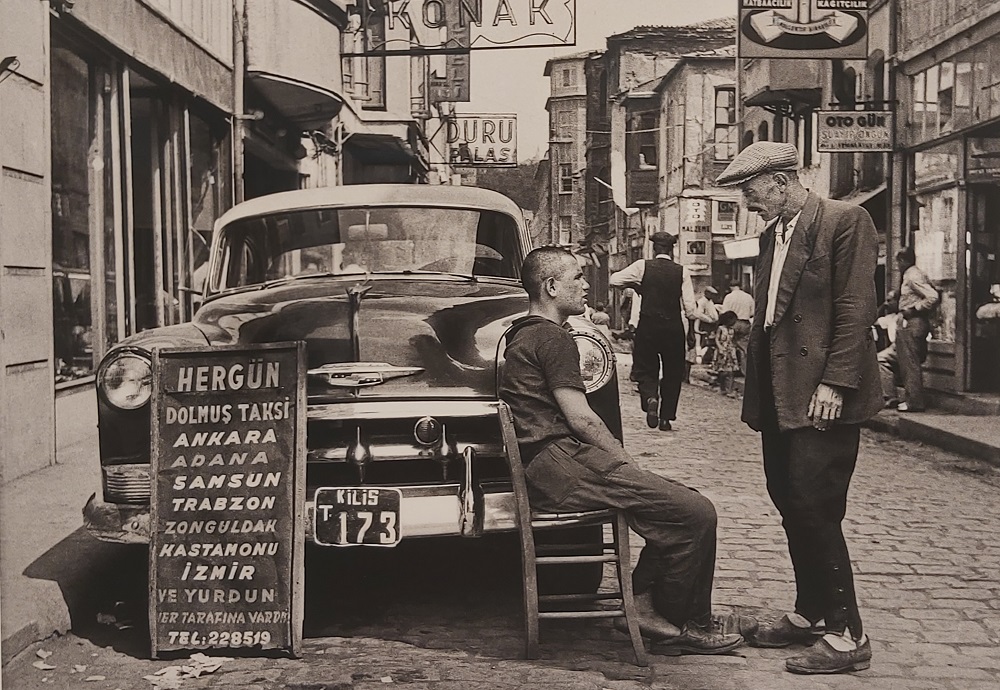
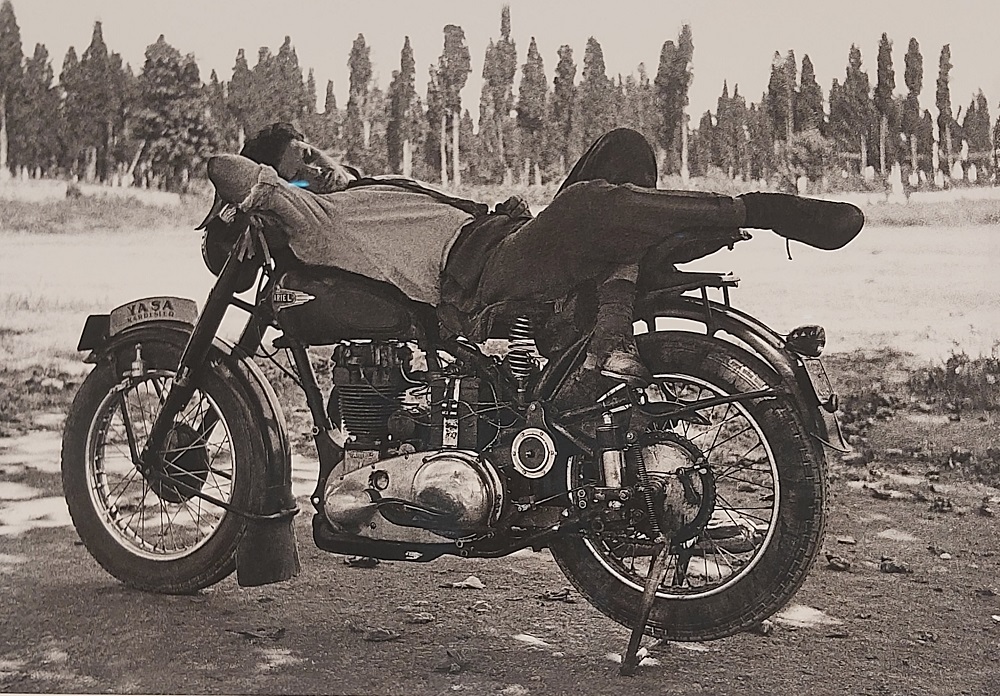
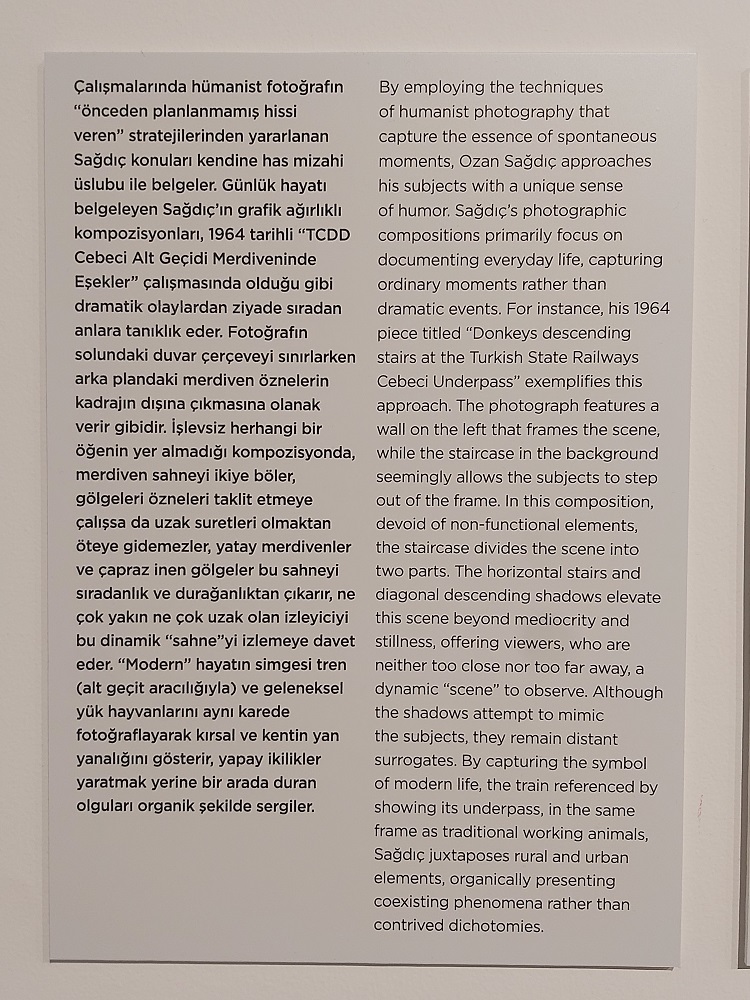
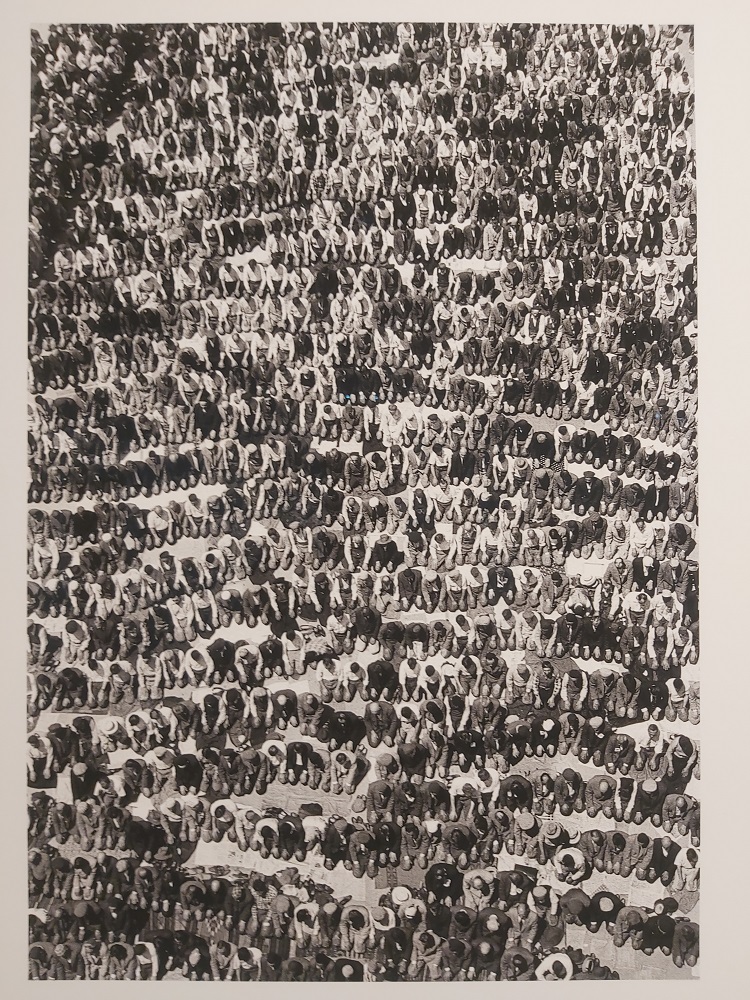
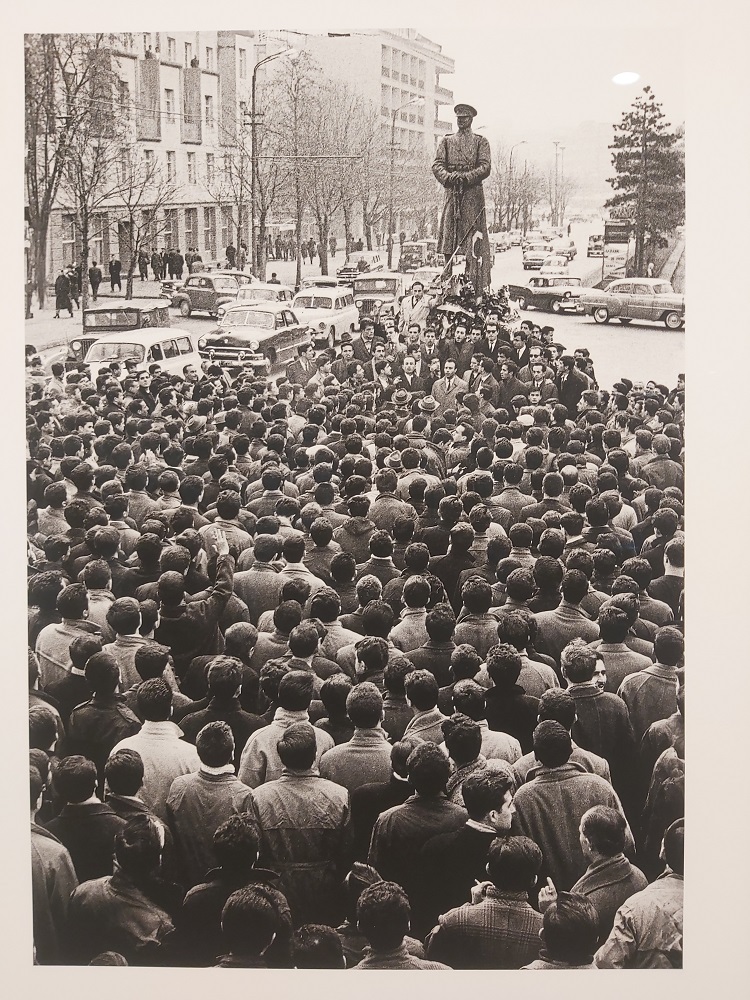
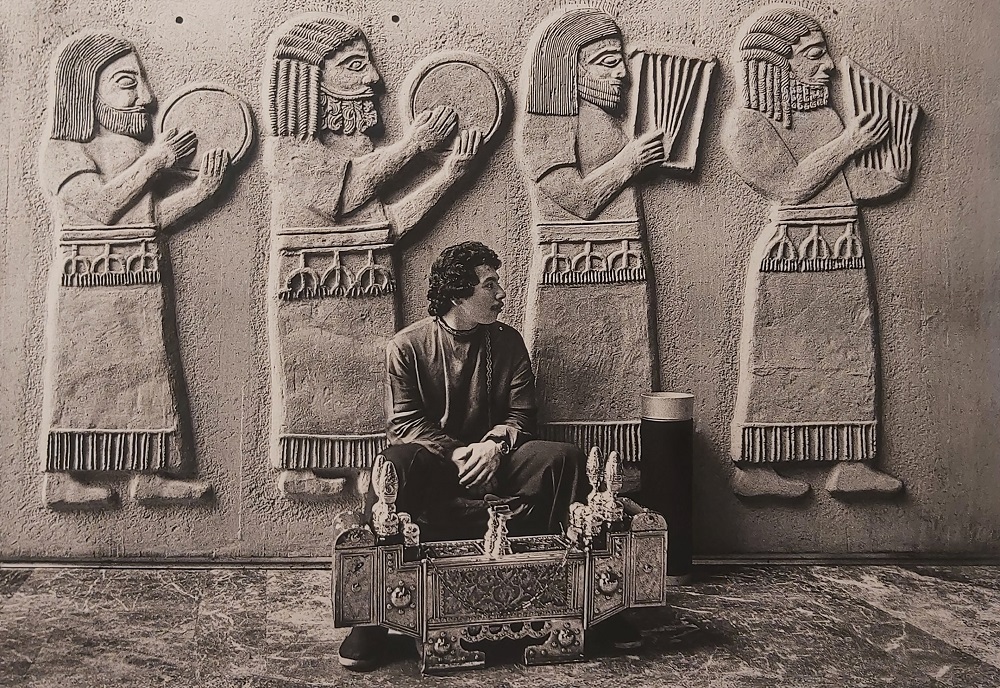
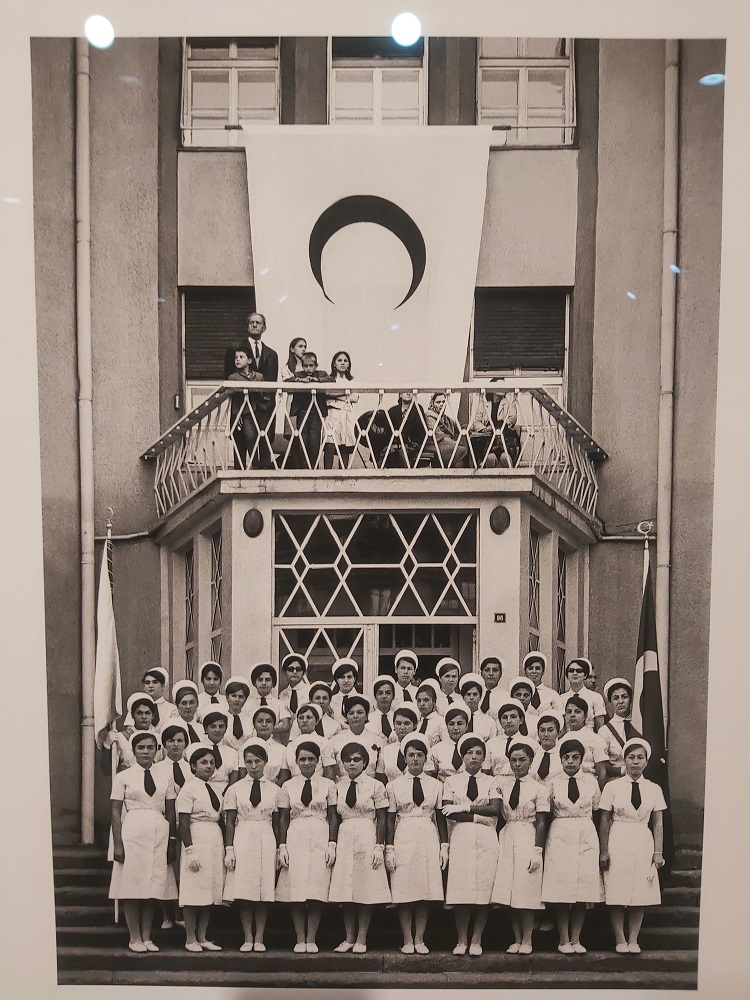
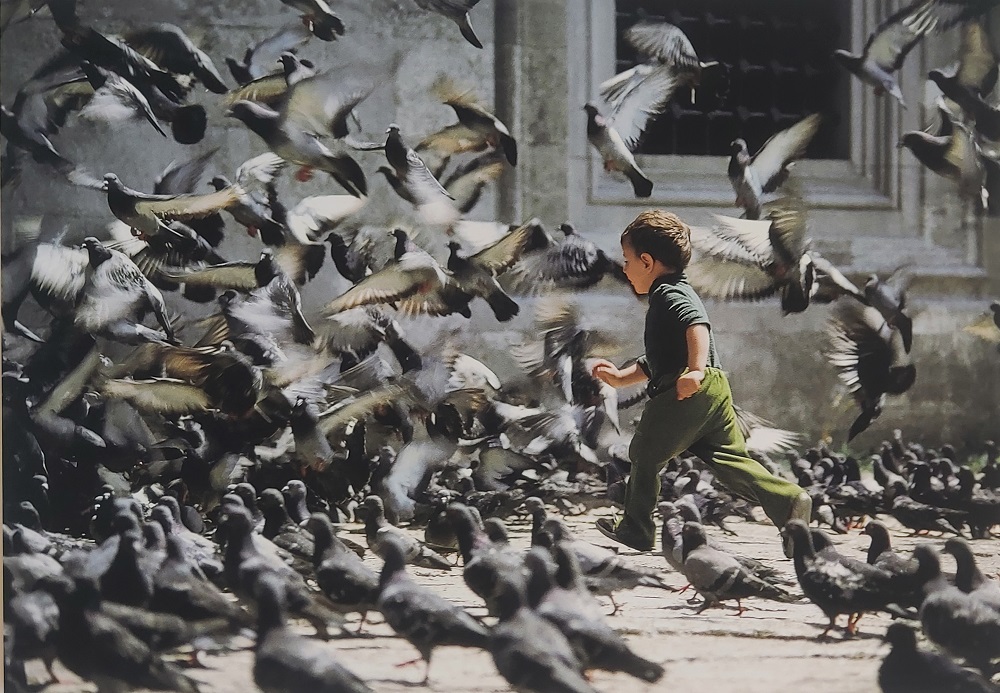
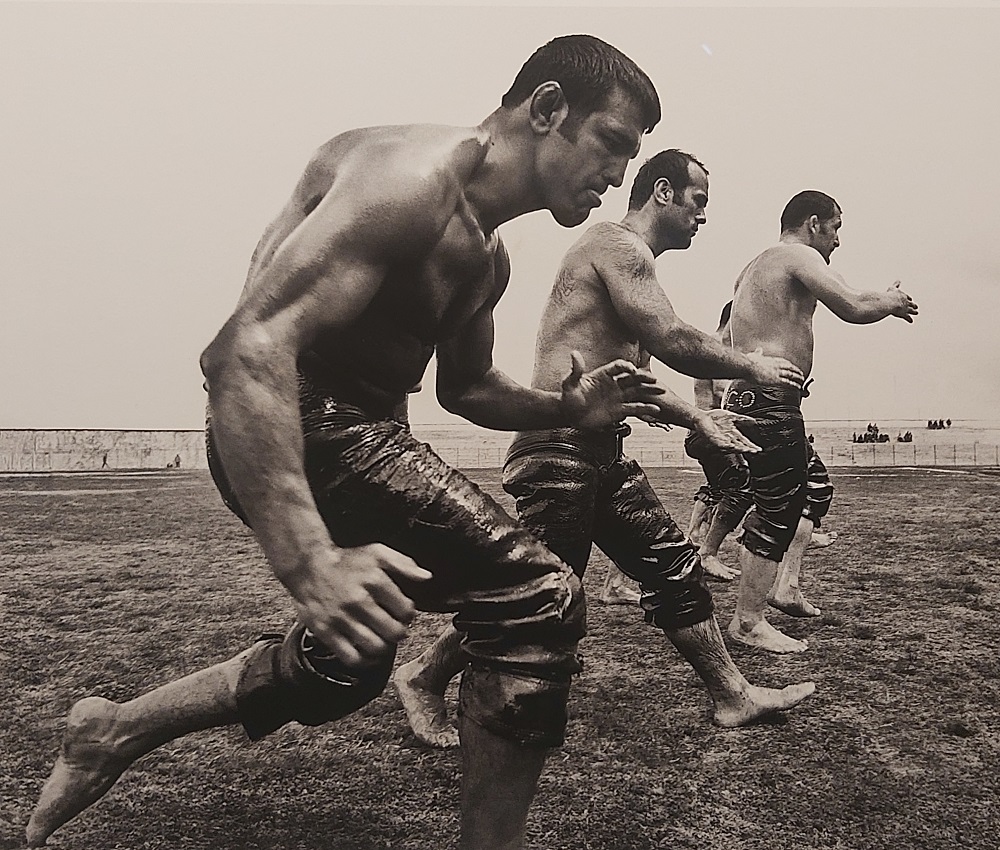
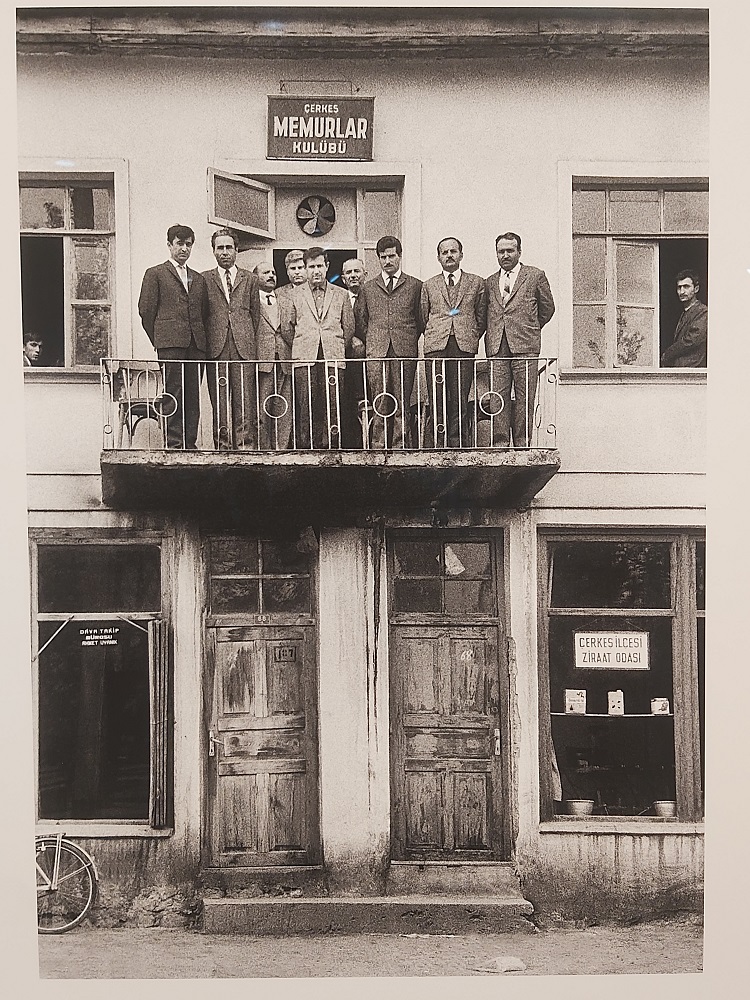
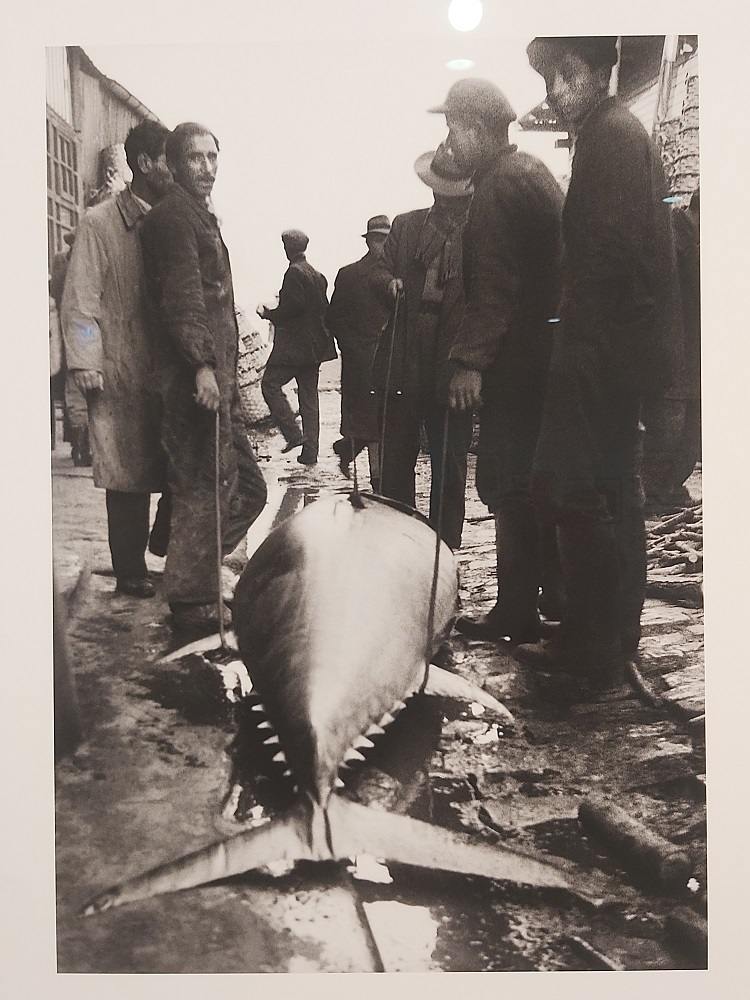
Ozan Sağdıç was born in 1934 in Burhaniye Pelitköy. He spent his childhood and early youth in Edremit, and while attending middle school in İzmir, his art and craft teacher was the painter Âbidin Elderoğlu. He went on to study at Kabataş High School in Istanbul as a boarding student, and during the summer vacation of 1953, he acquired his first box camera. He began capturing various scenes of Istanbul, and in 1954, he documented an event when the Bosphorus was covered in ice—his first experience with contemporary photography.
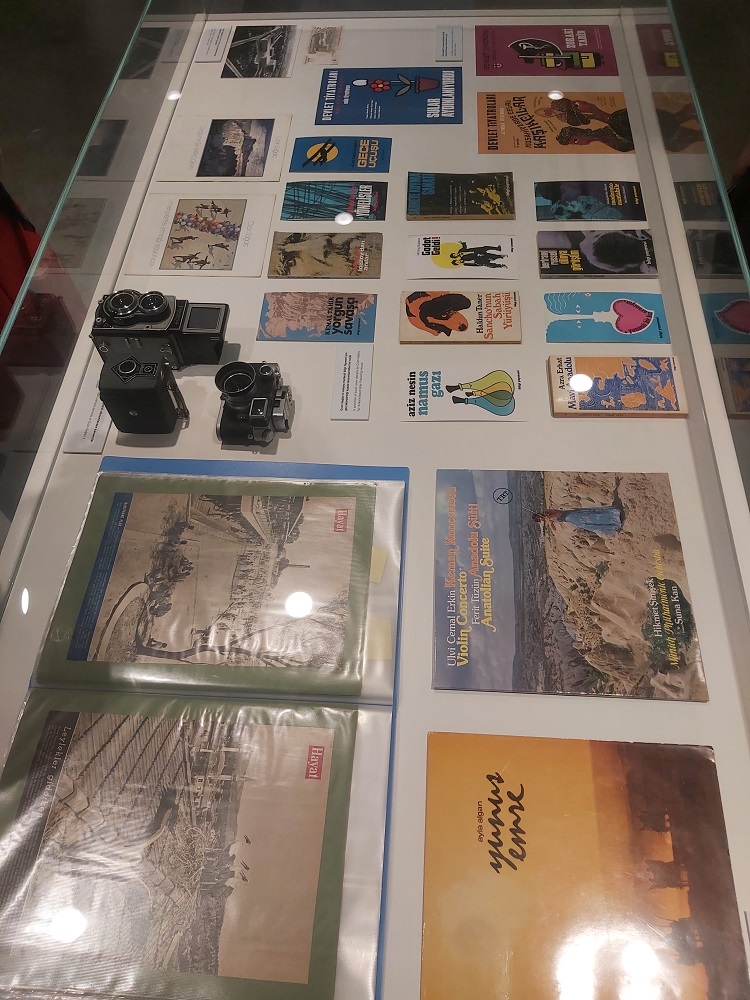
At one point, he worked as an assistant machinist at Lâle Cinema in his hometown Edremit and helped with the layout at the Edremit newspaper published by his older brother. In 1955, after returning to Istanbul, he began working at his first photo studio, Foto Sait. One evening, Mr. Sait introduced him to the board of the Istanbul General Photographers Association, where he was appointed as the secretary. Through this role, he got to know many photographers in Istanbul. Working at the studio of the association’s president, Şevket Tanju, he learned all the intricacies of portrait photography. With a borrowed Rolleiflex camera, he captured beautiful scenes of Istanbul.
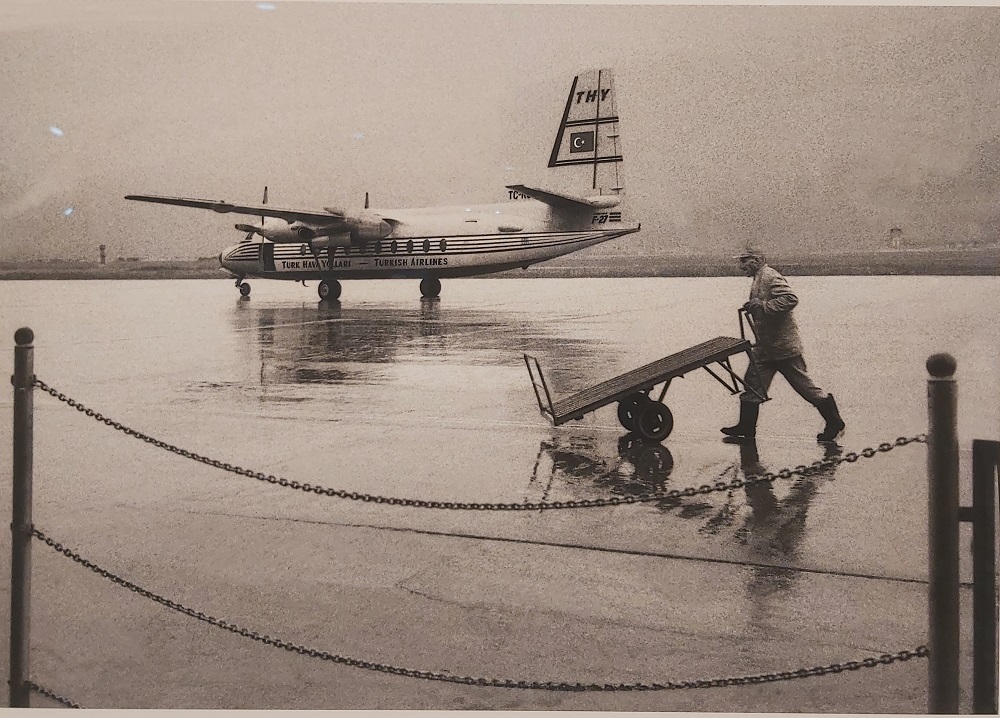
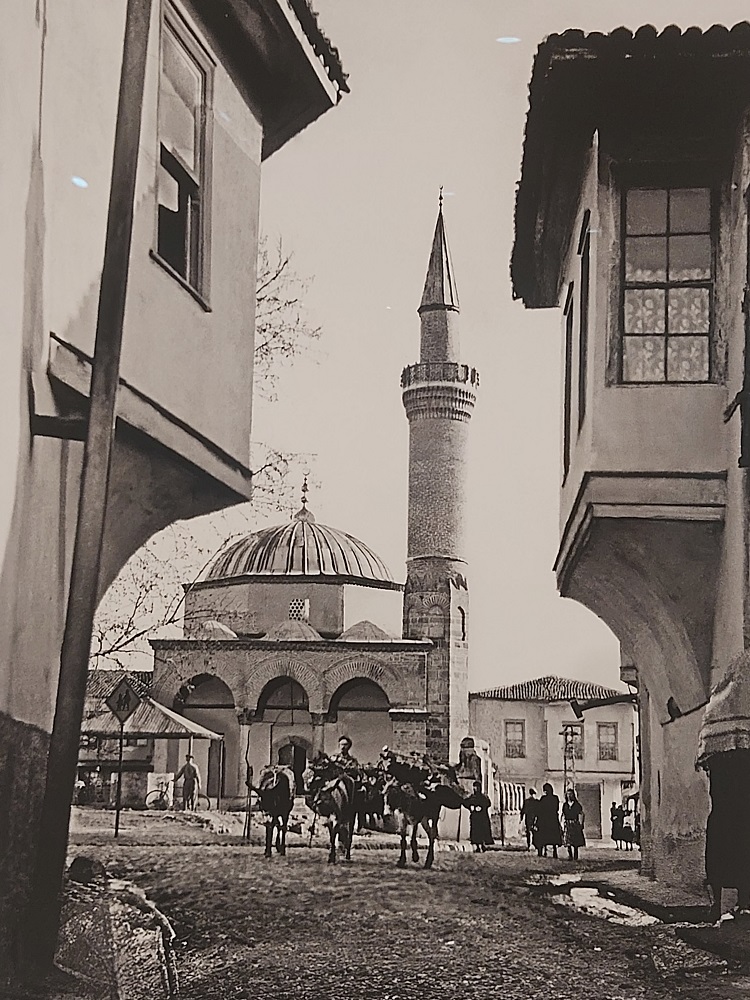
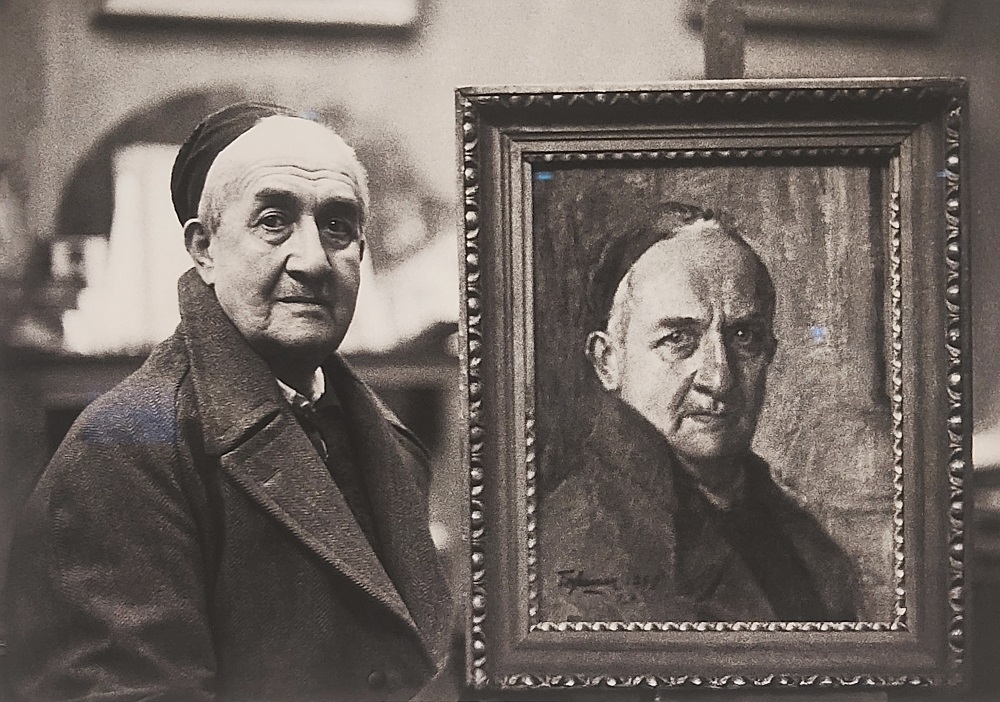
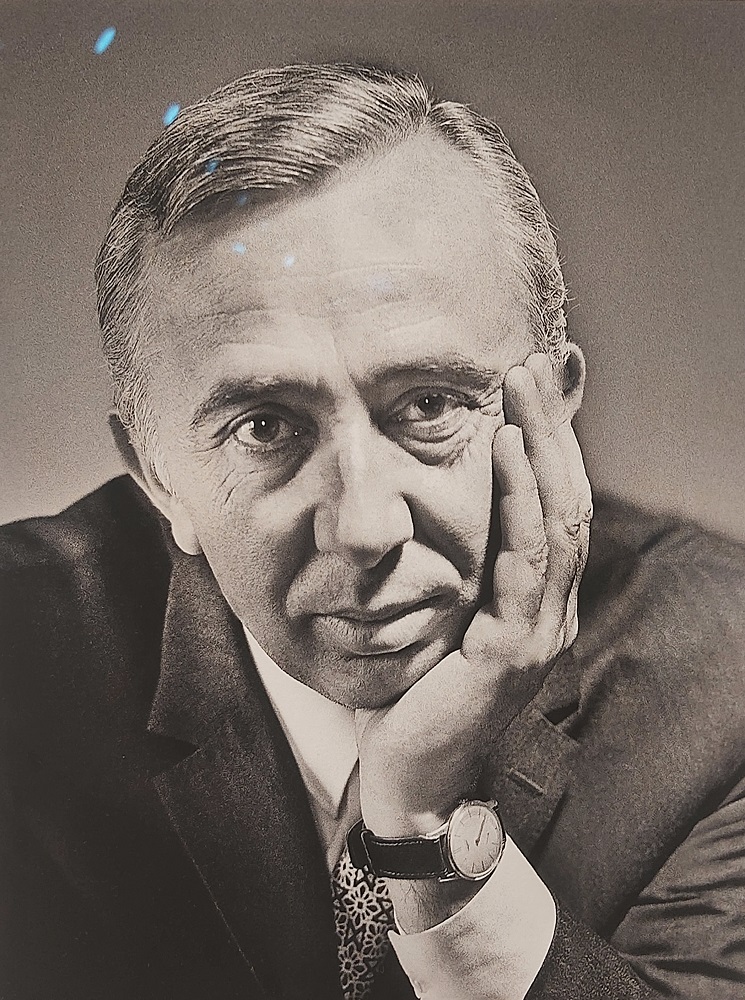
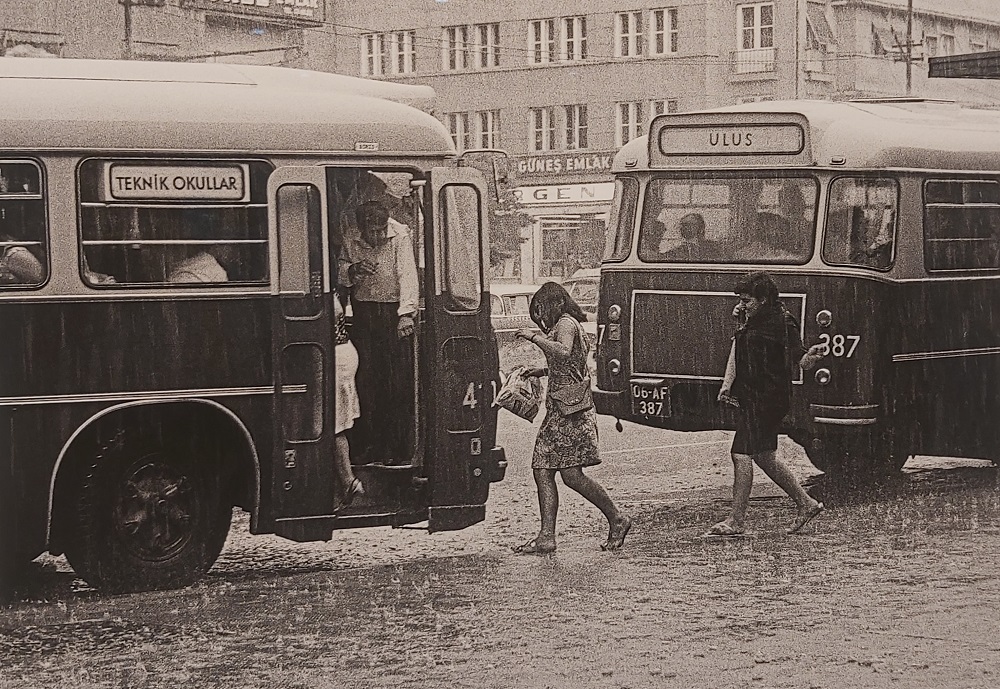
In 1956, he caught the attention of the team behind the weekly magazine Hayat. As soon as the magazine started publication, he became one of its first two photo reporters alongside Ara Güler and worked with the Istanbul team until 1960. That year, he was transferred to Hayat magazine’s newly opened Ankara office.
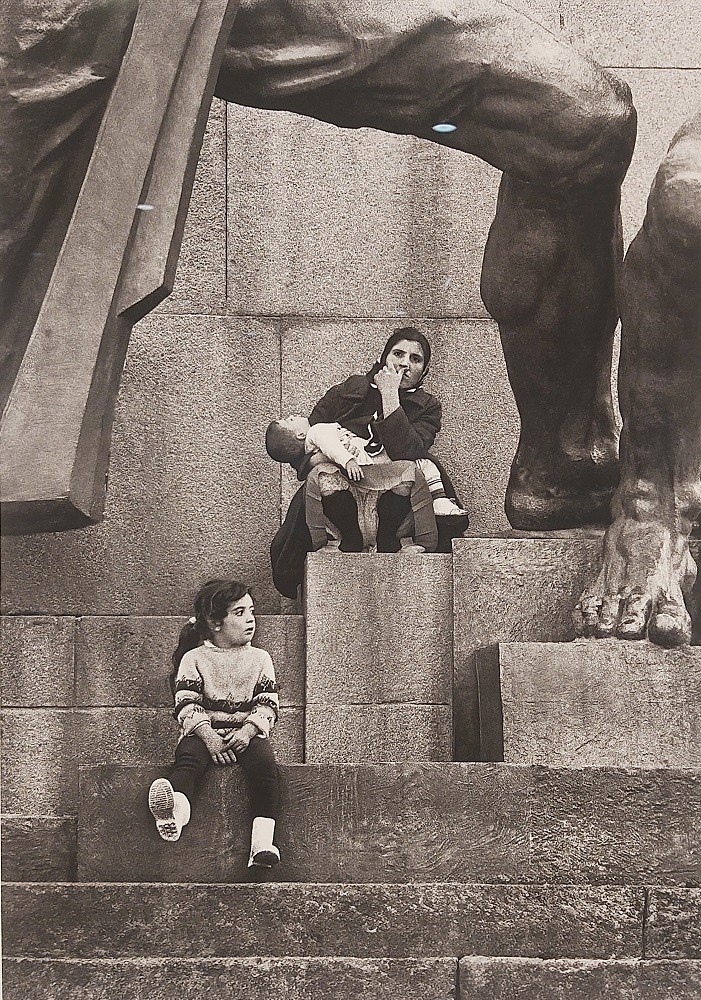
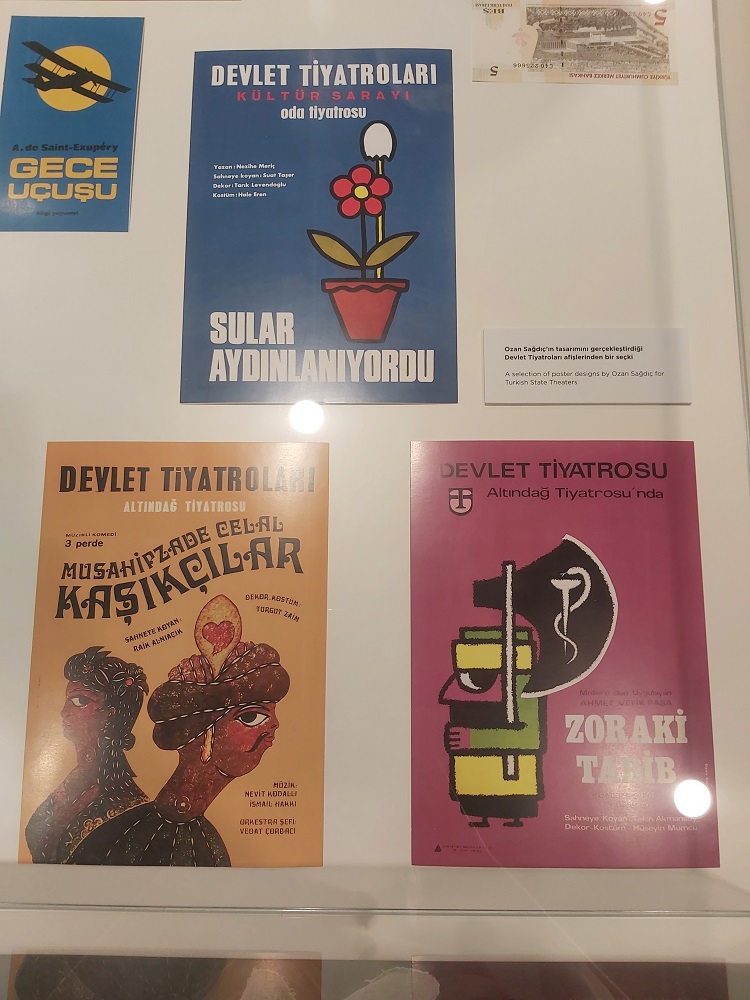
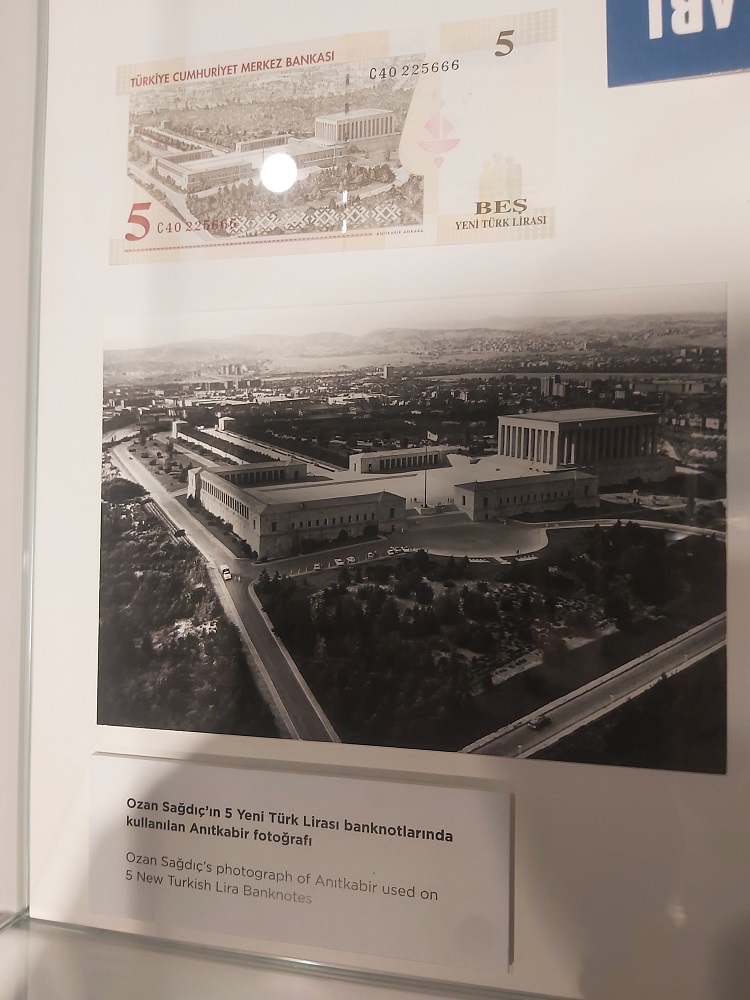
From that point on, he continued his career in journalism and photography in Ankara. There, he began photographing the stage performances of the State Theaters and contributed to their printed publications by designing the first theatre posters with a modern graphic sense. He also created book and publication covers that reflected contemporary graphic trends, and made significant contributions to the archival and promotional publications of the Ministries of Tourism and Culture. In 1968, one of his photos, sent to The British Journal of Photography, was published as the “Photo of the Year.”
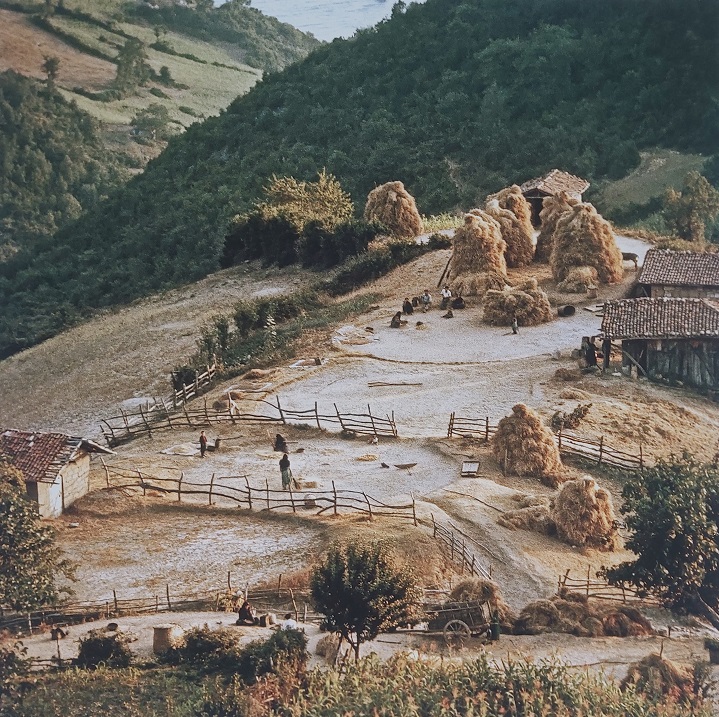
Throughout his career, Sağdıç has held around 50 personal exhibitions in Turkey and abroad. His diaporama shows, synchronized with music, have attracted special attention on several occasions. Additionally, he taught photography and art courses during the early years of the Faculty of Communication at Ankara University and the Faculty of Fine Arts at Hacettepe University.
In recognition of his contributions to Turkish photography, he was honored as an honorary member by both AFSAD and BUFSAD, and he was one of the founding members of FSK. Over the years, Sağdıç has served on various committees and advisory boards, including the UNESCO National Commission Culture Committee and the Cultural Ministry’s Art Advisory Board. He has also provided art consultancy to many organizations, such as TSE, the Turkish Cultural Foundation, and TKV. In addition to receiving the title of State Artist in 1998, he has been awarded numerous prizes, including the Art Institution Award in 1985, the Aydın Doğan Award in 2014, the TFSF Artist of the Year for 2020–2021, and the ÇAĞSAV Art Award in 2023.
Jacob Levy Moreno (1889–1974), the creator of Psychodrama, had a significant influence on Fritz Perls and the development of Gestalt Therapy. Moreno’s work introduced key concepts related to spontaneity, role-playing, and group dynamics, many of which Perls adapted into Gestalt practice.
Key Ways Moreno Influenced Perls and Gestalt Therapy
1. The Use of Psychodrama & Role-Playing
Moreno developed Psychodrama, a method where clients acted out emotions, conflicts, or life situations rather than just talking about them.
Perls adopted this experiential, theatrical approach, using techniques like: ✔ Role reversal (e.g., talking to an empty chair as if it were a person) ✔ Exaggeration (amplifying body movements and emotions) ✔ Dialogue techniques (encouraging internal conversations, such as the “topdog-underdog” exercise).
This active, expressive approach set Gestalt Therapy apart from traditional psychoanalysis.
2. The “Here and Now” Experience
Moreno emphasized immediacy—helping clients experience emotions in the present moment, rather than just analyzing past experiences.
This directly influenced Gestalt Therapy’s focus on the “here and now”, where clients are encouraged to experience their feelings fully in the moment, rather than intellectualizing them.
3. Spontaneity and Creativity
Moreno believed that spontaneity was key to psychological health, allowing people to break free from rigid patterns.
Perls integrated this by using improvisation and spontaneous expression in Gestalt sessions, rather than structured interpretations.
The Gestalt therapist, like a director in psychodrama, encourages the client to explore new ways of being rather than staying stuck in old narratives.
4. The Empty Chair Technique
Perls’ famous “Empty Chair” technique was inspired by Moreno’s role-playing exercises in Psychodrama.
This technique allows clients to: ✔ Engage in dialogues with different parts of themselves (e.g., inner conflicts, different perspectives). ✔ Confront unfinished business with people from their past. ✔ Gain insight through embodied interaction rather than abstract analysis.
5. Group Therapy & Encounter Groups
Moreno was a pioneer of group therapy, emphasizing interaction and emotional expression in a social context.
Perls later adapted Gestalt group therapy, where clients engage in live, interactive processing rather than passively listening.
Both approaches emphasize authenticity, directness, and experiential learning in group settings.
Summary: Moreno’s Influence on Perls
Moreno’s Concept
Perls’ Adaptation in Gestalt Therapy
Psychodrama & role-playing
Empty chair technique, exaggeration
Spontaneity & creativity
Experiential, expressive therapy
“Here and Now” focus
Gestalt’s present-moment awareness
Group Therapy
Gestalt encounter groups
Embodied emotional expression
Body awareness & integration
Conclusion
Moreno’s theatrical, action-based approach to therapy deeply influenced Perls’ Gestalt Therapy. Perls transformed therapy into an interactive, expressive process, making it more immediate, embodied, and experiential, much like Moreno’s Psychodrama.
Scenario Example of Moreno’s Influence in Gestalt Therapy
Let’s look at a practical therapy session where Moreno’s role-playing and psychodrama techniques are used in Gestalt Therapy.
Scenario: A Client with Unresolved Anger Toward Their Father
The client, Anna, has built-up resentment toward her father, who was emotionally distant during her childhood.
She struggles with expressing her feelings and often avoids confrontation.
Step 1: The Empty Chair Technique (Inspired by Psychodrama Role-Playing)
The therapist places an empty chair in front of Anna.
Anna is asked to imagine her father sitting in the chair and to speak directly to him.
The therapist encourages Anna to speak freely and express her emotions as if her father were actually there.
Anna hesitates, but then starts expressing anger, disappointment, and sadness.
As she speaks, the therapist asks her to exaggerate her emotions and gestures (another technique borrowed from Moreno).
Anna’s body language changes—she clenches her fists, raises her voice, and starts to feel her emotions more intensely.
Step 3: Role Reversal (Directly from Psychodrama)
The therapist asks Anna to switch seats and take on her father’s role.
She now has to respond as her father would.
This gives Anna a new perspective and allows her to see possible reasons behind her father’s emotional distance.
Step 4: Integration and Awareness
After switching roles a few times, Anna realizes that her father wasn’t intentionally neglecting her, but was emotionally shut down himself.
This awareness leads to emotional relief and self-acceptance.
The therapist helps Anna integrate her insights, shifting her focus from resentment to self-compassion.
Why This Works (The Moreno-Gestalt Connection)
Technique
From Moreno’s Psychodrama
Used in Gestalt Therapy
Empty Chair
Used in role-playing exercises
Helps resolve unfinished business
Role Reversal
Clients play different roles
Clients embody different perspectives
Exaggeration
Encourages emotional expression
Enhances awareness of feelings
Group or Individual Drama
Used to explore personal conflicts
Helps clients relive experiences in therapy
Conclusion
By acting out emotions rather than just talking about them, clients like Anna can gain deeper insights, release emotions, and move toward healing. Moreno’s psychodrama techniques made Gestalt Therapy more dynamic, expressive, and immediate, allowing clients to experience deep emotional breakthroughs.
Here’s a 30-minute workshop idea for your Gestalt therapy group. It’s fun, creative, insightful, and encourages collaboration in pairs. The theme will be “Exploring Polarities in Ourselves and Our Relationships.”
Workshop Outline: Exploring Polarities
Objective:
Participants will explore polarities within themselves and their relationships, fostering self-awareness, creativity, and connection.
Preparation:
Divide the group into breakout rooms, with 2 participants in each room.
Each pair will need a piece of paper and a pen (or a virtual whiteboard in Zoom for drawing).
Workshop Flow:
1. Introduction (5 minutes)
Briefly explain the concept of polarities in Gestalt therapy (e.g., “light vs. shadow,” “selfishness vs. selflessness,” “openness vs. guardedness”).
Share that the aim is to creatively explore and embody these polarities through a simple exercise.
Explain the structure: Participants will work in pairs, share insights, and return to the main room to discuss experiences.
2. Breakout Activity Instructions (2 minutes)
Assign a polarity to each pair (e.g., “control vs. freedom,” “giving vs. receiving”). If you’d like, let them choose from a pre-prepared list of polarities.
Each participant in the pair takes turns:
Person A will embody/role-play one end of the polarity (e.g., “control”).
Person B will embody/role-play the opposite end (e.g., “freedom”).
They will explore the following:
How does it feel to express this polarity?
How does it feel to interact with the opposite polarity?
3. Breakout Room Activity (15 minutes)
Pairs work together:
Each person gets 3 minutes to role-play their assigned polarity.
Afterward, they spend 4 minutes reflecting together:
What did they notice about their feelings?
How did they perceive the other’s role?
Where do these polarities show up in their own lives?
Encourage them to have fun with this exercise! They can draw, dramatize, or even use metaphors to express the polarities.
4. Group Debrief (8 minutes)
Bring everyone back to the main room.
Ask a few open-ended questions:
“What surprised you about this exercise?”
“What did you learn about your own relationship to polarities?”
“What creative approaches did you discover?”
Allow participants to share insights, but keep the pace brisk so everyone has a chance to speak.
Why This Workshop Works:
Fun: Role-playing encourages playfulness and creativity.
Creative: Participants can express polarities in unique, personal ways.
Insightful: The exercise naturally evokes self-awareness and deeper understanding of relational dynamics.
Here’s a list of engaging polarities you can use for your workshop:
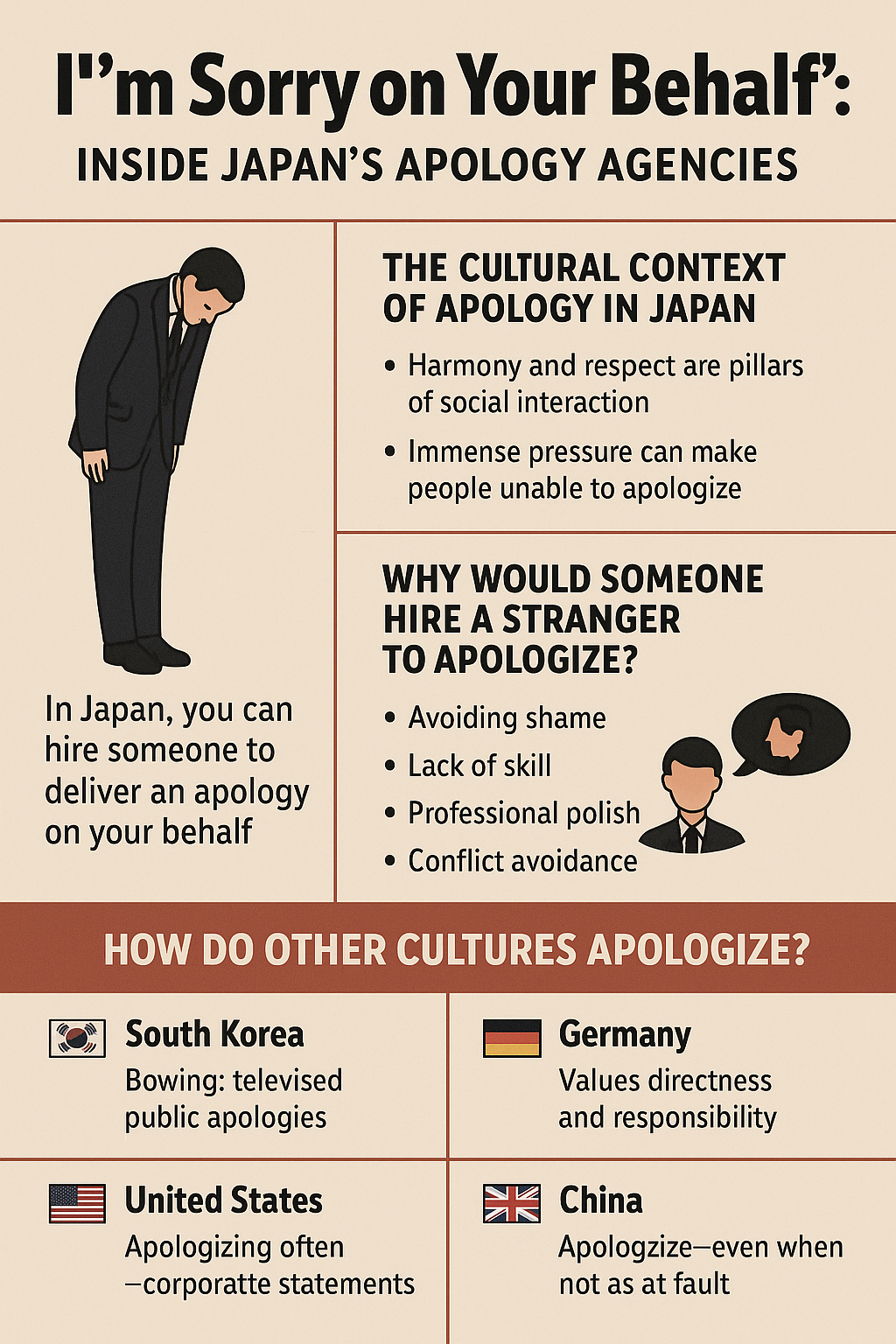
Intro: Imagine hurting someone’s feelings, missing a deadline, or breaking up with someone—and instead of crafting an apology, you hire someone to do it for you. In Japan, that’s not just an intriguing concept, it’s a business. Apology agencies, known as “shazai daikou” (謝罪代行), offer a unique service: they deliver apologies on behalf of clients, whether face-to-face, by phone, or even by letter. But what does this say about social norms, shame, and emotional labor in modern Japan?
1. The Cultural Context of Apology in Japan In Japanese society, harmony and respect are pillars of social interaction. The act of apologizing is not merely about admitting fault—it’s a ritual that restores balance and maintains face. The phrase “sumimasen” (すみません) is used frequently and fluidly to express regret, gratitude, or humility.
This deeply rooted culture of apology can also create immense pressure. People may feel unable to apologize due to shame, fear of confrontation, or simply being overwhelmed. That’s where apology agencies come in.
2. What Do Apology Agencies Do? These agencies act as emotional intermediaries. Services range from formal in-person apologies (complete with bows and suits) to letters that convey remorse with carefully crafted wording. Some even offer crying actors to show the depth of regret. Yes—there are professional apologists who can cry on command.
Situations vary:
A man hiring an agency to apologize to his ex-girlfriend for cheating.
A company using an agency to deliver a public apology to disgruntled customers.
A student who plagiarized an essay and wants someone to apologize to the professor.
3. Why Would Someone Hire a Stranger to Apologize? The reasons are surprisingly relatable:
Avoiding shame: Especially in cases involving deep embarrassment or personal failure.
Lack of skill: Some simply don’t know how to apologize effectively.
Professional polish: A carefully staged apology might carry more weight.
Conflict avoidance: When emotions run high, a neutral third party can prevent escalation.
4. Ethics and Emotional Authenticity But doesn’t this make apologies less sincere? Critics argue that outsourcing regret commodifies a deeply personal emotion. Others see it as a pragmatic solution in a high-context culture where the form can sometimes matter as much as the feeling.
Can a stranger really capture the pain behind an apology? Or is sincerity in Japan more about gesture and effort than raw emotion?
5. What This Tells Us About Modern Life Apology agencies offer a mirror to modern pressures—emotional outsourcing, growing loneliness, and the clash between tradition and efficiency. While it may seem bizarre from a Western perspective, it opens up broader questions about how societies manage conflict, shame, and reconciliation.
6. How Do Other Cultures Apologize? Apology is universal—but how it’s expressed varies dramatically across cultures. While Japan’s apology culture is formal and ritualized, other nations have their own fascinating approaches:
South Korea Much like Japan, apologies in Korea are crucial to social harmony. A sincere bow and the word “joesonghamnida” (조성합니다) are standard. Public apologies from celebrities or corporations are often televised, with kneeling and tears expected.
Germany Germans value directness. Apologies are straightforward, honest, and responsibility-focused. “Es tut mir leid” means “I am sorry,” often paired with an explanation or solution.
United States Americans apologize often—even for things they aren’t responsible for. “Sorry” can mean sympathy more than guilt. Public apologies are frequently shaped by legal concerns.
United Kingdom British people are famously apologetic. “Sorry” is used to maintain politeness, sometimes even when they are not at fault.
China In China, saving face is critical. Apologies may be avoided in public to prevent embarrassment, but gifts or symbolic acts can express remorse effectively.
New Zealand & Maori Culture The Maori concept of muru involves community rituals to restore harmony. Forgiveness is about healing the group, not just the individuals involved.
Rwanda Post-genocide Rwanda used traditional Gacaca courts, where public apologies and reintegration efforts were part of a national healing process.
Final Thought: Every culture has its own rhythm for reconciliation. Whether through a bow, a legal statement, a quiet word, or a community ritual, the essence is the same: restoring human connection. And sometimes, as Japan shows us, even that can be outsourced—but never entirely replaced.
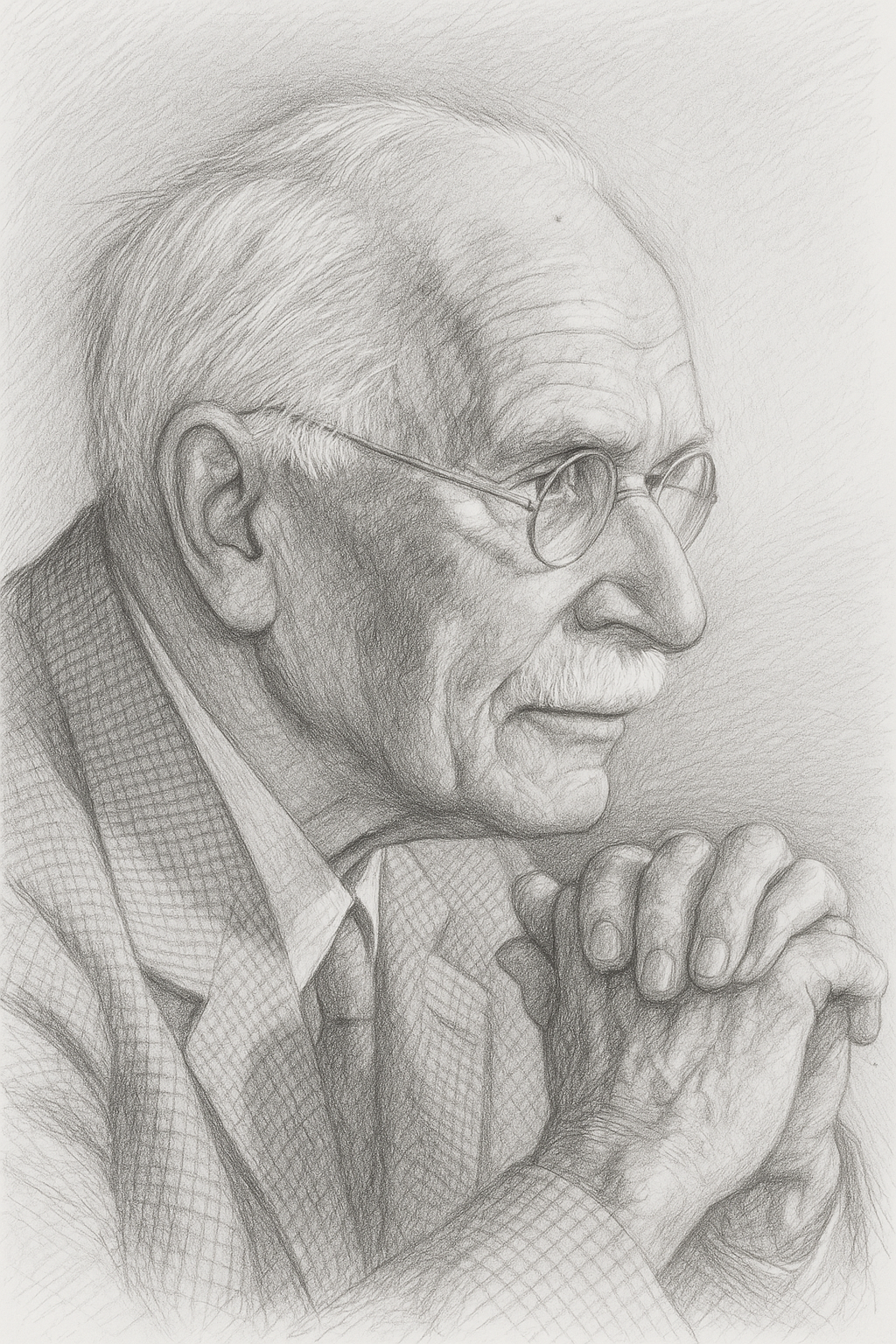
Carl Jung 1957 Restored Interview – Intuition, Individuality & Healing | Part 1
Carl Jung 1957 Restored Interview – The Self, The Unconscious, Psychosomatics & The U.S. | Part 2
1. The Persona: Social Mask vs. True Self
Question: How does Jung define the “Persona”? Answer:
The Persona is a social façade shaped by societal demands and personal compromises (e.g., a doctor’s bedside manner).
It is distinct from the “real personality.” Confusing the two leads to inner conflict and neurosis.
Jung warns that unconscious identification with the Persona creates a “Jekyll and Hyde” duality, causing psychological strain.
2. Ego, Self, and the Collective Unconscious
Question: What differentiates the Ego from the Self? Answer:
Ego: The conscious, empirical self (“I myself”).
Self: The totality of the personality, including unconscious elements. It transcends the Ego and integrates archetypal patterns.
Collective Unconscious: Contains universal archetypes (e.g., the Hero, Anima/Animus) shared across cultures. Jung cites examples like the “snake in the abdomen” dream, linking it to the Kundalini serpent in Eastern philosophy.
3. Introversion, Extroversion, and Psychological Functions
Question: How do introversion/extroversion and the four functions (thinking, feeling, sensation, intuition) shape personality? Answer:
Introverts focus on inner subjective experiences; Extroverts prioritize external stimuli. Most people are a mix.
Four Functions:
Sensation: Perceives reality.
Thinking: Analyzes logically.
Feeling: Evaluates emotional value.
Intuition: Accesses unconscious insights (e.g., predicting a bird’s resurfacing in water).
Intuition types (e.g., gamblers, doctors) rely on “hunches” from subliminal cues.
4. Synchronicity and Rhine’s Experiments
Question: How does synchronicity relate to meaningful coincidences? Answer:
Synchronicity describes non-causal, meaningful connections (e.g., dreaming of a red car before seeing one).
Jung cites J.B. Rhine’s statistical work on ESP as evidence that such phenomena surpass chance.
Critiques reductionist labels like “telepathy,” emphasizing the relativity of time and space through the psyche.
5. Psychic Energy and Critique of Freud
Question: How does Jung’s view of libido differ from Freud’s? Answer:
Freud’s “libido” narrowly centers on sexuality. Jung redefines it as general psychic energy driving all instincts (e.g., creativity, aggression).
Uses the metaphor of water flowing downhill (entropy) to explain energy’s directional flow toward balance.
6. Psychosomatic Medicine and the Mind-Body Link
Question: Can psychological factors cause physical illness? Answer:
Jung highlights cases where repressed emotions manifest as ailments (e.g., tuberculosis from shallow breathing due to unresolved complexes).
Critiques the idea that patients “choose” symptoms; instead, unconscious dynamics happen to them.
Supports research linking stress to ulcers, cancer, and autoimmune diseases.
7. The Mandala and Individuation
Question: What role does the Mandala play in therapy? Answer:
The Mandala (a circle within a square) symbolizes wholeness and the Self.
Appears spontaneously in dreams or art during psychological chaos, offering a compensatory image of order.
Individuation: The lifelong process of integrating conscious and unconscious elements to achieve Self-realization.
8. Historical Insights and Cultural Critique
Key Points:
Nazi Germany: Jung predicted its rise through patients’ archetypal dreams of “heroic saviors” like Hitler.
U.S. Psychology: Criticizes America’s extraverted bias and lag in understanding the unconscious.
Toynbee’s Civilizations: Links historical cycles to archetypal patterns (e.g., the Cold War as a clash of “red vs. white” alchemical symbolism).
9. Projective Tests and the Unconscious
Question: How do tests like Rorschach reveal hidden complexes? Answer:
Word Association Tests: Uncover repressed emotions (e.g., solving a murder via unconscious reactions).
Rorschach: Demonstrates how projections reflect inner conflicts. Jung stresses their didactic value for training psychologists.
10. Final Reflections on Psychology’s Future
Jung laments modern psychology’s neglect of the unconscious and mythic dimensions. He urges integrating historical, cultural, and biological perspectives to grasp the psyche’s full complexity. His parting advice: “The world hangs on a thin thread—the psyche of man.”
Conclusion: This interview underscores Jung’s enduring relevance, bridging individual therapy with universal archetypes. His insights challenge us to explore the depths of the unconscious, both personal and collective, as a path to healing and wholeness.
In 1991, a then 82-year-old Douglas Harding gave a powerful and humorous talk in Melbourne, Australia. Best known as the author of On Having No Head: Zen and the Rediscovery of the Obvious, Harding offered not doctrines or beliefs, but experiments—simple, firsthand inquiries that help individuals directly perceive their true nature.
His central premise? You are not what you look like.
Two Worlds: The As-Is vs. The As-If
Harding’s life work revolves around distinguishing between two realities:
The As-Is World: the world as directly experienced, immediate, unmediated, “woven of blessings”.
The As-If World: the socially constructed world shaped by language, convention, and external validation.
Most people, he says, live and die entirely within the “as-if” world—believing they are who others say they are, seeing themselves through the eyes of mirrors, photographs, and social roles. But through “headless” experiments, we can return to the as-is world, seeing the world not through thought or belief, but through direct observation.
“On Having No Head”: Seeing from Zero Distance
In his hallmark experiment, Harding invites us to look at what we’re looking out of. Do we really see two eyes in a face when we observe the world? Or do we see a seamless, frameless field of vision? Inwardly, we discover not a head, but an open, spacious awareness.
“What you look like to others, you are not. What you look out of, is who you really are.”
In a playful but profound way, Harding suggests we are transparent, spacious, awake capacity for the world.
The Experiments: First-Person Science
Throughout the talk, Harding insists we don’t believe him. Instead, we must test his claims through direct inquiry.
Examples include:
Pointing experiments: Point at your feet, then your chest, then your face—what do you see? At your feet and chest, you see something. When you point to your own face, from your own perspective, what do you see? Nothing but space—awareness.
Mirror experiments: The person in the mirror is a reflection, a role, a mask. But the viewer—the experiencer—is not a thing at all.
These are not mystical claims, he asserts—they are literal, physical, and present.
Theological Echoes: Mysticism Without the Myths
Harding connects his discoveries with the core mystical insights at the heart of the world’s great religions:
Christian mysticism speaks of “Christ in you, the hope of glory.”
The Upanishads declare “Tat Tvam Asi”—you are That.
Islamic Sufism claims, “He is closer to you than your jugular vein.”
Harding calls this the most shocking and radical claim of all—that our true identity is not a product of the world, but its origin. “The One you really are,” he says, “is nearer than near, and is eternal.”
Practical Implications: Love, Energy, and Trust
This isn’t just philosophy. Harding argues that seeing through the illusion of separation has real-life consequences:
Love becomes possible: True love isn’t confrontation between egos, but spacious presence meeting spacious presence.
Energy increases: Maintaining a false self-image is exhausting. Seeing through it, we reclaim vitality.
Inner peace: The “meatball” of the head is the source of stress. The headless reality is open, still, peaceful.
“We are not facing each other—we are space for each other.”
Harding’s friend Chris, present at the talk, echoes this: “There is no distance. There is no separation. And it frightens me. But it’s true.”
Who Was Douglas Harding?
Born in 1909 in Suffolk, England, Harding was raised in a strict Christian sect. In his 20s, he left that tradition and began a lifelong philosophical and spiritual quest. Trained as an architect, he later taught comparative religion at Cambridge, and wrote several books and gave workshops across Europe, Asia, and the United States.
Harding’s teachings didn’t die with him in 2007. His work lives on through an international community of “headless” explorers and teachers. Some key figures include:
Richard Lang – A close friend and collaborator of Harding’s, who continues to lead workshops and maintain the Headless Way website.
Rupert Spira – Though not a direct student, his non-dual teachings on awareness as our true identity echo Harding’s insights.
Tony Parsons – His uncompromising view of non-duality aligns with Harding’s view of the illusory personal self.
Sam Harris – While from a secular, neuroscientific background, his guided meditations often lead people to a similar realization of headlessness.
Conclusion: The One and Only Authority
Harding’s message is both radical and humble. He doesn’t claim to be a guru. He insists you don’t believe him. He simply invites you to look for yourself.
“You are the sole and final authority on what it’s like to be you.”
To Douglas Harding, spirituality isn’t about seeking a new self. It’s about seeing what’s always been here—this vast, open, empty presence.
A presence with no head. A presence that can never perish. A presence that is love itself.
The following article distills a profound conversation with Carl Jung, focusing on his exploration of intuition, its mechanisms, and its manifestations in human behavior. Jung’s insights are illustrated through vivid anecdotes, theoretical distinctions, and connections to broader psychological and scientific inquiries.
1. Defining Intuition: Perception via the Unconscious
Subject: The nature and definition of intuition. Jung’s Explanation: Intuition, according to Jung, is a form of perception mediated by the unconscious. Unlike sensory perception, which relies on direct observation, intuition operates through “intermediate links”—subtle, unconscious associations that yield insights without conscious reasoning. Jung likened it to a “chain of associations” where only the final result surfaces in awareness.
“Intuition is a perception by ways or means of the unconscious. That is as near as I can get.”
Real-Life Example: Jung recounted a story of two patients—a sensation-type man and an intuitive-type woman—who competed to spot diving birds on Lake Zurich. Despite the man’s attention to sensory details, the woman consistently predicted the birds’ resurfacing points through hunches, demonstrating intuition’s uncanny accuracy.
2. Intuitive Types: Extroverted vs. Introverted
Subject: Differences between intuitive-extroverts and intuitive-introverts. Key Questions:
How do intuitive-extroverts differ from intuitive-introverts?
What are their real-world manifestations?
Jung’s Answers:
Intuitive-Extroverts: These individuals focus on external possibilities. Examples include bankers, gamblers, and hunters who rely on hunches to navigate tangible opportunities or risks.
Intuitive-Introverts: They perceive “subjective factors” or inner psychic realities. Their insights often involve symbolic or archetypal imagery but are harder to articulate. Jung shared the case of a young woman who envisioned a “golden snake” emerging from her body during therapy—a metaphor for her psychological transformation.
“The introverted intuitive has a very difficult life… [their experiences] are utterly strange to the ordinary individual.”
3. Intuition in Modern and Primitive Contexts
Subject: The role of intuition across environments. Jung’s Observations:
Primitive Settings: In unpredictable environments (e.g., uncharted forests), intuition becomes vital for survival. Hunches about favorable locations or unseen dangers guide decisions.
Modern Life: Even in “safe” urban settings, intuition persists. For example, drivers might sense impending accidents through subliminal cues (e.g., patterns of pedestrian behavior).
Case Study: Jung described a woman who unknowingly lived in a brothel yet remained oblivious to her surroundings. While she lacked sensory awareness, her intuitive hunches about her therapy’s timeline (e.g., predicting 10 sessions) proved eerily accurate.
4. Intuition and Science: Clashing Perspectives
Subject: The tension between intuition and empirical science. Key Questions:
How do statistical methods (e.g., Rhine’s experiments) validate intuitive phenomena?
Jung’s Stance: Jung acknowledged overlaps between intuition and extrasensory perception (ESP), noting that Rhine’s statistical work demonstrated phenomena “beyond chance.” However, he criticized terms like “telepathy” as meaningless labels, emphasizing the need to view intuition as a relativization of time and space through the psyche.
“Rhine proves [intuition] is statistically graspable… a relativation of time and space through the psyche. That’s the fact.”
5. Practical Implications of Intuition
Subject: Intuition’s value in professions and daily life. Jung’s Examples:
Doctors: Intuition aids in diagnosing hidden complications.
Financial Experts: Bankers and investors rely on hunches to navigate volatile markets.
Everyday Decisions: Subtle warnings (e.g., unease while driving) prevent mishaps.
Takeaway: While modern society undervalues intuition compared to sensory data, Jung argued that it remains a critical adaptive tool, particularly in professions requiring foresight.
Conclusion: Embracing the “Unseen”
Jung’s dialogue underscores intuition as a bridge between conscious reasoning and unconscious wisdom. Whether through a gambler’s hunch, a doctor’s gut feeling, or an introvert’s inner vision, intuition transcends logic, offering insights that shape human survival and creativity. As Jung concluded, dismissing intuition risks ignoring a fundamental dimension of the psyche—one that science is only beginning to quantify.
“The psychologist should know of such things. You see?”
Integrating movement into daily life, especially through the lens of Gestalt therapy and body awareness, can help individuals reconnect with their physical selves, process emotions, and shift out of trauma-related “freeze” states (as described by Bessel van der Kolk). Here’s a structured approach:
1. Integrate Movement into Daily Routines
Micro-movements: Start small. Stretch while waiting for coffee, shift your weight while standing, or roll your shoulders during work breaks. These subtle actions disrupt stagnation and signal safety to the nervous system.
Mindful transitions: Use routine moments (e.g., walking to the bathroom, climbing stairs) to notice bodily sensations—the pressure of your feet on the ground, the rhythm of your breath.
Embodied rituals: Pair activities with movement, like a morning “body wake-up” (stretching arms overhead, shaking out limbs) or an evening wind-down (gentle yoga or swaying).
2. Gestalt Therapy & Body Awareness
Gestalt emphasizes present-moment awareness and the mind-body connection. Practices include:
Body scanning: Pause to notice physical sensations without judgment. Ask: “What do I feel in my body right now? Where is tension or ease?”
Grounding exercises: Stand barefoot, feel the floor, and rock gently side-to-side. Verbally acknowledge sensations: “I feel my feet rooted; my breath is slow.”
Amplification: If you notice a gesture (e.g., clenched fists), exaggerate it slightly to explore the emotion behind it. “What does this movement want to express?”
Empty chair technique: Physically move while dialoguing with an emotion or person (e.g., stand to express anger, sit to receive compassion).
Tap or rub your arms/legs to reignite proprioception.
Hold a warm mug, feel textures, or splash cold water on your face.
Breath-led movement:
Inhale while raising your arms, exhale as you lower them. Sync breath with motion to bridge mind and body.
Try “sigh and shake”: Exhale deeply with a sigh, then gently shake out limbs (releases tension).
Rhythmic motion:
Rock in a chair, sway to music, or walk rhythmically. Repetition calms the nervous system.
Playful movement:
Dance, skip, or jump—activities that bypass the “thinking brain” and spark spontaneity.
4. Practical Steps for Integration
Trauma-informed practices: Yoga, Tai Chi, or Qigong combine mindful movement with breathwork, fostering safety and embodiment.
Journaling: After movement, write down sensations, emotions, or images that arose. Gestalt encourages “owning” fragmented experiences.
Community & creativity: Join a dance class, hike with others, or engage in expressive arts (e.g., clay work, drumming) to reconnect socially and somatically.
Professional support: Therapies like Somatic Experiencing or Sensorimotor Psychotherapy directly address freeze states with guided body awareness.
Key Gestalt Principle: “Here and Now”
Movement becomes healing when paired with curiosity about the present moment. Instead of forcing change, ask:
“What is my body needing to move toward (or away from) right now?”
“How can I honor this sensation without judgment?”
By merging movement with mindful body awareness, you cultivate agency, safety, and aliveness—countering the dissociation of freeze. Start gently, celebrate small shifts, and prioritize self-compassion.
This topic originated from a note I wrote to myself based on a sentence I encountered in an exhibition during my visit to the Rijksmuseum in February. I find museum visits deeply inspiring, and as I explore exhibitions, I learn many things while countless questions arise in my mind…
Imagine a simple clay cup. In a bustling café, it is a disposable vessel, hastily discarded after use. Yet, in the tranquil setting of a Japanese tea ceremony, a similar cup becomes a revered artifact, embodying centuries of tradition and philosophy. This dichotomy illustrates a profound truth: the environment—whether natural, cultural, or social—shapes the meaning of objects in ways that transcend their physical form. This essay explores how environmental contexts across the globe redefine the significance of objects, weaving together examples from Japan, the Netherlands, India, and Indigenous Australia. By examining these diverse narratives, we uncover the dynamic interplay between place and perception, ultimately prompting reflection on how environmental changes might reshape our world’s material legacy.
I. Japan: The Tea Ceremony Bowl and the Aesthetics of Nature In Japan, the chawan (tea bowl) is not merely a utensil but a bridge between humanity and nature. Rooted in Zen Buddhism and wabi-sabi—an aesthetic valuing imperfection and transience—the tea ceremony transforms the bowl into a spiritual medium. The Japanese archipelago, with its volcanic soil and seasonal extremes, has long inspired reverence for nature’s fleeting beauty. Artisans craft chawan with irregular shapes and earthy glazes, mirroring the asymmetry of landscapes shaped by earthquakes and monsoons. During ceremonies, participants contemplate the bowl’s imperfections as metaphors for life’s ephemerality. Here, the natural environment directly informs the object’s symbolism, turning a mundane vessel into a vessel of philosophical contemplation.
Question to Ponder: How might urbanization and climate change alter traditional crafts tied to natural cycles?
II. The Netherlands: Tulips and the Engineered Landscape The Dutch tulip, now a global symbol of beauty, owes its fame to an environment literally carved from water. The Netherlands’ low-lying geography necessitated dikes and windmills, creating fertile polders where tulips thrived. In the 17th century, tulip mania saw bulbs traded as luxury commodities, reflecting both the country’s maritime economy and its mastery over nature. Today, tulips symbolize national pride and ecological innovation, with greenhouses enabling year-round cultivation. The flower’s meaning evolved from a speculative asset to an icon of resilience, demonstrating how human-engineered environments can redefine an object’s cultural and economic value.
Question to Ponder: Can technological adaptation dilute an object’s historical significance, or does it create new layers of meaning?
III. India: The Ganges River and Sacred Offerings In Varanasi, clay diyas (lamps) and flower garlands tossed into the Ganges are imbued with divine purpose. The river, considered a goddess in Hinduism, transforms these objects into acts of devotion. Pilgrims believe the Ganges’ sacred waters purify sins, making offerings a conduit for spiritual liberation. Yet, environmental pollution complicates this narrative: plastic waste now mingles with ritual items, sparking debates about ecological responsibility. The Ganges’ dual role as a holy site and a polluted waterway highlights how environmental degradation can destabilize an object’s traditional meaning, forcing societies to reconcile reverence with sustainability.
Question to Ponder: Can an object retain its sacredness if its environment is irrevocably altered?
IV. Indigenous Australia: The Boomerang and the Land For Indigenous Australians, the boomerang is both tool and storyteller. Crafted from hardy acacia wood, its curved design adapts to arid climates, enabling hunting and navigation. Yet, its significance extends beyond utility: intricate carvings map ancestral lands, encoding Dreamtime stories. The boomerang’s return flight symbolizes the enduring connection between people and Country—a term encompassing land, spirituality, and identity. When displaced from its environment, the boomerang becomes a souvenir, stripped of its cultural depth. This contrast underscores how environmental rootedness is essential to preserving an object’s authenticity.
Question to Ponder: How does dispossession from land affect the transmission of cultural knowledge through objects?
Conclusion From the Zen gardens of Kyoto to the watery polders of the Netherlands, environments act as silent collaborators in the storytelling of objects. They shape utility, infuse symbolism, and even dictate obsolescence. As climate change and globalization accelerate, the meanings we ascribe to objects will inevitably shift—raising a provocative final question: In a world of increasing environmental flux, how might future societies reinterpret the objects we hold sacred today?
This essay structure balances cultural diversity with thematic coherence, encouraging readers to reflect on the mutable relationship between place and meaning. Each section links environment to object, culminating in an open-ended inquiry that invites further exploration.
In Gestalt therapy, developed by Fritz Perls in the mid-20th century, the emphasis lies in cultivating awareness in the present moment — the “here and now” — as a gateway to authentic living. It is within this framework that the subtle but significant differences between answering and reacting, or receiving and taking, begin to unfold.
At the core of Gestalt thought is the idea that most of our suffering comes not from what happens to us, but from how we respond — often unconsciously. A reaction is automatic, a patterned behavior rooted in past experiences, emotional conditioning, or unresolved conflicts. It is what emerges when we are not fully present. We react when a tone of voice reminds us of a parent’s disapproval, when a question triggers our self-doubt, or when a challenge awakens an old fear.
Answering, on the other hand, is a deliberate, grounded choice that arises when we are aware of our experience in real-time. It reflects maturity, presence, and ownership. The Gestalt therapist doesn’t just ask “What do you feel?” but “What do you notice about what you’re feeling?” Through that inquiry, we learn to stay with discomfort, to observe it, and then — when we’re ready — to choose a response that is aligned with who we truly are, rather than who we were conditioned to be.
As Gestalt therapist Dan Bloom puts it:
“In Gestalt therapy, awareness is the medium through which the individual experiences their wholeness. To answer, rather than react, is to reclaim agency.”
This distinction is mirrored in how we approach the concept of receiving versus taking. In the Gestalt view, receiving is a fluid, co-created process. It acknowledges the relationship between self and other, between self and environment. It allows us to be impacted, to digest, to integrate. When a compliment is received, it lands. When beauty is received, it changes us.
Taking, however, can be a form of control. It often implies force, entitlement, or preconception. We “take” when we operate out of scarcity, fear, or a need to dominate the moment — often bypassing the vulnerability required to truly receive.
Gestalt therapists often guide clients through experiments that explore this very dynamic. A client might be asked to reach for something and then receive it from another’s hands. The subtle shifts in posture, breath, and internal resistance reveal a lifetime’s worth of habits about control, openness, trust, and contact. This somatic wisdom — the language of the body — becomes the site of change.
The Gestalt concept of the contact boundary is also central here. It’s the invisible threshold where we meet the world — and where the world meets us. Healthy contact means knowing when to move forward, when to withdraw, when to open, and when to assert. If we’re reacting, we might burst through the boundary or collapse into passivity. If we’re answering, we are aware — and thus, free to choose how we meet life.
Fritz Perls once famously said:
“Lose your mind and come to your senses.”
It’s an invitation — to pause, to breathe, to feel — before acting. In a world that prizes speed, this is radical.
Receiving vs. Taking: Insights from Sufism
Sufism, the mystical branch of Islam, offers profound insights into the concepts of receiving and taking. Sufis perceive the universe as a manifestation of divine love, where every element reflects the presence of the Divine. In this context, receiving is an act of openness and surrender to the divine flow, embracing what is given with gratitude and humility. Taking, conversely, implies a forceful acquisition, potentially disrupting the harmony between the self and the cosmos .
The practice of Samāʿ, a Sufi ritual involving music and movement, exemplifies the art of receiving. Through this practice, Sufis aim to transcend the ego and attune themselves to the divine rhythm, allowing spiritual truths to be received rather than seized .
Humanism: Embracing Responsibility in a Finite Universe
Humanism, grounded in reason and ethics, emphasizes the importance of conscious choice in responding to the universe. Without reliance on supernatural beliefs, humanists advocate for leading ethical lives that contribute to the greater good. This philosophy encourages individuals to receive life’s experiences with reflection and to take actions that are informed by empathy and responsibility
In the humanist view, the universe is understood through scientific inquiry, and meaning is derived from human connections and achievements. By consciously choosing to engage with the world in a thoughtful manner, individuals can create purposeful lives that resonate with their values .
Buddhism: Mindful Engagement with the Universe
Buddhism teaches that the universe is in a constant state of flux, governed by the law of impermanence. Rather than reacting impulsively, Buddhists practice mindfulness to observe experiences without attachment or aversion. This mindful awareness allows for a receptive state of being, where one can receive life’s moments with equanimity and respond with compassion .
The concept of dependent origination in Buddhism illustrates how phenomena arise interdependently. Understanding this interconnectedness fosters a sense of responsibility in one’s actions, encouraging responses that contribute to the well-being of all beings.
Taoism: Harmonizing with the Tao
Taoism emphasizes living in harmony with the Tao, the fundamental principle that underlies the universe. This philosophy advocates for wu wei, or effortless action, where one aligns with the natural flow rather than exerting force. In this context, receiving involves openness to the Tao’s guidance, while taking suggests resistance to its course .
By attuning to the Tao, individuals can respond to life’s circumstances with grace and adaptability. This harmonious engagement fosters balance and tranquility, allowing one to navigate the complexities of existence with ease .
A Reflective Inquiry
In contemplating these diverse perspectives, consider:
“Am I engaging with the universe through conscious answers or unconscious reactions? Do I receive life’s offerings with openness, or do I take them with resistance?”
Reflecting on these questions may illuminate the path toward a more intentional and harmonious existence.
Ameliyat sonrası hıçkırıklar şaşırtıcı derecede yaygın olabilir, özellikle karın, göğüs bölgesiyle ilgili ameliyatlar ya da genel anestezi uygulanmışsa. Genellikle zararsızdır ama iyileşme sürecinde oldukça rahatsız edici ve hatta ağrılı olabilir.
🔍 Ameliyat Sonrası Hıçkırık Neden Olur?
Anestezi yan etkileri (özellikle genel anestezi)
Diyaframı kontrol eden frenik veya vagus sinirlerinin tahrişi
Mide şişkinliği (ameliyat sırasında yutulan hava nedeniyle)
Bazı ilaçlar (örneğin steroidler ya da ağrı kesiciler)
Elektrolit dengesizlikleri
✅ Hastanın Yapabileceği Şeyler:
🧘♂️ Nefes Egzersizleri:
Yavaş ve derin nefes alma: Burnunuzdan 4 saniyede nefes alın, 7 saniye tutun, ağzınızdan 8 saniyede verin.
Nefes tutma: Derin bir nefes alıp mümkün olduğunca uzun süre tutun, sonra yavaşça bırakın.
Kağıt torba yöntemi(kalp veya akciğer problemi yoksa): Kısa bir süre boyunca yavaşça bir kağıt torbaya nefes alıp verin. Bu, kandaki CO₂ seviyesini artırarak spazmı durdurabilir.
🧊 Fiziksel Yöntemler:
Yavaşça buz gibi su yudumlamak
Buzlu suyla gargara yapmak
1 çay kaşığı şeker ya da bal yutmak
Dizleri hafifçe göğse çekmek (mümkünse, diyaframı yeniden düzenleyebilir)
🧠 Vagus Sinirini Uyarma Yöntemleri:
Soğuk su içmek veya yutmak
Diyafram üzerine hafif baskı uygulamak (doktor önerisiyle)
Hafif öksürmek ya da boğazın arka kısmını hafifçe uyarmak (pamuklu çubukla gibi)
💊 Tıbbi Çözümler (Eğer Hıçkırık Geçmezse):
Eğer hıçkırık 48 saatten uzun sürerse ya da iyileşmeyi engelliyorsa doktor şu ilaçları düşünebilir:
Klorpromazin (inatçı hıçkırıklar için en sık kullanılan ilaç)
Metoklopramid
Baklofen
Gabapentin (sinir kaynaklı nedenler için)
Bu ilaçlar reçetelidir, mutlaka doktorla görüşülmelidir.
The witness position is not just a therapeutic technique—it’s a way of being. These tools, inspired by Gestalt Therapy, mindfulness, and phenomenology, help you observe your inner and outer worlds with curiosity, clarity, and compassion. Integrate them into daily routines to foster resilience, self-awareness, and healthier relationships.
1. The Pause-and-Breathe Check-In
Purpose: Interrupt automatic reactions. How to Use:
When triggered (e.g., an argument, a stressful email), pause and take 3 intentional breaths.
Ask: “What am I feeling in my body right now? What story am I telling myself?”
Example: Before snapping at a coworker, you notice your jaw clenching and think, “I’m interpreting their tone as disrespectful. Is that true?”
2. The “Third Chair” Visualization
Purpose: Gain perspective on conflicts. How to Use:
Imagine a third chair in the room where an impartial “wise observer” sits.
Mentally step into this chair and ask: “What does this situation look like from here?”
Example: During a family dispute, the “observer” notices: “Everyone is speaking from fear, not malice.”
3. Sensory Grounding for Overwhelm
Purpose: Anchor in the present moment. How to Use:
Name 5 things you see, 4 things you hear, 3 things you feel, 2 things you smell, 1 thing you taste.
Example: Stuck in traffic, you note: “Red taillights, honking horns, seatbelt pressure, coffee smell, mint gum.” This disrupts rumination.
4. The “Journal of Noticing”
Purpose: Track patterns without judgment. How to Use:
Keep a daily log with two columns:
Observed: “My partner didn’t text back.”
Story: “They don’t care about me.”
Reflect weekly: “How often is my ‘story’ accurate? What else might be true?”
5. Body Scan at Thresholds
Purpose: Tune into embodied wisdom. How to Use:
Pause at physical thresholds (doorways, elevators, car doors) to scan your body.
Ask: “Where am I holding tension? What emotion is here?”
Example: Before entering a meeting, you notice a knot in your stomach—“Ah, I’m anxious about being judged.”
6. The “And” Practice
Purpose: Hold complexity without polarization. How to Use:
Replace “but” with “and” when describing conflicting feelings.
Example: “I’m angry at my friend AND I love them.” This builds tolerance for ambiguity.
7. Role-Reversal Mirror
Purpose: Empathize with others’ perspectives. How to Use:
In conflicts, mentally swap places with the other person. Ask: “What might they be feeling? What unmet need drives their behavior?”
Example: A rude cashier → “Maybe they’re exhausted from a double shift.”
8. The “Clouds in the Sky” Metaphor
Purpose: Detach from intrusive thoughts. How to Use:
Visualize thoughts/emotions as clouds passing by. Label them: “There’s the ‘I’m not good enough’ cloud.”
Whisper: “This too shall pass.”
9. The 24-Hour Witness Delay
Purpose: Avoid impulsive decisions. How to Use:
When facing a big decision, commit to 24 hours of “witnessing” before acting.
Journal: “What fears or desires are driving me? What would my calmest self do?”
10. Gratitude-as-Witnessing
Purpose: Counter negativity bias. How to Use:
Each night, name 3 specific moments you witnessed without judgment.
Example: “I noticed the sunset without rushing. I observed my envy without shaming myself.”
Bonus: The “Witness Partner”
Pair with a friend for weekly check-ins. Share observations without advice or judgment. End with: “I witness you.”
Gestalt Theory: By observing how we experience life—not just what we experience—we reclaim agency.
Final Note: The witness position is a muscle. Start small: pick one tool for a week. Over time, you’ll naturally respond to life’s chaos with curiosity instead of chaos.
Gestalt Therapy, born in the mid-20th century from the minds of Fritz Perls, Laura Perls, and Paul Goodman, is a dynamic and experiential approach to psychotherapy. Rooted in existential philosophy, phenomenology, and Eastern mindfulness traditions, it emphasizes awareness, contact, and responsibility in the here-and-now. Unlike therapies that dwell on the past or dissect the unconscious, Gestalt focuses on the totality of human experience—how we think, feel, and act in the present moment. At its core is the belief that healing arises when individuals fully engage with their lived reality, integrating fragmented parts of themselves into a cohesive whole.
Among its many innovative concepts, the witness position stands out as a transformative tool. This essay explores the witness position—what it is, where it comes from, and how it can revolutionize not only therapy but also relationships, workplaces, and everyday life.
Part 1: What Is the Witness Position?
The witness position is a state of mindful observation where individuals step back from their immediate reactions to observe themselves, others, and situations with curiosity and detachment. It’s akin to watching a play from the balcony rather than being swept up in the drama onstage. In Gestalt terms, this “meta-awareness” allows people to:
Notice patterns (e.g., “I always shut down when criticized”).
Therapists often guide clients into this position by asking, “What are you aware of right now?” or “Can you describe your feelings as if you’re an observer?” By doing so, clients gain clarity without judgment, creating space for growth.
Part 2: Philosophical and Cultural Inspirations
Gestalt’s witness position is a tapestry woven from diverse traditions:
Existentialism: Thinkers like Martin Buber and Søren Kierkegaard emphasized presence and authentic encounter. Buber’s “I-Thou” relationship—a meeting of whole beings—mirrors the witness’s non-objectifying gaze.
Buddhism: The concept of Sakshi (witness consciousness) in Hindu and Buddhist practices teaches detachment from ego-driven thoughts. Similarly, mindfulness meditation trains individuals to observe sensations without clinging.
Phenomenology: Edmund Husserl’s call to “return to the things themselves” urged suspension of assumptions (epoché), a precursor to the witness’s non-judgmental stance.
Fritz Perls, influenced by Zen and theater, famously said, “Awareness itself is curative.” The witness position embodies this idea.
Part 3: The Therapeutic Power of Witnessing
In therapy, the witness position helps clients:
Break cycles of shame: A client who witnesses their self-criticism (“I hear how harsh I sound”) softens their inner dialogue.
Integrate polarities: By observing conflicting emotions (e.g., love and resentment toward a parent), clients move toward wholeness.
Enhance self-support: Instead of seeking external validation, they cultivate inner resilience.
Case studies illustrate this: A trauma survivor, guided to witness her flashbacks as “past movies,” reduces their emotional charge. A couple learns to observe their arguments without blame, fostering empathy.
Part 4: The Witness in Daily Life
Family Dynamics
Parents often react impulsively to children’s tantrums. The witness position invites them to pause and ask: “What’s my child needing beneath this behavior?” A mother might realize her son’s outburst stems from overwhelm, not defiance, shifting her response from punishment to connection.
Workplace Interactions
In business, leaders who witness their stress during negotiations make calmer decisions. Teams practicing “witnessing” meetings—where one member observes group dynamics—spot unspoken tensions and foster inclusivity.
Conflict Resolution
A partner who witnesses their jealousy (“I notice I’m feeling threatened”) can communicate vulnerably instead of accusing. This disrupts the “blame game” and deepens intimacy.
Part 5: Voices Across Disciplines
Gestalt Practitioners: Psychologist Peter Philippson calls witnessing “the art of being fully present without absorption.”
Neuroscience: Research on mindfulness (e.g., Jon Kabat-Zinn’s MBSR) shows that observational practices reduce amygdala reactivity, enhancing emotional regulation.
Leadership Coaching: Consultants like Brené Brown advocate “rumbling with vulnerability,” a concept aligned with witnessing one’s fears.
Critics argue excessive detachment risks emotional disengagement. Yet Gestalt balances witnessing with active experimentation—awareness followed by action.
Conclusion: The Ripple Effect of Witnessing
The witness position is more than a therapeutic technique; it’s a way of being. By cultivating this stance, we transform not only ourselves but also our relationships and communities. It asks: Can we meet life’s chaos with curiosity rather than fear?
Final Inspirational Question: What might shift in your life if you paused today—just once—to witness your thoughts, feelings, and interactions as if they were clouds passing in the sky?
“Var olmak, ilişkide olmaktır” der Gestalt terapisti—bu sadece şiirsel bir ifade değil, varoluşun temel bir ilkesidir. Bizler soyut birer varlık değil, sürekli oluş halinde olan, içinde bulunduğumuz ilişkiler ağı tarafından şekillenen süreçleriz. Bu blog yazısı, şu derin ve karmaşık soruyu keşfetmektedir:
Gerçekten ilişki olmadan var olabilir miyiz?
Kendimizi ilişkide gözlemlemek ne anlama gelir ve bu gözlem, kendimizi, başkalarını ve dünyayı algılayışımızı nasıl etkiler? Gestalt terapisi, varoluşçu felsefe ve J. Krishnamurti gibi düşünürlerin içgörüleriyle, insan deneyiminin içsel yönlerini ve benliğin birlikte varoluş dokusunda nasıl şekillendiğini inceleyeceğiz.
I. Gestalt Perspektifi: Varlığın Temeli Olarak İlişki
Gestalt terapisi, Fritz Perls, Laura Perls ve Paul Goodman tarafından geliştirilmiş olup, odak noktası ne olduğumuz değil, nasıl olduğumuzdur. Sabit, durağan bir benlik kavramını reddeder ve deneyimin an be an farkındalığına vurgu yapar. Bu yaklaşımda, temas kavramı merkezi bir öneme sahiptir—benlik ve diğerinin buluştuğu sınır, farkındalığın ortaya çıktığı ve değişimin mümkün olduğu yerdir.
Gestalt terapisinde benlik, bir nesne değil, bir süreçtir: organizma ve çevre arasındaki sınır düzenlemesinin sürekli, ortaya çıkan işlevi. Biz sadece temasta kendimiz oluruz. Dolayısıyla, kendini gözlemlemek, yalnızca içe bakmak değil, başkalarıyla, dünyayla, zamanla, kendi düşünce ve duygularımızla nasıl ilişkide olduğumuzun farkına varmaktır.
“Farkındalık, kendi başına iyileştiricidir.” — Fritz Perls
Kendini ilişkide gözlemlemek, nasıl tepki verdiğimizi, kaçındığımızı, bağ kurduğumuzu, yansıttığımızı ve geri çekildiğimizi fark etmektir. Bir duruma yöneliyor muyuz? Çatışmadan mı kaçınıyoruz? Onay mı arıyoruz? Anı mı manipüle ediyoruz? Bunların hepsi, kim olduğumuzu şekillendiren ilişkisel stratejilerdir.
II. Ne Zaman Var Oluruz? Şimdi, İlişkisel Bir Olay Olarak
Gestalt perspektifine göre, biz şimdiki anda var oluruz—yalnızca zamanın izole bir birimi olarak değil, temasın gerçekleştiği yer olarak. Şimdi, potansiyelin gerçeğe dönüştüğü yerdir. Geçmiş, yalnızca şimdide yeniden deneyimlendiğinde önemlidir; gelecek ise yalnızca şimdi nasıl beklendiğiyle ilgilidir.
Bir kafede karşısında sessizce oturan bir yabancıyla oturan bir kişiyi düşünün. Yüzeyde, temas yok gibi görünebilir. Ancak içsel olarak, hikayeler oluşuyor, yansıtma gerçekleşiyor, merak uyanıyor olabilir. Belki rahatsızlık hissediyoruz, göz teması kurma isteği, görülme direnci. Bunların hepsi ilişkidir. Yabancı, bir ayna, bir ekran, bir katalizör haline gelir.
Bu anlamda, yalnızlıkta bile, anılar, hayaller, beklentiler, korkular ve ideallerle ilişkideyiz. Bu içsel fenomenlerle nasıl ilişki kurduğumuzda var oluruz. Gestalt terapisti, bu dinamikleri farkındalığa getirmemizi teşvik eder, onları düzeltmek için değil, daha tam olarak yaşamak için.
III. Soyutlamanın Tehlikesi: İlişki Dışında Var Olabilir miyiz?
Hindistanlı filozof Krishnamurti, insanları net görmeye davet eden yaşamı boyunca, soyutlamanın sorununa sıkça dikkat çekmiştir. Kendimizi, başkalarını, başarıyı, sevgiyi, ahlakı kavramlar içinde yaşadığımızda, olanla doğrudan temas kuramayız.
“Sözcük şey değildir. Tanım, tanımlanan değildir.” — J. Krishnamurti
Soyutlamak, deneyimden uzaklaşmaktır. İlişkinin zenginliğini bir etikete, bir hikayeye, bir inanca indirgemektir. Gestalt terimleriyle, soyutlama bir tür geri çekilmedir, temasın doğrudanlığından kaçıştır.
Soyutlamada var olabilir miyiz? Yalnızca bir fikir olarak. Ama yaşayan, nefes alan, farkında varlıklar olarak değil. Gerçekten var olmak, katılmak, hissetmek, dünyayla taze bir şekilde karşılaşmaktır, ön yargı perdesi olmadan. Soyutlama, sistemleri, kalıpları ve fikirleri anlamamıza yardımcı olabilir—ancak doğrudan deneyimin yerine geçemez.
IV. Gözlemleyeni Gözlemlemek: Kim İzliyor?
Kendini gözlemleme eylemi, derin bir soruyu gündeme getirir: gözlemleyen kimdir? Gestalt terapisinde, farkındalık sürekliliği ile çalışırız, farkındalığımızda neyin figür (ön planda) ve neyin zemin (arka planda) olduğunu fark etme süreci. Düşünceleri, duyumları, duyguları, davranışları gözlemleriz—ancak gözlemin arkasında sabit bir ‘benlik’ üzerine odaklanmayız.
Krishnamurti tekrar içgörü sunar: “Gözlemleyen, gözlemlenendir.” Bu radikal ifade, ikilik illüzyonunu yıkar. Yargılayan zihin, yargıladığından ayrı değildir. Gözlemlendiğinde öfkemiz bizden ayrı değildir—o biziz. Kendimizi nesnel olarak analiz edebileceğimiz saf bir bakış açısı yoktur. Gözlem, ayrılık değil, bütünleşme eylemi haline gelir.
Gestalt terimleriyle, bu bütünlük ilkesine uygundur. Kendimizi özne ve nesne olarak ayıramayız, aksi takdirde anın birliğini kaybederiz. Kendini ilişkide gözlemlemek, her gözlemin daha
V. Farkındalığın Sınırlarında: Temas, Kaçınma ve Otantiklik
Kendimizi gözlemlemek aynı zamanda nelerden kaçtığımızı da görmektir. Gestalt terapisi, kişilerin “temas sınırında” nasıl davrandığını inceler. Temas sınırı, organizma ile çevre arasındaki sınırdır — yani benim nerede bitip diğerinin nerede başladığı yerdir. Bu sınırda olan her şey ilişkidir.
Kaçınma mekanizmaları (örneğin projeksiyon, introyeksiyon, retrofleksiyon) bu sınırda devreye girer. Kimi zaman dış dünyadan geleni içselleştiririz (introyeksiyon), kimi zaman kendi duygularımızı başkasına yansıtırız (projeksiyon), bazen de yönelmek yerine geri çekiliriz (retrofleksiyon).
Bu mekanizmaları gözlemlemek; daha otantik, canlı ve temas halinde bir benlik yaratmak için fırsattır. Kendimizi ve başkalarını suçlamadan, “ne oluyor?” sorusunu sormakla başlar her şey.
Otantiklik, savunmasızlığın ve farkındalığın kesiştiği yerde doğar.
VI. Felsefi Derinlikler: Heidegger, Buber ve Krishnamurti ile İlişkinin Doğası
İlişki kavramı yalnızca terapi odasında değil, felsefi düşüncenin merkezinde de yer alır. Özellikle Martin Buber ve Martin Heidegger, “benlik” ve “varlık” meselelerine ilişkin radikal bakış açıları sunmuşlardır.
Martin Buber: “Ben-Sen” İlişkisi
Buber’in meşhur eseri Ben ve Sen‘de, iki temel ilişki biçimi tanımlanır:
Ben-O (Ich-Es): Nesnelleştirilmiş, ölçülen, kullanılan ilişkiler. Burada karşıdakine bir “şey” gibi yaklaşılır.
Ben-Sen (Ich-Du): Karşılıklı var olma hali. Kişi diğerini bir “şey” olarak değil, bir varlık olarak tanır.
Gerçek ilişki ancak “Ben-Sen” bağlamında mümkündür ve bu bağlamda benlik de ancak bu ilişkide şekillenir. Yani, ben “sen”le varım. Bu görüş, Gestalt terapisinin “ilişki içinde varlık” anlayışıyla güçlü bir biçimde örtüşür.
Martin Heidegger: “Dasein” ve Varlığın Açığa Çıkışı
Heidegger’e göre insan, “dasein” yani “orada var olan”dır. İnsan, dünyaya fırlatılmıştır ama bu dünyada varlıkla sürekli bir karşılaşma halindedir. Bu karşılaşma, ilişki kurma biçimimizi, anlam üretme yollarımızı ve kim olduğumuzu belirler.
Heidegger, soyutlanmış bireyin değil, dünyada belirli bir bağlamda bulunan varlığın peşindedir. Bu anlamda, ilişkisel varlık fikri onun felsefesinde de temeldir.
Krishnamurti: Bağdan Özgürlüğe
Krishnamurti, zihnin koşullanmış doğasına dikkat çeker. Ona göre, düşünce geçmişin bir ürünüdür ve ilişkiyi bozabilir. Gerçek ilişki, yargısız bir farkındalık gerektirir.
“Bir şeyi gözlemlediğinizde, düşünce araya girdiğinde artık ona doğrudan temas edemezsiniz.” — Krishnamurti
Bu, Gestalt terapisindeki “şimdi ve burada”ya benzer: Deneyime düşünceyle değil, farkındalıkla yaklaşmak.
VII. Temas Eksikliği ve Modern Yalnızlık: Dijital Çağda İlişkisizlik
Günümüz dünyasında her zamankinden daha çok iletişim halindeyiz — mesajlar, videolar, e-postalar, “beğen”ler, anlık paylaşımlar. Ancak buna rağmen insanlar kendilerini hiç olmadığı kadar yalnız, kopuk ve görünmez hissediyor. Neden?
Gestalt terapisinde “temas” sadece fiziksel yakınlık değil, duygusal ve varoluşsal bir bağdır. Bir başka kişinin varlığıyla tam anlamıyla karşılaşma, onunla “orada ve o anda” bulunma halidir. Dijital dünyada bu temas biçimi çoğu zaman simüle edilir ama hissedilmez.
Yüzeysel Temaslar, Derin Boşluklar
Dijital iletişim, çoğu zaman bizi görünmez ve soyut bir “ben” haline getirir. Filtrelenmiş yüzler, ölçülmüş kelimeler, algoritmalarla şekillenen bağlantılar. Bu temaslar derin değil, yüzeyseldir.
Yüzeyde çok kişiyle bağlıyız, ama içeride yalnızız. Otantik temasın yerini temsil, gösteri ve onay arayışı almıştır. Gestalt terapisi bu kopukluğu “kaçınma” biçimi olarak yorumlar: Gerçek karşılaşmadan kaçmak, çünkü orada savunmasızlık, bilinmezlik ve dönüşüm riski vardır.
Bedenin Unutuluşu
Modern yalnızlık, sadece zihinsel değil, bedensel de bir yalnızlıktır. Ekranlar karşısında geçirilen saatler, bedensel hislerle olan teması da zayıflatır. Gestalt terapisinde beden, farkındalığın en temel aracıdır. Bedenin sesini duymamak, yaşamın yankısını duymamak gibidir.
Krishnamurti bu konuda şunu söyler:
“Zihin, bedeni terk ettiğinde yalnızca imajlar kalır. Ve imajlar, yaşam değildir.”
VIII. İlişkinin Şifası: Kendilik, Diğeri ve Alan
Gestalt terapisinin sunduğu en güçlü perspektiflerden biri de “alan teorisi”dir. Bu teoriye göre, birey bir sistemin içinde var olur — bağlamından bağımsız değildir. Yani sen, ben ve bizim aramızdaki alan hep birlikte bir sistem oluşturur.
Alanı Gözlemlemek
Bir ilişki içinde yalnızca “ben” ve “sen” yoktur; bu iki kişi arasında oluşan alan da vardır. Bu alan, söylenmeyenleri, sezgileri, göz temaslarını, jestleri, sessizlikleri barındırır. Gestalt terapistleri danışanlarıyla bu alanı fark etmeye çalışır:
Şu anda aramızda ne oluyor?
Hangi kelimeler söyleniyor, hangileri yutuluyor?
Gözler nereye bakıyor? Bedende ne hissediliyor?
Bu farkındalık, kişinin sadece kendini değil, başkalarıyla olan ilişkisini ve dünyadaki yerini yeniden düzenlemesini sağlar.
“İlişki bir aynadır. Kendini tanımak isteyen, ilişkilerine bakmalıdır.” — Krishnamurti
IX. Varlık, Öznellik ve Otantik Yaşam: Benliğin İncelikleri
“Ben kimim?” sorusu, bireysel farkındalık yolculuğunun temelidir. Ancak bu sorunun cevabı hiçbir zaman sabit değildir. Gestalt terapisine göre benlik, akışkan, bağlamsal ve ilişki içinde değişen bir yapıdır. Varlık, bir süreçtir; bir şey değil, bir oluş halidir.
Özne Olarak Kendilik
Felsefede “özne” sıklıkla bilinci taşıyan varlık olarak tanımlanır. Ancak Gestalt terapisi, özneyi durağan bir “ben” olarak değil, farkındalık halinde ortaya çıkan bir deneyim olarak ele alır. Seninle kurduğum ilişkide farklı bir “ben”im, annemle başka bir “ben”, yalnızken daha başka biri.
Bu bakış açısı, sabit bir benlik inşa etmek yerine, her bağlamda kendimizi yeniden tanımayı, keşfetmeyi ve kabul etmeyi önerir. Yani otantik yaşamak, kendimizi “doğru” hissettiğimiz kalıplara sokmak değil, her an yeniden doğmaya cesaret etmektir.
Otantiklik: Uyumsuzluğun İçindeki Uyum
Otantiklik; uyum sağlamak zorunda kalmadan, “olma” cesaretidir. Ancak bu, çatışmalardan, belirsizliklerden, uyumsuzluklardan kaçmak demek değildir. Aksine, bu zorlukların içinde kalabilmek, onların içinden geçebilmek demektir.
Gestalt terapisi, otantik varoluşun önündeki engelleri fark ettirir: Toplumsal roller, aile kalıpları, geçmiş yaralar, başarı baskısı, sürekli “iyi olma” beklentisi. Bunları gözlemledikçe, artık onları yaşamak zorunda olmadığımızı fark ederiz.
“Gözlem, özgürleştirir. Yargısız farkındalık, dönüşümün ilk adımıdır.”
X. Düşünmeye Davet: Gözlemle, Hisset, Sor
Bu yazının amacı, yalnızca bilgi sunmak değil; sizi düşünmeye, sorgulamaya, hissetmeye davet etmektir. Bu nedenle kapanışı bazı sorularla yapıyoruz. Bu sorular, Gestalt terapisinin ve Krishnamurti’nin “kendini gözlem” felsefesine dayalıdır.
Kendinize Sorabileceğiniz Sorular:
Şu anda bedenimde ne hissediyorum?
Şu anda kendimi gerçekten hissediyor muyum, yoksa sadece düşünüyor muyum?
Bu ilişkide kimim? Ne kadar otantiğim?
Duygularım bana ait mi, yoksa geçmişten taşıdığım kalıplar mı?
Bir başkasıyla tam anlamıyla orada ve o anda bulunabiliyor muyum?
Soyut, yalnız ve düşünce içinde mi yaşıyorum; yoksa ilişkilerde, temasta ve bedenimde misin?
Sonuç: Varlık Temasta Açığa Çıkar
İlişki içinde kendini gözlemlemek, en büyük varoluşsal eylemlerden biridir. Kendimizi başkalarında, başkalarını kendimizde görmeye başladığımızda yaşam gerçekten başlar. Bu, yalnızca psikolojik bir iyileşme değil, aynı zamanda felsefi bir uyanıştır.
“Var olmak, temas etmektir. Temas etmek, yaşamaktır.”
1. Sakıp Sabancı Museum
2. Pera Museum
3. Istanbul Modern museum
4. Salt Beyoğlu
5. Arter Sanat
6. Borusan Artcenter
7. Salt Galata
8. Tophane-i Amire
9. Arkas Sanat Merkezi
Kika’s bookstore
1. The Power of Now- Eckhart Tolle
2. Loving what is- Byron Katie
3. 21 Lessons for the 21st century -Yuval Noah Harari