
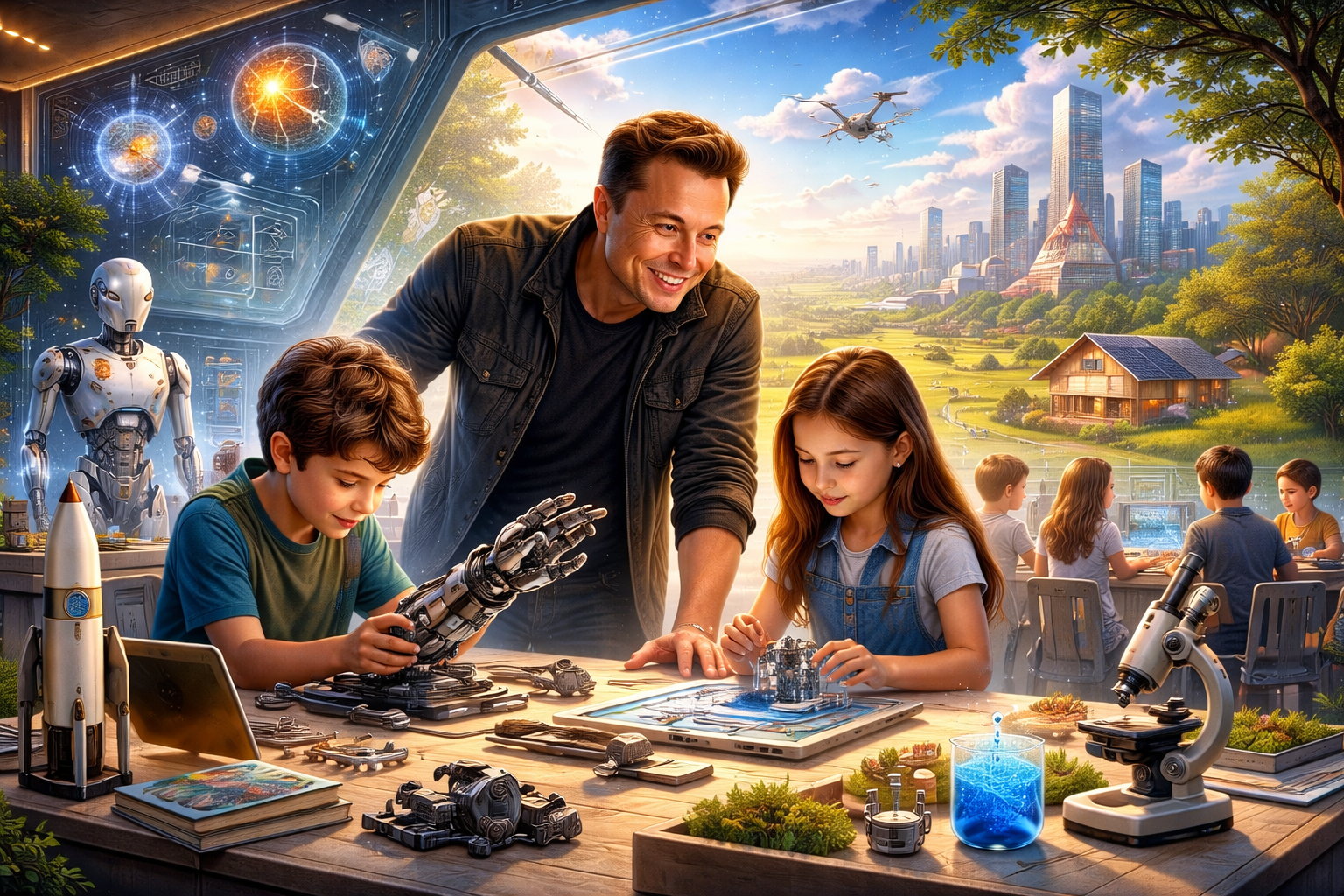
İmage: Prepared with OpenAI
Elon Musk on Learning in a Post-Labor World
When Elon Musk speaks about the future of work becoming optional, he implicitly dismantles the logic of today’s education system — even when he doesn’t always state it directly.
At the core of his critique is a simple observation:
Schools were designed to produce workers — not thinkers.
In a world where:
- jobs are no longer scarce
- labor is automated
- survival is guaranteed
the factory model of education collapses. elon
The Problem with Traditional Schooling
Musk has repeatedly criticized education for being:
- rigid
- obedience-based
- optimized for compliance rather than curiosity
The current system trains students to:
- memorize
- follow instructions
- tolerate boredom
This made sense when society needed predictable labor.
It makes no sense in a future where:
- AI outperforms humans in repetition
- knowledge is instantly accessible
- creativity, judgment, and curiosity are the only remaining human advantages
“Why are we teaching kids to memorize facts when a computer can do that instantly?”
The real issue, for Musk, is not what we teach —
but why we teach at all.
Learning as Problem-Solving, Not Credentialing
Musk consistently emphasizes first-principles thinking — breaking problems down to fundamentals rather than relying on authority, tradition, or credentials.
Applied to education, this leads to a radical shift:
- Learning should be project-based
- Subjects should be integrated, not siloed
- Students should learn by building and solving, not by passing exams
Understanding why something works matters more than knowing the answer.
In Musk’s view, degrees are weak signals.
Demonstrated ability is the real currency.
This is why he has openly stated that:
- college degrees are often overrated
- many of the best engineers never finished school
- curiosity beats credentials
Schools in a World Where Work Is Optional
Here is where Musk’s education views become truly disruptive.
If people no longer need to work, then education can no longer be justified as “job preparation.”
So what is its role?
Musk’s future implies three new purposes for education:
- Orientation
Helping young people understand what kind of problems are worth solving - Curiosity Cultivation
Keeping the instinct to explore alive instead of extinguishing it - Meaning Formation
Preparing minds for abundance — not scarcity
This is subtle but profound.
A society that solves scarcity without educating for meaning risks collapse through boredom, nihilism, or misdirected power.
The Hidden Risk: Educated for a World That No Longer Exists
Musk’s concern is not just inefficiency — it’s danger.
If schools continue to train:
- compliance
- external validation
- reward-seeking behavior
then a post-work society produces:
- disengaged adults
- identity crises
- populations optimized for systems that no longer need them
Education, in that case, becomes a delayed trauma.
A Quiet Alignment with the Bigger Picture
Interestingly, Musk’s education critique aligns with his broader philosophy:
- If money disappears, grades lose meaning
- If work is optional, obedience loses value
- If AI handles optimization, humans must handle purpose
Education becomes the last human infrastructure.
Not a pipeline to productivity —
but a container for consciousness development.
A Sentence That Captures It All
If Musk had to summarize his education philosophy in one line, it would be this:
“Teach people how to think, not what to think — because the world they’re being trained for won’t exist.”
REFERENCE:
Elon Musk: A Different Conversation w/ Nikhil Kamath | Full Episode | People by WTF Ep. 16
 Kika's world