
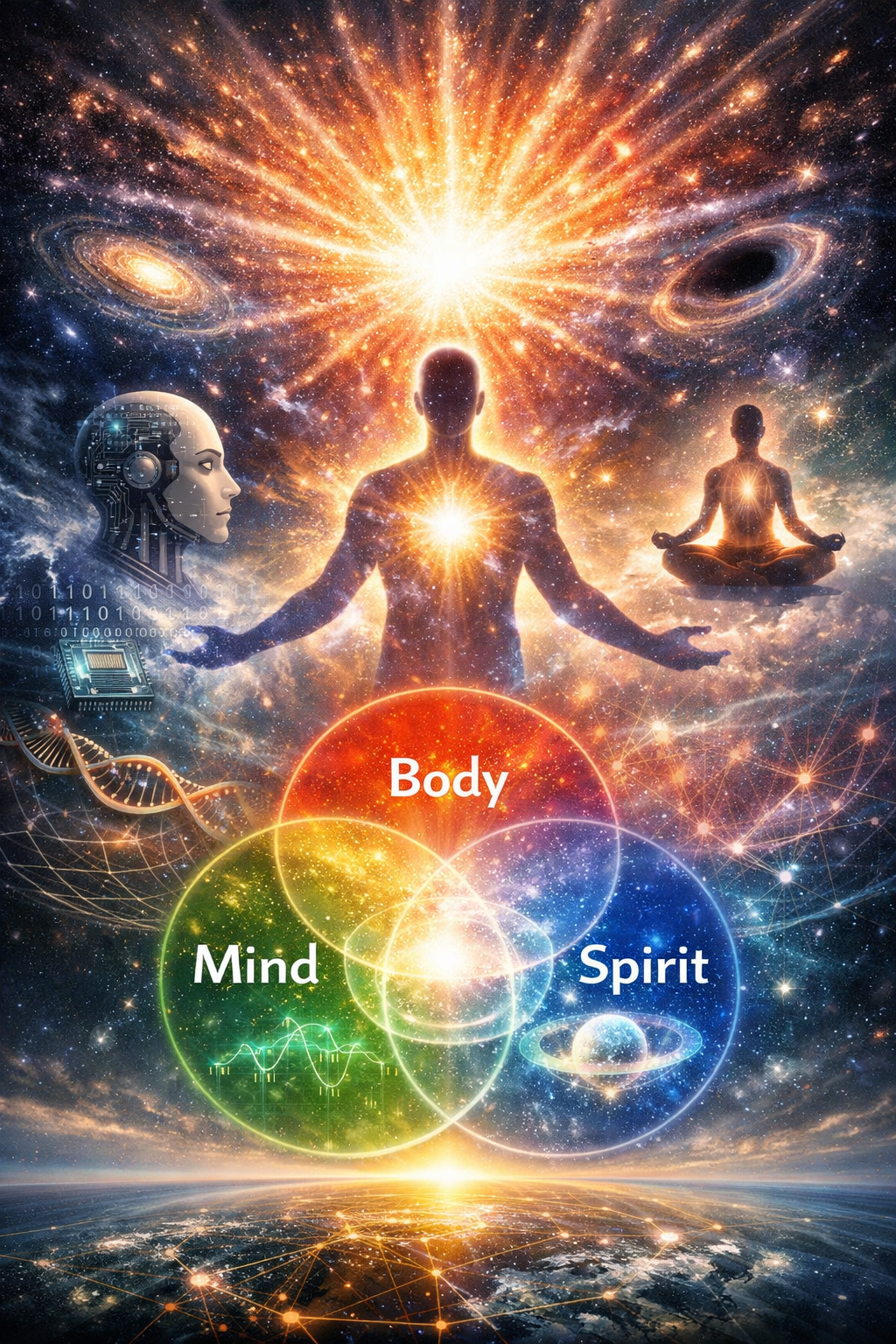
Federico Faggin, Quantum Meaning, and the Gestalt View of Wholeness
For decades, the dominant story of reality has been simple, reassuring—and deeply reductionist:
matter came first, complexity followed, and somehow, mysteriously, consciousness appeared at the very end.
But what if that story is upside down?
What if consciousness is not the product of the universe, but its starting point?
This is the radical and quietly revolutionary proposal of Federico Faggin—physicist, inventor of the first microprocessor, and in recent years, a profound thinker on consciousness, free will, and meaning.
What makes Faggin’s perspective especially compelling is not that it rejects science—but that it follows science all the way to its uncomfortable conclusions.
From Silicon to Self-Knowing
Faggin is not a mystic who wandered into physics.
He is a scientist who followed physics until it could no longer answer its own questions.
After helping shape the digital age, he encountered a limit that technology could not cross:
No amount of information processing produces consciousness.
A computer can copy information endlessly.
A human experience—love, fear, insight—cannot be copied.
This realization led Faggin to a bold re-framing:
“The body is classical information.
The mind is quantum information.
The spirit is meaning.”
“Consciousness and free will cannot emerge from something that does not already contain them.”
The Great Reversal: From Parts to Whole
Modern science has long tried to explain the universe by assembling parts:
atoms → molecules → cells → brains → consciousness.
Quantum physics quietly sabotages this approach.
Entanglement shows us that there are no truly separable parts.
Reality behaves as a non-local, interconnected whole.
Faggin takes this seriously and asks the question most theories avoid:
If reality is fundamentally whole, why do we keep trying to explain it from fragments?
Instead of starting with matter, Faggin starts with One—a unified field that is:
- Dynamic
- Holistic
- Capable of knowing itself
From this perspective, the Big Bang is no longer a material explosion.
It is something far more radical.
The True Big Bang: Self-Knowing
In Faggin’s cosmology, the true origin of reality is the first act of self-knowing.
Knowing is not passive observation.
Knowing is creative.
Every new knowing is a creation.
The universe does not unfold because particles collide—but because consciousness turns toward itself, generating perspectives, identities, and experiences.
“Knowing and existing are two faces of the same coin.”
This means:
- Consciousness is not inside spacetime
- Spacetime emerges from conscious interaction
Body, Mind, Spirit — Not a Hierarchy, but a Field
One of Faggin’s most original contributions is how he reframes body, mind, and spirit.
Not as levels stacked on top of each other—but as overlapping domains, like a color wheel:
- Body → classical information (structure, memory, form)
- Mind → quantum information (possibility, prediction, choice)
- Spirit → meaning (qualia, value, lived experience)
There are no sharp boundaries.
Life, experience, and awareness emerge in the overlaps.
✦ New perspective:
Spirit is not “above” the body.
It is the meaning that the body-mind field carries.
Why Conscious AI Is a Category Error
From this view, the dream of conscious AI collapses—not ethically, but conceptually.
AI manipulates symbols.
Consciousness experiences meaning.
A machine can simulate decisions.
It cannot be the one who decides.
Information can be copied.
Experience cannot.
This is not anti-technology—it is a call to humility.
Where This Meets Gestalt
At this point, Gestalt psychology steps in—not as an add-on, but as a natural ally.
✦ Core Gestalt Principle:
The whole is something other than the sum of its parts.
Faggin’s universe says the same thing—at a cosmic scale.
Strong Parallels
- Holism: Reality is primary as a whole, not assembled from fragments
- Experience first: Meaning arises from lived experience, not abstract explanation
- Field perspective: The individual is inseparable from the total field
- Contact and awareness: Knowing happens through interaction, not isolation
✦ Gestalt lens on Faggin’s “self-knowing”:
Self-knowing is not introspection—it is contact between the field and itself.
Where They Differ — And Why That Matters
Gestalt remains grounded in phenomenology and lived experience:
- What is happening now?
- How does awareness organize itself in the present?
Faggin extends this into cosmology:
- Why does experience exist at all?
- What kind of universe makes awareness possible?
Key difference:
- Gestalt works within experience
- Faggin asks what makes experience possible in the first place
Together, they form a powerful continuum:
from immediate awareness → to the architecture of reality itself.
A Closing Reflection
If consciousness is not a byproduct but a foundation, then:
- Meaning is not optional
- Ethics are not artificial
- Awareness is not secondary
And perhaps most radically:
We are not observers of the universe.
We are the universe knowing itself—locally, temporarily, uniquely.
“Life does not start with a cell.
It starts with One.”
REFERENCE:
Spacetime Is The Memory Of A Self Knowing Universe | Federico Faggin
 Kika's world