
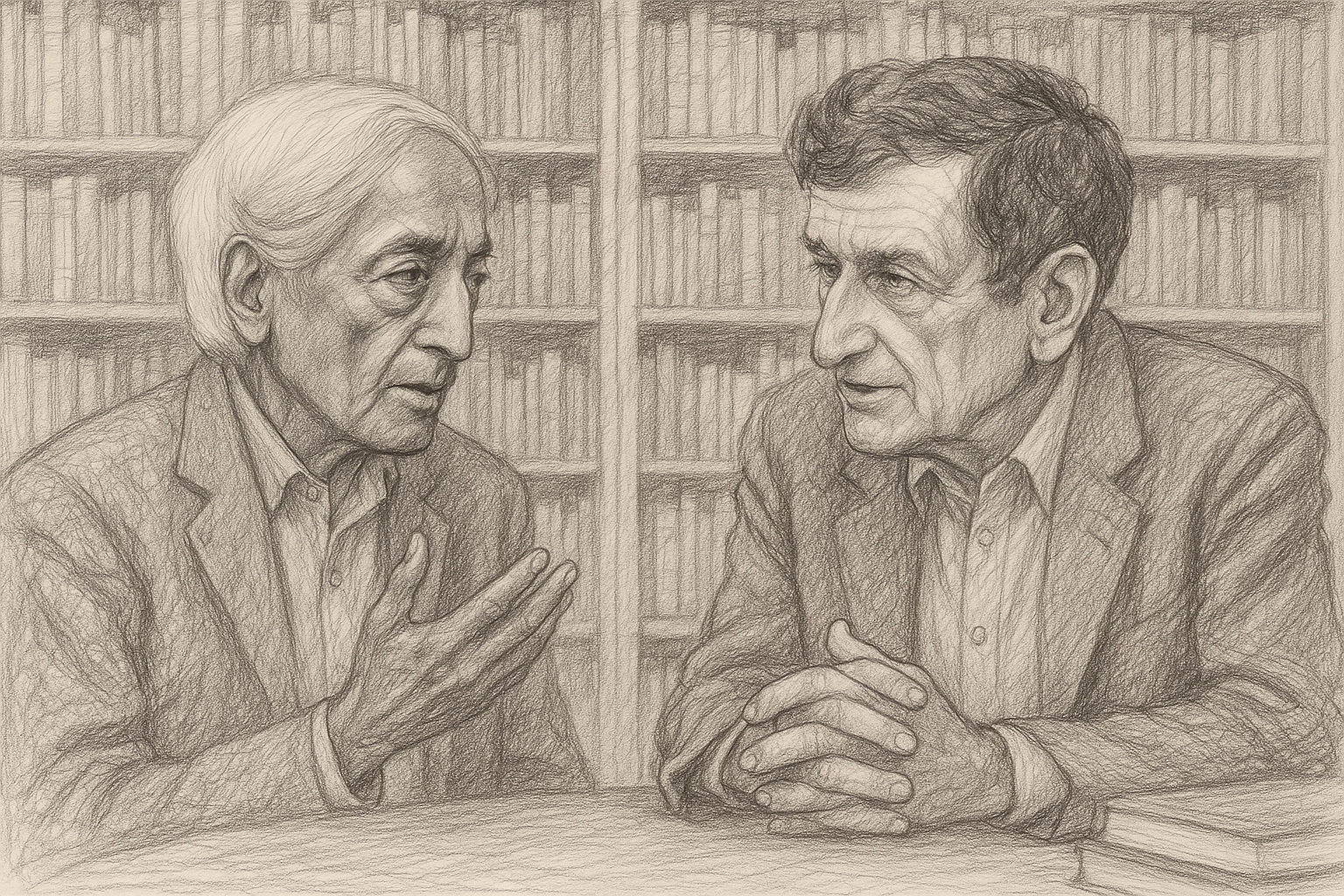
The 1980 conversation between philosopher J. Krishnamurti and physicist David Bohm, part of their “The Ending of Time” series, delves into profound questions about human consciousness, freedom, and the nature of reality. Below is an analysis of the key subjects, questions, and insights from their dialogue.
1. Psychological Conditioning and Freedom
Subject: The possibility of a mind free from psychological conditioning.
Questions:
- Can the mind ever be free from self-disturbance, conflict, and psychological memories?
- Is the idea of complete freedom an illusion?
Insights:
- Krishnamurti argues that the mind, though conditioned by the past, can achieve freedom through insight. This insight is not intellectual but a direct perception that dissolves psychological accumulation.
- Bohm raises a paradox: If the mind is entirely conditioned, how can it free itself? They agree that insight transcends both the “particular” (individual) and the “general” (universal), operating beyond ordinary logic.
2. The Nature of Thought and Time
Subject: The relationship between thought, time, and psychological accumulation.
Questions:
- Is thought synonymous with psychological time?
- How does accumulation perpetuate division and conflict?
Insights:
- Thought as Time: Psychological time arises from the accumulation of knowledge, memories, and desires. Krishnamurti states, “Thought is time”—a movement between past and future that traps the mind in a limited field.
- Accumulation as Division: Accumulation (psychological or material) creates division (e.g., religious, cultural, or ideological identities). This division fuels conflict, as seen in societal structures like capitalism or sectarianism.
3. Beyond the General and Particular
Subject: Transcending the duality of the “general” (universal) and “particular” (individual).
Questions:
- Can the mind move beyond the bias toward either the general or the particular?
- What lies beyond this duality?
Insights:
- The dialogue critiques humanity’s tendency to prioritize one over the other (e.g., philosophers favoring the universal, practical minds focusing on specifics).
- True freedom arises when the mind ceases to oscillate between these poles. Krishnamurti suggests a “ground” beyond both, accessible through insight.
4. The Role of Insight and Intelligence
Subject: The transformative power of insight and its relationship to intelligence.
Questions:
- Can insight uncondition the mind completely?
- Is intelligence distinct from thought?
Insights:
- Insight as Revolution: Unlike gradual change, insight is an immediate perception that dismantles conditioning. It is not generated by the individual or collective mind but arises independently.
- Intelligence vs. Skill: Intelligence is not mere logical skill but a quality intertwined with love. Krishnamurti emphasizes that love, unlike desire, is non-accumulative and dissolves psychological barriers.
5. Love and the Dissolution of Barriers
Subject: Love as a transformative force beyond psychological constructs.
Questions:
- Can love, with its inherent intelligence, break down the “wall” of conditioned thought?
- How does one access this love?
Insights:
- Love as Movement: Love is not a feeling or desire but an energy that transcends division. Krishnamurti states, “Love with its intelligence… covers the whole, it’s not particular or general.”
- Ending Movement: When the mind realizes it cannot “do” anything to reach love (as effort perpetuates conditioning), movement ceases. This stillness allows the “wall” of accumulation to dissolve naturally.
6. The Paradox of Accumulation
Subject: The illusion of security in psychological accumulation.
Questions:
- Why do humans cling to accumulation despite its destructive consequences?
- Can the mind abandon this ingrained habit?
Insights:
- Outward vs. Inward Accumulation: While physical accumulation (e.g., resources) offers survival benefits, psychological accumulation (beliefs, identities) creates false security and division.
- Seeing the Danger: True freedom begins with perceiving accumulation as inherently dangerous. Krishnamurti likens this to recognizing fire as a threat—no further action is needed once the danger is seen.
Conclusion: The Ending of Time
The dialogue culminates in the radical proposition that psychological time ends when accumulation ceases. This is not achieved through effort but through insight into the futility of desire and the illusion of security. Love and intelligence emerge not as goals but as natural states when the mind is free from its self-made constraints.
Bohm and Krishnamurti challenge listeners to question deeply ingrained assumptions, offering a vision of freedom that transcends logic, time, and the duality of human thought. Their conversation remains a profound exploration of what it means to live beyond the boundaries of a “man-made mind.”
 Kika's world