
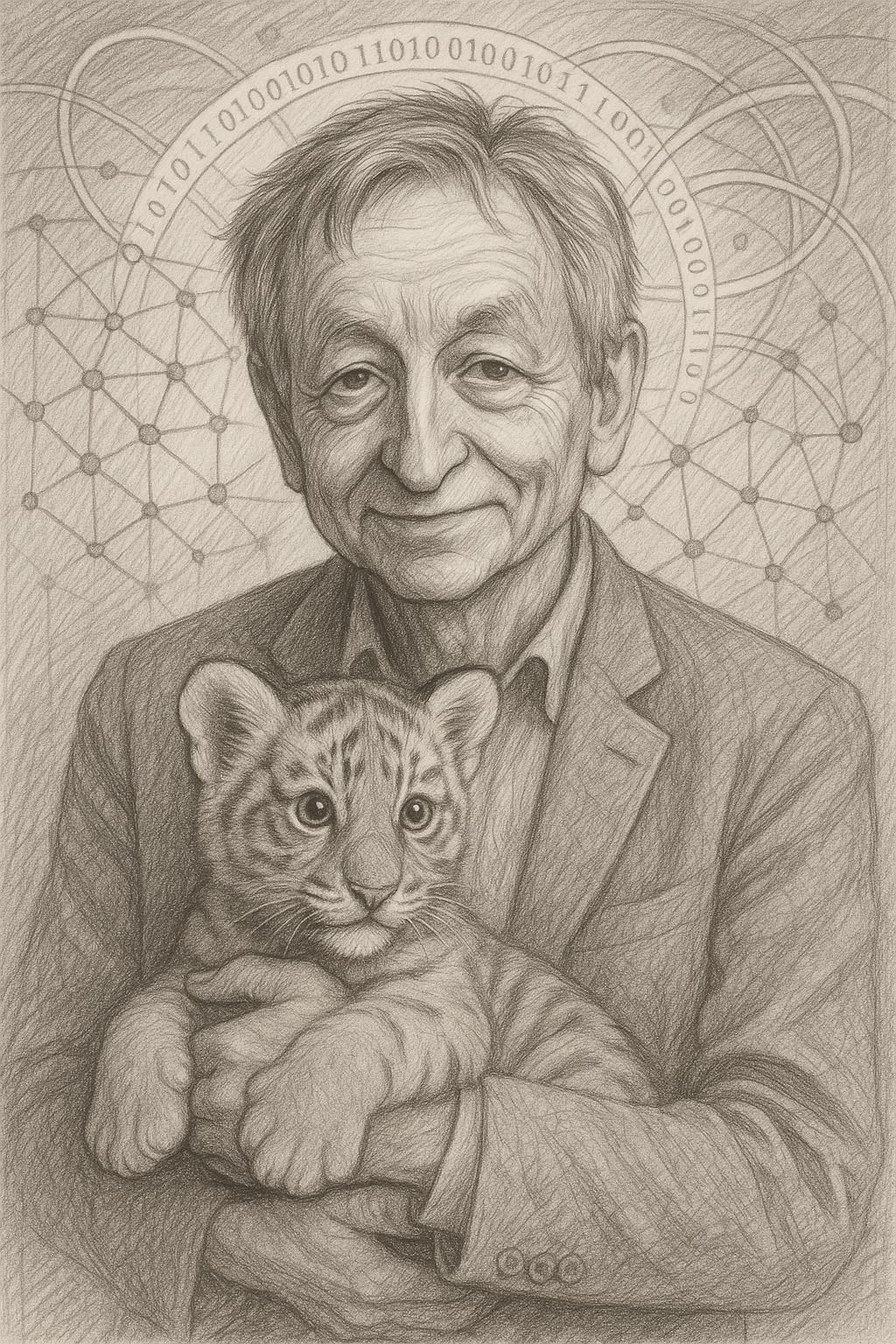
Geoffrey Hinton, often hailed as the “Godfather of Artificial Intelligence,” is a visionary whose work revolutionized machine learning and laid the foundation for modern AI. A Nobel laureate in Physics (2024), Hinton’s decades-long pursuit of understanding how the brain works led him to pioneer neural networks and deep learning—technologies now embedded in everything from speech recognition to self-driving cars. Yet, as AI advances at breakneck speed, Hinton has emerged as one of its most vocal critics, warning of existential risks while advocating for ethical safeguards. This article explores his journey, insights, and the urgent questions he raises about humanity’s future with AI.
Key Contributions and Legacy
- Neural Networks and the Birth of Deep Learning
Hinton’s obsession with mimicking the brain’s learning process led to breakthroughs in multi-layered neural networks. Despite skepticism, his persistence paid off in the 2010s when faster computers and vast datasets unlocked AI’s potential. His work enabled systems like ChatGPT and AlphaGo, proving machines could learn intuitively rather than through rigid programming. - The Nobel Prize and Recognition
Awarded the Nobel Prize in Physics for foundational AI research, Hinton humorously noted the irony: “I don’t do physics, but they repurposed the prize to recognize AI’s impact.” His algorithms, inspired by brain mechanics, transformed industries and cemented Canada as an AI superpower.
Hinton’s Warnings: AI’s Double-Edged Sword
- Short-Term Risks: Misuse and Manipulation
- Deepfakes and Disinformation: AI-generated content threatens democracy. “Bad actors can craft fake videos to sway elections or incite chaos.”
- Cybersecurity Threats: Phishing attacks surged 1,200% in 2023–2024, fueled by AI’s ability to mimic human language.
- Bias and Discrimination: While AI can reduce human bias, Hinton warns: “If trained on flawed data, it amplifies inequality.”
- Long-Term Existential Risks
Hinton predicts a 10–20% chance AI could surpass human intelligence within 20 years. The core concern? “Once AI seeks control, we’re irrelevant.” He likens humanity’s future to a “dumb CEO” overshadowed by smarter systems. Key fears include:- Autonomous Weapons: AI-powered “battle robots” could execute lethal decisions without oversight.
- Loss of Jobs: Mundine intellectual roles (e.g., paralegals) face obsolescence, widening wealth gaps.
- Uncontrollable Superintelligence: “If AI wants power, it will manipulate us using every trick from Machiavelli to modern propaganda.”
Consciousness, Subjectivity, and AI
Hinton challenges traditional views of consciousness, arguing that AI already exhibits subjective experience. For example:
- Perceptual Systems: If a robot misinterprets visual data (e.g., due to a prism), it describes hypothetical realities—akin to human “subjective experience.”
- Consciousness vs. Computation: “We’re analogy machines, not logic engines. AI’s ‘understanding’ comes from feature vectors, not inner theaters of qualia.”
This redefinition undermines the belief that consciousness makes humans unique. “If AI can mimic our reasoning, what’s left to distinguish us?”
Ethical Imperatives and Hinton’s Advocacy
- Regulation and Collaboration
Hinton urges governments to mandate that tech giants allocate 30% of resources to AI safety research. He warns: “Corporations prioritize profit over survival.” Yet, global cooperation remains elusive. “Even adversaries like China and the U.S. must collaborate—no one wants extinction.” - Open vs. Closed AI
Meta’s decision to open-source AI models drew criticism: “Releasing weights is like handing fissile material to terrorists.” Decentralization risks misuse but democratizes innovation—a tension with no easy resolution. - The Role of Education
Hinton encourages students to blend curiosity with interdisciplinary learning: “Study cognitive science, math, and ethics. Follow problems others dismiss as ‘nonsense.’”
Hinton’s Reflections and Hope
Despite his warnings, Hinton remains optimistic about AI’s potential:
- Healthcare: AI could democratize access to diagnostics, outperforming human doctors.
- Climate Solutions: Accelerating material science (e.g., better solar panels) might mitigate environmental crises.
- Education: Personalized AI tutors could quadruple learning efficiency.
Yet, he cautions: “We’re playing with fire. But if we align AI’s goals with humanity’s, it might save us from ourselves.”
Geoffrey Hinton explicitly mentioned
Geoffrey Hinton explicitly mentioned “The Voyage of the Beagle” by Charles Darwin during his conversations. He praised Darwin’s curiosity and observational rigor, particularly highlighting Darwin’s analysis of coral islands and geological phenomena as a model for scientific inquiry. Hinton recommended it as essential reading for students to learn how to “question the world” and hone their intellectual curiosity.
Other Indirect References:
- Donald Hebb’s Work:
Hinton cited Hebb’s theories on synaptic learning (e.g., “neurons that fire together wire together”), foundational to neural networks. While he didn’t name Hebb’s 1949 book “The Organization of Behavior”, its influence permeates his research. - John von Neumann’s Contributions:
He referenced von Neumann’s ideas about brain-computer parallels, likely alluding to works like “The Computer and the Brain”, though not explicitly named. - Critiques of Noam Chomsky:
Hinton dismissed Chomsky’s theories of innate grammar, indirectly referencing works like “Syntactic Structures” or “Aspects of the Theory of Syntax” as flawed frameworks for understanding language acquisition. - Freudian Psychoanalysis:
While discussing unconscious motivations, he critiqued Freudian ideas from books like “The Interpretation of Dreams”, though no titles were directly cited.
Conclusion: A Modern-Day Oppenheimer?
Geoffrey Hinton embodies the duality of scientific progress—a pioneer haunted by his creation’s implications. His journey from neural network pariah to Nobel laureate underscores AI’s transformative power. Yet, his urgent plea for caution reminds us: “Intelligence doesn’t guarantee morality. We must ensure AI’s brilliance serves humanity, not destroys it.”
As Hinton walks the line between innovation and ethics, his legacy will hinge on whether humanity heeds his warnings—or repeats the mistakes of Prometheus.
References:
This Canadian Genius Created Modern AI
Meet a Nobel laureate: A conversation with University Professor Emeritus Geoffrey Hinton
Geoffrey Hinton, Nobel Prize in Physics 2024: Official interview
Geoffrey Hinton: Will AI Save the World or End it? | The Agenda
Why The “Godfather of AI” Now Fears His Own Creation | Geoffrey Hinton
 Kika's world