
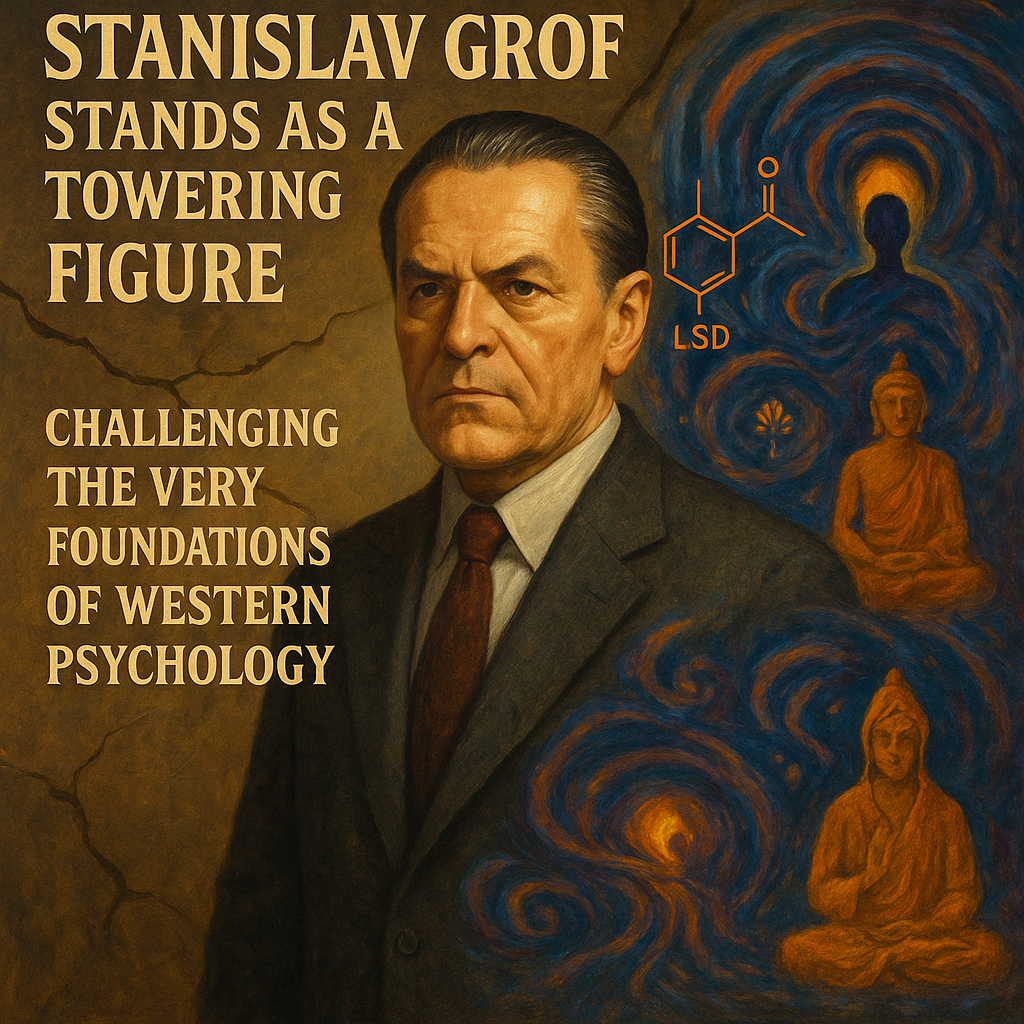
Psychiatrist Stanislav Grof stands as a towering figure challenging the very foundations of Western psychology. His decades of research into non-ordinary states of consciousness – through LSD therapy, Holotropic Breathwork, and studying spiritual traditions – reveal a vastly richer and more complex human psyche than conventional models allow. Based on the provided transcripts, here are the core subjects he illuminates:
- The Ego: False Identity vs. Essential Self:
- Freud vs. Spirituality: Grof contrasts Freud’s view of the ego as essential for accurate perception and adaptation to reality with spiritual traditions that see the ego as an obstacle to true spiritual development.
- The “False Ego”: He proposes that what dies in profound experiences (like psychedelics or deep breathwork) is not a vital function, but a false ego. This ego is forged during the traumatic experience of biological birth – specifically the intense confinement and struggle of the birth canal.
- Birth Imprint: This birth experience creates a fundamental sense of separation (“me vs. the hostile world”), the need for control, and underlying anxiety/paranoia that colors our entire life perspective. Letting go of this ego doesn’t impair functioning; it brings emotional freedom and a sense of being part of the world, not separate from it. Kafka’s paranoid mole story exemplifies this ego’s self-defeating nature.
- Holotropic States of Consciousness:
- Beyond “Altered States”: Grof rejects the term “altered states” (implying distortion) and coined “Holotropic” – meaning “moving toward wholeness.” These are specific non-ordinary states with immense healing, transformative, and evolutionary potential.
- Accessing Hidden Realms: In our ordinary state, we access only a fraction of our potential. Holotropic states open doors to deeper layers of the psyche normally inaccessible.
- Traditional Contexts: Grof identifies these states as the core of:
- Shamanic Initiatory Crises: Ordeals, dismemberment, death/rebirth, connection with nature/power animals, leading to self-healing and healing abilities.
- Rites of Passage: Socially structured rituals (using fasting, isolation, drumming, plants, ordeals) facilitating symbolic death/rebirth to mark life transitions (puberty, marriage, etc.), enabling psychological disentanglement from early dependencies (especially maternal).
- Ancient Mysteries (e.g., Eleusinian): Rituals based on death/rebirth myths, inducing identification with deities through powerful procedures (likely involving psychedelics like ergot-derived brews), leading to profound transformation (“born again,” “twice-born”).
- The Perinatal Domain: The Psychology of Birth:
- The Core Discovery: Grof’s most revolutionary contribution is the significance of the birth process. Contrary to Freud and mainstream psychiatry (which denied memory or psychological impact of birth), Grof found that experiences related to biological birth are deeply recorded in the psyche and constantly resurface in holotropic states.
- Basic Perinatal Matrices (BPMs I-IV): He mapped the birth process into four experiential clusters:
- BPM I: The undisturbed womb (oceanic bliss, union).
- BPM II: The onset of labor, cervix closed (“no exit” – claustrophobia, helplessness, existential despair).
- BPM III: The struggle through the birth canal (titantic struggle, sexual/sadomasochistic energy, aggression, purgatory).
- BPM IV: Birth itself and the relief/rebirth (death-rebirth experience, liberation, triumph, connection).
- Life Patterns: Unresolved emotions and physical sensations from these stages profoundly shape our adult psychology, relationships, and even pathologies (e.g., depression linked to BPM II, violence linked to BPM III). Healing involves reliving and integrating these experiences.
- Transpersonal and Archetypal Realms:
- Beyond the Personal: Grof’s work consistently shows experiences transcending personal biography and birth trauma:
- Past-Life Experiences: Vivid, seemingly historical recollections from other times/cultures, sometimes with verifiable details (referencing Ian Stevenson’s work).
- Archetypal Realms: Encounters with universal mythological figures, deities, and realms (light/dark, underworld/heavenly).
- Psychoid Phenomena: Experiences blurring the line between psyche and matter, like profound synchronicities (meaningful coincidences), challenging materialist science.
- Collective Unconscious: This validates and expands Jung’s concept, showing direct experiential access to these transpersonal dimensions.
- Beyond the Personal: Grof’s work consistently shows experiences transcending personal biography and birth trauma:
- Holotropic Breathwork: Psychedelic-Like Therapy Without Drugs:
- Origins: Developed with his wife Christina after LSD became illegal. Inspired by observing that specific breathing patterns could reignite or deepen psychedelic experiences during sessions.
- The Method: Combines accelerated breathing, evocative music (designed to guide an inner journey), focused bodywork (to release blocked energy/emotions), and a supportive setting (participants work in pairs: “breather” and “sitter”).
- The Experience: Induces holotropic states similar to psychedelics, facilitating access to perinatal material, emotional catharsis, transpersonal experiences, and the inner healing intelligence. Grof emphasizes its power and safety when conducted properly.
- The Goal: Mobilize the individual’s “inner healing intelligence” to process trauma, complete unfinished gestalts (especially birth), and move towards wholeness.
- Critique of Mainstream Psychiatry & Materialist Science:
- Pathologizing Spirituality: Grof fiercely criticizes psychiatry for misdiagnosing genuine spiritual emergencies or mystical experiences (holotropic states) as psychosis (“endogenous psychosis” is a meaningless label without biological basis).
- The Medical Model Failure: Symptomatic suppression with drugs (driven by pharmaceutical interests) ignores the root causes accessible in holotropic states and prevents deep healing.
- Cartesian-Newtonian Paradigm Limitation: He argues that materialist science (consciousness as a brain byproduct) is utterly inadequate to explain the phenomena observed in consciousness research. Modern physics (quantum, relativity) aligns more with mystical/spiritual worldviews than old materialism.
- A New Paradigm: Transpersonal Psychology & the Future:
- Founding Role: Grof co-founded Transpersonal Psychology with Maslow, Sutich, and others to include spirituality, peak experiences, and the full spectrum of consciousness.
- Integration Needed: He advocates for a psychology that integrates:
- Valid insights from Freud (biography) and Jung (archetypes/collective unconscious).
- The crucial perinatal domain (birth psychology).
- The transpersonal realms (past lives, archetypes, mystical states).
- Wisdom from ancient and indigenous traditions (shamanism, rites, mysteries).
- Humanity’s Crisis & Hope: Grof links humanity’s ecological and social crises (violence, greed, pollution) to the unintegrated ego/pain rooted in the perinatal matrices. He sees the exploration of holotropic states and the resulting spiritual awakening (“experiential spirituality” beyond dogma) as essential for humanity’s survival and evolution towards a more conscious, compassionate existence.
In essence, Stan Grof’s work provides a map to the deepest territories of the human psyche, validated through thousands of sessions. He reveals birth as a pivotal psychological event, champions the healing power of non-ordinary states accessed through breath and ritual, and calls for a psychology that embraces the full spiritual and transpersonal dimensions of human existence as the key to both individual wholeness and planetary survival.
References:
Holotropic Breathwork Founder Stan Grof on Birth, Life, Breath, and Death
Stan Grof, ‘the depths of the psyche’
Holotropic States of Consciousness – Radical Visions of Psychology
 Kika's world