
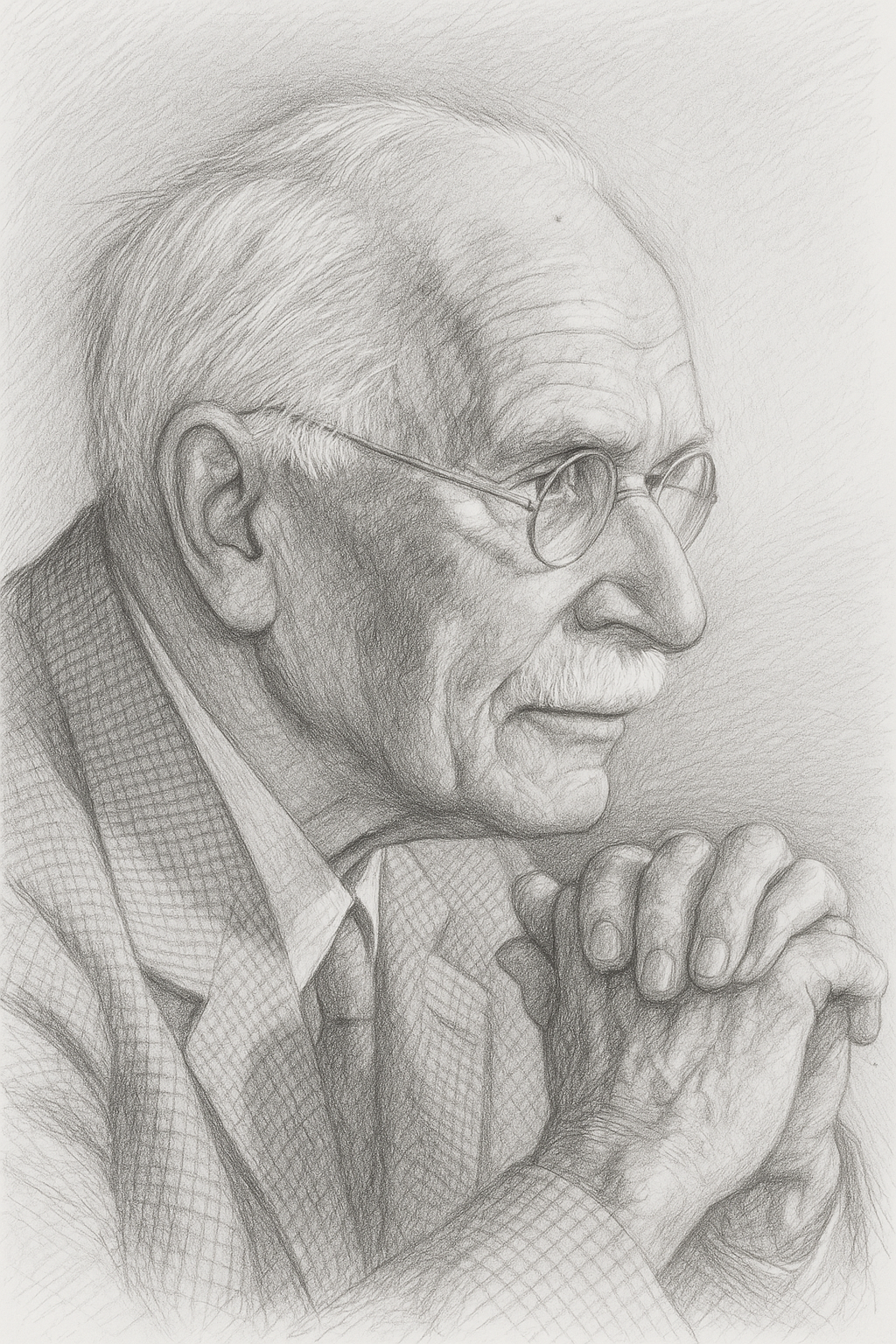
Carl Jung 1957 Restored Interview – Intuition, Individuality & Healing | Part 1
Carl Jung 1957 Restored Interview – The Self, The Unconscious, Psychosomatics & The U.S. | Part 2
1. The Persona: Social Mask vs. True Self
Question: How does Jung define the “Persona”?
Answer:
- The Persona is a social façade shaped by societal demands and personal compromises (e.g., a doctor’s bedside manner).
- It is distinct from the “real personality.” Confusing the two leads to inner conflict and neurosis.
- Jung warns that unconscious identification with the Persona creates a “Jekyll and Hyde” duality, causing psychological strain.
2. Ego, Self, and the Collective Unconscious
Question: What differentiates the Ego from the Self?
Answer:
- Ego: The conscious, empirical self (“I myself”).
- Self: The totality of the personality, including unconscious elements. It transcends the Ego and integrates archetypal patterns.
- Collective Unconscious: Contains universal archetypes (e.g., the Hero, Anima/Animus) shared across cultures. Jung cites examples like the “snake in the abdomen” dream, linking it to the Kundalini serpent in Eastern philosophy.
3. Introversion, Extroversion, and Psychological Functions
Question: How do introversion/extroversion and the four functions (thinking, feeling, sensation, intuition) shape personality?
Answer:
- Introverts focus on inner subjective experiences; Extroverts prioritize external stimuli. Most people are a mix.
- Four Functions:
- Sensation: Perceives reality.
- Thinking: Analyzes logically.
- Feeling: Evaluates emotional value.
- Intuition: Accesses unconscious insights (e.g., predicting a bird’s resurfacing in water).
- Intuition types (e.g., gamblers, doctors) rely on “hunches” from subliminal cues.
4. Synchronicity and Rhine’s Experiments
Question: How does synchronicity relate to meaningful coincidences?
Answer:
- Synchronicity describes non-causal, meaningful connections (e.g., dreaming of a red car before seeing one).
- Jung cites J.B. Rhine’s statistical work on ESP as evidence that such phenomena surpass chance.
- Critiques reductionist labels like “telepathy,” emphasizing the relativity of time and space through the psyche.
5. Psychic Energy and Critique of Freud
Question: How does Jung’s view of libido differ from Freud’s?
Answer:
- Freud’s “libido” narrowly centers on sexuality. Jung redefines it as general psychic energy driving all instincts (e.g., creativity, aggression).
- Uses the metaphor of water flowing downhill (entropy) to explain energy’s directional flow toward balance.
6. Psychosomatic Medicine and the Mind-Body Link
Question: Can psychological factors cause physical illness?
Answer:
- Jung highlights cases where repressed emotions manifest as ailments (e.g., tuberculosis from shallow breathing due to unresolved complexes).
- Critiques the idea that patients “choose” symptoms; instead, unconscious dynamics happen to them.
- Supports research linking stress to ulcers, cancer, and autoimmune diseases.
7. The Mandala and Individuation
Question: What role does the Mandala play in therapy?
Answer:
- The Mandala (a circle within a square) symbolizes wholeness and the Self.
- Appears spontaneously in dreams or art during psychological chaos, offering a compensatory image of order.
- Individuation: The lifelong process of integrating conscious and unconscious elements to achieve Self-realization.
8. Historical Insights and Cultural Critique
Key Points:
- Nazi Germany: Jung predicted its rise through patients’ archetypal dreams of “heroic saviors” like Hitler.
- U.S. Psychology: Criticizes America’s extraverted bias and lag in understanding the unconscious.
- Toynbee’s Civilizations: Links historical cycles to archetypal patterns (e.g., the Cold War as a clash of “red vs. white” alchemical symbolism).
9. Projective Tests and the Unconscious
Question: How do tests like Rorschach reveal hidden complexes?
Answer:
- Word Association Tests: Uncover repressed emotions (e.g., solving a murder via unconscious reactions).
- Rorschach: Demonstrates how projections reflect inner conflicts. Jung stresses their didactic value for training psychologists.
10. Final Reflections on Psychology’s Future
Jung laments modern psychology’s neglect of the unconscious and mythic dimensions. He urges integrating historical, cultural, and biological perspectives to grasp the psyche’s full complexity. His parting advice: “The world hangs on a thin thread—the psyche of man.”
Conclusion: This interview underscores Jung’s enduring relevance, bridging individual therapy with universal archetypes. His insights challenge us to explore the depths of the unconscious, both personal and collective, as a path to healing and wholeness.
 Kika's world